
BESA Center Perspectives Paper No. 2,390, June 21, 2026
EXECUTIVE SUMMARY: Israel has played a notable role in the political discourse of Recep Tayyip Erdoğan since October 7, 2023. Israel has served not merely as a target of criticism within Turkish foreign policy but also as a central instrument in shaping Turkey’s domestic politics and regional vision. By portraying Israel as a threat to regional and global stability, Erdoğan seeks to position Turkey as the defender of the Palestinians and the leader of the Muslim world. The reasons behind his anti-Israel rhetoric lie beyond the conventional explanation of a need to divert public attention from domestic crises. It has become a permanent component of the political identity Erdoğan has constructed for himself and of the role he envisions for Turkey in the region.
For centuries, the shadow theater of Karagöz and Hacivat occupied a central place in Ottoman-Turkish culture. Beyond serving as a popular form of entertainment, it functioned as a platform for social and political criticism. It is a satire directed at those in positions of authority, and serves as a forum in which accusations and ideas can be expressed that cannot always be voiced openly in the public sphere.
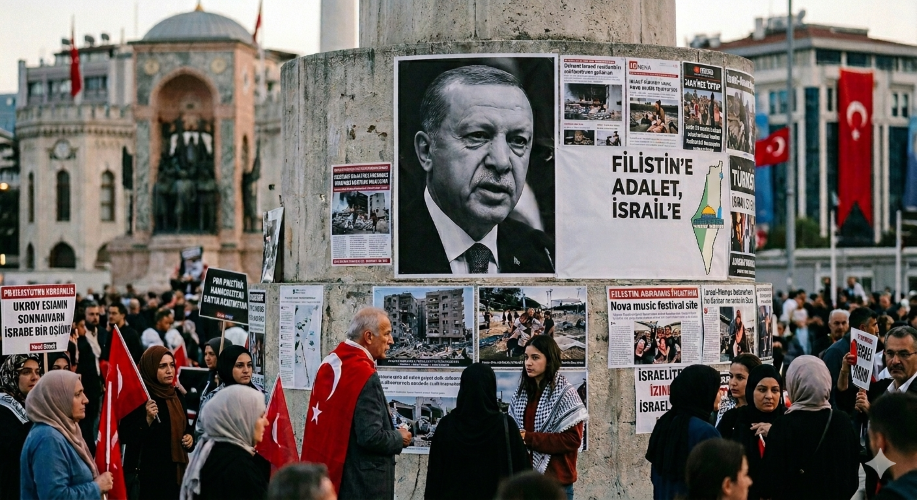
Recep Tayyip Erdoğan’s rhetoric toward Israel often operates in a similar fashion. Israel assumes the role of a central character on the political stage through which broader messages concerning leadership, identity, opposition, and regional order are conveyed. The question is whether Israel constitutes the actual focus of policy or whether it is merely one of the figures in a shadow play through which Turkey’s domestic political arena is shaped.
On 10 June 2026, during a meeting of the foreign ministers of the Organization of Islamic Cooperation (OIC) in Istanbul, held against the backdrop of the Israel-Iran war and the continuing conflict in Gaza, Erdoğan addressed developments in the Middle East within the framework of Turkey’s regional policy vision. Erdoğan’s central argument was that Israel constitutes the primary obstacle to regional stability and that peace cannot be achieved unless Israeli military actions are restrained. He declared, “If Israel’s banditry is not stopped, the entire region—and indeed all humanity—will pay the price.”
Erdoğan’s threats toward Israel, which are hardly new, have political, economic, military, and diplomatic dimensions. In November 2023, following the events of October 7, Erdoğan said that those who remain silent in the face of Israel’s crimes were complicit in them. In May 2024, Turkey suspended trade relations with Israel. On 28 July 2024, speaking before AKP supporters in the city of Rize, Erdoğan issued what was arguably his most direct threat to date, stating: “Just as we entered Karabakh, just as we entered Libya, we can do the same to them.” Later that month, he described Israel as a threat to humanity and to the world as a whole. In September 2024, he argued that the only way to stop what he termed Israeli “state terrorism” was through an alliance of Muslim states. In March 2026, he declared that although the war with Iran was Israel’s war, the entire world was paying its cost. By June 2026, he had returned to the familiar pattern of portraying Israel as a regional and global threat that must be contained.
Many commentators interpret this rhetoric as an attempt to divert public attention from Turkey’s prolonged economic crisis and the government’s political difficulties. Yet this explanation alone is insufficient for understanding Israel’s place in Erdoğan’s political discourse.
In the 10 June 2026 speech, Erdoğan also criticized the conduct of the AKP’s principal opposition party, the Republican People’s Party (CHP). Since the 38th CHP Congress in November 2023, at which Özgür Özel defeated Kemal Kılıçdaroğlu and replaced him as party leader, the CHP has been engaged in a prolonged struggle over its identity and internal centers of power. Özel’s election symbolized a demand for generational renewal and strategic change following a series of electoral defeats at the national level.
Internal tensions intensified over disputes concerning the legitimacy of the Congress and Kılıçdaroğlu’s political standing. One symbolic moment occurred when the party leadership traveled to Manisa to attend a memorial ceremony for the late mayor Ferdi Zeyrek, who was associated with Özel’s camp. While public attention was focused on the event, Kılıçdaroğlu and his supporters attempted to advance a political initiative designed to strengthen their position in the ongoing struggle for party leadership. Among Özel’s supporters, this move was perceived as a political maneuver and as evidence of the continuing conflict between the old elite and the new leadership.
These developments reflect an institutional crisis, characteristic of major opposition parties, in which questions concerning the replacing of the elite collide with questions of organizational legitimacy and struggles over political and symbolic resources.
Throughout this period, in parallel with the crisis within the opposition, Ankara has sought to position itself as a regional power that defends the Palestinians and promotes regional stability while arguing that Israel obstructs efforts to achieve ceasefires and diplomatic settlements.
Within official Turkish discourse in 2026, Israel fulfills three principal functions:
- Israel is a unifying factor in Turkey’s domestic arena
Harsh criticism of Israel is widely accepted across the Turkish political spectrum, including among members of the CHP. A notable example was the attempt by Israeli Defense Minister Israel Katz in April 2026 to bypass the Turkish government and appeal directly to opposition leaders through a strongly worded social media post directed against Erdoğan. In Turkey, the move was perceived as an attempt to exploit internal tensions within the CHP and deepen the divide between the opposition and the government.
The outcome was the opposite. Özgür Özel, Kemal Kılıçdaroğlu, Ekrem İmamoğlu, and other senior opposition figures all condemned Katz’s remarks, arguing that they constituted unacceptable interference in Turkey’s domestic affairs. Kılıçdaroğlu described foreign intervention in Turkish politics as “an unacceptable act of insolence,” while Özel referred to it as “complete impudence” (tam bir hadsizlik). Rather than dividing the opposition, the incident generated a broad backlash and demonstrated that even bitter political rivals may unite when Israel is involved.
This case represents only one example of the extent to which negative attitudes toward Israel transcend political camps, parties, and ideological divisions in Turkey. Despite profound disagreements between the government and the opposition on many issues, criticism of Israel remains one of the broadest areas of consensus within Turkish political life.
- Israel is an instrument of regional positioning
Erdoğan presents Turkey as both the defender of the Palestinians and the “savior” of the Muslim world. On numerous occasions, he has described Turkey as “the voice of humanity’s conscience” in contrast to what he portrays as Western silence. At summits of the Organization of Islamic Cooperation, he has repeatedly framed the Palestinian issue as a test for the Muslim world and called upon Muslim states to unite behind collective action, with Turkey playing a leading role in such initiatives.
Throughout 2024 and 2025, Erdoğan frequently called Turkey “the hope of the oppressed” (mazlumların umudu), “the voice of humanity,” and “the protector of Jerusalem”. Such formulations place Turkey in a role that extends beyond conventional national interests and assign it a regional—even global—religious and moral mission.
Nor is this role confined to rhetoric or to the Palestinian issue alone. It is accompanied by concrete policies, including humanitarian assistance, diplomatic engagement, and military intervention. In Somalia, Turkey has built hospitals, infrastructure, and a major military training base. In Libya, it intervened militarily in support of the internationally recognized government. In Bosnia, Ankara continues to emphasize its commitment to preserving the heritage and memory of Bosnian Muslims in the shadow of the Bosnian War. In Iraq and Syria, Turkey justifies its military and economic activities as measures intended to safeguard stability and protect Muslim populations.
Beyond these specific cases, Ankara appears to be preparing to become the most influential regional actor in the aftermath of the current regional upheaval and potentially to occupy the hegemonic position long associated with Iran. From Turkey’s perspective, even if the weakening of Iran is not necessarily desirable in itself, it may ultimately contribute to strengthening Turkey’s regional and global standing.
Israel serves as a means of framing domestic crises
As part of his criticism of the CHP, Erdoğan consistently links the weakness of the opposition to the need for strong leadership, embodied by the AKP and by himself personally, in the face of regional crises. Just as Israel is portrayed as an external threat not only to Turkey and the Middle East but also to global stability, the CHP is frequently presented as an internal threat to Turkey’s stability and democratic order.
In both cases, Erdoğan positions himself as the indispensable figure capable of protecting the nation.
Yet the central issue is not merely the portrayal of Israel as a common enemy of Turkey and the wider world, nor the depiction of Israel as a source of instability and conflict comparable to the internal challenges represented by the opposition. Nor is the primary issue the familiar argument that Erdoğan uses both domestic and foreign policy as distractions from Turkey’s economic difficulties and other domestic problems. This conventional assumption becomes less convincing when viewed in light of the severe crisis within the Turkish opposition itself. Erdoğan has little need for distractions when his principal political rivals are already deeply divided and preoccupied with internal struggles. In other words, there is little need for diversion when the opposition is experiencing such profound turmoil. This suggests that Israel has become a permanent component of the political identity Erdoğan seeks to construct. Even when the opposition is weak and fragmented, and even in the absence of an immediate electoral threat, anti-Israel rhetoric not only persists but often intensifies.
These statements are no longer simply about Gaza. Israel is increasingly portrayed as a force that threatens the regional order as a whole. Erdoğan does not invoke Israel merely to explain a specific event; rather, he uses Israel to define who belongs to “the people”, who constitutes “the enemy”, and why strong leadership remains necessary.
The question, therefore, is no longer what Erdoğan says about Israel but what role Israel plays in the political identity he seeks to construct. If Israel was once primarily an issue of foreign policy, since October 7 it has become a central instrument in shaping Turkey’s domestic politics and regional vision.
Behind the shadow screen, Israel is not merely an actor in the Middle East. It is one of the principal characters through which Erdoğan’s political theater is performed. From this perspective, Israel functions not simply as an object of foreign policy but as a recurring figure in the political drama through which Erdoğan defines leadership, legitimacy, and Turkey’s place in the regional order.
Prof. Efrat Aviv is a senior researcher at the Begin–Sadat Center for Strategic Studies and an Associate Professor in the Department of History at Bar-Ilan University.
BESA Center publications and research are made possible
in part thanks to the generosity of Saul Koschitzky and family