Debunking the Genocide Allegations
בחינה ביקורתית של האשמות “רצח העם” במלחמת חרבות ברזל
:קישור לפרסום המלא באנגלית
:FOX-קישור לכתבה על הפרסום ב
Search by tags:
Regions: Post-Soviet Eastern Europe and Eurasia; Central Asia; South Caucasus; Middle East; Baltics;
Countries: Страны Armenia; Azerbaijan; Belarus; Estonia; Georgia; Kazakhstan; Kyrgyzstan; Latvia; Lithuania; Moldova; Russia;
Tajikistan; Turkmenistan; Ukraine; Uzbekistan; Iran; China; Israel; Turkey;
Topics: Post-Soviet Geopolitics; Global and regional powers; Inter-state conflicts; FSU states domestic political and social affairs;
Debunking the Genocide Allegations: A Reexamination of the Israel-Hamas War (2023-2025)
Danny Orbach Yagil Henkin Jonathan Boxman Jonathan Braverman
The following study offers a thorough historical exploration and a quantitative-statistical analysis of the allegation that the State of Israel committed genocide against the Gazan population following the October 7, 2023, massacre. Specifically, we address the claims that Israel intentionally starved the Gazan population, that IDF ground forces deliberately massacred civilians, and that the Israeli Air Force (IAF) carried out indiscriminate bombings, failing to distinguish between combatants and civilians and conducting disproportionate strikes.
The goal of this study is to carefully assess both primary and secondary sources in order to draw independent conclusions about the factual aspects of the conflict. This process involved reviewing testimonies, primary sources, and the methodology of data collection utilized by organizations and researchers promoting the genocide allegation, as well as conducting statistical analysis and distinguishing between narratives promoted by various parties and verified facts. The purpose of our investigation is to identify the factual events that occurred, not to engage in legal or ethical discourse. While discussing the war’s legal and ethical implications is important, we firmly believe such discussion must be grounded in a solid foundation of facts to be meaningful as well as relevant.
Our focus on factual analysis in no way diminishes or ignores the severe human suffering in Gaza, nor does it seek to downplay the rhetoric or policy failures of the Israeli government. However, as we demonstrate throughout this report, subordinating factual analysis to the advocacy of a specific policy or ethical position undermines our ability to understand the facts needed to shape informed policy and ethical conduct. Therefore, we have made every effort to avoid taking any stance or offering recommendations that are not rooted in a comprehensive factual analysis.
This research is structured into eight chapters, each addressing different aspects of the Israel-Gaza conflict:
- Chapter 1 examines accusations of the deliberate starvation of Gaza’s civilian population.
- Chapter 2 addresses the lack of sufficient context for understanding Israel’s military actions during the war, particularly the challenges of urban warfare. We focus primarily on Hamas’s “human shields” practice and overall strategy, recognizing that war is shaped by reciprocal measures taken by all parties involved. Thus, the actions of one side to the conflict cannot be assessed without considering those of its adversary.
- Chapter 3 provides an in-depth analysis of claims regarding deliberate killings of civilians.
- Chapter 4 investigates allegations that Israel systematically violated the principles of distinction and proportionality in its strikes on the Gaza Strip.
- Chapter 5 critically reviews Gaza Health Ministry (GMOH) data and manipulations. While recognizing the uncertainty of the available figures, we offer a speculative scenario for how these manipulations skewed the actual gender and age distribution of casualties, and draw conclusions as to plausible combatant-civilian casualty ratios.
- Chapter 6 explores the capability of UN agencies, humanitarian organizations, and major media outlets to assess humanitarian crises in closed societies under oppressive regimes such as Hamas-controlled Gaza. It draws a comparison to Iraq under U.S. sanctions between 1991 and 2003, and explores the inability of said organizations to pierce the heavy-handed humanitarian deceptions of the Iraqi regime.
- Chapter 7 evaluates the ability of UN agencies and human rights organizations to credibly distinguish between civilians and combatants among war casualties in contexts marked by manipulation and politicization within closed or controlled societies. This chapter includes findings from a comparative analysis of the 2002 Battle of Jenin, the 2006 Lebanon War, and previous conflicts in Gaza.
- Chapter 8 analyzes the methodologies used by UN agencies, human rights organizations, and affiliated journalists and researchers that have led to recurring analytical failures, as well as the lack of subsequent insights or corrective action, even when these failures were eventually acknowledged by the same organizations.
Executive summary
This research offers a thorough historical exploration and a quantitative-statistical analysis of the allegation that the State of Israel committed genocide against the Gazan population following the October 7, 2023, massacre. Specifically, we address the claims that Israel intentionally starved the Gazan population, that IDF ground forces deliberately massacred civilians, and that the Israeli Air Force (IAF) carried out indiscriminate bombings, failing to distinguish between combatants and civilians and conducting disproportionate strikes.
The goal of this study is to carefully assess both primary and secondary sources in order to draw independent conclusions about the factual aspects of the conflict. This process involved reviewing testimonies, primary sources, and the methodology of data collection utilized by organizations and researchers promoting the genocide allegation, as well as conducting statistical analysis and distinguishing between narratives promoted by various parties and verified facts. The purpose of our investigation is to identify the factual events that occurred, not to engage in legal or ethical discourse. While discussing the war’s legal and ethical implications is important, we firmly believe such discussion must be grounded in a solid foundation of facts to be meaningful as well as relevant.
Our focus on factual analysis in no way diminishes or ignores the severe human suffering in Gaza, nor does it seek to downplay the rhetoric or policy failures of the Israeli government. However, as we demonstrate throughout this report, subordinating factual analysis to the advocacy of a specific policy or ethical position undermines our ability to understand the facts needed to shape informed policy and ethical conduct. Therefore, we have made every effort to avoid taking any stance or offering recommendations that are not rooted in a comprehensive factual analysis.
This research is structured into eight chapters, each addressing different aspects of the Israel-Gaza conflict:
- Chapter 1 examines accusations of the deliberate starvation of Gaza’s civilian population.
- Chapter 2 addresses the lack of sufficient context for understanding Israel’s military actions during the war, particularly the challenges of urban warfare. We focus primarily on Hamas’ “human shields” practice and overall strategy, recognizing that war is shaped by reciprocal measures taken by all parties involved. Thus, the actions of one side to the conflict cannot be assessed without considering those of its adversary.
- Chapter 3 provides an in-depth analysis of claims regarding deliberate killings of civilians.
- Chapter 4 investigates allegations that Israel systematically violated the principles of distinction and proportionality in its strikes on the Gaza Strip.
- Chapter 5 critically reviews Gaza Health Ministry (GMOH) data and manipulations. While recognizing the uncertainty of the available figures, we offer a speculative scenario for how these manipulations skewed the actual gender and age distribution of casualties, and draw conclusions as to plausible combatant-civilian casualty ratios.
- Chapter 6 explores the capability of UN agencies, humanitarian organizations, and major media outlets to assess humanitarian crises in closed societies under oppressive regimes such as Hamas-controlled Gaza. It draws a comparison to Iraq under U.S. sanctions between 1991 and 2003, and explores the inability of said organizations to pierce the heavy-handed humanitarian deceptions of the Iraqi regime.
- Chapter 7 evaluates the ability of UN agencies and human rights organizations to credibly distinguish between civilians and combatants among war casualties in contexts marked by manipulation and politicization within closed or controlled societies. This chapter includes findings from a comparative analysis of the 2002 Battle of Jenin, the 2006 Lebanon War, and previous conflicts in Gaza.
- Chapter 8 analyzes the methodologies used by UN agencies, human rights organizations and affiliated journalists and researchers that have led to recurring analytical failures, as well as the lack of subsequent insights or corrective action, even when these failures were eventually acknowledged by the same organizations.
Our key findings are as follows:
Chapter 1
1.A. Claims of starvation prior to March 2, 2025, were based on erroneous data, circular citations (creating a media “echo chamber”), and a failure to critically review sources. These starvation claims are not based solely on the ethical or legal interpretation of disputed data, but on a continuous pattern of reliance on empirically inaccurate information, unfulfilled predictions, and a failure to acknowledge errors, even after false data was debunked and withdrawn by those who introduced it. In fact, throughout most of the war more provisions were delivered into Gaza than prior to October 7, by a margin greater than any credible estimates of loss of Gazan agricultural production. Specifically, claims of deprivation are based on three empirically false assumptions.
First, there is the erroneous evaluation of the amount of food brought into the Gaza Strip prior to the war, which is currently used to estimate the number of food trucks required for Gaza’s survival. UN agencies and human rights organizations claim that 500 trucks must be provided daily to prevent starvation, alleging that, prior to the outbreak of the war, this was indeed the number of trucks arriving each day, with 150-180 (or up to 300, according to some sources) loaded with food. However, this claim is patently false.
A straightforward review of pre-war OCHA (the UN agency tasked with the transfer of aid and other goods into Gaza) data shows that throughout 2022, an average of only 292 trucks entered Gaza daily, half of which were loaded with construction materials, and of which only 73 were food trucks. Contrary to prevailing assumptions there is no evidence of widespread, life-threatening deprivation during that period. In fact, infant mortality rates in Gaza decreased, and life expectancy rose throughout 2006-2022 at rates comparable to those in Jordan, Egypt, and the West Bank. By 2022, the gap between Gaza and the West Bank in these parameters had narrowed, while Gazan life expectancy remained higher and its infant mortality rate lower than those of both Jordan and Egypt. The assumption that 500 daily trucks prior to the war were barely sufficient to keep Gazans perched on the brink of disaster led UN agencies and human rights organizations to wrongly conclude that fewer than 500 trucks per day entering Gaza must by definition result in starvation. This fallacy formed the basis for inaccurate calculations, including by the IPC, which have been widely disseminated in media reports and public discourse.
1.B. A second assumption made by UN agencies, human rights organizations, and many media outlets was that local food production in the Gaza Strip prior to the war was significantly higher than actual figures suggest. An Amnesty International report on this matter claimed that 44% of food consumption in Gaza was locally produced, and therefore the destruction of local production sources contributed to starvation. However, our review of this report reveals that it was based on an unclear calculation of Palestinian Central Bureau of Statistics (CBS) data from the early months of the war, which did not concern calorific intake. Rather, it merely compared between household expenditures on imported foodstuff to domestically produced foodstuffs. Most domestically produced food in the Strip consists of expensive items such as meat (raised on imported animal feed), fish, vegetables, and fruit. In contrast, the bulk of caloric intake comes from cereals and oils, which are not produced locally and are largely distributed as in-kind aid by UNRWA and the World Food Program (WFP). Together, these agencies account for 40% of the Strip’s required caloric consumption. The common assessments also failed to account for available data concerning Gaza’s extremely limited agricultural output and the basic food consumption patterns of neighboring countries, which would have uncovered the implausible nature of their conclusions. In fact, local agriculture in Gaza is unlikely to have accounted for more than 12% of the caloric intake prior to the war, even before subtracting exports of domestically produced foodstuff or meat, dairy and eggs produces with imported animal feed at a low conversion efficiency.
1.C. The third assumption made by UN agencies and human rights organizations pertains to the total amount of food entering the Gaza Strip during the war. Based on our analysis of available data, a maximum of 82 food trucks were needed daily during the war to ensure food supply equal to the prewar situation, without allowing for greater caloric density and efficiency of provisions during the war. On average, Israel exceeded this number up to the January 2025 ceasefire (during which the territory was flooded with food supplies sufficient for six additional months), providing a food supply sufficient to meet the caloric needs of the entire population, and also meeting other important nutritional parameters.
However, during the May 2024 Israeli military offensive in Rafah, UNRWA claimed that the number of trucks entering the Strip had dropped by 70%, below the pre-war levels, and persisted in this claim in the following months. This claim was disputed by reports from the IDF’s Coordinator of Government Activities in the Territories (COGAT), which showed that there was no reduction in food supplies and that May shipments were greater than those in April and that supply levels in the following months remained, on the average, higher than the preceding period – and in any event significantly greater than pre-war levels. UNRWA was eventually forced to retroactively correct its figures around December 2024, although these corrections were never publicly announced – or reported in the media. Updated UN data now conforms with COGAT’s assertion of increased supplies following May 2024.
Despite this, false reports concerning a drop in humanitarian supplies following the Rafah operation continue to be circulated, perpetuating claims of deliberate starvation.
1.D. Nevertheless, we strongly criticize the Israeli government’s decision in March 2025 to halt aid supplies to Gaza, notwithstanding the systematic looting and profiteering of aid by Hamas. Eventually, humanitarian aid resumed in May 2025, with an average of 100 trucks delivered daily, a number that was later increased to 170 per day. This supply level again exceeded pre-war measures. Despite this, the challenge of ensuring aid reaches Gazan civilians without being seized by Hamas persists. Thus, the promotion of alternative distribution methods (such as the Gaza Humanitarian Fund, GHF, efforts starting on May 24, 2025) to deliver aid without enabling looting or seizure by Hamas is not only a militarily legitimate practice but a humanitarian necessity. And yet, it was wrong to block traditional distribution methods before viable alternatives were established.
1.E. At the time of the publication of this report we are still engaged in an ongoing dialogue with the noted scholar Michael Spagat concerning his family survey on war casualties in Gaza, conducted during December 2024-January 2025. Methodological questions, most glaringly in regard to the seemingly massive over-representation of imprisoned family members in the survey population, and the low household size and number of children reported by this population, remain. However, insofar as the survey is representative and methodologically sound, the low level of non-traumatic death of children reported by the survey participants does not support a scenario of widespread malnutrition, let alone starvation-driven excess mortality. What excess non-violent mortality that has been reported is miniscule in comparison to projections circulated by the IPC, or the much-quoted Lancet studies. It is also concentrated amongst the middle-aged and elderly, and seems to be representative of the inability of Gaza’s medical system, which prior to the war offered near-Western level comprehensive coverage, to continue providing life-extending and life-saving treatments to individuals suffering from chronic diseases and acute conditions. This is a function of prioritizing treatment of traumatic injuries, disruption of medical supplies, and disruption of hospital activities by recurrent Hamas abuse of medical facilities and resultant IDF raids – raids which also inflicted severe damage on medical infrastructure.
1.F. In order to offer a grounded assessment, rather than one based on partial and slanted real-time reports, we are deferring judgement on the operation of the GHF aid distribution compounds and related shooting incidents. Our follow-up update, hopefully towards the end of the upcoming ceasefire, will focus on this issue. Instead, we limit ourselves to noting the context, competing claims, and identifying those claims which seem to us either sufficiently validated or conclusively debunked. More generally, this choice reflects our approach which prioritizes accuracy over immediacy, and general skepticism about the possibility of reaching conclusive findings in the immediate fog of war.
Chapter 2
2.A. A central flaw in the body of research outlining accusations of severe and deliberate war crimes by Israel in Gaza is the complete omission of any discussion about Israel’s adversary in the conflict, namely Hamas, and its tactics. It is impossible to properly assess the actions of the IDF (or any other military) without considering the specific conditions under which it operates. Additionally, one cannot reach ethical conclusions without understanding and addressing the factual circumstances of combat. Any conflict is inherently reciprocal, where one party’s actions influence the response of the other, shaping the means employed and the potential scope of military maneuvers.
2.B. Through a comparative historical analysis, we demonstrate that the war in Gaza represents one of the most complex military challenges ever faced by any Western army. Not only is the conflict being waged in an urban environment, which naturally presents significant obstacles for the offensive force and offers a multitude of defensive advantages in a three-dimensional terrain, but Hamas has also spent decades developing the most extensive subterranean tunnel network ever documented in military history. These tunnels span over 500 kilometers and include 5,700 connective shafts, all integrated into the civilian infrastructure of the Gaza Strip.
2.C. Relying on original documents, visual evidence, and numerous other sources, we demonstrate that Hamas, according to reports from its own operatives, consistently employs Gazan civilians as “human shields” to deliberately increase casualties and, in turn, amplify international pressure on Israel. In fact, the practice of increasing civilian fatalities to limit Israeli operations and generate international pressure is a central component of Hamas’ battlefield tactics. Hamas has used civilian homes, hospitals, and schools to store weapons, launch rockets, house combatants, and establish operational positions. Its operatives also wear civilian clothing to blend in with the population in areas designated as “safer” or humanitarian zones. Most notably, Hamas has focused on booby-trapping a vast number of buildings, leading to widespread devastation in the Gaza Strip—destruction that surpasses that typically seen in high-intensity urban warfare in other conflicts.
While these facts do not justify any action undertaken by the IDF nor absolve it of its obligation to comply with international law, nor do they serve as an argument against the possibility of war crimes, it is crucial to consider these circumstances when analyzing the Gaza war, especially when making legal or ethical judgments about the conduct of the conflict.
Chapter 3
3.A. There is no evidence to suggest a systematic Israeli policy of targeting or massacring civilians. Our assumption is that every war involves war crimes, and it is the responsibility of the military to investigate, identify, and hold accountable those responsible in order to minimize such transgressions as much as possible. Throughout our research, we have also reviewed verified forensic evidence that may indicate war crimes committed by individual IDF soldiers. However, those who accuse Israel of genocide erroneously suggest that most civilian casualties in Gaza were entirely unjustified from a military standpoint, portraying those cases in which deaths do seem unjustified not as outliers, but as part of a broader, systematic, and deliberate policy of extermination by the IDF. The small number of instances involving persuasive supportive evidence of intentional killings by military personnel does not support this accusation.
3.B. For example, among the numerous accusations presented by UN agencies, human rights organizations, and media platforms in one major database we studied, we located descriptions of incidents with evidence or specific claims of deliberate killings that account for a total of only 61 fatalities out of the 50,021 war casualties reported by the Gaza Health Ministry in their March 2025 report. Furthermore, some of these accusations are based on unreliable sources.
3.C. Our research includes a thorough review of social media posts, videos, and testimonies, juxtaposing these reports with existing data to assess their credibility. Our findings reveal that the majority of cases, which include forensic evidence and raise suspicions of severe war crimes, are typically instances of unjustified civilian deaths occurring during operations to clear buildings or Gazans entering “forbidden zones” declared by the IDF (in a few cases carrying white flags). We have carefully examined the military justification (or lack thereof) for such offensive actions, identifying the cases that strongly suggest potential war crimes.
3.D. It is important to emphasize that, throughout the Israeli-Gaza War, no credible forensic evidence has been provided to substantiate claims of close-range mass killings of civilians or executions of helpless noncombatants. The majority of such allegations appear to be based on Hamas-related organizations who offer no tangible evidence. This contrasts sharply with the substantial forensic evidence documenting atrocities in the 2025 massacres of Syrian Alawites, the Battle of Mosul, the Second Gulf War, and, of course, the October 7 attacks. However, there is credible forensic evidence for possible atrocities committed by IDF soldiers during the March 2025 attack on paramedics in Tal al-Sultan, a case that we examine in detail.
3.E. Subsequently, we provide a detailed and comprehensive review of testimonies from physicians associated with the Palestinian American Medical Association (PAMA), who volunteered in Gaza and made claims of the systematic murder of Palestinian children by IDF soldiers. We demonstrate that these claims are statistically and quantitatively improbable, contradict other studies on the distribution of injuries in the Strip, and are scientifically dubious.
Specifically, we question why physicians who have worked in Gaza’s hospitals for months claimed they never encountered armed Hamas operatives or infrastructure on hospital grounds, which contradicts the testimonies of Israeli hostages, a kidnapped Yazidi woman unrelated to the Israel-Palestine conflict, a Kurdish volunteer physician, and many Palestinians, which are also supported by forensic evidence produced by the IDF. Furthermore, we show that reports from volunteer physicians on the use of Israeli drones armed with sniper rifles to hunt down children throughout the Gaza Strip are contradicted by the facts. The IDF does not possess such weapon systems, and to date, we were unable to find credible reports of similar platforms being used by other militaries as well, except an improvised platform used by the Ukrainians.
Chapter 4
4.A. We have found no evidence to support claims of deliberate bombing of civilians by the IDF during the war, nor any indication of carpet bombing intended to inflict mass civilian casualties in Gaza. While we did identify a significant number of tragic cases where innocent civilians were killed, some of which raise concerns about negligence, lack of caution, or even disregard for human life, it is clear that the IDF has employed numerous protective measures to minimize “collateral damage.” Some of these precautions are unprecedented in global military history and have come at a significant cost to the IDF, particularly in terms of losing military advantages such as the element of surprise. Moreover, senior military command has vetoed several operations due to concerns over disproportionate collateral damage. As a result, urban warfare experts have raised concerns that IDF tactics, such as focused warnings to evacuate specific areas, may set unrealistic operational standards for other militaries in the future.
4.B. Our review of the evidence includes a thorough examination of key principles of international law, particularly the principle of proportionality. We demonstrate how IDF policy in this regard is misrepresented in mass media as well as in reports by UN agencies and human rights organizations. One common claim is that the IDF uses a so-called “convertibility quota” for permissible collateral damage, such as a standard of 20 civilian deaths for every junior Hamas operative or 100 for a senior operative. However, this claim has never been substantiated. In reality, this restriction is not a “quota” or a fixed standard for expected collateral damage, but rather a calculation determined by the military high command that sets the maximum acceptable damage relative to the expected military gains from an operation. This calculation is adjusted according to the specific combat scenario and is subject to the directives of the IDF Chief of the General Staff. It is also frequently updated in real-time according to available intelligence and decisions made by the high command.
Crucially, even when a planned attack meets the permissible standards for collateral damage, it is not automatically approved for execution by IDF command. Every offensive measure, whether targeting a senior or junior operative, must undergo a chain of approval, and there is no “quota” or fixed standard that automatically permits its execution. In some instances, commanders have aborted attacks even when the predicted damage falls below maximum thresholds, based on a variety of considerations. Through several examples, we demonstrate that the IDF has, in many cases, refrained from launching air raids despite clear opportunities to target enemy combatants, due to their proximity to civilians.
4.C. In our research, we conducted a meticulous analysis of the quantities of IDF armaments used, comparing them to examples from other war zones, and we demonstrate that these do not support any pattern of indiscriminate bombings. On the contrary, a very high number of civilian casualties can result from single bombs, especially when civilians are packed in densely-populated humanitarian shelters. In such circumstances, a military force aiming to maximize civilian casualties would likely opt for methods requiring the least amount of ammunition, unlike the case in Gaza.
4.D. Another key issue we address is the question of so-called “safe zones”. After reviewing the matter, we highlight the generally inaccurate media coverage of this issue, both in terms of its legal implications and quantitative reporting. According to international law, safe zones are areas designated through mutual agreement between the conflicting parties—in this case, Israel and Hamas—who must both commit to refraining from military activities within these zones. Since Hamas refused this commitment, Israel could only declare areas that were “relatively” safe. Nevertheless, the accusations that Israel conducted strikes in these zones in the same manner as in other areas are unfounded. The limited quantitative data available to us indicates that only about 1.2% of fatalities reported by the Gaza Health Ministry (GMOH) were located within these zones. While accurate data may suggest a slightly higher figure, it still represents a negligible proportion of the total number of deaths. The areas to which Israel directed Gazan civilians for evacuation were indeed safer than other parts of the Strip, by many orders of magnitude.
4.E. We have also examined claims against Israel for violating the principle of proportionality due to the use of “dumb” bombs, drones, and AI. Our analysis shows that these claims stem from a misunderstanding of military realities (such as underestimation of the actual accuracy of “dumb bombs” dropped by “smart pilots”) as well as the economic constraints and availability of weaponry in the international arms market. Military, technical, and economic factors make it clear that no army can avoid using “dumb” bombs, as there is a shortage of precision-guided munitions (PGMs) available on the international market or through self-production. Legally, there is no prohibition against their use, provided they are deployed in accordance with military necessities, with proper precautions to minimize collateral damage and adherence to the principle of proportionality. Furthermore, allegations that drones were used to “hunt” children have not been supported by any credible evidence.
4.F. Finally, our research has specifically investigated claims regarding the use of AI by the IDF and analyzed these reports within the framework of proportionality. Our findings reveal that, at most, AI has been employed as a supportive tool, and there is no evidence to suggest that the mind of a human officer, with all its psychological biases, is more effective in protecting civilian lives.
Chapter 5
5.A. Reports from the Hamas-controlled Gaza Health Ministry (GMOH) are unreliable, and this data is inevitably tainted by the “illusion of certainty”—the unfounded assumption that a single existing source is inherently trustworthy. The absence of official alternatives has led to a situation where all parties involved in the conflict, including UN-affiliated human rights organizations, Western countries, and even the Israeli government, rely on the GMOH. This occurs despite the fact that the ministry is directly controlled by Hamas.
5.B. By analyzing original Hamas documents, we demonstrate that since 2014, Gaza authorities have mandated the classification of all fallen combatants as “innocent civilians.” Hamas has consistently sought to present the highest possible civilian fatality count, directing its health ministry to manipulate data. This includes concealing natural mortality figures, reporting statistically improbable daily variance in fatalities, and omitting the names of Hamas military operatives who have been killed.
5.C. Additionally, claims of genocide are based on the segmentation of fatalities by age, gender, and involvement in combat. However, the data published by Hamas’ own Gaza Health Ministry (GMOH) reveals no significant difference in the distribution of fatalities when comparing the current war to Operation Protective Edge (2014). Such a variance would have indicated a shift in Israel’s warfare doctrine, which is not observed. A detailed statistical analysis shows that the frequently cited claim that 70% of war casualties are women and children is incorrect, even according to the GMOH’s own data – and was false from the very beginning of the war.
Chapter 6
6.A. The methodologies employed by human rights organizations and UN agencies are highly problematic. Unlike intelligence agencies, which can deploy operatives and gather data even within closed, insulated societies or hostile factions, human rights organizations are largely limited to relying on individual testimonies from witnesses, publicly reported data, and cooperation with local governments, hoping that these sources remain politically neutral. However, recent history disproves this naïve assumption, as political biases often influence the information gathered and reported.
6.B. In this chapter, we critically review the findings of academic researchers, medical experts, UN agencies and human rights organizations who concluded that hundreds of thousands of Iraqi children died during the American sanctions of the 1990s, based on reports from the Iraqi health ministry. The claim regarding the dramatic rise in infant mortality in Iraq originated from a survey conducted by the UN FAO (Food and Agriculture Organization), which indicated an increase in infant mortality from 40.7 per 1,000 children to 198.2 deaths per 1,000 births—five times the original figure. Unsurprisingly, the interviewers who conducted this survey were enlisted by the Iraqi health ministry.
6.C. The FAO report, along with all subsequent studies that relied on it as a primary source, presented estimates of over five hundred thousand additional pediatric fatalities in Iraq, generating intense international pressure to lift the sanctions and solidifying a global consensus about the horrific suffering endured by Iraqi children. This played a pivotal role in efforts to gradually ease the sanctions, ultimately leading to their complete removal.
6.D. However, following the collapse of the Saddam Hussein regime, it was revealed that this data was entirely false. There was no significant increase in child mortality in Iraq during the 1990s under the sanction regime. When one of the original researchers publicly admitted the errors in the original, 1995, report, her 1997 retraction not only received minimal media attention within the humanitarian community but received negligible academic citations compared to her original publication.
This phenomenon, which we term “the humanitarian bias,” reflects how organizations committed to providing aid often believe alarmist reports from parties to a conflict, viewing them as urgent calls to prevent an imminent disaster. Attempts to challenge this information with factual, quantitative evidence are frequently met with moral outrage, as they are perceived as dismissing the suffering of victims. The Iraqi case serves as an example of how, even after a myth has been conclusively debunked and retracted by its original source, the correction is often made under the radar, without affecting public awareness, media coverage, or academic discourse. We examine this case as a methodological archetype for the recurring errors made by humanitarian organizations in other conflict zones, including the current Israel-Gaza War.
Chapter 7
7.A. Due to their flawed methodology, UN and human rights organizations often struggle to provide reliable assessments of casualty numbers in conflict zones, and their reports must be carefully cross-referenced with other sources. As case studies, we analyzed their reports on various past conflicts, including Operation Defensive Shield, the Second Lebanon War, Operation Cast Lead, and Operation Protective Edge. For example, during the Battle of Jenin in 2002 (as part of Operation Defensive Shield) Palestinian civilians, medical practitioners, and Palestinian Authority officials claimed that Israel had committed a massacre of hundreds of camp residents. Human rights organizations quickly accepted testimonies alleging that Israel had slaughtered over 100 civilians, despite IDF reports detailing the exact number of fatalities (53) and their identities. Over time, evidence emerged showing that the final casualty figures closely matched the IDF’s reports, with the majority of fatalities identified as active combatants.
7.B. During the 2006 Lebanon War, Human Rights Watch conducted a detailed study and concluded that only a small number of Hezbollah combatants were killed by the IDF, in stark contrast to the higher civilian death toll. Their findings were incompatible with Hezbollah’s own casualty count – as well as providing an example of overrepresentation of minor militias (Amal and a Communist armed faction) who did not seek to conceal their casualties within HRW’s identified combatants. We have analyzed similar failures in previous conflicts in Gaza, specifically Operation Cast Lead (2008) and Operation Protective Edge (2014).
Chapter 8
8.A. Finally, based on our findings throughout this study, we attempt to define the problems and failures in methodologies employed by human rights organizations, media outlets, academic researchers, and UN agencies in conflict zones, also applicable to the current Israel-Gaza War. Our goal is to offer constructive feedback for the benefit of future evaluations. Specifically, we identify the following problems:
- The failure to critically evaluate information by compiling a large number of sources without assessing their reliability. This includes an unwillingness or inability to exclude unreliable sources, resulting in the mixing of credible and untrustworthy information. This approach ultimately creates the illusion of validation of false claims by presenting them as if they are supported by verified primary sources.
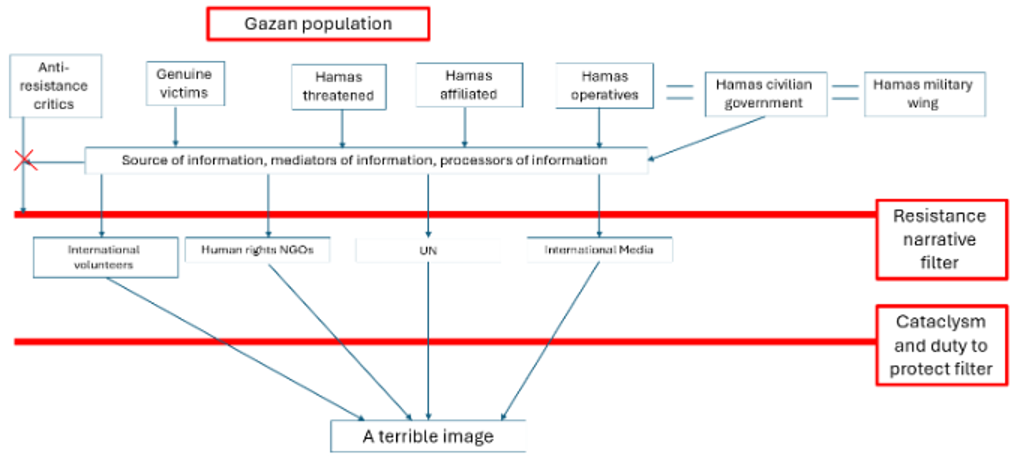
- The “inverse information funnel”: A situation in which a small number of biased sources are “fragmented” into an outwardly large corpus of seemingly reliable sources. This presents the false image of reliability, a failure often at the root of false accusations regarding massacres or starvation in Gaza. This phenomenon is described in Figure 1 below.
- The Echo Chamber Syndrome refers to the tendency to rely on reports that appear “verified” but simply echo one another, without referencing primary sources to substantiate their claims.
- The Burden of Proof Syndrome assumes that all information from Israeli military sources is inherently unreliable unless independently verified by a media outlet with immediate access to all information, open as well as classified. This standard is impossible to meet due to the sensitivity of intelligence sources. In contrast, claims from Gazan civilians, civil society organizations, and medical professionals—assumed by default to be neutral parties—are automatically accepted as reliable unless proven otherwise. However, as we demonstrate, testimonies from within Gaza’s closed, totalitarian society, including those of activists, journalists, and physicians, must be rigorously scrutinized. These reports should be cross-checked with other data, and, where possible, the primary sources should be thoroughly investigated.
- The illusionary “screen of certainty” refers to a bias stemming from the inability to complete or verify data on the number and status of combatant and civilian casualties, both on an individual and local level, as well as in total during a conflict. Many individuals and organizations find the lack of certainty and insufficient data unacceptable, and as a result, they often attempt to fill in the gaps using unreliable sources.
- Catastrophic proclamations and muted retroactive corrections describe the phenomenon where harsh accusations against Israel, particularly those reinforced by the UN regarding the demographic distribution of conflict casualties (with claims that 70% were women and children), the collapse of humanitarian aid in Rafah (with a reported 70% drop in aid allowed into the Strip), and claims about 500 aid trucks entering Gaza daily before the war, have all been conclusively refuted. In most cases, the claimants themselves retracted their reports. However, while accusations of a humanitarian catastrophe are widely echoed by the media, the humanitarian community, and even scholars, the retractions of these false reports were made with minimal publicity and complete lack of transparency. Retractions are rarely covered by the media, if at all. As a result, misinformation continues to be cited in media and UN reports long after being debunked by the original authors. This mirrors the findings presented in Chapter 6 regarding supposed infant mortality under the sanctions regime against Iraq.
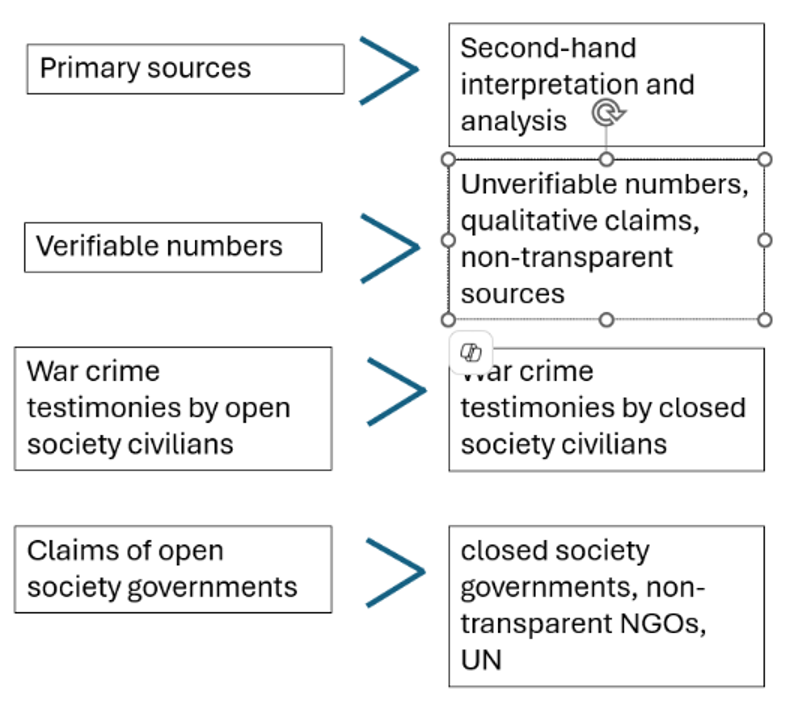
- That being said, our position is not that all claims made by human rights organizations should be categorically dismissed, nor that reports from Western militaries, including the IDF, should be automatically accepted. Researchers must remain mindful of potential methodological issues and biases in any analysis, including analysis of the current Israel-Gaza War. All research should be conducted with utmost caution, verifying and consolidating data from a range of sources—Israeli, Palestinian, and international—and conducting a thorough review of their credibility. To navigate this research minefield, we propose a more effective methodology for investigating war crimes in conflict zones such as Gaza. This proposal is illustrated in Figure 2 below.
Finally, we feel compelled to express our deep concern about the widespread use of the term “genocide” by certain parties we have reviewed. Much like currency losing value through inflation when printed recklessly, certain terms lose their significance when used indiscriminately. If all high-intensity urban military conflicts in the future—despite significant efforts to protect civilian lives—are labeled as acts of genocide simply because of the immense human suffering they cause, the outcome will be fundamentally contrary to the objectives of international humanitarian law. Rather than deterring aggressors and preventing atrocities, the term “genocide” will lose its profound legal and emotional weight, becoming a political tool. In future crises, including those where deliberate, systematic efforts to annihilate a nation or group occur, the trivialization of genocide will serve as an excuse for future atrocities. As a result, international laws meant to protect vulnerable populations could be severely undermined, with grave consequences for all of humanity.