PSCRP-BESA Reports No 79 (August 30, 2024)
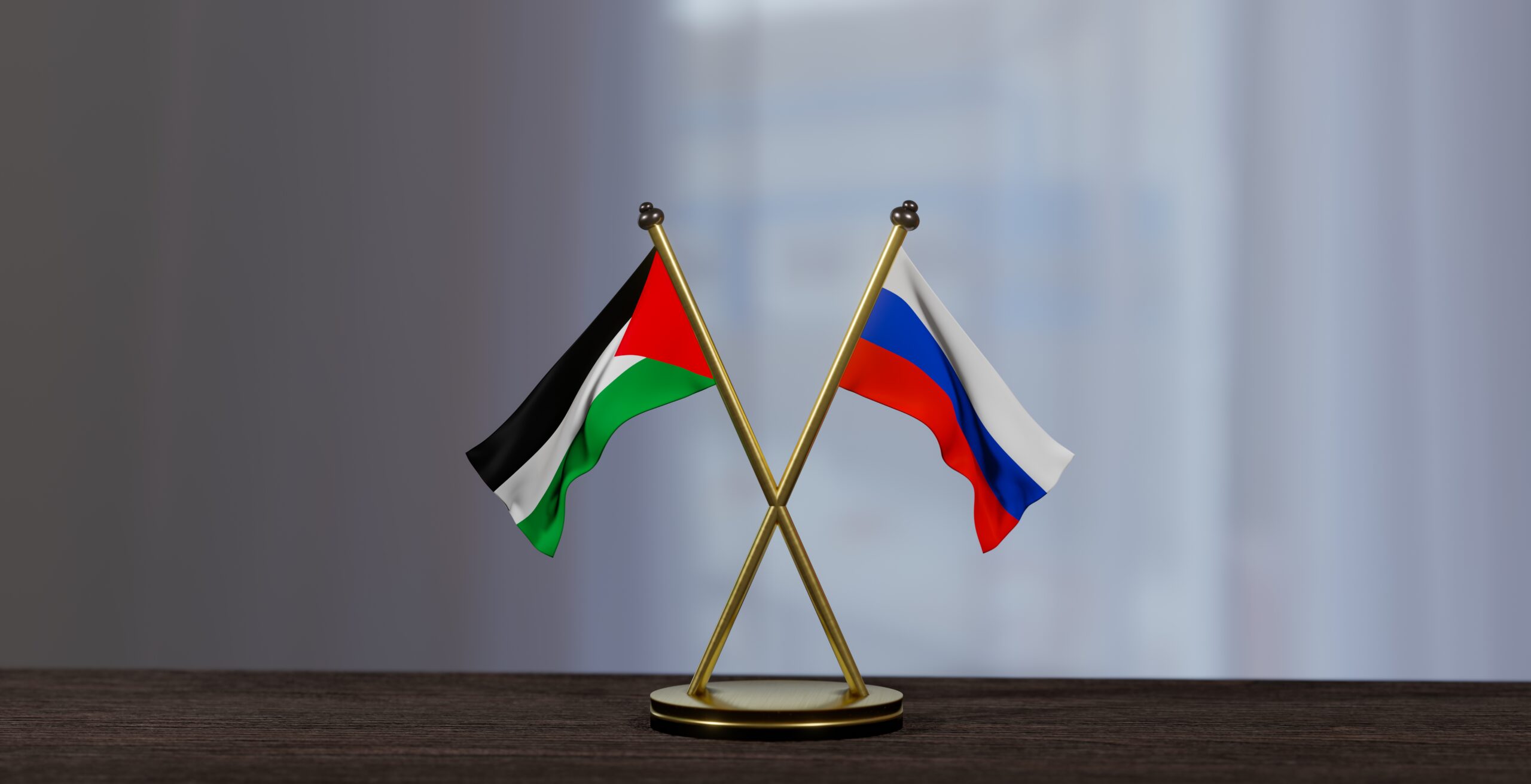
Against the background of the dramatic events in Eastern Europe and the Middle East that dominated the world information agenda in August, the visit of Mahmoud Abbas (also known as Abu Mazen), head of the Palestinian National Authority (PNA) in Ramallah, to Russia and his meeting with Vladimir Putin at the Novo-Ogaryovo residence near Moscow looked like a routine and, in general, unimportant event. But only at first glance.
Struggle for leadership in the Global South
It is quite clear why Abu Mazen needed this trip, which was declared a “state” visit in both Moscow and Ramallah. After the failure of Barack Obama’s “Russian reset” doctrine, after the Arab Spring and especially Trump’s “deal of the century” and Abraham accords of 2020–2022, the relevance of the PNA/PLO as a key factor in the Arab-Israeli settlement and the Middle East conflict as a whole in the eyes of the world and leading regional players has sharply declined. Therefore, Mahmoud Abbas’ obvious interest is to slow down, and ideally to torpedo this negative (for him) trend, using Russia as one of the few places in the world influencing the international agenda, where the head of the PNA/PLO is still taken relatively seriously.
Accordingly, from the very beginning of the Russian military invasion of Ukraine, Ramallah has sided with Moscow, which continues to repeat its long-exhausted chants about the creation of an independent Palestinian state with East Jerusalem as its capital as the only way to resolve the Middle East conflict.
As for the Russian Federation itself, it is not so much concerned with bilateral relations with the virtual “Palestinian state” as with much more pressing matters — its attempts to hijack the status of the main sponsor of the “Palestinian cause” from the West in order to gain geopolitical regional and global propaganda perspectives. These efforts have been visible since 2007, when President Putin officially announced Moscow’s desire to regain its status as a global superpower lost by the USSR as a result of its defeat in the Cold War. They intensified dramatically after Russia’s annexation of Crimea in 2014, and the final doctrine was formulated after February 24, 2022.
A critical element of this doctrine, which represented a specific synthesis of the Kremlin’s “neoconservatism” and formally “leftist” Soviet ideology, was its “anti-colonial aspect” — the movement of unprivileged “non-Western countries” (the “Global South”) against the “neocolonialist financial and technological hegemony” (or, in Putin’s words, the opportunity to “plunder the world through the power of the dollar and the technological dictate”) of the “Global North,” i.e., the countries of the West.
This trend, which has been evolving for a decade and a half, also had an obvious Middle East dimension: Moscow made it clear at the beginning of this change in Russia’s foreign policy that it was no longer ready to be satisfied with the (admittedly, to be fair, rather fictitious) status of “co-sponsor of the Middle East peace process.” The Kremlin intends to set the tone for it as one of the important old-new players in the region. It is clear that with such an “anti-imperialist” vision, which, incidentally, is also shared by the ultra-leftist and radical-progressive circles of Western countries, the theme of “Israeli colonialism,” allegedly oppressing the “freedom-loving people of Palestine,” was simply begging to be explored. This, in fact, manifested itself in the gradual revitalization of Soviet rhetoric about the alleged “pivotal nature of the Palestinian-Israeli conflict for the entire situation in the Middle East” and its “key role in the major regional crises threatening the security and stability of the region” and “efforts to eradicate extremism and terrorism”.
In Israel, meanwhile, the transformation of the long-exhausted cliché about the creation of an independent Palestinian state with a capital in East Jerusalem as (allegedly) the only solution to the Arab-Israeli conflict from a non-binding figure of speech into an operational doctrine of Russian diplomacy has become another argument of the Kremlin pessimists. That is, the revival of fears that by engaging in political confrontation with the United States and the West, Russia will sooner or later slip back to the global-political models and visions of the late Soviet era. And, consequently, to seeing Israel as a potential adversary, given its strategic partnership with the United States.
However, considering the booming Russian-Israeli relations at the end of the first and in the second decade of this century, such discrepancies between Jerusalem and Moscow initially looked secondary and surmountable. Both capitals realized that, unlike the USSR, Russia could not stand “on one Arab foot” in the Middle East — and for a long time Moscow did indeed try to observe, at least in appearance, the principle of the “balance of interests”. The first, initially latent signs of the failure of this scheme became visible in September 2018, when an incident in the skies of Syria (the destroying of an Il-20 electronic reconnaissance plane of the Russian Air Force by Syrian air defense, for which the Russian side rushed to accuse Israel) provoked a “patriotic” campaign in the Russian media. Many Russian public figures then literally competed in the harshness of anti-Israeli attacks, on the verge of, if not beyond, anti-Semitism. Although this campaign was soon curtailed, it became clear that the return of anti-Israeli and anti-Semitic tropes to the public discourse of the Russian Federation is quite possible should they be demanded by the authorities, and the winding down of the “special relationship” between Moscow and Jerusalem could become a reality.
This is precisely the prospect that has become increasingly apparent since the onset of Russia’s full-scale invasion of Ukraine. Israel condemned the Russian invasion and provided Ukraine with massive humanitarian, material, diplomatic and political support. Although it has not officially joined the bloc of Western countries opposing Russia, tensions between Moscow and Jerusalem have grown palpably — even if at first both sides tried to maintain a feeling of “business as usual.”
But even this tentative paradigm of relations was called into question after the bloody terrorist attack by Iranian proxy Hamas on October 7, 2023. The consequence of this aggression was not only an IDF anti-terrorist operation against Palestinian Arab Islamists, but also one of the most large-scale armed clashes between the global North and South. In this case, between Israel, openly supported by the United States and unofficially — the pro-American Sunni regimes of the Saudi bloc, on the one hand, and the Iranian-led “axis of resistance” to the West, on the other.
Abu Mazen in the Russian scenario
Moscow’s stand in the current sprawling regional military conflict in the Middle East is, at the very least, political and diplomatic support for the Arab proxies of Iran, while at the same time positioning itself as the patron of the still symbolically significant for the Arab-Islamic world “Palestinian Arab cause” as a whole. Which may perhaps look logical to the Kremlin’s geopolitical priorities: strengthening the strategic partnership with Iran, as well as competing for leadership of the “global South” with China and other contenders for this status in general.
It is revealing, for example, that almost immediately after the beginning of Israel’s war with Hamas in the Gaza Strip, the Russian Federation at the highest level voiced (with considerable pleasure) declarations about the “failure” of American diplomacy, which allegedly “monopolized” the mediation efforts to resolve the Palestinian problem. This discourse was instantly joined by the Russian state media, in which a pronounced pro-Palestinian and anti-Israeli line began to dominate literally overnight, shaping the corresponding sentiments of the Russian public.
In our opinion, the fact that the Kremlin needed the head of the Palestinian Authority Mahmoud Abbas in this arrangement, and not, for example, Abu Marzook, a member of the Hamas political bureau, who is also warmly received in Moscow, has its own explanation.
First, Moscow cannot ignore the fact that Hamas, which is viewed as quite respectable there, is still officially considered a terrorist organization not only in almost all Western countries, but also in most moderate Sunni Arab regimes, which officially continue to declare their commitment to the creation of a “Palestinian state”. And that is why the head of the PNA, Abbas, for all (and a lot of) the irritation he causes in these capitals, remains their official contact on the “Palestinian street”. Therefore, the claims of the Russian authorities for leadership of the “global South”, with an emphasis on such groups as Hamas, are unlikely to look legitimate in the eyes of the leaders of the Saudi bloc states.
It is no coincidence that when Vladimir Putin met with Palestinian Authority Chairman Mahmoud Abbas this month, Russian reconfirmed “Russia’s support for the creation of a Palestinian state” (based on the Abu Mazen’s infamous “preliminary conditions”) and stressed that their “position on a peaceful settlement with Israel remains unchanged”. In return, the PA Chairman insured Putin that he stood with Moscow “without the slightest doubt” . Both declarations may become additional arguments to persuade the leaders of moderate Arab regimes to continue in a more positive way the dialogue that Vladimir Putin tried to start with them during the hastily organized visit to Saudi Arabia and UAE in December last year.
Second, although it is quite obvious which side the Russians have actually taken in this Middle East war, it is still important for them to show that Moscow is still a partner and mediator for all actors in the Muslim part of the Middle East. And, accordingly, it is able to speak on equal terms with both Shiite Iran and Sunni Arab regimes; with Russia’s protégé, the pro-Iranian Assad regime in Damascus, and with pro-American Riyadh. And finally, and perhaps most difficult of all, to show that Moscow is equally respected by the hard-line “secular nationalists” of the PNA/PLO in Ramallah and the radical Islamists of Hamas in the Gaza Strip.
Russian repeated attempts to reconcile rival factions and restore the “unity of the Palestinian people” have been linked to this last aspect, which can yield a lot of image points in the region. Russia has already openly organized state-level events four times to show that the West is not the only one capable of influencing the resolution of this issue. The first time was in late May 2011 in the form of a summit of Palestinian Arab organizations, which included Hamas, Islamic Jihad and other terrorist groups, in addition to the Fatah organization, the governing wing of the PLO ruling the Palestinian Authority.
The inviting party was the Institute of Oriental Studies of the Russian Academy of Sciences, and not the state authorities (who, apparently, were still a little uncomfortable with formal participation in a dialogue with representatives of organizations that were not going to renounce terror even in lip service). That is why it was stressed that the participants in this seemingly “private public-academic initiative” were organizations and movements that had already signed a treaty for the restoration of Palestinian unity in Cairo earlier that May.
The next three events were officially held under the auspices of the Ministry of Foreign Affairs of the Russian Federation. The first such meeting of representatives of the leadership of Fatah, Hamas, and 7 other factions took place in Moscow on January 16, 2017, with no practical results other than statements and declarations. The second meeting of rival Palestinian factions, which gathered in Russia in 2019 at the invitation of the same level to reach a unification agreement, ended in much the same way — the parties could not even agree on a final communiqué.
In other words, these and other such events on the Russian soil supplemented the long list of failed negotiations between Fatah/PLO and Hamas leaders that took place, sometimes with the participation of other Palestinian groups of various persuasions, between 2007 and 2021 under the auspices of Saudi Arabia, Qatar, Egypt and others. As well as the series of agreements they signed in Mecca, Sana’a, Cairo, Algiers, Beirut, Doha and Damascus on moving towards an “era of unity” and partnership that none of them intended to honor.
The fourth meeting (the third officially hosted by Russian government agencies), a three-day consultation between Fatah/PLO, Hamas and 12 other Palestinian Arab factions, was held in Moscow from February 29 to March 2, 2024. Despite the fact that the five-month-long war in Gaza seemed to have called into question the previous ideas and rules of the game, the goal of the consultations was once again declared to be “restoring Palestinian unity”. It must be assumed that the Kremlin and the Russian Foreign Ministry no longer harbored any illusions in this regard.
The new meeting in Moscow, which, as Foreign Minister Sergei Lavrov frankly stated, was supposed to “knock the trump cards out of the hands of the forces” holding up the settlement of the Palestinian-Israeli conflict (probably in the way Moscow would have liked), looked more like an occasion for yet another propaganda attack on Washington. And in practical terms — to question “the actions of the United States, which in recent months, along with Qatar and Egypt, has become a key mediator in the Palestinian-Israeli settlement”. Equally important for the Russian leadership was the issue of forming a “unified Palestinian government of technocrats,” on which, according to Ayman Al-Raqab, a member of the Fatah delegation, the Palestinian factions intended to reach a common agreement in Moscow, as he told the Russian news agency TASS.
As expected by many, the event ended with almost nothing, and then China immediately took the initiative (and the pro-government Russian media pretended that this was the way it had been planned from the beginning).
But if an agreement between the former and current terrorist Palestinian Arab factions, even purely declaratory, ever happens, Moscow will have grounds to insist that it was there that the process was given impetus. And accordingly – on its right to influence decisions concerning the post-war arrangement in the Middle East region. And this is the third reason why Moscow needs Abu Mazen as head of the PNA, and especially as leader of the PLO, regardless of the degree of fairness of his claims to represent all Palestinian Arabs – in Judea and Samaria (in the “West Bank” of the Jordan River), in the Gaza Strip, as well as the Palestinian diaspora, and even Arabs who are citizens of Israel.
Fourth, the “Palestinian issue,” which still enjoys a lot of sympathy in the world and which is symbolized by the PNA (rather than by Hamas, which is becoming a symbol of “Palestinians in general” only in strongly anti-Israeli circles), is a convenient way for Russia to link the two conflicts: the Ukrainian-Russian and Iranian-Israeli conflicts. It creates a convenient analogy between Russia and Iran, which are at war, as they claim, with “American satellites” — Ukraine and Israel, respectively. And the reason for attacking them, first with the help of their proxies and then directly, in both cases is claimed to be the “protection of brothers” (the eastern Ukrainian separatists of DNR/LNR for Moscow, and Palestinian Arabs for Tehran).
It can be argued to what extent such allusions are actually helpful to Moscow, but so far they seem to serve the main purpose of Russian foreign policy strategy — to justify and legitimize the new ideology of Russian anti-colonialism. In effect, summarizes Andrei Kazantsev, an expert on Russian foreign policy, “Putin has presented his own aggression and annexation of foreign territories as self-defense, allegedly aimed at dismantling Western imperialism and liberating the global South.”
Initially, this ideological link in the global confrontation between the “North” and the “South” was felt mainly in the strategy of the Iranians, but now, apparently, this approach is becoming acceptable in Moscow as well. Especially given the fact that if Russia is included in the “Axis of evil,” it would make no sense for it to play second fiddle there.