PSCRP-BESA Reports No 120 (March 18, 2025)
Belarus is the only post-Soviet country whose national language has been losing its positions over the decades that followed the collapse of the USSR. At the same time, it is the only post-Soviet state other than the Russian Federation where Russian has the status of the state language (in Kyrgyzstan, Russian has the status of “official” but not the state language). Despite the fact that the Belarusian language nominally has the same status as the Russian language, the total dominance of the Russian language in Belarus is apparent to anyone who has visited the country. According to the 2019 census, 54.1% of the country’s population called the Belarusian language their mother tongue (while 84.9% identified as ethnic Belarusians), but only 26% said that they speak Belarusian at home. According to experts, in reality this figure is even lower. In many cases a mixed form of speech known as “trasianka”, which has elements of both Russian and Belarusian languages, is referred to as the Belarusian language. According to the National Statistical Committee of Belarus, in the 2023/2024 school year only 8.58% of schoolchildren were taught in the Belarusian language. The curtailment of education in the Belarusian language began when Alexander Lukashenko came to power in 1994: back in the 1994/1995 school year, 40.6% of the country’s schoolchildren were taught in the Belarusian language. Currently, many public services in the country (e.g., courts, law enforcement agencies, STEM higher education) are available only in Russian. Paradoxically, after three decades of independence, Belarusian has found itself in the position of a language whose further existence is under threat. Live communication in Belarusian cities now looks a kind of exotic — a situation that in Europe is comparable, perhaps, only to the situation of the Irish language in Ireland.
However, unlike Irish, which bears limited resemblance to English, Belarusian is very close to Russian. Therefore, since Belarusian language and literature remain compulsory subjects in Belarusian schools, the overwhelming majority of the country’s residents understand Belarusian well, although they are not its active speakers. In everyday life, the dialects of the Belarusian language are spoken by rural residents (and their use is dwindling), while its literary form is spoken almost exclusively by teachers of the Belarusian language and literature, Belarusian-speaking writers, journalists, actors, and the like. The question arises: why does the Lukashenko regime, which pursues a consistent course not just for cooperation, but for integration with Russia, retain state support of the Belarusian language, albeit very limited?
The answer to this question is unambiguous: this regime needs the Belarusian language not as a living language, but as a symbol of the national uniqueness of Belarusians and Belarus. Alexander Lukashenko is not interested in the complete elimination of the Belarusian statehood and its absorption into the Russian Federation, since in this case he would lose power, turning, at best, into the head of one of the regions of the federation, whom Vladimir Putin appoints and dismisses at will. It is no coincidence that despite the fact that the Union State Treaty between Russia and Belarus was signed back in December 1999, right after Vladimir Putin came to power, and that Belarus’ dependence on Russia is very high, Belarus still retains a certain degree of statehood. For the time being, Alexander Lukashenko manages to balance on the verge of complete loss of independence, although he has long ago turned the country under his control into a satellite of Russia.
It is doubtful that without Russian support Alexander Lukashenko would have managed to stay in power during the mass protests against election fraud in 2020–2021. These protests showed that Belarusian civil society falls somewhere between Russia and Ukraine in terms of ‘passionarity’, or commitment to their cause. Unlike the protests of the Russian opposition, which peaked in 2011–2013, the protests of the Belarusian opposition were truly massive (considering the size of the population of both countries), and their participants demonstrated organized behavior and persistence, which the Russians could not even dream of. However, unlike the Ukrainian opposition during the Euromaidan of 2013–2014, the Belarusian opposition did not respond to violence on the part of the authorities by choosing a strategy of peaceful protest.
As a result, the protests in Belarus were suppressed with unprecedented brutality: according to human rights organizations, between 5 and 12 people were killed, at least 6 went missing, more than 1,400 were injured, more than 35,000 were detained by security forces, at least 450 were tortured, at least 663 were sentenced to various prison terms. By comparison, the protests in Russia in 2011–2013 failed to achieve their goals — in spite of the fact that the Russian authorities did not use even a fraction of the violence used against the protesters in Belarus. In the notorious Bolotnaya Square case, opened in Russia against opposition activists, 15 people were sentenced to 2.5 to 4.5 years in general regime correction facilities, 1 person was sentenced to compulsory treatment in a closed psychiatric ward, and 1 person was given a suspended sentence.
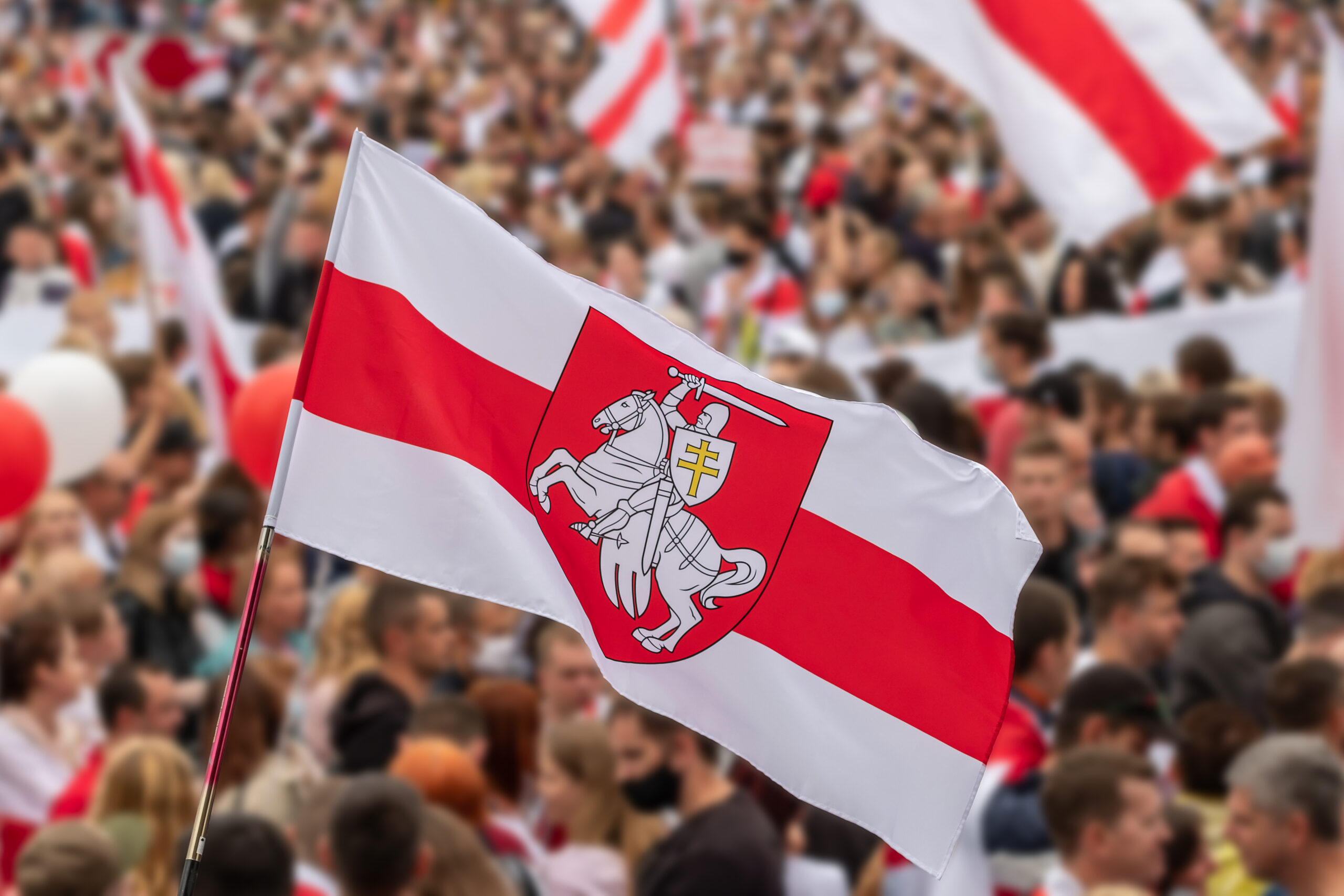
It should be noted that the Belarusian opposition actively used and still uses the Belarusian language. Communicating in Belarusian in everyday life became a marker of opposition sentiments for many Belarusian citizens. Moreover, we are mainly talking about people who grew up in Russian-speaking families and consciously switched to the Belarusian language. One can find many accounts of such a transition and recommendations to those wishing to switch from Russian to Belarusian on the Internet. In this respect, modern Belarusian opposition circles are ideological successors to the government of Belarus in the first years of independence (1991–1994), when, under the influence of the small opposition of the Belarusian Popular Front “Adrazhenne” (BPF “Revival”), the conservative majority of the Supreme Soviet made decisions that distanced Belarus from what later became known as the “Russian world”: the Russian language did not enjoy the status of the state language, and the coat of arms and the flag of the Belarusian People’s Republic proclaimed in 1918 were adopted as symbols of the independent Republic of Belarus. It was also proposed that the national anthem of the Belarusian People’s Republic, banned during the Soviet era, be adopted, but this never happened. After Alexander Lukashenko came to power, the flag and coat of arms of the Belarusian SSR were restored, with some adjustments, and the Russian language received the status of the state language along with Belarusian.
After multiple amendments to the Constitution of the Republic of Belarus, allowing Alexander Lukashenko to stay in power indefinitely, and after the forceful suppression of the 2020–2021 protests, many people consider Alexander Lukashenko an illegitimate president. However, this does not cancel the fact that he originally came to power with the support of the majority of Belarusians, opposing the national-democratic course of the BPF, primarily for economic reasons. Nothing of the kind happened in other post-Soviet states, in particular in Ukraine, Lithuania and Latvia that border Belarus. The reason for this difference was the long-standing weakness of the Belarusian national movement compared to the national movements of neighboring nations, including the Ukrainians, who are historically and linguistically close to Belarusians.
In the 17th–18th centuries, Ukrainians had their own autonomous state entity, the Hetmanshchina. The liquidation of the Hetmanshchina and the strengthening of Russian colonial oppression caused discontent of at least part of the Ukrainian elite. Belarus was in this period an integral part of the Grand Duchy of Lithuania, which was dominated by Polish and polonized nobility.
By the beginning of the 19th century, the Ukrainian elite had a good command of their national language. Even after becoming part of Russian literature, many writers of Ukrainian origin retained an interest in Ukrainian issues and adherence to the Ukrainian national narrative — suffice to name the writings of Nikolai Gogol. There were no comparable figures in Belarusian culture in the 19th century. Prominent historians Mykola Kostomarov (1817–1885) and Mykhailo Hrushevsky (1866–1934) actively worked on Ukrainian historiography. Thus, the first issue of the 10-volume “History of Ukraine – Rus’”, positioning Ukraine as the successor of Kievan Rus’, was published in 1898. Comparable editions on the history of Belarus appeared only in the 21st century. The modern Belarusian national narrative considers modern Belarus as the successor of the Grand Duchy of Lithuania and claims its history and symbols.
Additional factors contributing to the development of the Ukrainian national movement were the existence of a “Ukrainian Piedmont” in the form of Galicia and the Ukrainian Greek Catholic Church, which acted as the Ukrainian national church in western Ukraine. This turned Galicia into a springboard for the spread of Ukrainian literature and Ukrainian national ideas throughout most of the Ukrainian ethnic territories that were part of the Russian Empire, just as Piedmont served as a springboard for Giuseppe Garibaldi in unifying Italy. The Belarusian national movement had no such “Piedmont”.
The weakness of the Belarusian national movement in comparison with the Ukrainian one also manifested during the period of the struggle for independence that followed the collapse of the Russian Empire. The Belarusian People’s Republic, proclaimed in March 1918, was unable to form a full-fledged state, as its territory was under German occupation, which did not recognize the independence of the Belarusian People’s Republic, and in December it ceased to exist. In contrast, the Ukrainian People’s Republic existed for three years and was destroyed by the Bolsheviks after fierce resistance. During the short period of independence, many important institutions of Ukrainian statehood were established.
“Belarusization”, i.e., the policy of active expansion of the functions of the Belarusian language pursued in the 1920s, was a particular case of the policy of ‘Korenizatsia’, or ‘indigenization’, carried out in the USSR at large. Its curtailment began in the Belarusian SSR as early as 1929, and its results were much more modest than the achievements of Ukrainianization, the curtailment of which in the Ukrainian SSR was carried out a decade later.
The facts mentioned above predetermined the weakness of the Belarusian national movement and facilitated both linguistic and ideological Russification of Belarus. It is indicative that the poll conducted at the end of 2023 showed that 55% of Belarusians believe that Belarusians, Ukrainians and Russians are parts of the “three-pronged Slavic nation”, and only 42% — that Belarusians are a separate nation. There is no doubt that the modern Belarusian national-democratic opposition relies primarily on the second, smaller, but socially active group of the country’s population that is distancing itself from Russia and Russians.
After the suppression of the 2020—2021 protests, most of the Belarusian opposition leaders who avoided imprisonment found themselves in exile, as well as many thousands of their supporters. At the same time, unlike the Russian opposition, the Belarusian opposition showed a high degree of self-organization. Back in August 2020, at the height of the protests in Belarus, ex-presidential candidate Svetlana Tikhanovskaya announced the creation of the Coordinating Council of the Belarusian opposition (CC), which has since continued to work actively as a single representative body of the national-democratic opposition, with seven party factions. The EU adopted a resolution recognizing the CC as “a temporary representation of people demanding democratic change” and called on all EU member states to assist it.
In August 2022, after the beginning of a full-scale Russian invasion of Ukraine, including the incursion launched from the territory of Belarus, the CC created its executive body, the United Transitional Cabinet of Belarus, headquartered in Vilnius, which became, in fact, the government of Belarus in exile. It was headed by Svetlana Tikhanovskaya. The Belarusian opposition openly says that the transitional cabinet created by it is planning to become the real government of Belarus in the transitional period after the removal of Alexander Lukashenko from power.
Given the current realities of Eastern Europe, it is extremely important that the Transitional Cabinet took upon itself, among other things, the function of forming a new Belarusian army. It should be based on the Belarusian volunteer formations fighting on the side of Ukraine, first of all, the Kastuś Kalinoŭski Regiment. Unlike members of the Russian opposition, the organized Belarusian opposition has no doubts about the necessity to support the AFU.
To summarize, we can state that the fate of Belarus depends to a very large extent on the outcome of the Russian-Ukrainian war. In case of Ukraine’s defeat or freezing of the conflict, the current situation may continue for a long time. And in case of Russia’s defeat, Belarus’s path to Europe may turn out to be very short.