PSCRP-BESA Reports No 177 (January 14, 2026)
Armenia finds itself at a pivotal juncture in its modern history. The August 2025 peace declaration brokered by President Donald Trump in Washington offered Yerevan something previously unimaginable: a pathway to normalized relations with Azerbaijan, access to new trade corridors bypassing both Russia and Iran, and deeper integration with Western economic and security structures. Yet even as fuel shipments from Baku begin crossing into Armenian territory after decades of hostilities, Armenian officials are simultaneously courting Tehran with pledges to elevate bilateral relations to a strategic partnership. This hedging strategy, while understandable for a small nation surrounded by larger powers, may ultimately prove self-defeating.
The stakes could hardly be higher. Armenia, a landlocked country of fewer than 3 million people, sits at the intersection of Russian, Turkish, Iranian and increasingly Western spheres of influence. Its geography has historically been both a curse and an opportunity. The Trump administration’s active diplomacy in the South Caucasus represents a rare moment when American attention has focused on this strategically significant but often overlooked region. Whether Armenia seizes this opportunity or squanders it through contradictory signaling will shape the country’s trajectory for decades to come.
The Constitutional Conundrum
The Trump-brokered agreement remains unsigned, caught in a constitutional impasse. Azerbaijan demands Armenia remove what Baku interprets as territorial claims embedded in the Armenian constitution before formalizing the peace. The preamble to Armenia’s 1995 constitution references the 1990 Declaration of Independence, which in turn alludes to a 1989 joint resolution by Soviet Armenia and the Nagorno-Karabakh regional council calling for unification. For Azerbaijan, these references constitute an implicit territorial claim that must be excised before any lasting peace can be achieved.
The required constitutional changes cannot occur without a referendum, now postponed until 2027. This delay creates dangerous uncertainty. Prime Minister Nikol Pashinyan faces parliamentary elections this year with approval ratings in the low double digits. Many Armenians blame him for the loss of Nagorno-Karabakh in 2023, when over 100,000 ethnic Armenians fled what the European Parliament has called ethnic cleansing. The trauma of that exodus remains raw, and opposition politicians have seized upon Pashinyan’s peace overtures as evidence of capitulation rather than pragmatic diplomacy.
Separating the polarizing election from the constitutional referendum may be tactically prudent for Pashinyan, but it leaves the peace agreement in diplomatic limbo, vulnerable to spoilers on all sides. Should Pashinyan lose power before the referendum takes place, his successor may prove far less willing to pursue normalization with Baku. The window for peace, opened by American mediation, could close as quickly as it appeared.
Russia and Iran: Colossi on Clay Feet
Both Moscow and Tehran are actively working to prevent Armenia from drifting westward, deploying a combination of political pressure, economic inducements and propaganda. Russia is supporting opposition figures who advocate for a union state on the Belarus model, while billionaires with Kremlin connections position themselves as potential challengers to Pashinyan. Samvel Karapetyan, a dual Russian-Armenian oligarch arrested in June over allegations of plotting to overthrow the government, exemplifies this pattern of Kremlin-aligned figures positioning themselves as alternatives to the current leadership.
The Kremlin’s intentions were laid bare when state television host Vladimir Solovyov openly discussed launching a special military operation against Armenia, declaring that losing the country would be as significant as losing Ukraine. Solovyov’s remarks went further, questioning why Russia should respect international law if its national interests demanded otherwise. Armenian politicians called his remarks an attempt to justify the use of force against a sovereign state. The leader of the Republic party noted that Solovyov does not treat Armenia as a state but rather as a zone of Russian influence, adding that the Russian propagandist’s nervousness stems from his awareness that Armenian voters have repeatedly rejected Moscow’s preferred candidates.
Iran, meanwhile, deploys softer tactics. President Masoud Pezeshkian visited the family of an Armenian Christian martyr from the Iran-Iraq war on Christmas Eve, emphasizing millennia of shared history and religious ties. During the visit, Pezeshkian stressed that Iran’s strength and stability owe much to the sacrifices of martyrs from all ethnic and religious backgrounds, a message clearly calibrated to resonate with Armenian sensibilities. Tehran is also eager to discuss regional transit routes, positioning itself as an alternative to Western-backed corridors. Iranian officials have emphasized the goal of elevating relations to a strategic level, offering Armenia an alternative axis should Western engagement falter.
Yet both patrons are severely weakened. Russia remains mired in Ukraine with grim prospects for international rehabilitation, its military reputation tarnished and its economy under unprecedented sanctions. Iran faces the largest protests in over a decade, with demonstrators challenging the regime’s legitimacy across multiple provinces. The threat of intensified sanctions under a second Trump administration looms large, potentially crippling Tehran’s ability to offer meaningful economic support to allies. Choosing either as a patron carries substantial risks that could burden multiple generations of Armenians.
The Promise of Peace
The concrete benefits of normalization are already materializing. In December 2025, Azerbaijan dispatched its first fuel cargo to Armenia since the collapse of the Soviet Union, with SOCAR sending over 1,200 tons of gasoline by rail via Georgia. A second, larger shipment followed in January 2026, comprising 6,100 tons of petrol and 1,500 tons of diesel. These deliveries reduce Armenian dependence on Russian energy imports, which accounted for over 60 percent of fuel consumption in 2024. The symbolism is as important as the substance: commercial ties severed for three decades are being restored, demonstrating that peace can deliver tangible economic dividends.
More importantly, the proposed Trump Route for International Peace and Prosperity would connect Azerbaijan to its Nakhichevan exclave through Armenian territory, transforming the South Caucasus into a viable alternative corridor linking Europe to Central Asia while bypassing both Russia and Iran. For Armenia, participation in this corridor would end its isolation, attract foreign investment and create leverage that small states rarely enjoy. The question is whether domestic politics will permit Yerevan to capitalize on this opportunity before it evaporates.
The Diaspora Dilemma
Armenian-Americans represent another complicating factor in Yerevan’s calculations. The Armenian National Committee of America (ANCA) has positioned itself in opposition to the current government, viewing Pashinyan as a traitor who surrendered ancestral lands. This stance places the diaspora lobby at odds with the elected leadership in Yerevan and complicates efforts to present a unified Armenian voice in Washington.
ANCA recently escalated its criticism of Israel, claiming Israeli policy runs contrary to Jewish traditions while accusing the Netanyahu government of denying the Armenian genocide and endangering Jerusalem’s Armenian Quarter. Such rhetoric risks antagonizing the Trump administration, which maintains close ties with Israel and has little patience for organizations that criticize American allies. At a moment when American engagement in the South Caucasus could prove decisive, ANCA’s positioning threatens to marginalize the very diaspora lobby that should be amplifying Armenia’s case in Washington. The organization’s approach may satisfy nationalist sentiments among some diaspora Armenians but does little to advance Armenian interests in the corridors of power.
The West Must Step Up
If the United States and Europe are serious about fostering a peaceful South Caucasus beyond the reach of Russian and Iranian influence, the time for sustained engagement is now. The Trump administration brokered a historic agreement; the challenge now is ensuring that agreement leads to lasting peace rather than another frozen conflict. This requires diplomatic follow-through, economic support and a clear message that the West will not abandon Armenia to Russian or Iranian pressure.
The recent USAID shutdown ended programs designed to help Armenian media achieve financial sustainability and stopped funding to increase the strategic communications capacity of the Armenian government. Investment in civil society and independent media would help counter Russian influence operations certain to intensify as parliamentary elections approach. The West should also consider supporting the Armenian government in making the case for peace to skeptical domestic audiences. Without such investment, Russian propaganda and disinformation may prove decisive in shaping Armenian public opinion.
Choosing a Path
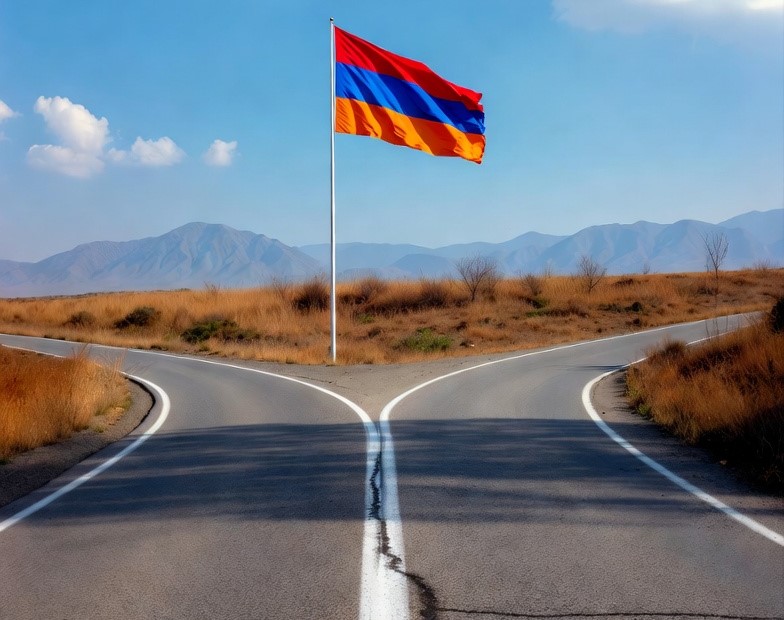
Armenia’s policy of hedging between competing powers may appear rational for a small state navigating treacherous geopolitics. But the ground is shifting beneath such calculations. Russia and Iran are not the patrons they once were, and aligning with declining powers carries long-term costs that successive Armenian governments will struggle to overcome. The Trump-brokered peace offers something tangible: economic integration, energy security and a stake in emerging trade corridors that could reshape the region.
The global political landscape has undergone a profound transformation. The era of multipolarity, in which smaller nations could deftly balance between great powers, extracting concessions from all while committing to none, is giving way to a starker reality. From Eastern Europe to the Indo-Pacific, countries are being compelled to choose their allegiances. Neutrality is becoming a luxury that geography and circumstance deny to many. Armenia, wedged between hostile and declining powers, cannot afford the illusion that it can indefinitely play all sides. The time for running with the hare and hunting with the hounds is over.
The West, for its part, must recognize that diplomatic victories require follow-through. A peace agreement initialed but never signed, a trade corridor promised but never built, would represent a failure not only for Armenia but for American credibility in a region where Russia and Iran remain eager to reassert their influence. Peace in the South Caucasus is within reach, but it demands commitment from both sides. Armenia must end its strategic ambiguity and demonstrate that it is prepared to anchor itself in the Western orbit. And the West must be prepared to support that choice with more than rhetoric.
PSCRP team