
BESA Center Perspectives Paper No. 2,374, April 14, 2026
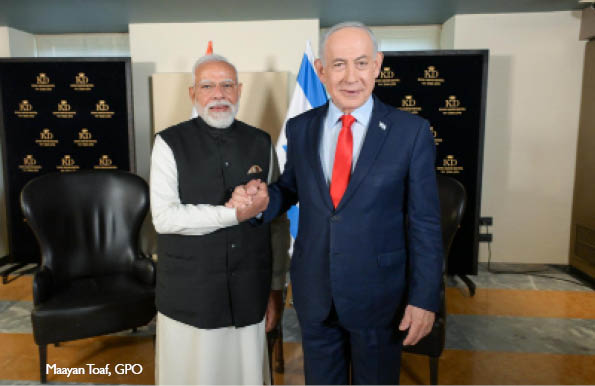
EXECUTIVE SUMMARY: Prime Minister Narendra Modi’s visit to Israel in February 2026 was not just another diplomatic stopover. It represented a strategic reset that consolidates a shift from a procurement-based relationship to a model of systems integration. This shift positions India as a strategic rear and capability partner for Israel in a changing threat environment that now entails a saturation threat (UAVs, loitering munitions, multi-layer attacks), terrorism as policy, supply-chain vulnerability, and intensifying great-power technological competition. In this context, elements usually treated as “economic” – AI, quantum, digital public infrastructure, a free trade agreement – are no longer peripheral civilian add-ons. They are part of the infrastructure of national resilience, standard-setting, supply-chain endurance, and operational advantage. The core test after the visit is whether the strategic intent is translated into durable mechanisms like projects, standards, co-production, and standing working groups.
Modi’s visit: A strategic reset
The strategic significance of Narendra Modi’s February 2026 visit to Israel lay not only in the event itself but in how it was framed. The visit was presented as a consequential event intended to lock in a structural upgrade in the relationship. In security affairs, a “historic” moment is not merely symbolic; it is a binding signal. It sends a message to third parties, bureaucracies, industries, and defense establishments that the parties intend to move from “functional relations” to capability-producing relations.
This reset has a political dimension in that it de-hyphenates India’s relationship with Israel. It enhances India’s capacity to deepen ties with Israel without tying it automatically to the Palestinian issue. This does not mean India has abandoned its traditional diplomatic positions. Rather, it has altered the relationship’s “glass ceiling”. Israel is no longer treated primarily as a sensitive file requiring cautious calibration. It is now viewed as a partner that can and should be presented openly as such, especially in terms of security, industry, and dual-use technology.
A strategic rear in the saturation age
The central argument behind this new model is that India is evolving from a major customer of Israel’s defense industry into a strategic rear – in other words, a partner that can provide industrial depth, production capacity, skilled manpower, and, most significantly, endurance through a prolonged crisis.
In the saturation age, the ability to sustain capability is no longer about which systems were purchased. It is about systemic survivability and operational continuity: availability of components, production tempo, maintenance and upgrades under stress, rapid adaptation across theatres, and the ability to support forces over time. Under such conditions, a partner with an industrial scale like that of India can be a strategic asset. When threats are defined by volume, tempo, and attrition, depth can determine whether a state retains operational effectiveness or slides into operational-economic exhaustion.
This is what drives a shift from procurement to systems integration. The relationship is no longer a classic supplier–client model in which value is measured by delivery of a product. Value is instead measured by an integrated capability composed of manufacturing, standards, knowledge infrastructures, and integration into domestic industrial ecosystems. This is a doctrinal change that creates smart interdependence: that is, interdependence that increases resilience rather than worsens vulnerability.
Technology as operational advantage: AI, quantum, and semiconductors
From a security perspective, AI, quantum, and semiconductors are not mere engines of growth. They are foundational layers of operational superiority and influence over the standards environment. In an era in which sensors, communications, data processing, cyber, and AI shape detection, identification, target allocation, and fire management, control over the technological stack is a precondition for operational capability.
This is precisely where a systems-integration mindset is required. AI is not just “start-up culture”; it is an integrated capability involving data fusion, decision processes, models, computer infrastructure, and cyber layers. Quantum is not just the distant future; it shapes the current debate on secure communications, encryption, and information resilience. Semiconductors are not just an industry; they are a core vulnerability of every modern civil-military system.
As India pursues technological autonomy and seeks to reduce dependence on East Asian supply chains, it will look for partners that can contribute to system quality. Israel can add value here via systems architecture, cyber capabilities, algorithmic strengths, and the translation of innovation into operational concepts. For Israel, India supplies what Israel lacks at scale: manufacturing, market depth, and broad deployment. The combination is a force multiplier.
DPI and an FTA: The infrastructure of endurance
It is natural to view digital public infrastructure (DPI) and free trade agreements (FTAs) as economic instruments. But in a world of technological competition, they are also tools of functional sovereignty. Whoever controls payment infrastructures, financial networks, data flows, and standards controls tempo, access, and the ability to operate policy under pressure. Standards diplomacy—whether in digital systems, fintech, or industrial ecosystems—creates positive “lock-in”: mutually reinforcing interdependence that makes political backtracking harder and increases predictability for stakeholders.
Linking Israeli capabilities to Indian infrastructures is thus about more than commercial convenience. It is a mechanism that not only deepens the partnership but makes it more unlikely to unravel in a crisis.
Multilateralism as architecture: IMEC and I2U2 as a force multiplier
India is not positioning Israel solely within a bilateral relationship. Frameworks such as IMEC and I2U2 create an environment in which Israel functions as a node, not merely a partner. For national security, the significance of this is twofold: infrastructure links, financing, and standards make the partnership more politically resilient, and embedding Israel in a Western-regional architecture places the relationship within a broader contest for influence vis-à-vis China.
Strategically, IMEC is not just a corridor. It is an architecture of connectivity with implications for infrastructure security, route protection, energy resilience, and competition over standards. This is where economics becomes security.
Risks: Multi-alignment and the Arab dilemma
Even after a strategic reset, India will continue to pursue multi-alignment. It relies on the Arab world for energy, trade, and the employment of millions of Indian citizens. It also seeks to remain a leading actor in the Global South, an arena in which criticism of Israel can be severe, and there are domestic political sensitivities to be considered. The practical implication for Israel is clear: do not make assumptions about India’s full diplomatic alignment in international forums. Build instead on a measurable capability partnership wherein Indian and Israeli interests are aligned and thus more impervious to shifts in rhetoric.
The war that erupted soon after Modi’s February 2026 visit did not overturn the logic of the new India-Israel partnership. It exposed its true hierarchy of interests. New Delhi did not sever contact with Tehran; nor did it abandon the language of multi-alignment. But the crisis made clear that India now has far more to gain from nurturing its relationship with the United States, Israel, and the Gulf States than from cultivating its connection to a heavily sanctioned and strategically weakened Iran. This is not simply a matter of diplomatic preference. It reflects a cold geopolitical calculation: reliable partners for India are those that can contribute to its long-term security, technological advancement, energy resilience, market access, and broader rise in the international system. Iran still matters to India, particularly with regard to connectivity and as a residual westward option, but it no longer offers the same strategic leverage it once did. In that sense, the war clarified that the deepening India-Israel relationship rests not on sentiment or rhetorical convergence but on a hardening logic of national interest, resilience, and selective alignment under conditions of regional stress.
A roadmap for Israeli decision-makers
If the 2026 visit constitutes a strategic reset, Israel must extract concrete outcomes. A practical roadmap should include the following:
- Select two or three anchor co-development projects to be “Made in India,” focusing on counter-UAS, layered air and missile defense, and operational cyber. Each project should have defined timelines and funding.
- Establish a standing systems-integration mechanism: an NSC-MoD-industry forum alongside technical working groups (standards, core components, production processes).
- Build a supply-chain resilience program: Map bottlenecks and establish production/assembly/stockpiling capabilities in India as a strategic rear.
- Pursue a controlled linkage to DPI: Identify where Israel adds value (cybersecurity, authentication, information protection) and implement in phases.
- Operationalize minilateral frameworks: Leverage I2U2/IMEC to anchor standards, infrastructure security, and route protection as part of a capability package.
Conclusion
Narendra Modi’s February 2026 visit to Israel should be viewed as a doctrinal signal: a shift from procurement-based ties to a relationship that produces systems integration. In an era of saturation threats, terrorism, and technological competition, India can become more than a diplomatic partner: it can become a strategic rear. The decisive question is not what is said in ceremonies but what is built afterwards: mechanisms, standards, co-production, and enduring infrastructures. That is the difference between a “historic moment” and a sustained strategic advantage.
The war that broke out after Modi’s visit reinforced this logic. It showed that under conditions of regional stress, India’s partnership with Israel is not merely politically sustainable but strategically compatible with New Delhi’s wider hierarchy of interests. In that sense, India’s value to Israel lies not only in industrial scale but in the fact that the relationship increasingly rests on converging calculations of resilience, deterrence, and national interest.
Dr. Lauren Dagan Amos is a member of the Deborah Forum, a lecturer and a researcher in the Department of Political Science and the Security Studies Program at Bar-Ilan University. She specializes in Indian foreign policy.