
PSCRP-BESA Reports No 199 (April 28, 2026)
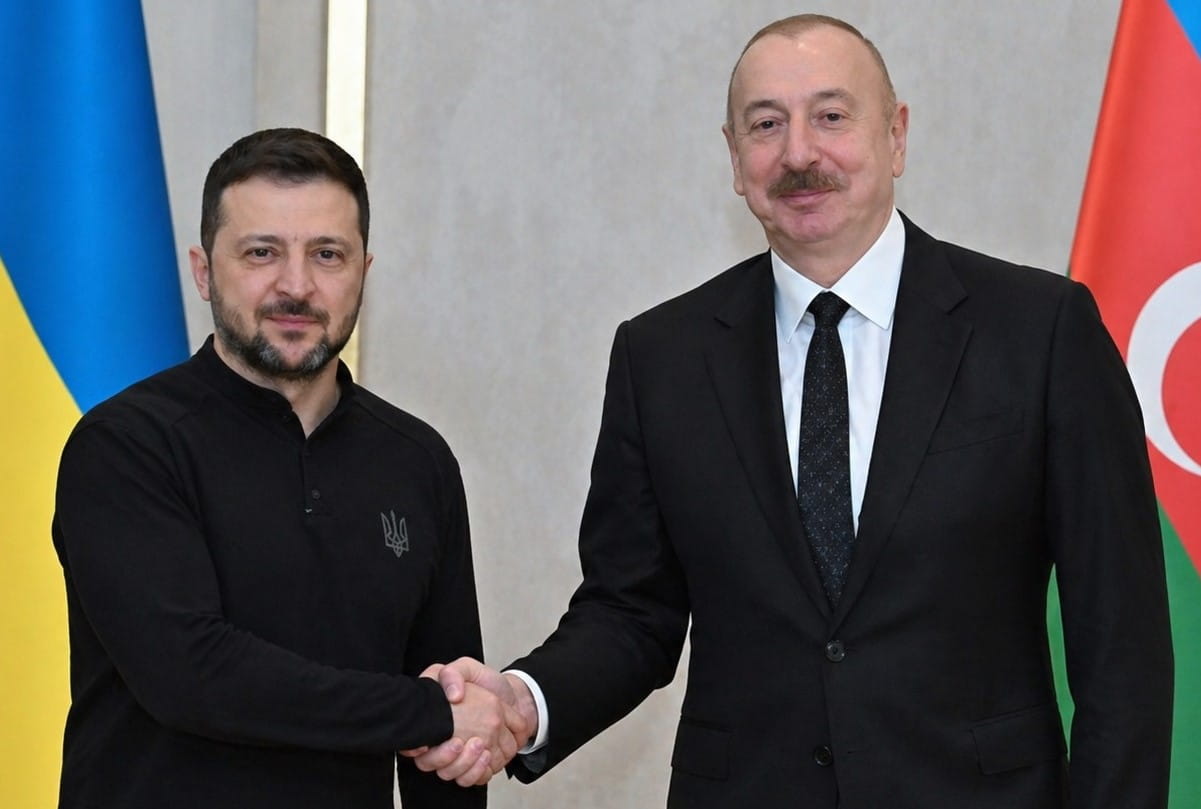
Volodymyr Zelensky’s April 25 visit to Gabala and his joint appearance with Azerbaijani President Ilham Aliyev produced six bilateral agreements spanning defense, energy, and trade — and positioned Baku as a prospective venue for trilateral Ukraine-Russia-U.S. negotiations. The episode crystallized a broader realignment already underway in the South Caucasus, one that Russian state media, wire services, and pro-war commentators struggled to process with composure.
The Visit and Its Immediate Optics
Zelensky’s arrival in Gabala on April 25, 2026, marked his first trip to the South Caucasus since Russia’s full-scale invasion of Ukraine began in February 2022. The choice of venue was not incidental: Gabala sits in northern Azerbaijan, approximately 100 kilometers from the Russian border — a geographic detail that did not go unremarked in either Moscow or Baku.
At the joint press conference, Aliyev confirmed that both countries’ defense industries offered “excellent opportunities” for joint production, and acknowledged that military-technical cooperation had been on the agenda of the closed-door session. Zelensky, for his part, extended an offer that inverted the usual diplomatic choreography: he proposed that Azerbaijan serve as the venue for trilateral negotiations among Ukraine, the United States, and Russia — “if Russia is prepared for diplomacy.” The conditional clause was precise and deliberate.
Ukrainian specialists in air-defense systems were already on the ground in Azerbaijan at the time of the visit, a detail Zelensky disclosed publicly, signaling that the cooperation announced in Gabala was not aspirational but operational. Aliyev also confirmed Azerbaijani support for Ukraine’s territorial integrity and recalled his own visit to Kyiv in January 2022, days before Russia’s attack, announcing that their next meeting would take place on Ukrainian soil. By April 2026, cumulative Azerbaijani humanitarian assistance to Ukraine had exceeded $45 million.
How the Russian Media Apparatus Responded
The Kremlin’s official reaction to Zelensky’s Baku trilateral-talks proposal was calibrated for dismissiveness rather than engagement. Peskov, speaking to Vesti journalist Pavel Zarubin on April 26, declined to address the venue offer directly; instead, he returned to Moscow’s standard holding formula, saying that Kyiv needed to “summon the will” and make the decisions necessary to reach agreements, since “further along, more painful decisions will be required.” The formulation — which assigns all diplomatic agency to Ukraine while casting Russia as a patient, principled party — has been Peskov’s consistent register since the Geneva round in February. What was conspicuously absent was any substantive comment on Azerbaijan’s suitability as a venue or on Aliyev’s decision to host the visit at all. That silence was more instructive than anything Peskov said. Parliamentary commentary was blunter: Konstantin Zatulin, first deputy chairman of the Duma’s CIS affairs committee, told Lenta.ru on April 25 that Azerbaijan was “not suitable” for Russia as a negotiating venue, calling Baku an “unreliable partner” and suggesting Zelensky had proposed it purely as a gesture of flattery toward Aliyev. Zatulin also recycled the grievance over the downed AZAL airliner, complaining that Baku had “double standards” — demanding Russian apologies while offering “not a word of condemnation” toward Ukraine.
The Russian state wire services processed the Gabala summit through the lens of institutional minimalism. RIA Novosti published a straight factual account of Aliyev’s joint-production statement, referring to Zelensky by name without editorial embellishment. What was conspicuously absent from the wire coverage was any analysis of why Baku had agreed to host the visit at all — a silence more eloquent than anything that was printed.
Vedomosti and the business-oriented press covered the visit in a factual register, without the derisive epithets deployed by nationalist outlets. Kommersant followed suit with a matter-of-fact report.
Vladimir Solovyov’s broadcasts on Russia-1 devoted no significant analytical segment to the Gabala summit itself — a revealing omission from a show that rarely passes up an opportunity to position Russia as the indispensable actor in any post-Soviet drama. The program’s April 26 edition addressed the Zelensky-Aliyev meeting only in summary form, with Solovyov’s commentators preferring to dwell on the attempted attack on President Trump in Washington as the week’s dominant story. The subject displacement was itself a communicative act: a topic too uncomfortable to engage is a topic that goes undiscussed.
Dmitry Kiselev’s flagship Sunday broadcast “Vesti Nedeli” on April 26 likewise treated the Gabala summit as secondary material, with its headline segments devoted to Iran, Trump, and the Chernobyl anniversary. Kiselev, whose program has historically been the main venue for elaborate anti-Ukrainian narratives directed at a mass audience, appears to have encountered in the Baku summit a story whose contours resisted domestication within the standard framework of Western encirclement and Ukrainian desperation. An Azerbaijani president voluntarily meeting Zelensky, reaffirming territorial-integrity principles, and offering to co-produce weapons does not lend itself to a triumphalist framing from Moscow’s perspective.
The Duma’s response was left to Viktor Vodolatsky, first deputy chairman of the CIS affairs committee, who issued the most explicit threat in the Russian political class’s reaction: if Azerbaijani-Ukrainian jointly produced weapons reached Russian territory, Azerbaijan would “automatically” become a “unfriendly” state. The threat landed with a notably hollow ring. The broader Russian political vocabulary for managing recalcitrant neighbors had been calibrated in an era when those neighbors had fewer alternatives. That era has passed.
The Telegram Ecosystem and Its Tells
The most analytically revealing responses came not from state broadcasters but from the Telegram channels that constitute the operational core of Russian nationalist commentary. The influential channel Dva Maiiora (“Two Majors”), with nearly 1.2 million subscribers, attacked Aliyev with ethnic-slur-laden invective, calling him a “trader of perishable food” and threatening to attack the Azerbaijani “mafia” in Moscow. Argumenty i Fakty (AiF), the mass-circulation weekly that functions as a weather vane for mainstream conservative opinion, cited an expert who explained the proposal to hold the talks in Azerbaijan by its proximity to Iran: “Zelenskyy is trying to paint a picture that there are two conflicts involving military action — one in Ukraine and one in Iran — and that, sooner or later, they may merge into a single conflict. In other words, he is threatening the world; he is threatening everyone.”
The fringe Orthodox-nationalist broadcaster Tsargrad, whose Telegram channel functions as an amplifier for maximalist anti-Western positions, confined itself to news-feed entries listing the visit’s main facts, an unusual restraint suggesting editorial uncertainty about how to frame Azerbaijan’s conspicuous autonomy. The pro-Kremlin Eurasian affairs outlet EADaily notorious for seeding fake news resorted to recycled invective, characterizing Zelensky as a “narco-führer” and mocking his proposal for Baku-hosted negotiations as street-level gangster talk. The pro-Kremlin aggregator Bloknot ran a headline reading “Masks Off” alongside coverage of Aliyev’s “warm” reception of Zelensky — framing cordiality itself as an act of betrayal.
What pro-Kremlin nationalist outlets and the Telegram ecosystem and as a whole could not generate was a coherent narrative of Russian agency. The channels that have excelled at constructing stories of Ukrainian desperation and Western hypocrisy found in the Gabala summit a story in which the post-Soviet periphery behaves as though Moscow’s approval is unnecessary. The structural difficulty is that such behavior, once it occurs openly and without consequence, becomes a template. According to Ukrainian and regional media, Moscow applied diplomatic pressure on both Astana and Baku to prevent the visit; Kazakhstan yielded and canceled Zelensky’s planned stop, while Azerbaijan declined. The asymmetry — one capitulation, one refusal — was itself a data point that the pro-war media apparatus had no satisfactory way to contextualize.
The Broader Realignment and What It Reveals
The Gabala summit coincided with, and drew meaning from, a broader reorganization of South Caucasus diplomacy that had been advancing since the U.S.-brokered Armenia-Azerbaijan peace framework initialed at the White House last year, when President Trump hosted Aliyev and Armenian Prime Minister Nikol Pashinyan. The agreement dissolved the OSCE Minsk Group — the Russia-chaired mediation architecture established in the 1990s — as a formal precondition, installing the United States as the primary external guarantor of a process that Moscow had long treated as its exclusive domain.
The Trump Route for International Peace and Prosperity, the connectivity corridor linking Azerbaijan to its Nakhchivan exclave through Armenian territory, is explicitly designed to route trade between Turkey and Central Asia without passing through either Russia or Iran. Russia advocated for solutions developed by “countries of the region” alongside “immediate neighbors” — a formulation that would restore its seat at the table — but could not translate that preference into effective leverage. The RAND Corporation and Chatham House have each noted that Russia’s most plausible role in the current process is as a spoiler rather than a shaper — a significant demotion from the position it occupied in 2020, when it brokered the ceasefire ending the Second Nagorno-Karabakh War.
That 2020 ceasefire — which deployed Russian peacekeepers as the nominal guarantors of Karabakh’s status — proved to be the last significant exercise of Moscow’s regional arbitration. When Azerbaijan moved to restore full control over Karabakh in September 2023, the Russian contingent stood aside. The lesson was registered not only in Yerevan, which subsequently accelerated its pivot toward Western partnerships, but across a region that had long structured its risk calculations around the assumption of credible Russian security commitments.
The picture that emerges from Gabala is therefore less about a bilateral meeting between two heads of state than about the cumulative renegotiation of a regional order. Azerbaijan is functioning as an autonomous diplomatic actor, offering to mediate between parties and signing defense agreements on its own terms. Armenia and Azerbaijan are engaged in a cautious but substantive normalization brokered by Washington, with Moscow — once the co-chair of that process — reduced to expressing preferences it cannot enforce. Ukraine is presenting itself as a credible security-technology partner to states in a region Russia has historically treated as its exclusive sphere of influence.
The Russian information apparatus’s response — ranging from state-wire minimalism to nationalist Telegram invective, with no persuasive middle ground of confident analysis in between — is, in itself, a diagnostic. When a media system that is otherwise fluent in the construction of triumphalist narratives falls silent or reaches for ethnic slurs, it is typically because the event at hand does not fit the narrative architecture available. The Gabala summit was such an event. That it produced so little coherent Russian commentary is, arguably, the most informative thing about it.