PSCRP-BESA Reports No 201 (May 7, 2026)
by Gershon Kogan*
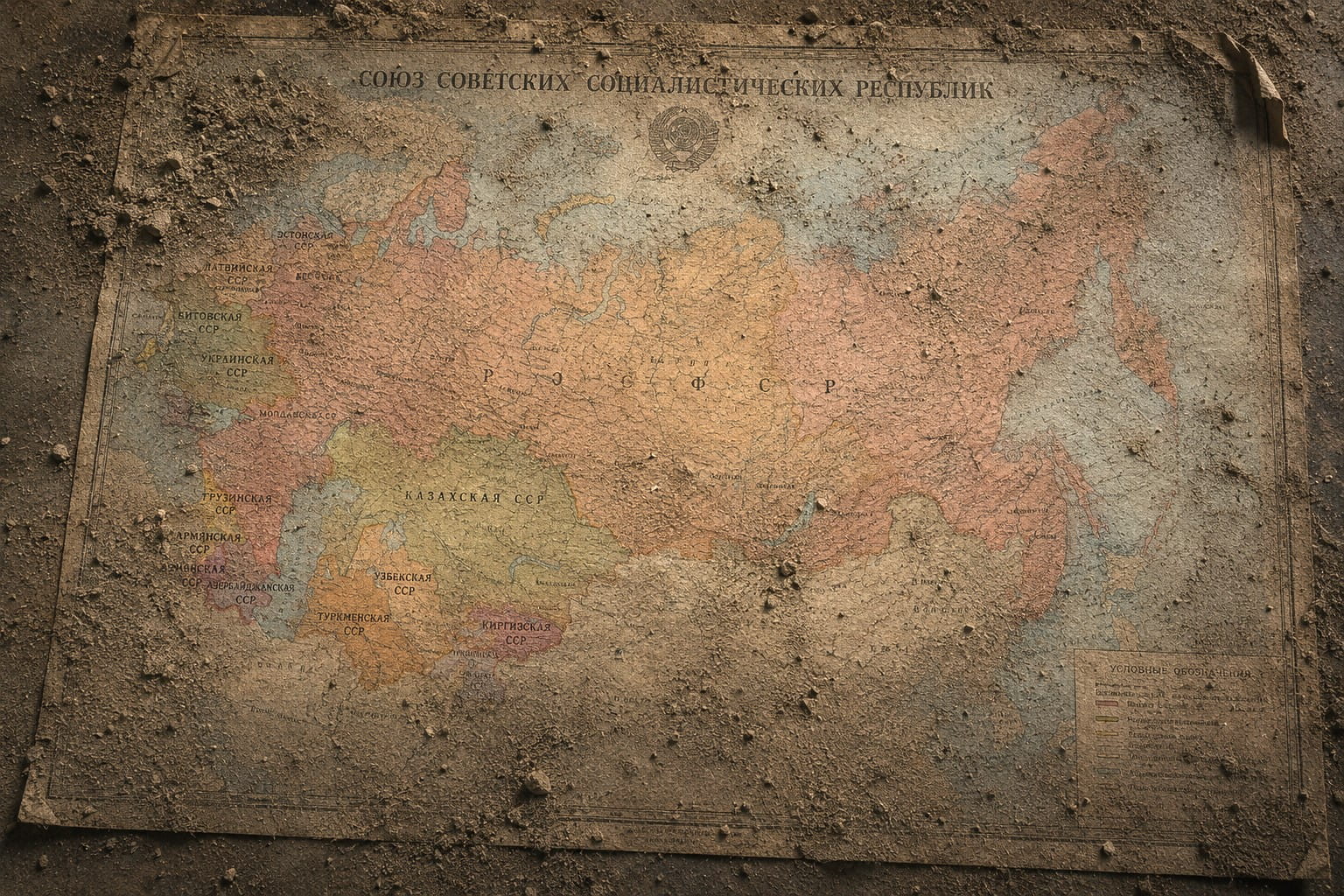
On December 8, 1991, three men met in a hunting lodge in the Belovezha Forest and signed a document dissolving the largest state on earth. Stanislav Shushkevich, Leonid Kravchuk, and Boris Yeltsin — the leaders of Belarus, Ukraine, and Russia — did not hold a referendum. They did not consult the populations of the twelve other republics whose futures they were deciding. The Soviet Union, they declared, had ceased to exist. The Commonwealth of Independent States would take its place.
That decision is now old enough to be assessed, not merely debated. More than three decades have passed — sufficient time to distinguish structural outcomes from transitional turbulence, to separate the consequences of dissolution from the noise of the initial shock. The question this paper asks is deceptively simple: Did the fifteen successor states benefit from the dissolution of the USSR, relative to the late Soviet baseline? The answer, as the evidence will show, is neither straightforwardly yes nor straightforwardly no. It depends, with remarkable precision, on geography, institutional anchors, and the historical accidents of elite decision-making in the early 1990s.
As a scholar working primarily on Iran and the Persian-speaking world, I approach this question with two comparative reference points that are rarely brought into conversation with post-Soviet studies. Iran is a multi-ethnic state — Persian, Azeri, Kurdish, Arab, Baluch — that has so far resisted fragmentation despite sustained internal pressures, international isolation, and a decade of revolutionary upheaval. Afghanistan, its eastern neighbour and a state with deep Persian cultural and linguistic roots, underwent complete governmental collapse and experienced ethnic warlordism of a severity unmatched elsewhere in the post-Cold War world, yet it preserved its territorial integrity — at the cost of Taliban rule. Neither country dissolved. Both are instructive.
The Belavezha Accords were a political choice, not a historical inevitability. Multi-ethnic federations do not automatically fragment when central authority weakens: the evidence of Iran and Afghanistan — to say nothing of India, Nigeria, or Indonesia — demonstrates that territorial disintegration is one possible outcome among several, not a structural destiny. This matters for the analysis that follows, because it means that the outcomes observed across the fifteen successor states cannot be attributed to the mere fact of Soviet ethnic diversity. They must be explained by the specific decisions made, the institutions built or abandoned, and the geopolitical affiliations chosen in the years after 1991.
The dissolution of the Soviet Union was preceded by a promise, implicit in the logic of market transition, that integration into the global economy would deliver prosperity. For some successor states, that promise was kept. For others, it has not been kept to this day.
The economic shock of the early 1990s was universal and severe. Between 1990 and 1995, GDP fell across all fifteen republics — a contraction that, in aggregate, exceeded the decline the United States experienced during the Great Depression. The causes were structural: the collapse of Gosplan severed inter-republican supply chains overnight, hyperinflation destroyed savings, and privatisation programmes transferred productive assets to politically connected insiders rather than creating competitive markets.
The three Baltic states — Estonia, Latvia, and Lithuania — pursued rapid institutional integration with the European Union. By 2023, Estonia’s GDP per capita at purchasing power parity stood at approximately $41,700 in current international dollars, Lithuania’s at $44,000, and Latvia’s at $36,000. From a late Soviet baseline of roughly $9,000–9,500 (PPP, 1990 Maddison estimates), the multiplication is approximately fourfold. This is not merely recovery from transitional shock; it represents genuine structural transformation.[1]
Russia presents a more complex picture. Its GDP per capita at PPP reached approximately $47,400 in 2024 — nominally the highest of any successor state. This figure requires significant qualification: Russian GDP since 2022 has been substantially inflated by wartime fiscal expenditure, military procurement, and sanctions-induced import substitution. Kazakhstan follows a broadly similar hydrocarbon-dependent pattern at a lower absolute level (~$32,000–34,000 PPP).
At the other end of the distribution, Tajikistan’s GDP per capita remains at approximately $4,500 PPP. Kyrgyzstan ($7,000) and Uzbekistan ($10,500) have recovered their Soviet-era baselines but have not surpassed them by any margin that would justify the human cost of transition. Moldova and Ukraine remain at $14,000–15,000 PPP — below the IMF global average of $22,452 in 2023.
Life expectancy tells a broadly consistent story with one significant exception. All fifteen successor states show improvement compared to the 1985–1987 baseline, with gains ranging from approximately two years (Georgia, Azerbaijan) to eight years (Estonia). This aggregate finding, however, conceals a dramatic mid-period collapse. Male life expectancy in Russia fell by nearly six years between 1991 and 1994 alone — driven by economic shock, the collapse of the public health system, and a catastrophic rise in alcohol-related mortality.15 The current Russian figure of approximately 73 years is therefore not a straightforward improvement on the Soviet baseline; it is a recovery from a man-made catastrophe.
One structural conclusion emerges clearly: the single strongest predictor of post-Soviet modernisation is not natural resource endowment, not initial income level, and not the speed of privatisation. It is institutional anchor. The three states that achieved binding integration with a rule-of-law supranational body — the European Union — are the three states that converted transitional shock into long-term structural development. Every other positive outlier can be explained more parsimoniously by commodity rents than by successful institutional reform.[2]
The Demographic Paradox
The economic and health data reviewed in the preceding section suggest a broadly positive post-Soviet trajectory. The demographic record tells a sharply different story — one that constitutes, arguably, the most consequential and least discussed legacy of the Soviet collapse.
Between 1990 and 2024, the combined population of the fifteen successor states fell from approximately 289 million to roughly 240 million — a net contraction of nearly fifty million people in the space of a single generation. This figure is without modern peacetime precedent. It exceeds the demographic losses of most twentieth-century wars, though through entirely different mechanisms: not mortality, but emigration and collapsing fertility.
The losses are not distributed evenly. Moldova has lost approximately 45 percent of its 1990 population — the most severe proportional contraction of any state in the world not experiencing active genocide or famine.18 Ukraine, which had a population of nearly 52 million at independence, recorded approximately 37.9 million residents in 2024 — a decline of some 27 percent that preceded, and therefore cannot be explained solely by, the full-scale Russian invasion of 2022.19 Georgia has lost roughly 32 percent of its population; Latvia 30 percent; Lithuania 22 percent; Armenia 14 percent.20
The Baltic states present a particular analytical challenge. Estonia, Latvia, and Lithuania have achieved the highest levels of economic development and political freedom in the post-Soviet space — and have simultaneously sustained some of its most severe demographic losses.21 Freedom of movement, in other words, produced population haemorrhage. The European Union simultaneously provided the institutional anchor for Baltic prosperity and the exit mechanism for its working population.
At the opposite end of the distribution, the five Central Asian successor states have all recorded substantial population growth since 1990. Uzbekistan’s population has increased by approximately 79 percent, from 20.3 million to 36.4 million; Tajikistan has effectively doubled.22 Azerbaijan, driven by high fertility rates and the reintegration of displaced persons from the Karabakh conflict zone, has grown by 43 percent. The post-Soviet demographic contraction is not a temporary transitional phenomenon. Fertility rates in the Baltic states, Ukraine, Moldova, and Georgia remain well below replacement level. The populations that departed in the 1990s and 2000s did not return.
The security achievements of several successor states deserve emphasis precisely because they tend to be overlooked. Estonia, Latvia, and Lithuania have maintained unbroken peace on their own territories since independence, despite sharing a border with Russia and having experienced Soviet military violence as recently as January 1991. Belarus and Kazakhstan have avoided armed conflict on their territories, though both states have used lethal force against domestic political protest — events that fall below the UCDP threshold but constitute serious episodes of state violence under any reasonable definition. The January 2022 unrest in Kazakhstan resulted in at least 238 deaths according to official government figures.
Turkmenistan occupies a singular position in this study — not as a representative case but as a methodological warning. Its inclusion in any comparative analysis of post-Soviet development requires explicit qualification, because the data on which such analysis depends are, in the Turkmen case, systematically unreliable.
The problem is structural. Turkmenistan has been governed since independence by a succession of personality cults of exceptional intensity: first under Saparmurat Niyazov (1991–2006), and subsequently under Gurbanguly Berdimuhamedow (2007–2022) and his son Serdar Berdimuhamedow (2022–present). In a state of this character, national statistics are instruments of political performance rather than empirical measurement. The IMF has repeatedly noted the absence of reliable national accounts data for Turkmenistan.The Fragile States Index 2024 assigns Turkmenistan a score of 70.3 out of 120 — placing it in the ‘Warning‘ category.
The Social Progress Index assigns Turkmenistan a score of 29.7 out of 100 — one of the lowest in the world. Turkmenistan holds the fourth-largest natural gas reserves in the world, yet this resource wealth does not translate into measurable human development gains. Turkmenistan thus illustrates, in extreme form, a broader limitation: the states most resistant to empirical scrutiny are precisely those where the human cost of post-Soviet development is most likely to be concealed.
To summarize
More than nine centuries ago, the Persian statesman and vizier Nizam al-Mulk observed that the collapse of political order rarely occurs instantaneously: when the foundations of power weaken, the realm does not fall in a single day — first the order dissolves, then the people scatter.[3] The post-Soviet experience suggests that this insight retains its force. The Soviet Union did not collapse on 8 December 1991. It collapsed across a decade of institutional decomposition, ethnic violence, and elite defection that began no later than 1988. The Belavezha Accords were a political choice — a ratification of disintegration already underway, not its cause.
The data reviewed across the preceding sections support three conclusions. First, post-Soviet development has produced genuine modernisation gains. Economic output has grown across virtually all fifteen successor states; life expectancy has increased in every case where reliable data exist; and three states have achieved levels of political freedom and institutional quality that compare favourably with the established democracies of Western Europe.
Second, those gains have been purchased at a demographic price that standard development metrics do not capture. The post-Soviet space has lost approximately fifty million people since 1990 — through emigration, declining fertility, and in some cases war. The states that achieved the most by conventional measures lost the most by demographic ones. The states that retained their populations did so largely by foreclosing the freedom of movement that drives emigration.
Third, the dissolution of the Soviet Union did not produce a single post-Soviet trajectory. It produced at least three — Liberal Prosperity, Authoritarian Stability, and Demographic Expansion — each internally coherent, each entailing trade-offs that its alternatives do not, and none of which can be declared the unambiguous winner of the post-imperial competition. The Baltic states achieved freedom and prosperity but are emptying. The Central Asian states are filling but remain poor and unfree. Russia achieved neither freedom nor demographic health, and its pursuit of imperial restoration has imposed costs on itself and its neighbours that will compound for generations.
The broader implication extends beyond the post-Soviet space. As debates about state fragmentation continue in the Middle East and elsewhere, the Soviet experience offers a sobering empirical baseline: the dissolution of a large multiethnic state does not automatically produce the conditions for human flourishing. It produces, instead, a distribution of outcomes whose long-term shape depends less on the act of dissolution itself than on the institutional choices — and the geopolitical opportunities — available to successor states in its aftermath.
Those opportunities, as the Baltic case makes clear, are not equally distributed. And that asymmetry is perhaps the most important lesson the post-Soviet experiment has to teach.
Dr. Gershon Kogan – orientalist, specializing in Iranian Studies
NOTES
[1] Baltic GDP data: World Bank NY.GDP.PCAP.PP.CD, cross-referenced with IMF WEO October 2024 (https://www.imf.org/en/Publications/WEO). 1990 Maddison estimates: Maddison Project Database 2023, University of Groningen, https://www.rug.nl/ggdc/historicaldevelopment/maddison/
[2] Anders Åslund, How Capitalism Was Built, 2nd ed. (Cambridge: Cambridge University Press, 2013), ch. 11.
[3] Nizam al-Mulk, Siyasatnama (The Book of Government), ed. and trans. Hubert Darke (London: Routledge, 2002). The formulation is a paraphrase capturing the argument’s substance.
* This article is a part of a yet-unpublished larger research report