
BESA Center Perspectives Paper No. 2,398, July 29, 2026
EXECUTIVE SUMMARY: Israel has had the technological and industrial wherewithal to manufacture its own fighter-bombers since the early 1970s—yet ever since the mid-1980s, Jerusalem has repeatedly passed up this option in favor of continuing to rely on the United States to fulfill the IAF’s manned aircraft requirements. In light of current trends in both Israel and the United States, Jerusalem must urgently revisit this approach. Israel needs to design and build its own fighter-bomber—a Lavi 2.0.
During the years before the 1973 Yom Kippur War, Israel Aircraft Industries (IAI)—later to be renamed Israel Aerospace Industries to reflect its growing involvement in space-related projects—delivered Nesher (Vulture) fighter-bombers to the Israel Air Force (IAF). A locally assembled derivative of the French Dassault Aviation Mirage V, the Nesher performed quite well in the war, particularly in the air superiority role. A couple of years after the Yom Kippur War, IAI began to manufacture Kfir (Lion Cub) fighter-bombers for the IAF. A significantly more sophisticated derivative of the Mirage V, the Kfir, too, turned out to be a successful aircraft whose later versions were even acquired by a few foreign air forces. In the mid-1980s, IAI built prototypes of the Lavi (Lion) fighter-bomber, an advanced aircraft specifically tailored to meet the IAF’s contemporary requirements. But then, in 1987, the Israeli government peremptorily canceled the Lavi program.
Since the early 1970s, then, Israel has possessed the technological and industrial wherewithal to produce high-quality fighter-bombers. Be that as it may, Jerusalem has consistently refrained from doing so ever since 1987. There are several reasons for this. First, the United States has provided the IAF with substantial numbers of advanced fighter-bombers over the years to maintain Israeli air superiority throughout the Middle East. Second, Washington has generally expressed opposition to the development of an advanced Israeli fighter-bomber, a reflection of the American aircraft industry’s fear that the existence of such an aircraft could negatively affect foreign sales of its own wares. And third, because the production of an advanced fighter-bomber has never been cheap, building one would have placed a great strain on the Israeli economy, certainly from the mid-1980s through at least the first decade of the 2000s.
While the decision to terminate the Lavi program was clearly correct under the prevailing circumstances of the mid-1980s, it is no longer prudent to eschew the production of an advanced “blue-and-white” fighter-bomber in today’s world, especially in light of recent trends in both Israel and the United States. Prime Minister Benjamin Netanyahu recently unveiled a prudent long-term plan to substantially expand Israel’s military-industrial base in order to significantly lessen the country’s dependence on foreign arms. But it appears thus far that this plan pertains primarily to the production of ancillary items like missiles, bombs, lasers, and a wide range of electronic and cyber warfare systems rather than to the production of weapons platforms like a fighter-bomber. Without advanced platforms, however, many of these ancillary items cannot be utilized to maximum effect. At the same time, the prime minister has expressed a desire to completely phase out American financial aid to Israel over the coming years, which would surely make the purchase of American fighter-bombers far more expensive down the road.
Moreover, if trends in American politics continue along their current trajectory, Israel might not even be permitted to purchase American fighter-bombers in the future. The traditional moderate liberals and moderate conservatives who have historically dominated American politics—and who have historically constituted one of the most important sources of support for Israel in the United States—are rapidly shrinking in both number and influence, and they are being increasingly replaced by radical left- and right-wing ideologues who are extremely hostile to Jews and Israel. That the Democratic Party has already been heavily subverted by such elements is strikingly revealed by recent congressional votes in both the Senate and House of Representatives in which large percentages of party members voted against military assistance to Israel. While the Republican Party is less antithetical to Jews and Israel at the moment, its radical wing, currently represented by Vice President J.D. Vance, could become ascendant over the coming years, which would certainly not be good news for Jerusalem. While such worrisome trends could eventually reverse themselves, Israel can no longer afford to count on the hope that the United States will return to its senses.
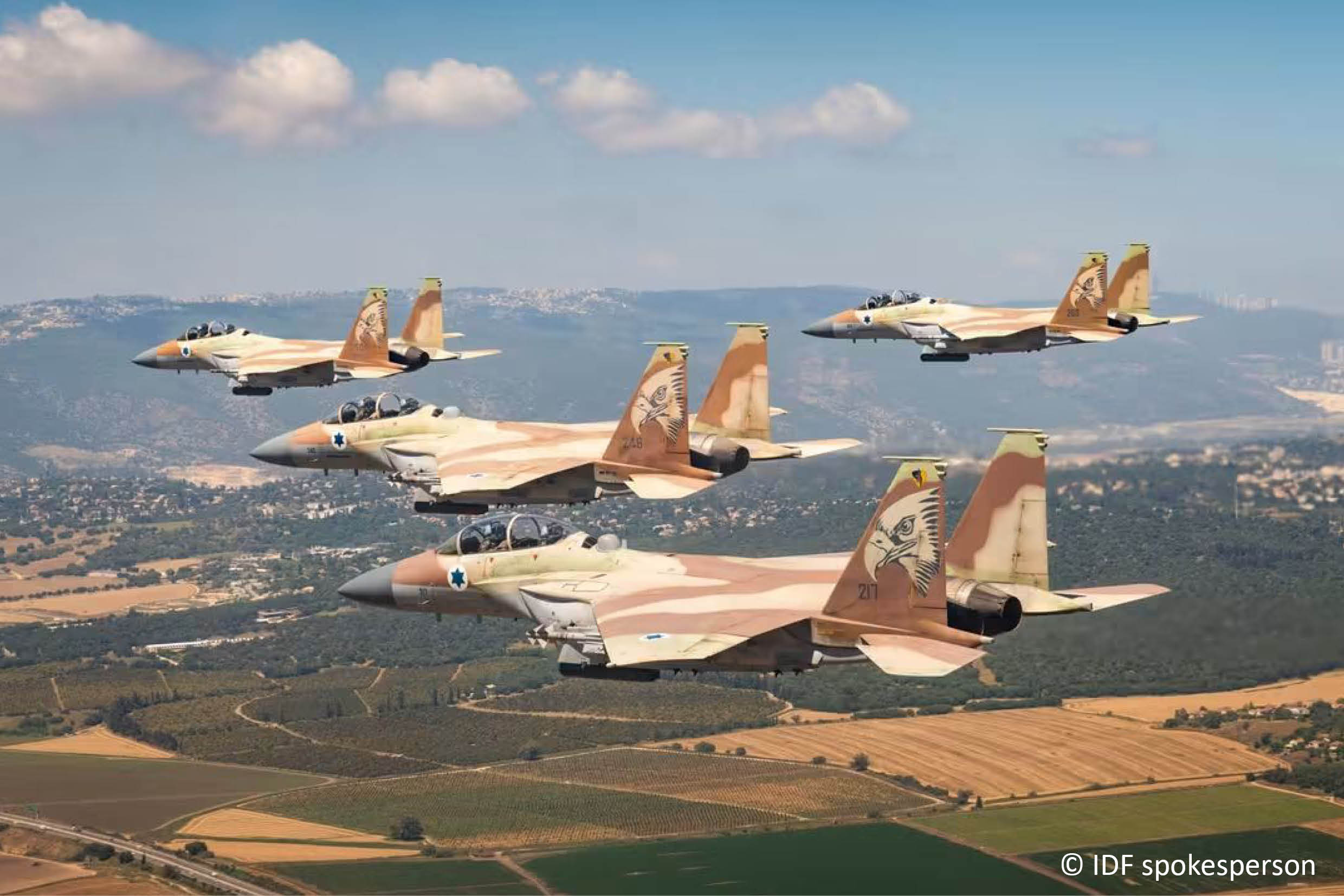
Given the tremendous expansion in size and sophistication of the Israeli economy over the past couple of decades, given the imperative that Israel reduce its dependence on foreign arms, and given the potential unreliability of the United States as a patron in future, it is incumbent upon Jerusalem to urgently consider producing an advanced fighter-bomber locally. Technologically, industrially, and economically speaking, Israel definitely possesses the capabilities to design and build such an aircraft. Indeed, Israeli defense companies already manufacture major components of the F-35 Lightning II stealth aircraft, including wings and pilot helmets. The designing and building of an airframe, engine, and all the other components that go into an advanced aircraft are well within the country’s reach. If specific components of an advanced fighter-bomber, such as the engine, are ultimately deemed too expensive or time-consuming to design and build from scratch in Israel, those components can be built in-country under license—if not from the United States or a European country, then from Russia or even China (so long as no restricted Israeli or American technology is compromised in the process).
Military and economic experts will, of course, raise all sorts of objections to the manufacture of an advanced blue-and-white fighter-bomber. A few of the more obvious ones can be briefly addressed here. First, they will argue that such an aircraft, no matter how advanced, would still be inferior in important respects to its American counterparts. Perhaps, but a blue-and-white fighter-bomber would certainly be advanced enough for the IAF to maintain air superiority throughout the Middle East, particularly when equipped with state-of-the-art Israeli-made electronics and ordnance. Second, they will contend that regardless of Washington’s policy toward Jerusalem in the future, the United States has already promised to provide Israel with additional F-35s, as well as upgraded F-15s, meeting the IAF’s fighter-bomber requirements for the foreseeable future. That may be the case, but Washington can easily wriggle out of even legally binding commitments to sell aircraft to Jerusalem. And third, they will argue that allocating money from the Israeli defense budget to design and build an advanced blue-and-white fighter-bomber would divert funds from other crucial domestic arms procurement programs, not to mention from the training and operational activities of the Israel Defense Forces (IDF). True, but Israel is now a wealthy country that can raise its defense budget to cover the additional cost of a fighter-bomber program without inflicting excessive harm on its economy or society.
To put it bluntly, Jerusalem needs to activate a “doomsday” plan to confront the very real prospect that the IAF could one day, in the not-too-distant future, find itself without access to an adequate supply of advanced fighter-bombers. The time to activate such a plan is now, not once disaster is already on the doorstep. Why not begin today to phase out the IAF’s current complete dependence on the United States for advanced fighter-bombers by moving ahead with the design and manufacture of a similar blue-and-white aircraft, a Lavi 2.0 so to speak?
David Rodman is an independent defense analyst whose most recent book is Israel’s National Security Predicament: Guarding the Third Temple.
BESA Center publications and research are made possible
thanks to the generosity of Saul Koschitzky and family