
PSCRP-BESA Reports No 229 (September 9, 2026)
The government of Armenian Prime Minister Nikol Pashinyan has stepped up efforts to involve Central Asian countries in the “Trump Route for International Peace and Prosperity” (TRIPP). Kyrgyzstan and Kazakhstan have expressed cautious interest in the project, Radio Free Europe/Radio Liberty reports.
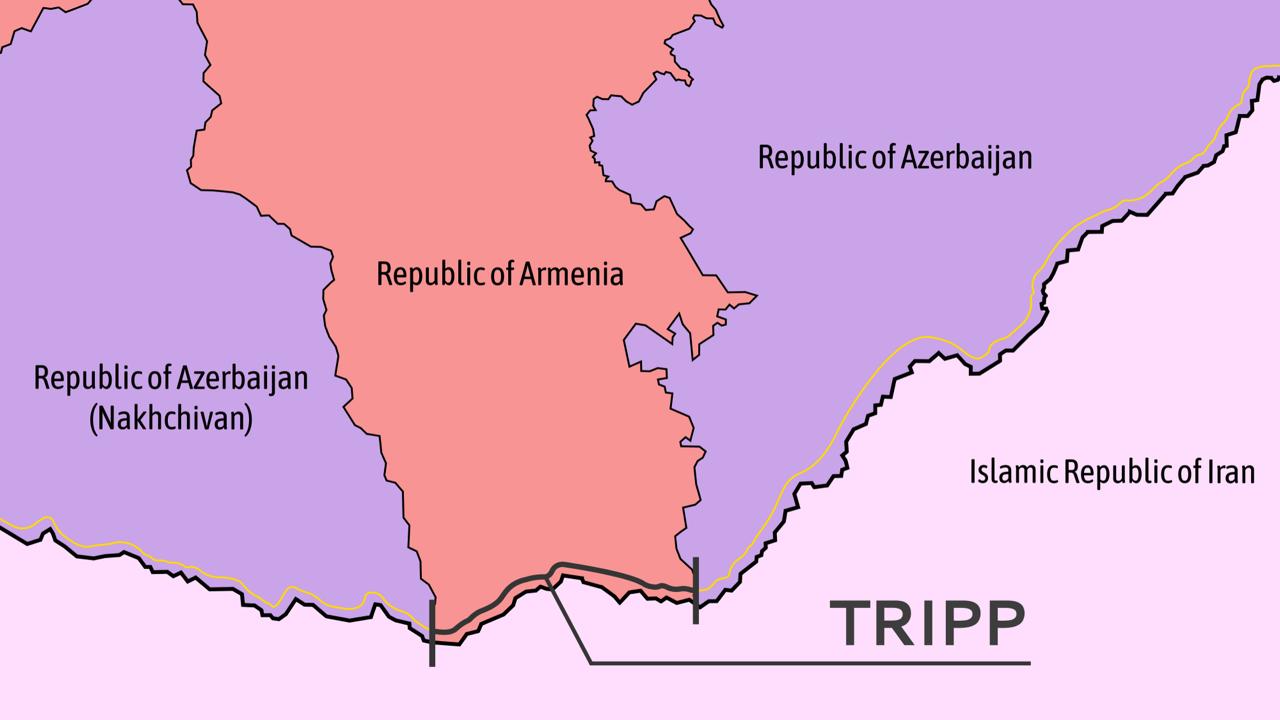
TRIPP is a 43-kilometer transport corridor that will run through Armenian territory along the Iranian border and connect the two parts of Azerbaijan. The corridor is expected to include roads and railways, pipelines, power transmission lines, and fiber-optic cables.
The route is ultimately expected to become an important link in the Middle Corridor, which connects China with Europe through Central Asia and the South Caucasus. This 6,500-kilometer multimodal transport and transit corridor bypasses Russia, and its importance has increased sharply in light of Russia’s war against Ukraine and instability in the Middle East.
The creation of a corridor in the South Caucasus is envisaged by the peace agreement between Baku and Yerevan. Russia and Iran, however, are strongly opposed to it. Nevertheless, the Armenian government continues to work actively to advance the project. Armenia’s ambassador to the United States, Narek Mkrtchyan, said that research work should be completed by the end of 2026. In early September, U.S. and Armenian officials visited Syunik Province, where the corridor is expected to run, to review the progress of technical work.
Ahead of the SCO summit in Bishkek, Armenia offered Kazakhstan and Kyrgyzstan 5 percentage points each from its 26 percent stake in TRIPP, according to Kyrgyz media. In other words, the two Central Asian countries would become not merely partners but shareholders in the project.
At the same time, Armenian Prime Minister Nikol Pashinyan discussed with Kazakh President Kassym-Jomart Tokayev the possible transfer of Armenia’s railway network to the management of a Kazakh company instead of a Russian one.
Both Kyrgyzstan and Kazakhstan are reportedly interested in the project and hope to connect their railway networks with those of the South Caucasus in order to facilitate the transportation of goods to Europe. Some commentators have proposed continuing negotiations with Armenia and raising specific questions about the benefits of participating in TRIPP as shareholders. As landlocked countries, they are interested in unrestricted access to corridors that expand their export opportunities.
Other commentators point out that Kazakhstan’s and Kyrgyzstan’s participation in the project would contribute to stability in the South Caucasus, which has long been a zone of conflict. The possibility of transferring management of Armenia’s railway network to the Kazakh side should also be viewed in this context, since Astana maintains normal relations with Russia and Moscow should not categorically oppose such an initiative.
At the same time, at the official level both Kyrgyzstan and Kazakhstan have so far refrained from making unequivocal statements about their willingness to participate in TRIPP, most likely in order to avoid antagonizing Russia. Experts commenting on the project have reached this conclusion. Russia is unhappy that 74% of TRIPP will remain in U.S. hands and that American military personnel could potentially be involved in providing security for the corridor.
Against this backdrop, Russia continues to exert strong pressure on Armenia. Significant trade and economic restrictions have already been imposed. As Konstantin Zatulin, deputy chairman of the Russian State Duma Committee on CIS Affairs, has stated, these restrictions will not be lifted as long as Prime Minister Nikol Pashinyan’s government remains in power. Moreover, Russian media suggest that the pressure will intensify and that new measures will follow, including restrictions on money transfers between the two countries, reduced transport links, higher energy prices, further cuts in imports of Armenian products, and the deportation of Armenian citizens working in Russia.
Russia is not the only opponent of the “Trump Route.” Iran, Armenia and Azerbaijan’s southern neighbor, recently demanded that security for the TRIPP project on Armenian territory be provided exclusively by the Armenian Armed Forces or by the armed forces of a third country already present in Armenia — that is, Russia. News.am reports this, citing its own sources.
According to the outlet, Tehran is seeking in this way to prevent the deployment of U.S. military personnel near its border. The Iranian authorities fear that, if American forces are deployed there, Tehran could regard them as potential military targets amid continuing tensions with the United States.
Thus, as we can see, the Central Asian countries are prepared to support the corridor project in the South Caucasus because its economic benefits are evident, but they fear a sharp reaction from Russia and, to a lesser extent, Iran. The elites of these countries do not want to openly challenge the Kremlin, their long-standing partner, or take steps that Moscow could interpret as hostile. Russia is already exerting very strong economic and political pressure on Armenia, while the experience of the war in Ukraine shows that the Russian leadership may be prepared to go even further. Yet trade and economic sanctions alone could be sufficient to destabilize Central Asian states.
Consequently, for TRIPP to advance successfully, these countries need to be provided with security guarantees. The states of the region must be confident that participation in Trump’s initiative will not harm their interests. The United States and its Western partners must avoid repeating the mistakes made in relation to Georgia and genuinely stand behind the countries of Central Asia and the South Caucasus.