PSCRP-BESA Reports No 241 (October 21, 2026)
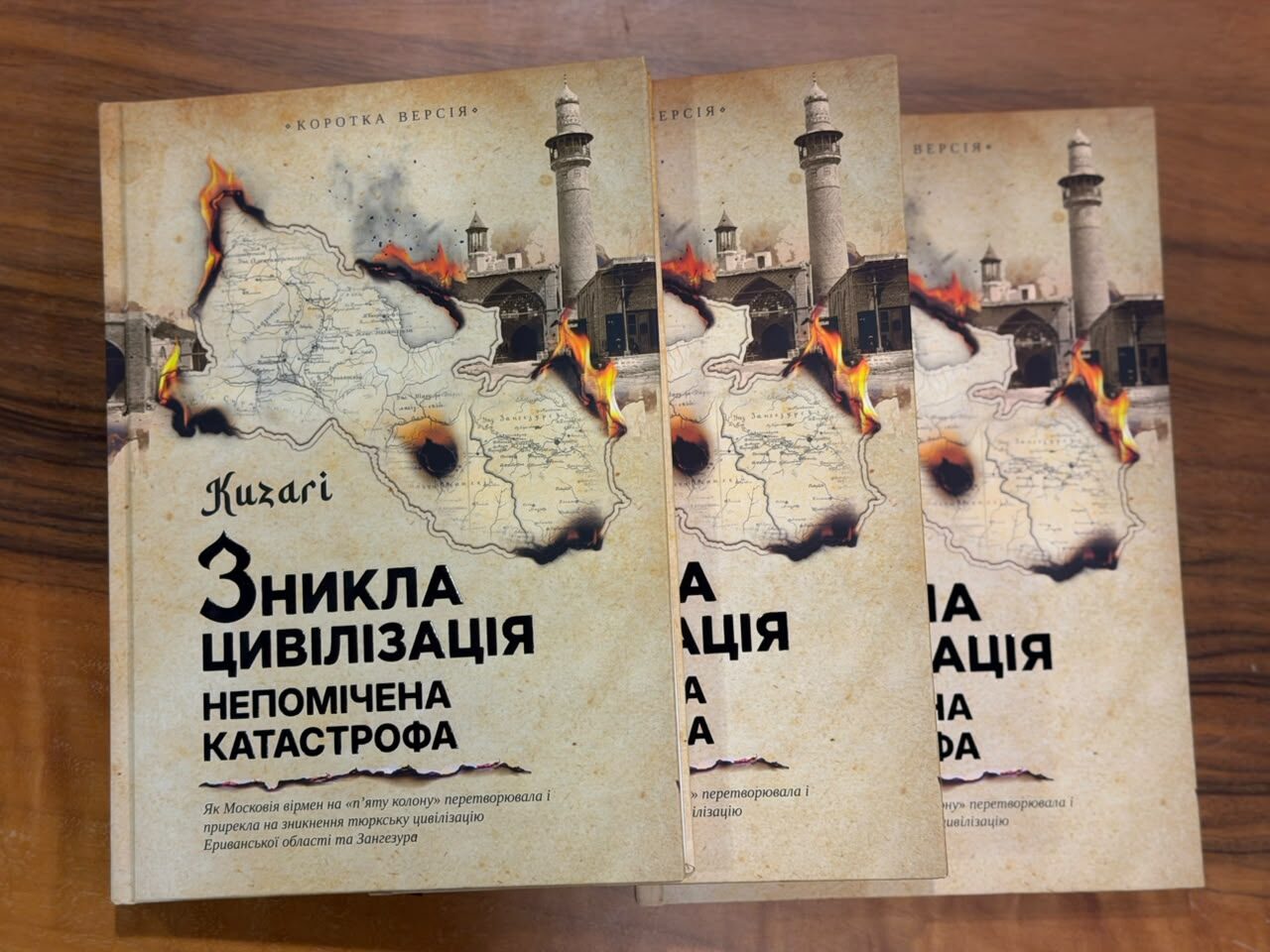
In September 2026, the book “Znykla tsyvilizatsiia — nepomichena katastrofa” (Perished Civilization — An Overlooked Catastrophe) by a Ukrainian historian writing under the pseudonym Kuzari was published in Ukraine by the Kyiv-based publishing house Zaliznyi Tato. News of its publication emerged on September 19. On the same day, a presentation and discussion of the book, organized as part of the Book Country Days, was scheduled to take place at the Readeat bookstore in Kyiv, featuring historian Olena Liapina and writer Oleh Kryshtopa. The 144-page publication is an abridged version of a considerably more extensive historical and documentary study examining the disappearance of the Turkic population of the Erivan Governorate and Zangezur, as well as the role of Russian imperial policy in reshaping the ethnic landscape of the South Caucasus.
The book’s publication is noteworthy for both its subject matter and the circumstances of its release. The Ukrainian researcher addresses one of the most painful and politically sensitive chapters in the history of Armenian-Azerbaijani relations, proposing that it be examined within the broader context of Moscow’s centuries-long expansion. At the same time, the author conceals his identity, uses an unusual philosophical pseudonym, and bases his research on an extensive body of historical documents and testimonies.
What readers encounter is a work that goes beyond conventional historical commentary. It is an attempt to reconstruct the fate of an entire cultural community while explaining the mechanisms through which imperial policies transformed the ethnic, demographic, and cultural structure of a vast region.
A History Told Through Documents
Perhaps the greatest strength of Kuzari’s research lies in its approach to historical sources. The author’s project shows that the whole study covers 1,765 historical sources that cover several centuries. These include documents from the Russian Empire and the Soviet period, state archival materials, diplomatic accounts, eyewitness memoirs, and historical works by Armenian authors and European scholars.
Of particular significance is the methodological principle that the author states: he consciously excludes Azerbaijani and Turkish sources from the main body of evidence, preferring to use documents of the Russian imperial and Soviet periods, the writings of Armenian historians, and the materials of French and British diplomatic archives. Thus, in reconstructing the history of the Turkic population of the South Caucasus, Kuzari primarily draws on Russian and Armenian sources representing parties historically opposed to Azerbaijanis, as well as documents produced by European observers who were not directly involved in the regional conflict.
This choice carries not only scholarly significance but also an obvious polemical dimension. When the existence of Turkic settlements, changes in the ethnic composition of the population, resettlements, and other historical developments are documented in Russian administrative reports, Armenian historical writings, or European diplomatic correspondence, such evidence acquires particular weight.
Rather than simply setting one national interpretation of history against another, Kuzari seeks to use documents whose origins make it difficult to automatically categorize them as part of the Azerbaijani historiographical tradition. The origin of a source does not, in itself, guarantee the objectivity of its interpretation. Russian officials, Soviet statisticians, diplomats, and participants in national movements also held their own political views and prejudices. Nevertheless, comparing their accounts makes it possible to raise questions that are considerably more difficult to address through familiar ideological formulas. This approach is precisely what distinguishes the work: Kuzari attempts to conduct a historical debate not so much through contemporary political statements as through the documentary record of the past.
The Disappearance of a People and the Erasure of Memory
The central theme of the book is the fate of the predominantly Muslim Turkic population of territories that today form part of the Republic of Armenia.
The author traces historical processes that, according to his interpretation, led to the gradual displacement of this community, the destruction of its cultural environment, and its effective disappearance from the region by the end of the twentieth century.
Yet Kuzari’s interest extends beyond demographics. His research also examines the disappearance of the material and symbolic traces of human presence.
In this context, historical place names, cemeteries, mosques, gravestones, building ruins, ancient routes, and testimonies from people who have preserved memories of their ancestral homes acquire particular significance.
The research project includes materials from field expeditions, photographic and video documentation of historical sites, and comparisons between historical toponyms and modern geography. A separate component consists of nearly fifty video interviews with eyewitnesses and descendants of displaced people, recorded in Azerbaijan, Georgia, and Turkey.
This gives the research an additional human dimension.
Statistics can document a population decline, while an archival record can confirm a resettlement or administrative decision. But the testimony of someone who remembers the name of their native village, the location of a family cemetery, or the circumstances of their expulsion allows us to recognize the individual lives behind historical processes.
At the same time, oral history requires the same critical scrutiny as written documents. Memories can change, and family narratives can acquire new meanings. What makes these interviews particularly valuable, therefore, is not merely their existence but the possibility of comparing them with archival records and geographical evidence.
One of the book’s most compelling questions concerns the boundary between the physical disappearance of a cultural community and the erasure of its memory.
A building can be demolished, a settlement renamed, and an administrative map redrawn. But is it possible to completely erase a people’s historical presence when traces of it survive in documents, geographical names, and personal recollections? It is this question that gives the book significance extending far beyond the specific conflict in the Caucasus.
Moscow as the Central Actor
Although the study focuses on the territory of present-day Armenia, Russia emerges as its principal political and historical subject. Kuzari proposes examining the tragic chapters in the history of the Caucasus’s Turkic population not exclusively as consequences of the Armenian-Azerbaijani confrontation, but as the result of prolonged imperial policies under which relations between peoples became an instrument for consolidating the authority of the central state.
In the author’s interpretation, resettlements, administrative reforms, changes in the demographic balance, and the exploitation of interethnic tensions constituted interconnected mechanisms of regional control. The study covers not only the Russian imperial period but also the Soviet era, including deportations, changes to administrative boundaries, and shifts in nationality policy.
A distinctive feature of this approach is its attempt to trace the continuity of methods of governance across changes in political regimes. Rather than focusing on individual rulers or ideologies, the narrative examines the mechanisms through which ethnic territories were administered and controlled. Admittedly, the proposition that Moscow pursued a single, consistently implemented strategy over several centuries requires particularly rigorous substantiation. There were substantial differences between the policies of the nineteenth-century tsarist government, the decisions of the Bolsheviks in the early twentieth century, and the actions of the late Soviet leadership.
The existence of similar practices does not, by itself, prove the existence of a continuous, centrally coordinated plan.
Nevertheless, the question Kuzari raises deserves attention: to what extent were ethnic conflicts on the peripheries of empires the result of naturally emerging tensions, and to what extent were those tensions created or intensified by imperial policies themselves?
It is this framing that makes the book particularly relevant to Ukrainian readers, who increasingly examine the history of Eastern Europe and the Caucasus through the lens of Russia’s colonial legacy.
Who Is Behind the Name Kuzari?
The identity of the author is no less intriguing than the content of his research.
Kuzari is presented as a Ukrainian historian, but his real name has not been publicly disclosed. Such anonymity is unusual for a scholarly work that seeks to challenge established historical interpretations.
It inevitably raises questions about the researcher’s professional background, academic training, access to sources, and the circumstances in which the study was produced.
At the same time, the scale of the project is genuinely impressive.
According to information released by the project itself, the collection of materials began in 2021, with dozens of assistants from eight countries contributing to the effort. Research was conducted in archives and libraries, as well as on the ground in the Caucasus.
Such an undertaking requires substantial organizational resources, familiarity with archival research, a command of historical terminology, and the ability to work with materials in multiple languages.
Particularly revealing is the attention devoted to often-overlooked details: historical microtoponymy, changes in administrative and territorial divisions, resettlement routes, the locations of vanished settlements, and material traces of earlier cultural life.
These features suggest a project developed with the involvement of specialists possessing extensive knowledge of the Caucasus.
However, it would be inappropriate to conclude, solely on the basis of the archives consulted, that the anonymous author personally knows all the relevant languages, independently examined every document, or has experience working with restricted state archival collections. The project itself acknowledges collective assistance in locating materials, which helps explain much of the research’s considerable scope.
The author’s anonymity has also given rise to more speculative theories, including suggestions of possible support from government agencies, political institutions, or intelligence services.
Such hypotheses are based on the financial and organizational complexity of the research, its political orientation, the alignment of certain conclusions with the interests of Azerbaijan and Ukraine, and the choice of a publisher whose catalogue includes politically charged and military-historical literature.
However, there is no convincing publicly available evidence that Ukrainian or Azerbaijani government institutions, much less intelligence agencies, were involved in producing the book.
Such theories should therefore be regarded strictly as speculation rather than established fact.
A more important question is whether the publicly available documentary evidence allows the author’s conclusions to be independently verified, regardless of who is behind the pseudonym.
In this respect, the decision to make the research materials publicly accessible is particularly significant. Readers are invited to assess not only the researcher’s authority but also the evidence he presents.
Why Kuzari?
The author’s pseudonym deserves separate consideration. The name Kuzari inevitably evokes the famous philosophical work of the medieval Jewish thinker Judah Halevi, The Kuzari, also known as The Book of Refutation and Proof on Behalf of the Despised Religion. Written in the twelfth century, the work explores questions of religious truth, historical memory, and the spiritual choices of a Khazar ruler. One of its central themes is the possibility of defending the beliefs and historical experience of a community that lacks political dominance.
It cannot be asserted that the Ukrainian historian deliberately chose his pseudonym for this reason: there is no publicly confirmed explanation from the author establishing such a connection.
Nevertheless, the intellectual parallel is intriguing. Like the medieval philosophical work, Kuzari’s contemporary book centers on defending the historical memory of a community whose past, in the author’s view, has been marginalized within the dominant historical narrative. A similarity can also be identified in their approaches to argumentation.
While Judah Halevi drew upon historical experience as a fundamental basis for his reasoning, the contemporary Kuzari seeks to challenge established political narratives through documentary evidence. There is, however, a fundamental difference between the two works. The medieval Kuzari is a philosophical and religious defense of faith, whereas the contemporary study claims the status of a historical reconstruction grounded in documentary evidence.
The book’s subtitle, An Overlooked Catastrophe, is also noteworthy. The very word “catastrophe,” when used in the context of the destruction or disappearance of a human community, inevitably evokes associations with European cultures of remembrance, including the concept of the Shoah.
However, the possibility of such an association does not necessarily mean that the author intentionally draws a direct historical parallel between the Holocaust and the fate of the Caucasus’s Turkic population.
From a scholarly perspective, such a comparison would require separate justification.
Nevertheless, the chosen terminology demonstrates the author’s intention to move the tragedy under examination beyond the confines of a local national dispute and present it as a question of universal historical memory.
The Book in the Context of Contemporary Politics
The publication of this study in Ukraine in 2026 cannot be considered independently of the prevailing political circumstances.
The Russia-Ukraine war has substantially intensified Ukrainian society’s interest in the history of Russian expansion, colonial practices, and national movements in territories formerly belonging to the Russian Empire and the Soviet Union.
Against this backdrop, Kuzari’s book fits naturally into a broader intellectual debate about Moscow’s role in shaping interethnic conflicts.
Significantly, the publication is presented in Ukraine not merely as a study of South Caucasian history, but also as an attempt to understand the universal mechanisms of imperial power.
However, the book’s contemporary political relevance also creates potential difficulties for its academic reception.
In Azerbaijan, the study’s central arguments resonate with the concept of the historical presence of Azerbaijanis in the territory of present-day Armenia, a concept that has come to be known in political discourse as “Western Azerbaijan.”
In Armenia, such an approach inevitably touches upon sensitive questions of national history, territorial belonging, and historical legitimacy.
Consequently, the study occupies a space in which scholarly analysis is difficult to separate entirely from contemporary political disputes.
This is simultaneously the source of its public significance and its vulnerability.
On the one hand, the book draws attention to historical evidence that deserves examination and discussion. On the other, its central conclusions need to be compared with scholarship representing alternative historiographical perspectives, including studies of the history of the Armenian population, its own tragedies, deportations, and experiences of violence.
It is especially important to ensure that criticism of imperial policies does not turn into collective accusations against an entire people.
Historical responsibility borne by specific political forces, state institutions, and participants in events must not be replaced by the notion of collective ethnic guilt.
Ultimately, the scholarly credibility of such research will depend on its willingness to acknowledge the complexity of regional history rather than relying exclusively on documents that support a single interpretation.
Strengths and Limitations of the Research
Among the clear strengths of Kuzari’s project are the scale of the collected materials, its emphasis on documentary evidence, its combination of written sources with oral history, and its attempt to connect demographic developments with transformations of the cultural landscape.
Equally important is the opportunity for readers to examine the underlying sources openly.
The complete version of the study and its accompanying materials are available online. This allows readers to go beyond the abridged Ukrainian edition and consult more extensive arguments and documentary evidence.
At the same time, the 144-page book published in Kyiv represents only a condensed account of a much larger body of research.
It should therefore not automatically be regarded as a comprehensive presentation of the entire evidentiary base. Some quotations, footnotes, comparative analyses, and supplementary materials inevitably fall outside the scope of the printed text.
This is particularly important when assessing the author’s most far-reaching conclusions.
When a researcher speaks not merely of resettlements, demographic changes, or the destruction of cultural sites, but of a systematic policy aimed at eliminating an entire civilization, the causal relationships involved require rigorous substantiation.
A distinction must be made between documented historical events, their possible motivations, and the overarching historical interpretation that connects them into a single narrative.
An extensive bibliography does not, in itself, relieve the author of the need for such scrutiny.
Nevertheless, it is precisely the openness of the sources and the possibility of substantive debate that make this research worthy of serious attention.
Concluding Reflections
Perished Civilization — An Overlooked Catastrophe is a book that is difficult to regard as an ordinary historical publication.
It addresses the disappearance of an entire cultural world, raises questions about the role of imperial policies in shaping the destinies of the peoples of the South Caucasus, and proposes reexamining familiar historical events through an extensive body of archival documents and testimonies.
At the same time, its publication demonstrates how closely historical scholarship, national memory, and international politics have become intertwined.
An anonymous author, an unusual philosophical pseudonym, a research network spanning several countries, numerous archival documents, field expeditions, and eyewitness testimonies give the project the character of an almost detective-like historical investigation.
Yet the book’s central mystery is not the identity of Kuzari.
Far more important is the question he poses: how does a people disappear from a territory where its settlements, culture, and historical memory existed for centuries, and what roles do state power, demographic policy, and the subsequent reinterpretation of the past play in that process?
The answers offered by the author may inspire agreement, skepticism, or fundamental objections. They require independent scholarly verification and open professional debate.
Nevertheless, the very fact that the study draws upon documentary records, eyewitness testimonies, and material traces of a perished cultural environment makes it a noteworthy contribution to contemporary historical writing.
Ultimately, the value of Kuzari’s research should be judged not by how closely it aligns with the political interests of any particular country, but by how convincingly it helps reconstruct the complex, tragic, and often contradictory history of the peoples of the South Caucasus.
And if the book encourages historians from different countries to explore previously understudied archives, critically compare historical accounts, and initiate a substantive discussion about the fate of perished communities, that alone will constitute an important achievement of its publication.