PSCRP-BESA Reports No 245 (October 24, 2026)
by PSCRP team
Secretary of State Marco Rubio’s visit to Samarkand, with a large business delegation behind him, shows how highly Washington now rates Central Asia. A region that Moscow long treated as its own preserve is drifting out of the Russian orbit, and the United States has moved in with minerals, transit routes, and a partner at the western end of the Caspian.
A Secretary of State Arrives with His Business Community
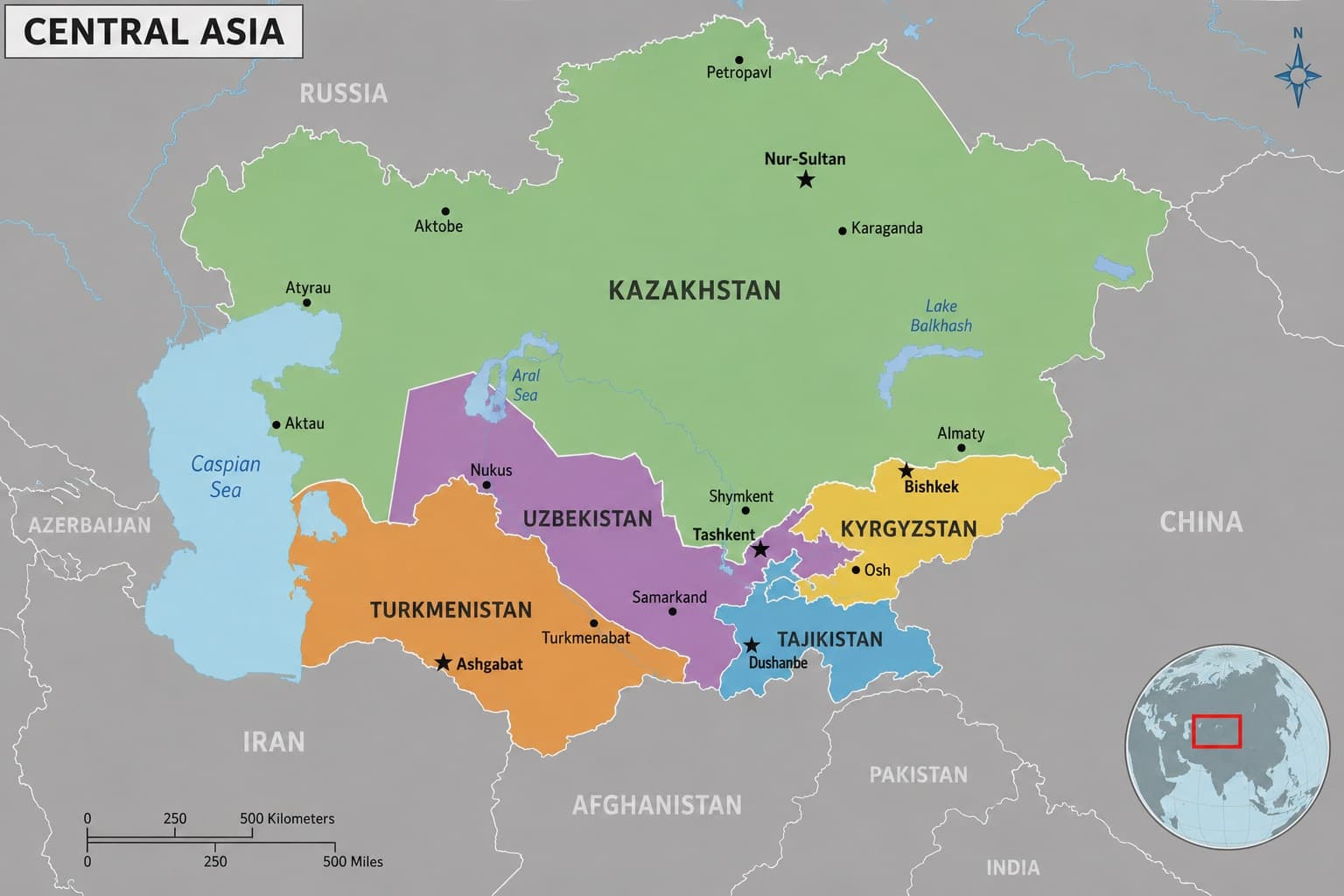
Rubio landed in Samarkand on October 18 for a C5+1 ministerial meeting with the foreign ministers of Kazakhstan, Kyrgyzstan, Tajikistan, Turkmenistan, and Uzbekistan, and he came with more than 200 American business leaders. Asked why he was spending time on Central Asia while several international crises demand attention, he replied that it is an important relationship and one Washington wants to build. The November 2025 summit in Washington had already produced more than $25 billion in announced agreements and commitments, many of them at an early stage of development, and the Samarkand delegation suggests that the administration intends to turn those pledges into projects.
The substance of the talks points in the same direction. The joint statement backed investment in the Trans-Caspian route, which media describe as a link between Central Asia and European markets through the Caspian Sea, the South Caucasus, and Turkey that bypasses Russia. A secretary of state who endorses a trade corridor designed to avoid Russian territory, in the company of the region’s five foreign ministers, signals that Central Asia is leaving Moscow’s orbit and that Washington has noticed.
Vladimir Pastukhov reads the visit in just this way. He is a political scientist and lawyer who has lived in London since 2008, according to University College London, and Jamestown records that he once served as counsel to the Russian Constitutional Court, the State Duma, and the Moscow mayor’s office, which gives him a close acquaintance with the habits of Russian officialdom. In a Telegram post, a format that lets him be terser and more figurative than in his academic writing, he proposes with evident irony that advocates of Russian decolonization canonize Vladimir Putin, since no tsar or Bolshevik did more to dismantle the Russian-Soviet imperial space. By his account the war in Ukraine first cost Moscow its soft power in Eastern Europe, then nearly the entire South Caucasus, and now Central Asia. China moved first, gathering the region’s leaders in Xi’an, and the Americans followed once they saw what he calls ownerless property drifting toward Beijing. The Kremlin, he adds, has no attention to spare, because it is stuck in the autumn mud of southern Ukraine.
One Side’s Loss, Another’s Treasure
What Russia is leaving behind is worth having. Kazakhstan produced 25,839 metric tons of uranium in 2025, roughly 40 percent of world output, according to the World Nuclear Association. The same country hosts the Northern Katpar and Upper Kairakty tungsten deposits, which their American developer describes as among the largest undeveloped tungsten resources in the world. Fastmarkets reports that the US Export-Import Bank has issued a letter of interest for up to $900 million of the estimated $1.1 billion in capital costs, that the United States has not mined tungsten since 2015, and that China accounted for more than 80 percent of global mine output in 2024.
Rare earths receive the most attention in official rhetoric. An analysis first published by Carnegie Politika records that President Tokayev has called them the “new oil” and that President Mirziyoyev has announced rare earth projects worth $500 million. The same analysis puts China’s share of global critical mineral production at 60 percent and of processing capacity at more than 85 percent, and it adds that Tajikistan, which has rich antimony reserves, sends 78 percent of its output to China for processing. Washington’s interest in the region therefore reflects a wish to loosen a dependence on Beijing that has become a strategic vulnerability, and uranium, tungsten, antimony, and rare earths give that wish a concrete address.
CSIS cautions that the region’s mineral exports remain oriented toward China and Russia, that shipments to Western markets still depend on Russian rail and maritime infrastructure, and that power shortages inherited from the Soviet period limit production and processing. Resources in the ground will matter only once a route to market exists, and that requirement leads to the Caspian.
The Caspian Gateway and the Axis With Baku
Every shipment on the Trans-Caspian route must cross Azerbaijan, which is why Washington’s recent courtship of Baku fits so naturally with its Central Asian agenda. In August 2025 President Trump waived Section 907 of the Freedom Support Act, which had barred direct American military assistance to Azerbaijan since the first Karabakh war, at the White House meeting that also launched the Trump Route for International Peace and Prosperity across southern Armenia, according to CEPA. That analysis expects Russia and Iran to resist the corridor’s success.
Vice President Vance followed in February 2026 by signing a Charter on Strategic Partnership with President Aliyev in Baku and announcing the delivery of American patrol boats, as OC Media reported. Minerals mined in Kazakhstan and Uzbekistan thus have a prospective route to Western buyers through a partner that Washington has spent a year cultivating, which gives the axis between Central Asia and Azerbaijan a clear logic. Its weak point is physical capacity, since OilPrice notes that the corridor remains constrained by port capacity, rail interoperability, customs delays, and tariff stacking.
Competing With China, Leaving Russia Behind
The contest that is taking shape in Central Asia has two principal contenders. China holds the processing capacity and the proximity, and the United States brings capital, technology, and a stated willingness to underwrite new routes. Rubio’s statement that Washington was not asking anyone to stop talking to other countries reads as an acknowledgment that Central Asian governments will continue to trade with several partners and that the United States must win business on its merits.
Russia no longer sets the terms. What remains of its position, including the reliance of Central Asian exporters on Russian rail and Kazatomprom’s 25 percent share in Russia’s Novouralsk enrichment plant, consists of vestiges of a past influence. Whether Washington can match its announcements with finished mines, refineries, and railways will decide how durable its new position proves, and the outcome will be settled between American and Chinese capital, with Moscow watching from the sidelines.