
PSCRP-BESA Reports No 249 (November 10, 2026)
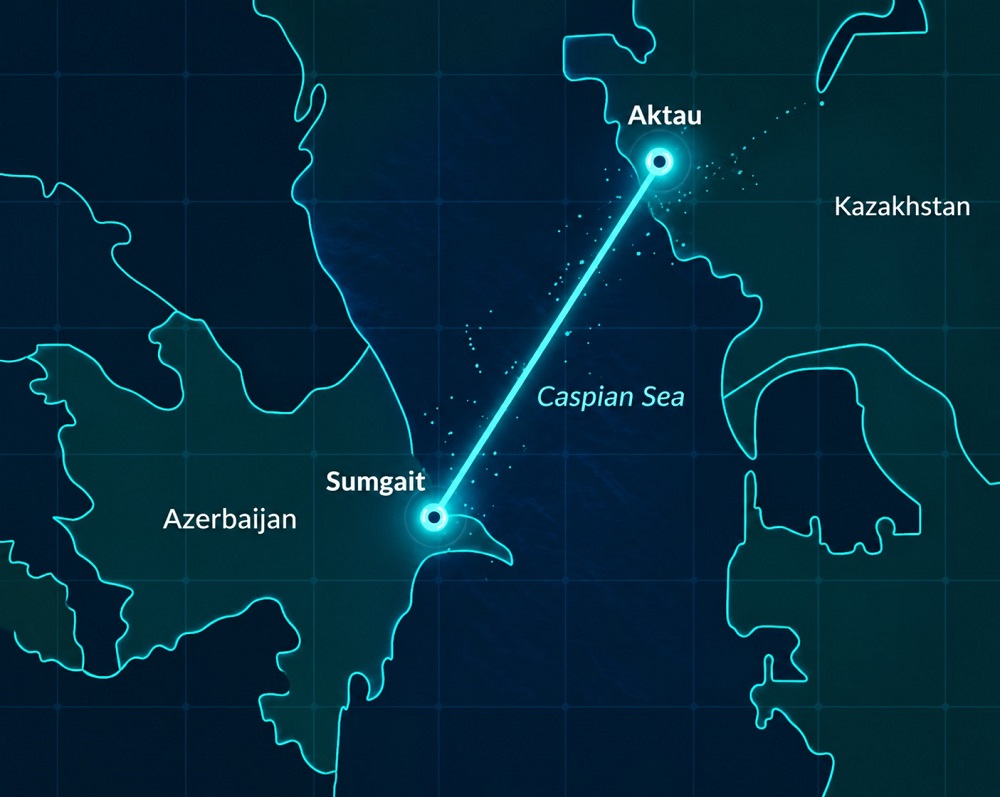
When the presidents of Kazakhstan and Azerbaijan inaugurated a 380-kilometer fiber-optic cable beneath the Caspian Sea on October 15, they opened the first fiber-optic link across the Caspian seabed. Designed for a capacity of at least 400 terabits per second, the cable matters chiefly because it creates an alternative: data moving between Central Asia and Europe can now take a westbound route that avoids Russian networks. Kazakhstan gains an additional international connection, and Azerbaijan strengthens its role as a transit hub. Uzbekistan and Kyrgyzstan, which depend on Kazakhstan for international connectivity, stand to gain indirectly, and carriers and cloud providers gain another potential route between Asia and Europe. How far these gains extend will depend on how much traffic the link comes to carry.
A Region Built Around One Gateway
Geography has long dictated how Central Asia reaches the global internet. The region is landlocked, and the Internet Society describes it as heavily dependent on connectivity from Russia, with backbone fiber interconnected with Russian networks through several border crossings. The Times of Central Asia, summarizing the society’s 2025 report, notes that Russian operators remain Kazakhstan’s principal suppliers of international bandwidth, and that Uzbekistan and Kyrgyzstan in turn rely on Kazakhstan for their own international links.
The obvious alternative, reaching Europe southward through Red Sea subsea systems, carries a concentration risk of its own. A subsea cable specialist told the Associated Press in March 2024 that more than 90 percent of communications between Europe and Asia pass through cables in the Red Sea. The figure is an industry estimate, and it illustrates the concentration along that corridor, where several cables had just been cut. A later analysis by the Middle East Research and Information Project concluded that the trailing anchor of the stricken ship Rubymar strongly appears to have severed cables there, disrupting between 25 and 70 percent of internet traffic between Europe and Asia, and noted that roughly 150 to 200 cable faults occur worldwide each year, most of them caused by anchors.
The Caspian route sits between these two concentrations. According to the Times of Central Asia, it gives operators the option of directing data through Azerbaijan, Georgia and Turkey toward Europe, which provides redundancy independent of existing routes through Russia, and it forms part of the broader Digital Silk Way initiative. The cable itself runs only between Aktau and Sumgayit, and the onward route depends on the terrestrial and subsea systems beyond its endpoints. The operative word is “option.” The cable leaves every existing path in service and adds a second gateway to a region that previously relied chiefly on one.
A Nervous System That Grows New Pathways
Engineers often liken the internet’s backbone to a nervous system, and the image suits this project. A nervous system that loses a pathway grows new connections around the injury and puts dormant ones to use. The internet does something similar when routing shifts traffic onto a path that already exists, as an analysis of the Baltic Sea cable cuts by RIPE Labs concluded. A new path requires physical construction, and a link grown between two healthy nodes, here Aktau and Sumgayit, is the closest counterpart to growth around a weak point. As in biology, it takes time. The cable was first proposed in 2019 and laid in the summer of 2026. Kazakhtelecom’s chairman has said that adjustments to the line will continue through the end of 2026 and, as reported by the Times of Central Asia, that its benefits should become apparent in early 2027 at the earliest.
Here the comparison needs refining, since Russian networks function and carry much of the region’s traffic, which places the concern in the terms of passage. Under a 2019 law, Russian providers must install technical equipment for centralized traffic management and filtering, part of a framework that a Carnegie Russia Eurasia Center analysis said would give the communications regulator Roskomnadzor unparalleled powers, including an official “off switch.” Reporting by Mediazona describes deep-packet-inspection equipment as reading traffic in real time to identify the nature of the traffic as well as its destination; where communications are not encrypted, their content is open to inspection as well. Gavin Wilde, then a Carnegie nonresident fellow, wrote in the Russian Analytical Digest about the longer-standing SORM surveillance system and Roskomnadzor’s use of its infrastructure to block traffic. A relay through which much of the region’s traffic passes, under rules the neighbors do not set, fits the situation better than a damaged nerve, and the new cable offers a second route around that relay.
Internet routing also follows commercial policy in addition to physical layout. Physical connectivity does not by itself imply that traffic can or will use a path, because the Border Gateway Protocol is a policy-driven system. Which route a given operator’s traffic takes will therefore depend on commercial agreements and prices, and a bypass that carries no traffic remains anatomy without function.
Who Gains, and How
For Kazakhstan the gains are redundancy and positioning. The Ministry of Artificial Intelligence and Digital Development estimates that the route could help more than double the country’s international data transit to 21.6 terabits per second in the coming years, according to the Times of Central Asia. The cable’s announced design capacity of at least 400 terabits per second is substantially larger, but the two figures are not directly comparable, since the capacity initially available for commercial traffic has not been disclosed. Bagdat Mussin, chairman of Kazakhtelecom, has said the cable could support Data Center Valley, a cloud and artificial intelligence complex under development in Ekibastuz. Kazakhstan’s expansion of satellite connectivity, including Starlink, adds another layer of access and resilience, though satellite networks do not replace the backbone role of terrestrial and submarine fiber.
For Azerbaijan the cable confirms a role as a link between Central Asia and Europe. President Ilham Aliyev said at the launch that Central Asian and South Caucasus countries and the wider region would use the line, and he tied it to Azerbaijan’s recent admission as a full participant in the Consultative Meetings of Central Asian heads of state. Qazinform is a state news agency, so the quotation reflects official positioning, and the underlying logic still holds, since the westward route runs through Georgia and Turkey with Baku at its hinge.
Beyond the two founders, Uzbekistan and Kyrgyzstan gain a second westbound option by extension. Carriers and cloud providers moving traffic between East Asia and Europe gain a route that JAM News judges competitive on latency and that bypasses both Russia and Iran. The supply chain is itself international. According to the Caspian Policy Center, as reported by the Times of Central Asia, the cable was supplied by a Chinese manufacturer and uses Japanese optical fiber and Western terminal equipment. The project therefore diversifies routes without tying the region to a single national technology ecosystem.
A security benefit can be stated precisely. Traffic that takes this route avoids Russian providers’ inspection equipment. Encryption protects content wherever it travels, so geography alone does not confer immunity from interception, and the networks at either end remain outside the cable’s influence. The route removes one set of intermediaries whose rules the sender did not choose.
What Will Decide the Outcome
The decisive questions concern access and resilience. CaspiLink, the joint venture of Kazakhtelecom and AzerTelecom, operates the system. The Times of Central Asia reports that the operators have not said how much traffic the cable will carry or how much of the traffic now routed through Russia it could absorb, and published reporting offers no prices for outside buyers of capacity. Until those terms are public, the strategic significance of the cable is clearer than its commercial role.
A second physical route also needs supporting conditions to function as a resilient one. Traffic must be able to switch to it, and it requires sufficient independent terrestrial backhaul, reliable electricity and working networks at both ends. JAM News adds that a working corridor requires sufficient terrestrial capacity in Azerbaijan, Georgia and Kazakhstan, a developed network of data centers, and commercial agreements between operators. The cable itself remains a single physical point of failure. Anchors are the most common cause of cable faults, as the Middle East Research and Information Project noted, so protection and repair capacity deserve the same attention as route selection. Developing Telecoms reports that, as of November 2026, the planned second phase, to Turkmenistan, has no publicly announced timeline.
The legal terrain looks favorable, with some points still open. The 2018 Convention on the Legal Status of the Caspian Sea requires, for cables and pipelines, the consent only of the states whose sectors they cross, ending a regime in which Russia and Iran had been able to block projects by demanding approval from all littoral states, according to the Polish Institute of International Affairs. That analysis concerns pipelines. Its warning that the convention’s environmental provisions could give Moscow and Tehran a lever to delay seabed projects cannot be assumed to apply to telecommunications cables.
A recent Russian decree suggests that the flow of dependence is not entirely one-way. On November 2, after Ukrainian drone strikes on data centers operated by Yandex and others, the Kremlin allowed Russian data center operators to use computing capacity abroad on a temporary basis, according to Silicon UK. Each arrangement requires approval by a government subcommission and the Federal Security Service. The decree names no country, and nothing indicates that Kazakhstan or Azerbaijan would be asked to host anything. It does show that a state built on infrastructure sovereignty has begun to treat capacity beyond its borders as a fallback. Neighbors with new data center capacity and a new route westward would hold something Moscow wants, and they would need to decide on what terms to sell it. Hosting of that kind would also bring the interest of Russian security services and sanctions exposure, which any prospective host would have to weigh.
A cable around Moscow also leaves the governments at the endpoints in charge of their own networks. The route reduces exposure to Russian transit infrastructure, and traffic remains subject to the policies of whichever networks carry it. Kazakhstan’s authorities shut the internet down nationwide for several days in January 2022, with operators including Kazakhtelecom implementing the blackout, as Access Now reported, and the Internet Society has recommended that Astana drop obligations to route traffic through a centralized gateway. Freedom House’s 2025 assessment gave Kazakhstan 37 out of 100 and once again classified it as “Not Free,” according to Orda.kz. Eurasianet notes that the country’s score improved after less extensive shutdowns and progress in diversifying its telecommunications sector.
A fair reading is a measured one. The cable makes Russian transit routes optional for part of Central Asian connectivity and leaves them in place for those who choose them. Optionality ends dependence gradually, contract by contract. If the operators price the route competitively and the terrestrial links keep pace, Kazakhstan and Azerbaijan will have built an alternative that their neighbors and international carriers can use. The nervous system in this image recovers by growing new connections and then using them. The cable has been laid and inaugurated, and the using, on the operators’ own timetable, begins in earnest in early 2027.