BESA Center Perspectives Paper No. 2,400, August 4, 2026
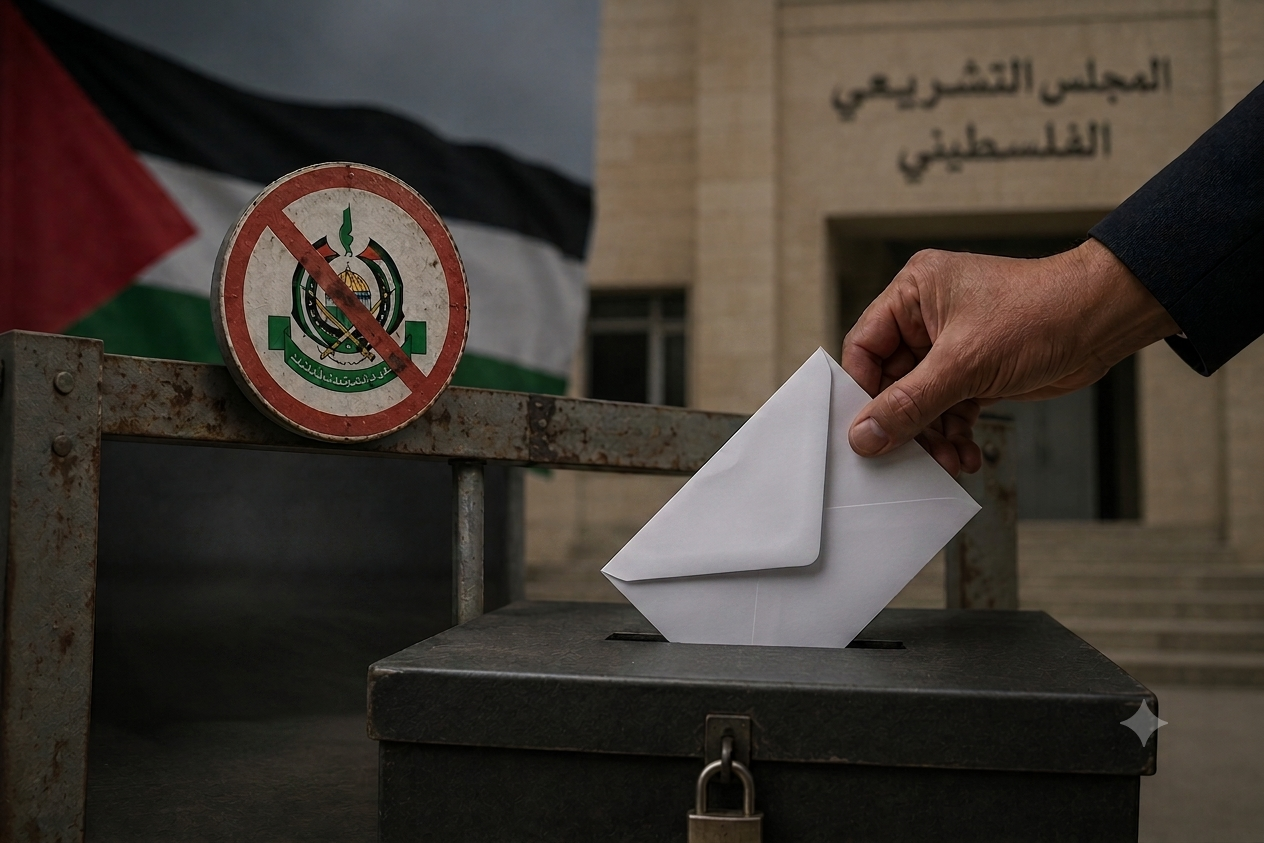
EXECUTIVE SUMMARY: Following the October 7 war and the documentation of the atrocities committed by Hamas against Israeli civilians, the limited political legitimacy the organization had retained within the Palestinian political system eroded dramatically. The Palestinian elections scheduled for 2026 are being held in a framework of institutional reform intended to align the Palestinian Authority with international requirements as it seeks international recognition of a future Palestinian state. One of the reform’s defining features is the deliberate exclusion of Hamas and Palestinian Islamic Jihad from the democratic process because of their status as terrorist organizations. The upcoming Palestinian elections are thus a mechanism by which to create a new source of legitimacy for the Palestinian political system—one that no longer rests on Hamas’s victory in the 2006 elections but instead on an institutional framework from which the movement is excluded. Despite the public support Hamas continues to enjoy for its October 7 attack, its absence from the forthcoming elections indicates that in practical terms, the organization has lost its status as a legitimate political actor within the Palestinian arena following the war and has been relegated primarily to the role of a militant military organization operating outside the institutional political system.
The October 7 war effectively came to an end with the ceasefire that entered into force on October 10, 2025, on the basis of President Trump’s Twenty-Point Plan. The initial stages of the plan focused on securing the return of the hostages and an Israeli withdrawal to the Yellow Line. Since the completion of the first phase, a dual reality has emerged on the ground. On the one hand, a relatively stable status quo has prevailed in the areas of control between Israel and Hamas. On the other hand, profound diplomatic stagnation has characterized the efforts to implement the remainder of the Twenty-Point Plan, which was subsequently anchored in UN Security Council Resolution 2803.
Despite this clear international framework, the future of the Gaza Strip remains unresolved. Hamas refuses either to disarm or to transfer authority to civilian actors, while Israel is unwilling to withdraw to an additional security line as stipulated in the plan. From Hamas’s perspective, the current situation constitutes a status quo that cannot endure indefinitely. Hamas has also questioned the legitimacy of the Peace Council, describing it as “more inclined toward the occupier (Israel) than the occupied”.
For Hamas, the war ended primarily with what it considers a cognitive victory. This conclusion emerges from two booklets published by the organization, the first in January 2024 and the second in December 2025, in which it claims achievements that are mostly situated in the cognitive and political spheres. Hamas highlights Israel’s growing international isolation, the tightening of sanctions against it, the deterioration of American public opinion and campus sentiment toward Israel, and the expansion of international legal proceedings against it, particularly the issuance of arrest warrants for senior Israeli officials. Hamas does effectively acknowledge a tactical military defeat, but insists that it was not defeated strategically. In an article by Rami Abu Zubaydah published on Hamas’s Palestinian Information Center website, Hamas and the entire “Axis of Resistance” are portrayed as flexible organizations capable of adapting to changing circumstances with relative ease, whereas Israel is described as possessing considerable military power but lacking the ability to achieve a lasting strategic victory, capable only of temporary tactical successes. Hamas argues, in other words, that it has not been deterred, even if it has been militarily subdued; in time, so the organization believes, it will recover and be able once again to strike Israeli civilians.
Hamas’s current military weakness has created a political window of opportunity for Mahmoud Abbas. Within the framework of the Palestinian Authority’s reform process, and subject to the conditions of the Twenty-Point Plan, Abbas designated 2026 as the year of elections for the Palestinian national institutions: the Palestinian National Council (PNC), which serves as the parliament of both the Palestine Liberation Organization (PLO) and, in practice, the broader Palestinian national movement; and the Palestinian Legislative Council (PLC), whose last elections were held in January 2006, when Hamas secured a parliamentary majority. Elections will take place in November 2026, first for the PNC and then for the PLC.
Abbas is fully aware that in the aftermath of the October 7 war, allowing Hamas and Palestinian Islamic Jihad to participate in the elections would trigger serious international repercussions, including reductions in financial assistance, pressure from donor states, and Israeli and American countermeasures. As a designated terrorist organization in most countries around the world, Hamas effectively lost the political legitimacy required to participate in Palestinian elections after October 7.
The elections constitute a central component of the Palestinian Authority’s reform agenda, which is designed to satisfy the requirements of the Twenty-Point Plan. Under that framework, holding general elections for the Palestinian National Council, the Palestinian Legislative Council, and the presidency of the Palestinian Authority is considered an essential prerequisite for the international recognition of a future Palestinian state.
It follows that, should the elections indeed be held in November, they are likely to constitute a political defeat of strategic significance for Hamas, as it will not be participating. After twenty years, Palestinians are expected to return to the polls to elect their representatives. Ostensibly, nothing could appear more democratic: the expansion of the Palestinian Legislative Council to 200 members, representing a broader spectrum of political views; elections to the Palestinian National Council on November 1, 2026; elections to the Palestinian Legislative Council on November 28; and, in early 2027, presidential elections for the Palestinian Authority.
However, Hamas and organizations aligned with it have been working vigorously to undermine the legitimacy of the forthcoming elections. In an opinion piece published on Hamas’s Palestinian Information Center website, author Muhammad Shahin argues that rejecting the elections’ legitimacy “is not a rejection of democracy but rather a defense of its true meaning.” According to him, Palestinian elections held without the participation of an Islamist party representing Hamas and Palestinian Islamic Jihad contradict the will of the Palestinian people and would merely strengthen Fatah.
Drawing on its experience in previous electoral campaigns, Hamas is acutely aware that there is no certainty as to when another round of elections might be held. Consequently, exclusion from the 2026 elections is not merely an isolated event; its consequences could be long-lasting. Other articles published on the Hamas website directly attack Mahmoud Abbas and the Palestinian Authority leadership, portraying the regime as corrupt and failing to provide genuine representation of the people’s will. The announced elections are described as enjoying neither public confidence nor broad national consensus. This narrative is being consistently promoted across Hamas’s media outlets.
For the time being, Abbas appears determined to proceed with the elections as scheduled while stipulating that only political parties approved by the Central Elections Commission in Ramallah will be permitted to participate. Elections are also expected to be held in the Gaza Strip, though it remains unclear under what framework or according to what practical arrangements.
The implication is that while Hamas continues to enjoy considerable public support because of the October 7 terrorist attack, it lacks an official political channel through which to translate that support into electoral power in the upcoming elections, apart from the option of boycotting the vote. Past experience, in particular that of the 1996 elections, suggests that even if Hamas and Palestinian Islamic Jihad were to boycott the elections, the boycott would not necessarily undermine the legitimacy of the electoral process in the eyes of most international actors.
It can therefore be argued that Hamas has, in effect, suffered defeat on the intra-Palestinian political front as well. Although it continues to claim a cognitive victory and maintains a narrative of steadfast resistance against Israel, it no longer possesses any real capacity to shape the Palestinian political system through electoral participation and legitimate institutional representation the way it did in previous elections for the Palestinian presidency and the Palestinian Legislative Council. The gap between Hamas’s proclaimed cognitive victory and its tangible political defeat constitutes one of the defining characteristics of the post–October 7 reality.
Lt. Col. (res.) Dr. Shaul Bartal served extensively in various security capacities in the West Bank. He was a lecturer in the Middle Eastern Studies and Political Studies Departments and is a senior research fellow at the Begin-Sadat Center for Strategic Studies at Bar-Ilan University.
BESA Center publications and research are made possible
thanks to the generosity of Saul Koschitzky and family