

BESA Geo-Energy Insights No. 10, August 16, 2026
EXECUTIVE SUMMARY: Electricity cooperation between Israel and Syria is technically possible, but would be considerably more difficult than the indirect gas exports that are already taking place via Jordan. Unlike natural gas, electricity trade must be balanced in real time, creating immediate dependence on shared infrastructure. A model of small, reversible, and externally monitored electricity links that serve defined civilian projects and are detached from either side’s national grid is therefore the most likely path for the future. The most realistic first step would be a small pilot connection from the Golan Heights to Druze communities in southern Syria, supported by existing wind generation, new solar capacity, and battery storage. Lebanon would also be able to participate through separate solar and storage projects in the south, with a direct Israeli connection considered only after security conditions between the two countries improve. Such projects could support water pumping, hospitals, and municipal services in both Syria and Lebanon while giving Israel influence over regional reconstruction. While such initiatives would likely never lead to a fully integrated regional grid between the three actors, they can become more than just a symbolic peace project. Their success would depend on strict reliability standards, the consent of the local communities, and the ability of each side to disconnect without destabilizing its own grid.
While Israel already exports natural gas indirectly to Syria through regional arrangements involving Jordan, electricity trade between the two countries poses a much more difficult test. While gas can be stored, redirected, and politically repackaged through intermediaries, electricity must be generated and consumed almost simultaneously. A cross-border power line therefore produces a more visible and immediate form of dependence on shared infrastructure that is harder for either side to deny or conceal via third parties.
Despite these constraints, limited electricity cooperation could still serve important interests on both sides. Israel has an interest in strengthening certain civilian communities and local governance along Syria’s southern border, while communities in southern Syria need reliable electricity for hospitals, water pumping, communications, and municipal services. The most realistic model for electricity cooperation between the two countries would therefore be confined to defined civilian loads that operate as electrically isolated microgrids rather than forming part of a synchronized Israel-Syria network.
On the Syrian side, the country’s power system remains severely damaged after years of war, and even a modest supply of electricity from Israel could prove beneficial. Electricity supply has often been limited to only a few hours per day. Damaged transmission lines, substations, and high technical losses continue to constrain the recovery of water, healthcare, agriculture, and industry. This is especially true for the border regions of southern Syria, where Israel holds direct strategic and security interests. Electricity shortages in Quneitra, Daraa, and Suwayda weaken local government, increase dependence on diesel and informal suppliers, and make border communities more vulnerable to armed actors.
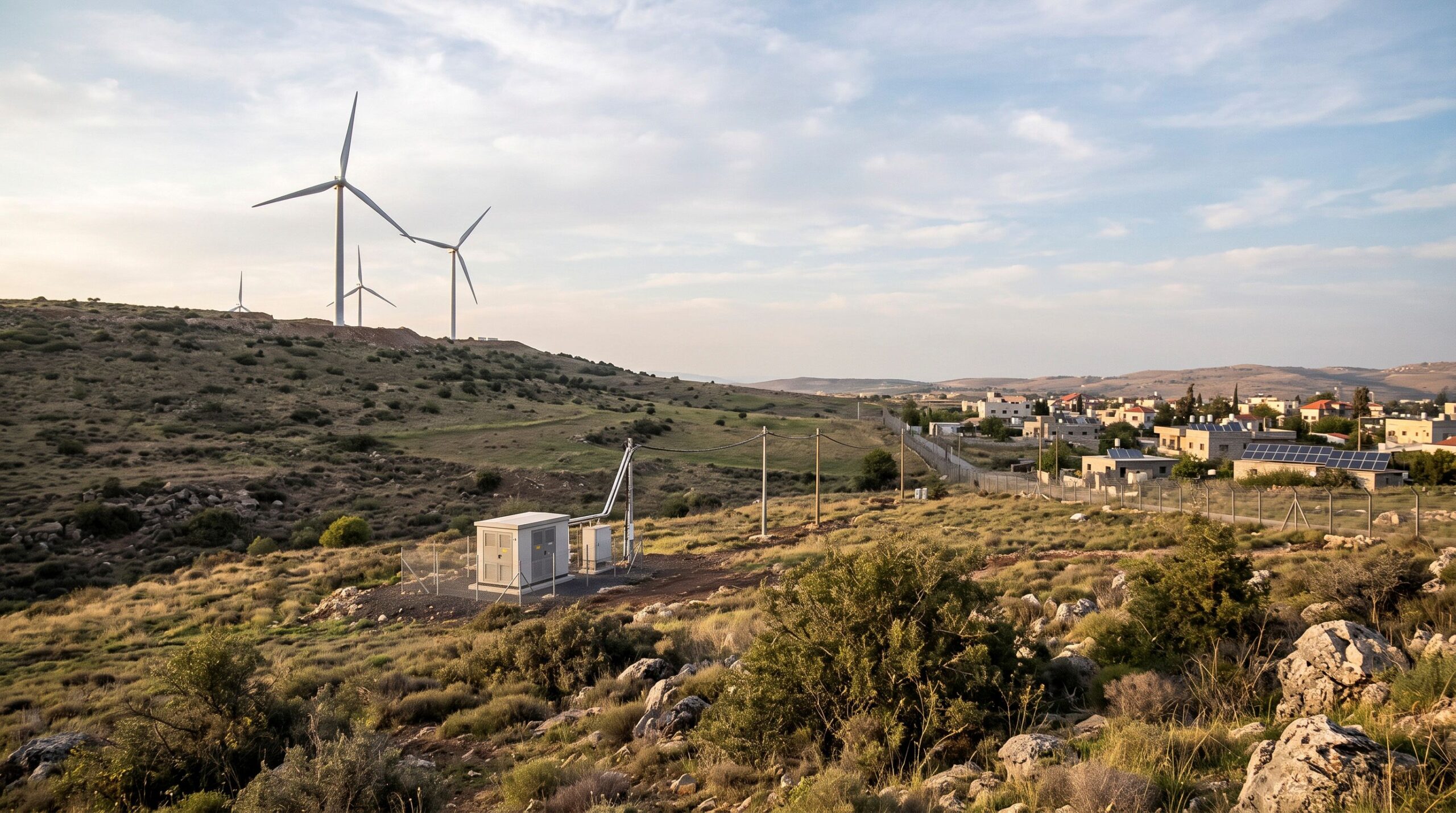
Israel already possesses a significant wind-energy base in the Golan Heights that can serve the communities in Syria. The 109 MW Emek Habacha wind farm produces about 320 GWh annually, while the 207 MW Genesis Wind project (Ruach Bereshit) is connected to the national grid through an underground 27-kilometer high-voltage cable. A third project, the proposed 104 MW ARAN wind farm in the northern Golan, has received regulatory approvals but remains stalled amid intense local opposition. Together, the two operational projects provide 316 MW of installed wind capacity, demonstrating that the Golan can host several hundred megawatts of wind generation and the transmission infrastructure needed to connect it to the grid.
However, Israel and Syria are unlikely to build a large wind farm together along the ceasefire line, at least for the immediate future. Such a proposal may be politically attractive on paper but is unrealistic under present conditions. Large turbines are permanent, visible, difficult to protect, and constrained by military requirements. Wind projects in the Golan have also generated strong opposition among parts of the local Druze community over land ownership, access to agricultural plots, environmental damage, and the political status of the territory. These objections have had tangible consequences. The 104 MW ARAN project has been delayed for several years, and another attempt to resume construction in May 2026 was halted by renewed local protests. Placing new turbines in or near the area of separation would entail dealing with both local and international legitimacy issues that may be too strong to overcome.
A more practical model would separate generation from formal cooperation. Israel could produce electricity on its side of the line and transfer a limited quantity through a dedicated feeder to defined civilian consumers in southern Syria,particularly Druze communities near the border, such as Hader, with which Israel already maintains humanitarian and medical channels. These could include a modest supply of 5MW for hospitals, water-pumping systems, and municipal facilities near Quneitra. If the arrangement proves reliable, it could expand further to 25-30MW. This amount would not solve southern Syria’s electricity shortage, but could serve to strengthen local governance capacity and a limited municipal network.
The suggested electricity connection in the Golan Heights would not synchronize the Israeli and Syrian national grids, as this would create a form of interdependency that neither side wishes to pursue. It would instead operate as a radial and automatically separable supply line. Syrian consumers receiving Israeli electricity would be isolated from the wider Syrian grid when necessary, and the line would disconnect automatically if frequency, voltage, or security conditions moved outside agreed limits. This would protect Israel’s northern region from instability in the Syrian network, whereas battery storage and local backup generation on the Syrian side would ensure that an Israeli suspension would not immediately shut down a hospital or water system.
For Israel, the benefits would be strategic as well as humanitarian. A controlled electricity link could strengthen civilian administration in southern Syria, reduce reliance on diesel-smuggling networks, and give local authorities an incentive to prevent attacks on cross-border infrastructure. It would also allow Israel to influence reconstruction standards and monitor which facilities receive support. Unlike broad financial aid, electricity can be metered, capped, and directed toward specific services.
Despite the small scale of cooperation, the potential risks involved in this project are still high. A transmission line can become a target, and Israel could be accused of collective punishment whenever supply is reduced for technical or security reasons. A critical region in Syria could become dependent on a source that Israel might interrupt during a crisis. Israel, meanwhile, could find itself responsible for maintaining supply to communities governed by an unstable or hostile authority. What may first be presented as a show of goodwill may quickly become seen as a “natural right” that delegitimizes any justification for Israel to cut supply. These problems can be limited through narrow contracts, transparent interruption rules, and third-party administration.
The Golan Heights also demonstrates why local consent matters. Renewable energy is sometimes described as a “low politics” path to cooperation, but wind and solar projects are intensely connected to land, planning, landscape, and sovereignty. Any cooperative project that appears to appropriate Druze land or predetermine the political status of the Golan will produce opposition rather than integration. The first projects should therefore use existing infrastructure, public facilities, reservoirs, rooftops, or previously developed land. Local representatives should participate in oversight and benefit-sharing so as not to repeat the mistakes of the previous wind projects in the region.
Lebanese electricity cooperation with Israel will require a different sequence than that of Syria. On the one hand, Lebanon is very receptive to renewable energy sources. Southern Lebanon’s electricity sector has increasingly relied on decentralized solar power, and the government has also begun reactivating dormant utility-scale solar licenses, including a 15 MW project covering the South Lebanon and Nabatieh governorates. Existing plans to import 150-250 MW of Jordanian electricity through Syria (most of which is generated via Israel’s natural gas supply) also demonstrate that Lebanon’s grid can support regional electricity imports.
Despite these advantages, a direct Israel-Lebanon line may be less realistic at present than an Israel-Syria connection. So long as Hezbollah has any hold in southern Lebanon, security and political conditions will make shared infrastructure between the two countries highly vulnerable. The near-term Lebanese component can therefore only exist if it were to consist of an internationally administered solar and battery project for civilian infrastructure in southern Lebanon. Projects totaling 5-15 MW across municipal clusters in the Marjayoun and Hasbaya districts could support water pumping, hospitals, and municipal services without connecting directly to Israel. Israel’s role would only be to support protected delivery of equipment, avoid interference with monitored civilian facilities, and participate in a regional technical forum. A direct feeder from northern Israel to southern Lebanon should remain an option for later, conditional on a durable security arrangement and a credible Lebanese government authority capable of protecting it.
Over time, Syria could provide the bridge between the Israeli and Lebanese tracks. Jordan, Syria, and Lebanon have discussed rehabilitating their electricity interconnections, and earlier agreements envisioned supplying Lebanon with 150 MW at night and 250 MW during the day through the Syrian grid. If those lines are restored, electricity generated or displaced by Israeli supply in southern Syria could indirectly improve the regional balance available to Lebanon, even without a formal Israel-Lebanon contract. This would replicate some of the political ambiguity already seen in regional gas trade.
Israel should therefore pursue electricity cooperation as a ladder rather than a single grand project. The first rung is separate solar and storage systems serving civilian facilities. The second is a small, reversible Israel-Syria feeder with independent metering and automatic islanding. The third is an expanded southern Syrian network that can interact with restored Syrian-Lebanese connections. A jointly operated regional grid, or a direct Israeli supply line to Lebanon, should come only after these limited arrangements have demonstrated technical reliability and political durability.
Every stage should be governed by strict and clear conditions: designated civilian end users, third-party monitoring, prepaid or escrowed payments, physical protection, clear interruption clauses, and no reliance on the connection for Israel’s own critical loads. The infrastructure should remain outside the area of separation and avoid contested private land. The US and EU could provide financing and guarantees, while an international development body could verify use and arbitrate technical disputes.
Renewable electricity cannot resolve the political conflicts between Israel, Syria, and Lebanon. It can, however, create carefully bounded interests in stability. The realistic objective is not to make the three countries dependent on one another, but to make limited cooperation more valuable than disruption. For Israel, that means beginning with projects that strengthen civilian resilience across its northern borders while preserving control, reversibility, and freedom of action when necessary.
Dr. Elai Rettig is a senior lecturer in the Department of Political Studies and a senior research fellow at the Begin-Sadat Center for Strategic Studies at Bar-Ilan University. He specializes in energy geopolitics and national security.
This paper is part of an ongoing collaborative project between
the BESA Center and the Konrad Adenauer Foundation-Israel entitled
“From Conflict Lines to Power Lines:
Energy Cooperation Between Israel, Syria and Lebanon”