
 BESA Geo-Energy Insights No. 9, July 2, 2026
EXECUTIVE SUMMARY: Israeli gas exports to Syria are already a reality, but they are currently conducted indirectly, through swap deals and resale arrangements with Jordan and Egypt rather than through a formal Israel-Syria contract. This creates a strategic dilemma for both sides. On the one hand, a direct Israel-Syria gas contract could provide clearer accountability, stronger safeguards against disruptions, and a basis for future energy cooperation that may include Lebanon as well. On the other hand, direct gas trade could be politically premature and expose both sides to domestic criticism: in Israel, because of concerns over dwindling domestic gas reserves after the large export agreement with Egypt in 2025; and in Syria, because of fears that Israel could politicize gas supply or use it as leverage. Indirect contracts through Jordan and Egypt may be easier to implement and deny, but they also blur responsibility and reduce both sides’ control over supply conditions. Israel should approach this question not as a binary choice between formal normalization and continued ambiguity but as a practical debate over which contracting model best serves its interest in stability, leverage, deniability, and long-term regional integration.
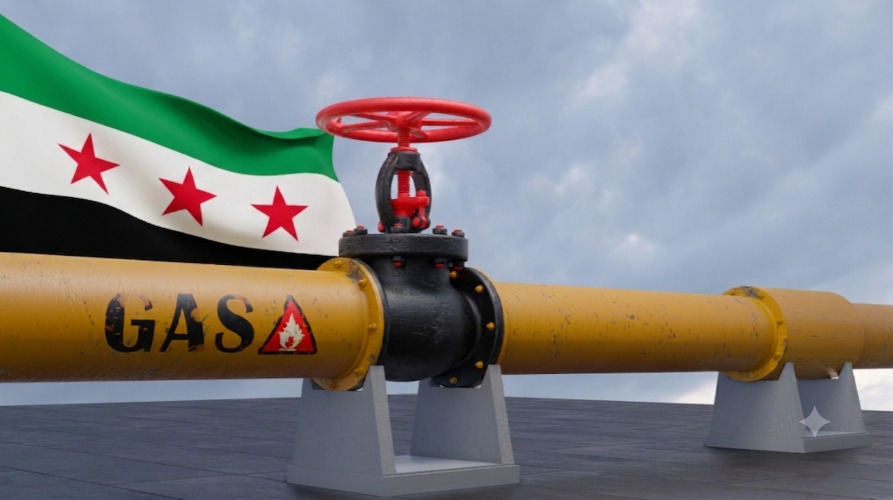
In January 2026, Jordan signed a gas supply agreement with Syria to provide it with roughly 1.45 billion cubic meters (BCM) per year through the Arab Gas Pipeline. Although the agreement does not stipulate where the gas originates, it is clear that Syria is receiving Israeli gas in all but name. Jordan has only one small domestic gas field and imports 85% of its gas from Israel, with the rest coming via LNG imports through Aqaba. Although regional officials initially claimed that the gas from Jordan to Syria originates from Qatari LNG, the current pipeline configuration makes that claim unlikely. Israeli gas is already flowing southward through the same system; gas entering through Aqaba cannot travel northward beyond Amman to get to Syria. This means gas supplied to Syria through Jordan is in fact Israeli gas that is being politically repackaged as “Jordanian” or “Qatari” via swap deals and resale arrangements.
Although Israel and Syria have not signed a direct gas contract, a de facto Israeli gas export route to Syria already exists, with the ambiguity serving as a political mechanism that makes the arrangement possible for both sides. The hidden trade route allows Damascus to receive the gas without acknowledging its dependence on Israel, and it allows Israel to contribute toward Syria’s energy recovery without formally entering into a normalization agreement with it. In addition to Jordan, Egypt has also signed an MOU with Syria to supply it with gas, and in May 2026 Lebanon joined a gas exchange framework with Jordan and Syria. This web of agreements allows any gas supplies sent to Syria or Lebanon to be presented as Jordanian, Egyptian, LNG-based, or part of a regional swap arrangement, even when it is Israeli supply that is making the flow possible. Political deniability is thus preserved for all parties.
This unlikely gas arrangement is the product of Syria’s critical need for gas. Syria’s domestic gas production fell from about 8.7 BCM in 2011 to about 3 BCM during the long civil war. Its power sector remains one of the most urgent tests of state reconstruction. Turkey has started moving Azerbaijani gas into northern Syria through the Kilis-Aleppo route, with Qatar involved in financing. That project is expected to provide around 1.2 BCM annually and support several hours of additional electricity in affected areas, but this is only a partial solution. Jordan’s supply through the Arab Gas Pipeline joins a wider competition over who will shape Syria’s postwar energy recovery. Israel may not be visible in this competition, but it is present within the regional gas system.
The immediate policy question is therefore not whether Israeli gas can reach Syria (because it already does), but whether Israel and Syria should consider a direct gas contract or leave this indirect supply arrangement as it is. The answer is not obvious. Each model offers different combinations of deniability, reliability, leverage, accountability, and political risk for both sides.
For Syria, the indirect route has clear advantages, as it reduces the political cost of receiving Israeli gas. A Syrian government trying to rebuild electricity supply may prefer to describe the gas as coming from Jordan, Egypt or Qatar rather than defend a direct agreement with Israel. This is especially important while the new political order in Damascus is still consolidating its legitimacy. Indirect supply also allows Syria to benefit from existing infrastructure without turning a technical energy need into a public diplomatic concession.
But this deniability comes at a price. If Syria receives gas through Jordan and Egypt, its energy security depends on their decisions. Both Jordan and Egypt may choose to prioritize their own domestic markets and freeze exchange agreements to Syria during shortages, or even use their transit status as leverage against Syria during political disagreements. Syria could thus find itself dependent on Israeli gas yet without a direct contract with Israel to which to turn if supplies are disrupted. The indirect route also renders Syria dependent on Jordanian and Egyptian infrastructure without full control over the terms of supply. For Damascus, indirect gas is thus politically convenient in the short run but contractually weak during a crisis.
For Israel, too, indirect supply has both advantages and disadvantages. On the plus side, it allows Israeli gas to contribute to regional stabilization without forcing a premature political breakthrough with Syria. It gives Jordan and Egypt a useful mediating role, reduces the visibility of Israeli involvement, and allows energy cooperation to emerge gradually. Israel can test whether Syrian reliance on regional infrastructure will create pragmatic behavior over time while avoiding the domestic and diplomatic exposure that would follow a formal gas deal with Damascus.
But the indirect route also reduces Israeli leverage. If Israel does not formally sell gas to Syria, it has less control over end-use restrictions, crisis clauses, payment mechanisms, and responsibility for interruptions. It may not know which Syrian power plants benefit, whether gas is reaching politically sensitive areas, or whether hostile actors are indirectly gaining from improved energy supply. Israel may also receive little diplomatic credit for helping stabilize Syria while still being blamed if flows are interrupted because of war, technical failure, or a decision by Jordan to prioritize domestic supply. Israel could end up sustaining part of Syria’s recovery without clear visibility, safeguards, or recognition.
A direct contract would thus offer benefits to both sides. It would clarify volumes and prices, provide payment guarantees and arbitration mechanisms in case of interruptions, reduce the ability of intermediaries to manipulate supply, and allow both sides to place energy cooperation within a broader regional framework backed by the US. If managed carefully, a direct contract could become a limited, technical form of cooperation rather than a dramatic normalization gesture.
The direct model could also support Lebanese gas supply. Lebanon’s electricity crisis remains one of the deepest drivers of its economic and political collapse. Previous attempts to supply Lebanon through Egypt, Jordan, and Syria were delayed by financing, sanctions, and infrastructure problems. A more stable Syrian gas corridor could eventually allow Lebanon to receive gas or electricity through a more reliable regional arrangement.
Yet despite these benefits, a direct contract would also carry serious domestic political costs for both sides. On the Israeli side, a formal agreement with Syria would reopen the domestic debate over gas exports amid dwindling local gas reserves. The major gas agreement signed between the Leviathan partners and Egypt in August 2025 sharpened this debate, as it promised Egypt another 130 BCM of Israeli gas through 2040. While this was commercially important, it raised the concern that Israel may run out of domestic gas by 2045 if no additional gas reserves are found and domestic demand remains high. The deal with Egypt took several months to receive final approval from the Israeli government, in part because of this concern, and it was finally granted only after domestic-market safeguards were added to the trade deal in case of domestic shortage. This public debate dampened the Israeli government’s appetite for another large and visible gas agreement with Syria or Lebanon.
Israeli decision makers would need to justify why another export channel is necessary, how it fits within export caps, and what safeguards are in place to protect Israeli consumers from future shortages. They would also need to explain why Israeli gas should be sold directly to a state that does not recognize Israel, the future political orientation of which remains uncertain, and whose territory may still contain actors hostile to Israeli interests. A direct contract might offer clarity, but that clarity would make political responsibility harder to avoid. As such, the Israeli government may prefer to consider the new 130 BCM agreement with Egypt as already containing within it any future gas deal with Syria.
For Syria, a direct contract with Israel could be even more difficult. The Damascus government wants reliable gas but it may fear being accused of legitimizing Israel ahead of any broader political settlement, including over the fate of the Golan Heights. It may worry that Israel would use gas as a political instrument in future crises, and may prefer to preserve bargaining room with Turkey, Qatar, Egypt, Jordan, and the Gulf states rather than place itself too conspicuously inside an Israeli and US-linked energy framework. In other words, a direct deal may give Syria more predictable supply, but it could expose Damascus to accusations that Syria’s reconstruction is being shaped by Israeli influence.
The choice between direct and indirect exports should therefore be viewed as a sequencing dilemma. Indirect supply may be more practical in the short term because it allows gas to flow without asking either side to make a symbolic concession. Direct contracting may become more attractive later if indirect arrangements prove too vague, intermediaries use their position for leverage, interruptions become frequent, or both sides decide they want clearer rules. The issue is not which model is better but which model fits the political conditions and infrastructure needs of each stage.
Israel should prepare for both possibilities. For indirect exports, it should clarify whether existing export licenses to Egypt and Jordan allow onward supply to Syria and Lebanon or whether such supply requires prior notification. It should ensure that contracts include domestic supply protections, crisis clauses, and basic transparency regarding onward flows. It should also coordinate with Egypt and Jordan so that Israeli officials are not surprised by public announcements that repackage Israeli gas as part of a wider regional supply scheme. For a possible direct contract, Israel should define the minimum conditions that would make such a deal acceptable. These could include end-use restrictions for civilian electricity generation, monitoring arrangements, protection of infrastructure, payment guarantees, and international backing.
Syria, for its part, would need to decide whether the benefits of predictability and contractual clarity outweigh the political costs of visible cooperation. Europe and the US could help by providing political cover, technical assistance, and financial guarantees that lower the risk for both sides.
The Syrian gas question is therefore not simply an energy issue but a test of whether regional infrastructure can become a stabilizing instrument without asking politics to move faster than it can. Indirect supply offers deniability and speed while direct supply offers clarity and accountability. Both models have strategic value and both carry risks.
The most important step for Israel is to recognize that the issue may already be moving ahead, even without a formal Israeli decision. If Jordan, Egypt, Syria, and Lebanon develop gas arrangements that rely on a regional system partly sustained by Israeli gas, Israel will be involved whether it announces it or not. It should therefore treat the question as a matter of strategic planning rather than commercial spillover. The first Israeli gas deal with Syria may never be called an Israel-Syria gas deal, but Israel should still decide what it wants such a deal to achieve.
Dr. Elai Rettig is an assistant professor in the Department of Political Studies and a senior research fellow at the Begin-Sadat Center for Strategic Studies at Bar-Ilan University. He specializes in energy geopolitics and national security.
This paper is part of an ongoing collaborative project between
the BESA Center and the Konrad Adenauer Foundation entitled
“From Conflict Lines to Power Lines:
Energy Cooperation between Israel, Syria and Lebanon”