PSCRP-BESA Reports No 115 (February 20, 2025)
by Dor Shabashewitz
Secessionist movements have existed in Russia for as long as the Russian Federation itself. After the end of several heated conflicts in the 1990s and early 2000s, Moscow dismissed independence demands as inherently unserious, bordering on political role-playing. They started making a slow comeback in the late 2010s as a reaction to the rapid Russification of ethnic minorities, xenophobia, regional inequality, and the republics’ decreasing autonomy. Still, as of late 2021, pro-independence voices enjoyed little recognition outside of niche internet communities—mainstream ethnic activism criticized the government but not to the point of demanding secession. This started changing when Russia began its full-scale invasion of Ukraine in February 2022.
The Congress of the Oirat-Kalmyk People provides an example of this shift. Founded in 2015 as a grassroots alternative to the presidential “United Russia”-dominated regional parliament, this organization held biannual meetings in Kalmykia’s capital, Elista. They were attended by members of the republic’s intelligentsia, including heads of state-funded cultural institutions, and members of the so-called systemic opposition. There, they would elect informal representatives who then published statements on what they deemed the genuine interests of the Kalmyk people, as opposed to the regional government’s policies. Members of the Congress spoke of historic and modern-day injustices and criticized the Kremlin. Independence, however, was not discussed as a serious option at the time due to a combination of fear of political repression and a genuine lack of popularity.
In February 2022, the Congress’s leaders took a hard line against the invasion of Ukraine. Alarmed by the overrepresentation of ethnic minorities among those sent to the war, they also spoke out against the participation of Kalmyk soldiers in the invading force. Shortly afterward, they were forced to emigrate and began reshaping their organization in exile. In October 2022, members of the Congress signed a provisional declaration of independence, stating that their new goal was the creation of a sovereign Kalmyk state.
This shift from autonomism to secessionism within several pre-existing ethnic movements and the emergence of numerous new ones culminated in the creation of umbrella organizations and platforms uniting secessionists from various regions of Russia. Prior to 2022, individual ethnic movements operated independently, and the few international contacts they had were with activists from countries speaking related languages, such as Estonia for the Mari movement and Turkey for the Tatar movement. With the emergence of umbrella organizations, most notably the Free Nations League and the Free Nations of Post-Russia Forum, diplomacy became a major tool for Russia’s independence movements.
With their similar goals and names, the Free Nations League and the Free Nations of Post-Russia Forum are often confused by policymakers, journalists, and curious laypeople alike. Some seem to think that they are one and the same thing, while others describe them as competitors. An even more unusual mistake was made by Russian officials. In November 2024, the Supreme Court of Russia declared the Forum a “terrorist organization.” In January 2025, Russia’s Federal Security Service updated its list of terrorist organizations accordingly. The newly created entry for the Forum included 172 alleged “branches” of the organization, with the League described as one of them. This characterization was entirely inaccurate. The two organizations are neither branches of each other nor adversaries—they simply occupy different niches.
Founded by the Ukrainian entrepreneur and Euromaidan participant Oleh Mahaletsky in May 2022, the Free Nations of Post-Russia Forum is exactly what the name suggests: a forum. It is a platform for semi-regular conferences where ethnic activists, opposition politicians, bloggers, and researchers meet to present and discuss their visions of how Russia’s territory should be divided, governed, and transformed after a hypothetical dissolution.
Although certain publications provide lists of secessionist movements that are members of the Forum, it is technically incorrect to speak of “membership” in an organization that exists to arrange public events. Participation in the Forum’s conferences does not have to be regular or even agreed upon by the leadership of a certain movement—a single presentation by a Tatar activist does not necessarily indicate that Tatar secessionism as a whole has “joined” the Forum. Between the conferences, the Forum’s activity is largely limited to maintaining a social media presence.
That is not to say that the Forum has little impact—it has managed to secure support from a number of politicians and well-respected researchers in Europe, North America, and beyond. As a result, the Forum’s conferences take place at prestigious venues, including the national parliament buildings of Lithuania, Italy, and Japan, as well as the European Parliament in Brussels. Attended by high-ranking politicians, these events are routinely highlighted by major media outlets, thus helping promote the cause of Russia’s indigenous peoples and their struggle for independence.
At the same time, the Forum often faces criticism from other decolonization activists. Many argue that it gives a platform to practically anyone who asks for it, including fringe movements with unrealistic demands, extreme rhetoric, and no measurable legitimacy. According to the critics, such speakers risk turning the event into a spectacle, undermining the credibility of the more established independence movements.
The Free Nations League, coincidentally also founded in May 2022, differs from the Forum in that it is a registered NGO with a written charter, well-defined membership criteria, and a complex, hierarchical internal structure. Although personal membership in the League is possible in exceptional cases, the bulk of its members are activists from pre-existing ethnic movements that officially joined the League as groups rather than individuals. These include the aforementioned Congress of the Oirat-Kalmyk People, as well as a variety of movements representing the Bashkirs, Buryats, Circassians, Chechens, Erzyas, Mokshas, Sakhas, Tatars, and two regional movements without an ethnic affiliation advocating for independence for the Saint Petersburg and Kaliningrad regions, respectively. Members of these movements take turns as leaders of the League, with Radjana Dugar-DePonte of the Buryat organization Erkheten currently serving as its president.
Compared to the Forum, much of the League’s work is ongoing and internal, rather than tied to specific events. Members of the League’s constituent ethnic movements attend workshops to improve their communication strategies and reach more co-ethnics still residing in Russia. The League also functions as a media entity, whose work extends beyond strictly political messaging—the organization’s YouTube channel features educational content on the history of Russia’s ethnic groups, interviews with non-Slavic Russian prisoners of war in Ukraine, stories of people rediscovering their minority roots after forced assimilation, and more. Lastly, the League’s constituent movements organize rallies in exile, protesting Russia’s ethnic policies and its war against Ukraine, as well as commemorating the Circassian genocide, the deportation of the Kalmyks, and other colonial crimes of the past.
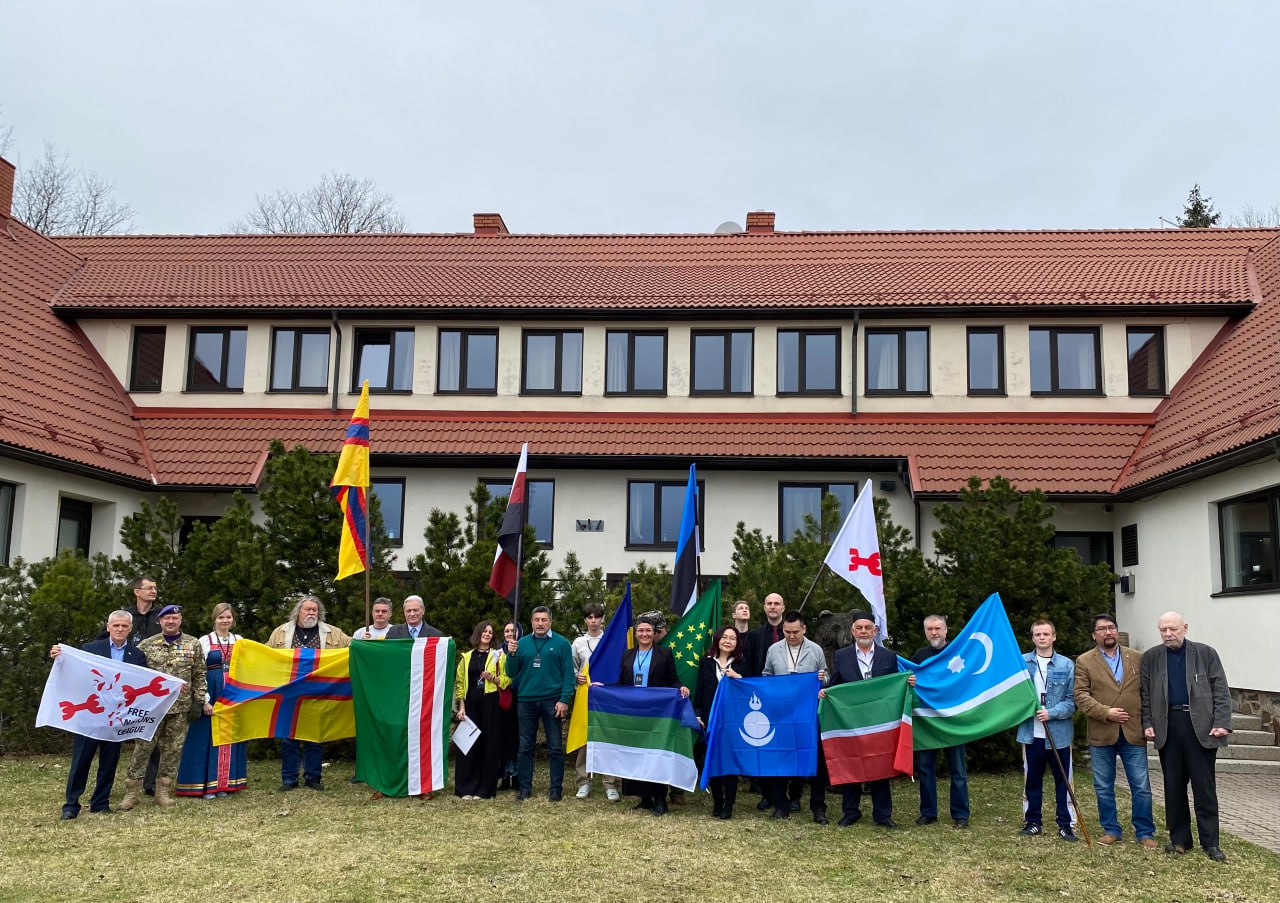
While the Forum holds several major conferences a year, the League has only held one similar event so far: the First Congress of the Free Nations League in Otepää, Estonia, in April 2024. Nevertheless, decolonization activists often praise the League for its diplomatic efforts—they simply take a different form. The Forum’s efficiency can be measured by the “big names” its conferences attract as speakers, guests, and commentators. The League prefers talking directly to policymakers, many of whom are not public figures or widely known, behind the scenes. These talks sometimes lead to real decisions, such as Ukraine’s Verkhovna Rada recognizing the Circassian genocide and the right of Chechnya to sovereignty, or two Baltic states facilitating the emigration of numerous indigenous activists facing persecution in Russia.
As is evident from the two organizations’ social media posts and personal conversations with their members, most secessionists agree that their movements do not have the means to make their regions independent at present. They are simply waiting for Russia’s dissolution, which they hope will happen for different reasons, such as military defeat, economic collapse, and conflicts within the elites. It is important, they say, to be prepared when or if this day comes. Each ethnic movement has its own idea of what this preparation should involve, ranging from drafting the laws of their hypothetical future states to undergoing basic military training so that they can act in case of a power vacuum.
For many, public relations are the most important part of this preparation process, and the Forum and the League facilitate it in complementary ways. The Forum lets grassroots activists reach a global audience and normalize the very idea of a decolonized Russia as a topic of discussion in Europe and North America. The League’s activity is more multifaceted. On the one hand, it helps ethnic activists in exile improve their communication strategies to engage their respective domestic audiences—namely, their co-ethnics remaining in Russia. On the other hand, it connects secessionist movements with decision-makers in other countries with the stated goal of pre-securing international recognition of their right to sovereignty before they get a chance to exercise it. In the meantime, these connections help ethnic movements solve some of the more mundane problems their members face, including ensuring their personal safety.
Perhaps unsurprisingly, Russia’s secessionist movements often disagree on their vision of the country’s future—some even have territorial disputes with each other. For example, both Kalmyk and Nogai secessionists claim Astrakhan as part of their desired states. As the more open and “filterless” platform, the Forum lets them discuss and argue publicly. The League, with its strict membership criteria and collective decision-making, takes a more careful approach, resolving debates internally and only publishing what has been agreed upon by all of its constituent movements.
Regardless of how realistic the ambitions of these two organizations are, their ongoing preparatory work is already changing the ethnopolitical landscape of Russia’s opposition and diaspora. The Russian invasion of Ukraine did not just radicalize Russia’s ethnic minority movements, it also forced them to connect, cooperate, and form blocs. The Free Nations League’s work presents an especially interesting case of cooperation. Owing to the organization’s structure and its activists being scattered throughout many countries, people of vastly different ethnolinguistic and religious backgrounds from across Russia increasingly find themselves exchanging ideas, sharing experiences, and even representing each other in their contacts with the outside world. Within the framework of these umbrella organizations, it is not uncommon for an Erzya activist to try and persuade a Ukrainian politician to vote in accordance with the interests of the Circassian movement, while a Buryat “diplomat” helps a Mari blogger facing persecution escape from Russia to Estonia.
This nascent feeling of solidarity between politically active and nationally conscious members of various ethnic minorities may have a lasting influence on the ethnopolitics of Northern Eurasia. What we are witnessing is the emergence of a new alliance of Russia’s “non-Russians,” which should not be overlooked. The numerous anti-decolonization statements by mainstream Russian liberal opposition figures such as Yulia Navalnaya and Maxim Katz show that, in Russia’s informal political discourse, ethnic secessionists are increasingly viewed as a single movement and a competitor serious enough to at least mention and criticize.
Whether exiled oppositionists, ethnic Russians or others, are likely to have a say in shaping Russia’s future is a matter of debate. Organizations like the League and the Forum are often dismissed as irrelevant get-togethers of powerless émigrés. However, the frequent arrests of their supporters in Russia and the role of secessionist social media groups in the 2024 Bashkortostan protests show that they do have an audience within the country. For now, the gathering of ethnic activists from different regions is happening in exile. In the event of a mass return, whether caused by Russia’s dissolution or democratization, it may lead to these newly formed alliances becoming a political force on the ground—perhaps a niche one, but with shared and clearly defined interests and increasing experience in diplomacy, networking, and campaigning.
Dor Shabashewitz is a researcher and journalist with a background in history and social anthropology and a long-time contributor to Radio Free Europe/Radio Liberty’s Tatar-Bashkir Service. His interests include ethnic minority activism, nationalities policy and the interplay between language and identity in Russia and Central Asia.