BESA Center Perspectives Paper No. 2,369, March 18, 2026
EXECUTIVE SUMMARY: The achievements of the joint American-Israeli Operation Epic Fury/Roaring Lion are already fundamentally changing Iran’s strategic posture. However, several key variables are in question and can affect the operation’s results, and therefore it is appropriate to think about the future the using the methodology of Alternative Futures, and derive some understandings. This paper analyzes Alternative futures for possible evolving scenarios, for the characteristics of a continuation of the existing regime and for a different regime in Iran. The main conclusions from the analysis: Preparations should be made now for the post-war period including plans for enforcement by force and creating the conditions required for another round (‘Rising Lion 3’). The international community should demand a real agreement – a ‘CNOHMP Deal’ that addresses the Chemical, Nuclear, Hormuz, Missile and Proxy issues. Efforts should be increased to find leaders who can run Iran with a different approach: a “Gorbachev” in the existing regime and/or a “King” in another.
Examining a situation with high uncertainty through “alternative futures”
The achievements of the joint American-Israeli operation Epic Fury/Roaring Lion are dramatically altering Iran’s strategic posture. A significant portion of the regime’s threatening capabilities appear to have been destroyed, and its ability to rehabilitate them is even more severely affected. The Iranian leadership has taken a severe blow and is only partially functioning. Iran has chosen to fire on its neighbors, distancing itself from them. The regional defense coalition greatly reduces the scope of physical damage Iran is able to cause its targets, including Israel, and Iran’s ability to threaten maritime energy traffic in the Straits of Hormuz is diminishing. The changes in oil prices do not indicate a real energy problem but rather reflect political and speculative manipulation. Secretary of War Pete Hegseth’s words on March 13 sum up the balance: “We’re going up; they’re going down”.
However, several fundamental variables remain in question:
- The Iranian public: Will a tipping point come when the Iranian public actively move to overthrow the regime, and have the regime’s forces been weakened sufficiently for such a move to succeed?
- The Iranian regime: Who are the real decision-makers in Iran today and what line do they take in their inner chambers, beyond their expected (and mostly false) statements of defiance? Who will survive the war? Can a coup occur?
- The flow of oil: How able are the Americans and their allies to minimize disruptive nuisances in the Strait of Hormuz and ensure a near-free flow of energy traffic?
- Uranium stockpiles: Will a solution be found for Iran’s enriched uranium stockpile, which is protected in sites deep in the mountains? These stockpiles should be neutralized to fully and permanently eliminate Iran’s ability to produce nuclear weapons.
- An extreme action: Can the Iranians carry out an extreme action that would change the dynamics of the war, such as a significant blow to the United States military, the use of chemical or radioactive materials in weapons, or a significant terrorist attack?
- President Trump’s decision-making: How long will Trump feel the war is succeeding at reaching his goals and improving rather than harming his standing at home?
To evaluate such variables and draw conclusions about desired courses of action, we can apply the methodology of Alternative Futures to a series of questions.
- What are the possible evolving scenarios?
The main possible components of the future scenarios are:
- End of the war (on the assumption that once the US ceases military operations, Iran will cease as well).
- Regime change.
- Regime radicalization.
- Regime disintegration.
- Regime recovery.
- A real agreement reached that addresses all aspects of Iran’s bad behavior – a “CNOHMP deal”: Chemical, Nuclear, Oppression, Hormuz, Missiles, Proxies.
- Military enforcement actions.
- Another war (‘Raising Lion 3’).
Based on these components seven main scenarios can be described:
- Optimal: Regime change gains critical mass and then the war ends.
- Good: The war ends, and then regime change occurs when the public recognizes the weakness of the regime and dares to replace it.
- Affirmative: The war ends with the Iranian leadership agreeing to a CNOHMP deal.
- Tolerable: The war ends with the regime radicalized but crumbling. It ceases to pose a strategic threat to its surroundings, and a long period of transition begins.
- Enforcement: The war ends, the regime is radicalized and trying to restore its capabilities, and enforcement by American and/or Israeli military force is required to prevent escalation and negative behavior (see the idea of SSG: Semi Self-Governance, which was discussed in Perspective No. 2326 from January 2025).
- Another war: The war ends, but the regime regroups and strives to rebuild its capabilities. Israel with/without the United States embark on another war to slow down the reconstruction process and increase the chances of regime change.
- Negative: The war ends, the regime is militarizing and trying to restore its capabilities, and the international community – including Israel – does not act effectively to stop it.
In the current situation, it appears that the more likely scenarios – given the lack of a substantive change towards either regime change or a CNOHMP deal – are that the radicalization of the current regime leads to either disintegration or military moves by Israel and/ or the United States, be they enforcement or another war, to prevent the regime’s re-strengthening.
- What would continued control by the existing regime look like?
By cross-referencing two main variables, external and internal behavior, we can define four possible alternative futures:
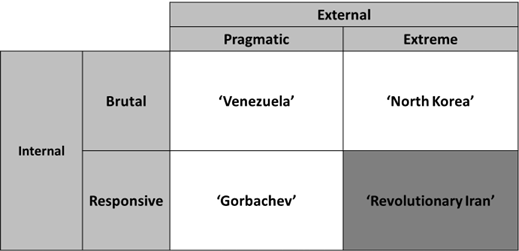
- ‘Venezuela’– A regime that is externally pragmatic and internally brutal. The regime’s top brass agree to far-reaching concessions (a public or secret CNOHMP deal) in exchange for their continued control of the country. As things stand right now, it will take time for such an attitude to strengthen and take hold within the regime.
- ‘North Korea’– An extremist regime that is both externally and internally brutal. In this scenario, an IRGC dictatorship would act forcefully both domestically and internationally. This appears to be a reasonably likely development, though it is unstable in the medium and long term (making it a period of transition to change).
- ‘Gorbachev’– A regime that is pragmatic abroad and benevolent at home. This scenario would require the rise of a leader from within the regime who will moderate its foreign and domestic policies to reestablish regime control in other ways. At present, no figures have been identified who could lead such a move.
- ‘Rafsanjani’– A regime that is outwardly extremist but inwardly positive. This would be an attempt to revert to a situation in which a belligerent outward approach garners relatively broad public support. On the face of it, such a situation can no longer be repeated.
In the current situation, the most likely scenario to emerge is ‘North Korea’ — that is, an IRGC dictatorship. It is less likely (but not impossible) that the regime will develop a different approach towards either the outside world or the internal arena.
- What would a new regime look like?
Here you can cross between two main variables, degree of stability and degree of openness, to reach four alternative futures:
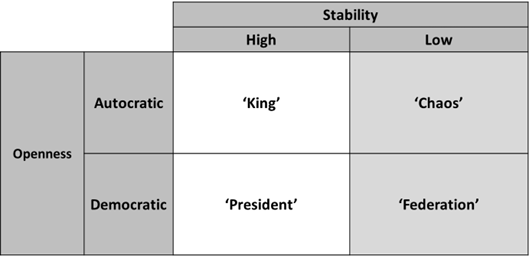
- ‘King’: A stable autocratic regime. In this scenario, an undemocratic ruler comes to power. This is Iran’s natural state throughout history, but it is not known how long such a ruler would continue to receive legitimacy from the public considering the oppression it has endured in recent decades.
- ‘Chaos’: An unstable and autocratic regime. In this instance, the new government has difficulty controlling the many populations in the country, and attempts to exert control over them in an undemocratic way. This leads to open conflict between factions (for example, supporters of the ex-Islamic regime and supporters of the Shah) and between ethnic groups. Such disintegration runs counter to the longstanding sentiment of the Iranian people.
- ‘President’: A stable democratic regime. In this case, Iran moves towards a state of elected democracy. This would be unprecedented in Iranian history, and it is unclear whether it could be stabilized over time.
- ‘Federation’: An unstable democratic regime. In this scenario, Iran is divided into homogeneous regions containing factions or ethnic groups. The main problem would be what happens to Tehran and Isfahan, which are large, relatively mixed cities.
Scenarios that maintain an integrated Iranian state appear more likely because they reflect the broad consensus of the Iranian people. It is difficult to assess the likelihood that an autocratic or democratic ruler will emerge.
Conclusions
The importance of examining Alternative Futures lies less in the analysis itself than in the possible implications that arise from it. The main conclusions of our examination of alternative futures for Iran are:
- Prepare for additional rounds: Given that scenarios of regime change or an overt or covert CNOHMP deal may not develop, it is advisable to begin preparing now for military enforcement measures after the end of the war and to create the conditions required for another round (‘Rising Lion 3’).
- Pressure for a CNOHMP deal: Regardless of progress towards regime change, and in light of Iran’s widespread targeting of countries in the region and blockade of the Strait of Hormuz, the international community must be mobilized for the broadest possible consensus to exert uncompromising pressure on Iran to agree to a CNOHMP deal.
- Alternative leadership: It would be wise to increase efforts to locate, support and advise figures who can serve as regime heads who can lead Iran to a different approach: a “Gorbachev” in the existing regime or a “King” in another. This might be even the same figure – a Gorbachev who changes the regime and then develops into a King. Active action to promote such figures may also make it difficult to build a consensus within the current regime around the hard line of the IRGC. Scenarios of Iran’s disintegration or transition to a full democracy seem less likely, so it would be inadvisable to invest most effort in those directions.
- A cohesive and aggressive international coalition: The current situation involves a group of like-minded countries, led by the United States, that encompasses the countries of the region that were attacked as well as countries from Europe and East Asia. This group is presenting a clear front against the Iranians that makes it difficult for them to maneuver. Other countries, particularly Russia and India, can de facto back this front through their silence.
Col. (res.) Shay Shabtai is a senior researcher at the BESA Center and an expert in national security, strategic planning, and strategic communication. He is a cyber security strategist and a consultant to leading companies in Israel.