
PSCRP-BESA Reports No 111 (Jan 14, 2025)
By Alex Grinberg
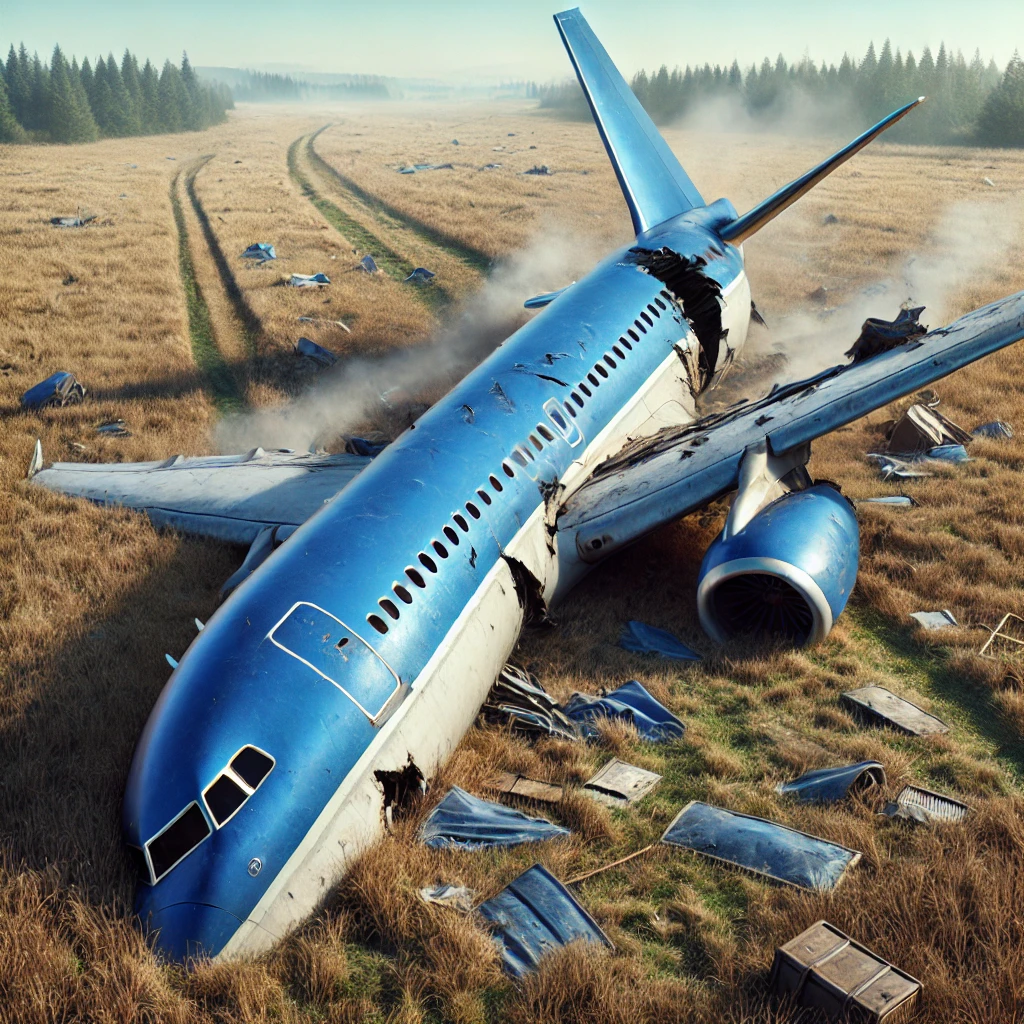
On December 25, Azerbaijan Airlines Flight 8243 crashed near Aktau, Kazakhstan, while en route from Baku to Grozny. The Embraer 190 aircraft, carrying 67 people, including five crew members, broke apart upon impact, resulting in 38 fatalities. The victims included citizens of Azerbaijan, Russia, and Kazakhstan, with the remaining passengers hospitalized with various injuries.
Initially perceived as a tragic accident, it has now become a case study of Russian military negligence and Azerbaijan’s diplomatic prowess. The incident was neither caused by human error nor technical failure but rather by what evidence suggests was a catastrophic series of failures by Russian military authorities.
The sequence of events began forty minutes after takeoff when the aircraft entered Russian airspace over Chechnya. The pilots reported the loss of GPS signals and other navigational aids, likely due to Russian military jamming systems deployed against Ukrainian drones operating in the region. An object, likely shrapnel from a Russian air defense missile, struck the aircraft shortly after, causing a loss of control.
The official Russian narrative claimed that heavy fog over Grozny forced the aircraft to divert to Makhachkala. However, the plane never reached this alternate destination. Instead, facing severe control issues, the crew initiated emergency protocols and attempted to reach Aktau, where the aircraft ultimately crashed.
Crucial evidence from the crash site revealed perforated holes in the tail section inconsistent with the Russian authorities’ initial explanation of a bird strike. These markings matched the characteristic damage pattern of surface-to-air weaponry. The timing coincided with Ukrainian drone activities in Chechnya, which had prompted heightened Russian air defense alertness.
The root of the tragedy lies in a critical oversight: Russian authorities failed to implement the “Carpet plan”—a” mandatory protocol requiring verification of civilian aircraft presence before activating air defense systems. The GPS jamming intended to interfere with Ukrainian drones instead disabled the civilian aircraft’s navigation systems, which made this negligence worse.
The aftermath revealed a pattern of attempted cover-ups by Russian authorities. While official channels maintained the bird strike narrative, pro-war Telegram channels, including Fighterbomber and Rybar, contradicted this version, suggesting the involvement of Russian air defense systems. The VChK-OGPU channel specifically pinpointed the incident to Chechnya’s Naursky district, approximately 18 kilometers northwest of Grozny airport, an area known to host military units equipped with air defense systems.
Chechen authorities have not issued any official comments regarding the plane crash. Following the tragedy in Aktau, Akhmat commander Apti Alaudinov praised air defense personnel for their “high professionalism.” Meanwhile, Chechen leader Ramzan Kadyrov presented an award to his nephew, who serves as the republic’s Security Council Secretary, after the latter reported that all targets over Chechnya had been eliminated on the day of the crash.
Azerbaijan’s response demonstrated remarkable diplomatic finesse. While avoiding direct confrontation, Azerbaijani authorities systematically dismantled the Russian narrative. They first rejected the bird strike theory, then strategically released information through international media. Caliber.az identified a Pantsir air defense system as the likely culprit, with Reuters independently confirming this assessment.
The situation reached a turning point on December 29, when Russian President Vladimir Putin called President Ilham Aliyev to express condolences and apologize. However, the Kremlin’s official communication notably downplayed the incident, referring to it merely as “a tragic incident in Russia’s airspace.”
Azerbaijan has maintained a strategic advantage by ensuring the aircraft’s black boxes were transferred to Embraer, the Brazilian manufacturer, guaranteeing an independent investigation. President Aliyev rejected Russia’s proposal for an interstate aviation investigation, citing Kazakhstan’s involvement as the crash site location.
This incident may have broader implications for regional politics, potentially affecting negotiations over the Zangezur corridor—a crucial commercial route connecting Azerbaijan to Turkey and Europe while bypassing Iran.
The crisis has demonstrated that effective confrontation with Russia requires a delicate balance: maintaining firmness while preserving diplomatic channels. Azerbaijan’s handling of the situation offers valuable lessons in modern statecraft, showing that even regional powers can successfully manage conflicts with larger nations through calculated, strategic responses while pursuing concrete diplomatic objectives.
Capt. (res.) Alexander Grinberg, Former IDF Military Intelligence & Research Fellowship, Expert on Iran in IDF Military Intelligence