PSCRP-BESA Reports No 166 (November 21, 2025)
Reviving the “Abraham Accords” — the process of normalizing relations between Israel and the previously hostile yet “moderate” Sunni Arab regimes of the Saudi bloc (the UAE, Bahrain, Morocco, and Northern Sudan), initiated by U.S. President Donald Trump during his first term — has become one of the top priorities of the Republican administration following Trump’s return to the White House in January 2025.
From the Saudi bloc to Azerbaijan — and beyond?
Part of this package was the achievement of a ceasefire in the Gaza Strip, with the prospect of transforming it into a long-term truce capable of ending the two-year war that began with the bloody aggression against Israel by Hamas — the radical Islamist terrorist organization controlling the Strip — on 7 October 2023, followed by the IDF’s response operation Iron Swords. That escalation, in turn, derailed the process of rapprochement between Israel and Saudi Arabia.
The normalization of relations between Israel and the Kingdom of Saudi Arabia would undoubtedly become a trigger for the establishment of full diplomatic relations between the Jewish state and not only other pro-American Arab regimes in the Middle East, but also a number of non-Arab Muslim states, such as Pakistan, Malaysia, and Indonesia — the latter being the world’s most populous Muslim-majority country. Therefore, the end of the war in the Gaza Strip (though not yet in the Middle East as a whole) may revive the dialogue between Jerusalem and Riyadh, especially given that Trump’s plan envisions the involvement of the Saudis and their allies in the Washington-designed plan for “external administration” and reconstruction of the Strip “after Hamas.”
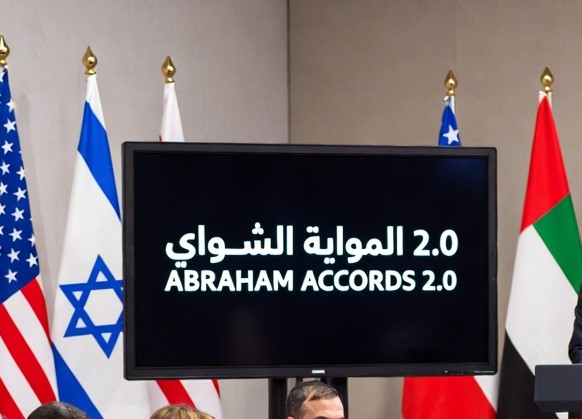
However, this time Donald Trump’s vision for the scope and meaning of the Abraham Accords is clearly far broader. Abraham Accords 2.0 envisions the formation, under U.S. auspices, of a large-scale economic, political, and — not least — defense-oriented strategic alliance in the eastern segment of the “Greater Middle East.” Such an alliance could become a serious counterweight to the anti-Western axis of Moscow and Beijing across Central, South, and Southeast Asia, and in the Middle East — to the jihadist regime of the Shiite ayatollahs in Tehran and its satellites, patronized by those global competitors for influence in the “Global South.”
In light of these prospects, the expanded version of the Abraham Accords could also include states that have maintained diplomatic and partnership relations with Israel for several decades already, in some cases quite close ones.
It was expected that among such states the first candidate to join this project would be Azerbaijan, which has maintained long-standing strategic partnerships with Israel in diplomacy, economics, and security, driven by shared challenges and threats emanating from the Iranian bloc. Moreover, it was assumed that Baku would be able to persuade other post-Soviet Central Asian states — and the entire Turkic world — to join this “pact of reconciliation”.
Unsurprisingly, the pro-government Iranian think tank Iran Diplomacy expressed concern, stating that “by bringing Central Asian countries closer to Israel, Baku is seeking to enhance its own ties with the United States and bolster its role in Washington’s regional policy”.
Their concerns were well-founded: with Baku launching the ambitious Middle Corridor (TITR) project — a trade route from Southeast Asia to Europe via Central Asian states — Azerbaijan is becoming one of the critical links in a developing transcontinental network. Israel may find itself integrated not only into this promising trade architecture, but also into the merging of the “extended” Abraham Accords with the India–Middle East–Europe Economic Corridor (IMEC) — a 5,000-kilometer transport and infrastructure system consisting of a rail link, an electricity grid, a hydrogen pipeline, a high-speed data cable, and other elements. IMEC is envisioned as an economic-geopolitical alternative to China’s Belt and Road Initiative.
Why Kazakhstan?
Yet the first post-Soviet Turkic state to openly declare its intention to join Abraham Accords 2.0 was Kazakhstan — as officially announced by President Kassym-Jomart Tokayev during his meeting with Donald Trump on 7 November of this year.
Signs that such an initiative was already being diplomatically prepared became evident earlier, on 12 June of this year, following a meeting in Washington between U.S. Secretary of State Marco Rubio and his Kazakh counterpart Murat Nurtleu.
The starting point for the process that culminated on 6 November at the second “U.S.–Central Asia” summit, held at the White House, was the creation ten years earlier of a forum aimed at advancing economic and geopolitical cooperation between the United States and the five post-Soviet Central Asian states — Kazakhstan, Kyrgyzstan, Tajikistan, Turkmenistan, and Uzbekistan.
For the first several years, cooperation occurred primarily through contacts among foreign ministers. However, the clear mutual interest — and the regional leaders’ desire to diversify their systems of strategic partnership beyond Russia, which had remained the dominant geopolitical force in the region for three decades after the USSR’s collapse — gradually elevated U.S.–Central Asian cooperation in the C5+1 format to the highest political level.
This trend accelerated sharply after Russia’s full-scale invasion of Ukraine in February 2022. In the same year, the Secretariat of the C5+1 group was established, aiming to further institutionalize the platform and expand U.S.–Central Asian engagement in support of shared priorities.
And already in September of the following year, 2023, the summit in New York brought together the leaders of the post-Soviet Central Asian republics — hosted by then U.S. President Joe Biden.
The new/old master of the White House, Donald Trump, continued this tradition: the second summit of the C5+1 forum took place in Washington a little over a year later — on 7 November 2025. It was on this occasion that the official and ceremonial announcement of Kazakhstan’s entry into the Abraham Accords was made.
Although many observers, noting that Kazakhstan — the largest and most economically powerful state in the region — has actually had formal relations with Israel since 1992, downplayed the significance of Astana joining the Accords and considered its move primarily a symbolic gesture, as noted by Dov Zakheim, a columnist for the semi-official Washington outlet The Hill, in fact, Kazakhstan’s accession signifies far more than merely a rubber stamp of a long-standing relationship.
Indeed, Kazakhstan, according to observers, has emerged as the United States’ primary economic partner in Central Asia, accounting for over 96% of Central Asia’s U.S. exports (approximately $2.4 billion out of a regional total of $2.5 billion). U.S.–Kazakhstan trade has grown meaningfully in recent years. Bilateral trade peaked in 2024 at $4.2 billion, the highest level in six years, with U.S. exports to Kazakhstan accounting for 53.2% of the total.
Although in the first eight months of 2025 total trade between the two countries experienced a 25.8% drop compared to the same period in 2024, U.S. exports to Kazakhstan remained relatively stable. So for the United States, Kazakhstan might be seen as a “flagship” in converting diplomatic engagement into tangible deliverables: critical minerals (antimony, tungsten, rare earth elements, and 40% of the uranium deposits in the world), regional connectivity, and security coordination.
In light of these trends, for Astana — as President Kassym-Jomart Tokayev openly stated while departing for the Washington summit — joining the expanded version of the Abrahamic alliance “means that we will receive certain dividends in terms of economic cooperation,” that is, this is mostly about bilateral relations with the United States. And the traditional “good relations with Israel and the Middle Eastern countries” serve as a positive backdrop on the way to that goal. (In the wording of the country’s Foreign Ministry statement — “this important decision is taken exclusively in the interests of Kazakhstan and fully corresponds to the balanced, constructive, and peace-loving foreign policy of the republic”.)
Although even in this sense it is hardly worth fully accepting the opinion of those who see Astana’s move — and, potentially, future moves by other Central Asian leaders — as “an attempt to find creative ways to secure foreign policy victories for Trump and earn his favor at minimal cost to themselves.”
In any case, in the vision of Trump’s team, however important the economic aspect may be for the United States in its relations with Kazakhstan, and whatever political image dividends it might bring, this is clearly not the limit of their ambitions. Likewise, in our view, it is not limited to the desire to find an alternative to the stalled process of expanding the first circle of the “Abraham Accords,” which came to a halt after the Hamas terrorist attack on Israel on 7 October 2023 and the beginning of Israel’s military operation in the Gaza Strip.
The struggle for rare earths and other valuable minerals is a critical element of Washington’s regional and global geopolitical game — including, and possibly among its highest priorities, in its confrontation with Beijing and, to some extent, Moscow. And Central Asia occupies far from the least important place in this context. All the more so because it is precisely there that the eastern flank of the strategic geopolitical and economic alliance of U.S. partners on the Asian continent is located.
By entering Central Asia on such a scale, Trump, in search of a weak link on the geographic axis between the two contenders for leadership in the “Global South,” as noted in conversation with the author by the respected Israeli military and political analyst Grigory Tamar, “is in effect putting his boot between China and Russia.” If Trump indeed succeeds in linking all these states — from post-Soviet Central Asia to Israel and Saudi Arabia, and the members of its bloc — into a single economic and defensive alliance, Tamar argues, “then considering their combined volume of raw materials, technologies, military capabilities, economic and industrial resources, and so on, we will get a construction that may well surpass the former Soviet Union in its potential… And integrating such a conglomerate with India would allow Trump to build a monster that even China will not be able to cope with”.
Interim conclusions and possible prospects
So, while the American strategy on this issue is complex, multifaceted, yet overall fairly transparent, their South Caucasian and Central Asian counterparts are still determining not so much the general idea — which appears broadly acceptable to them — as the methods of integrating themselves into the Abraham Accords 2.0 and the potential consequences of such a step.
On the one hand, for the Central Asian states, participation in the project offers an opportunity to maintain their multi-vector foreign policies, avoiding dependence on either Russia or China. On the other hand, as they move closer to the West, it remains equally important not to damage relations with Moscow or Beijing. It is telling that on 11 November, exactly four days after participating in the Washington “5+1” summit, Tokayev travelled to Moscow for a meeting with Russian President Vladimir Putin. The meeting resulted in the signing of a Declaration on elevating interstate relations between Russia and Kazakhstan to the level of a comprehensive strategic partnership and alliance, which, as one can see, was not hindered by Astana’s recently announced rapprochement with Washington and may even have accelerated the process. (Notably, once the presidential aircraft crossed into Kazakhstan’s airspace, it was escorted by an honor guard of the Russian Air Force.)
Another indicator of Astana’s updated multi-vector policy was a speech delivered on 11 November of this year at the academic conference “Expanding Horizons of BRICS Cooperation” held at the Moscow State Institute of International Relations. Rustem Kurmanguzhin, a professor at Narxoz University in Almaty, proposed an innovative idea: that BRICS countries should view the current U.S. Republican administration not as a geopolitical rival or adversary, but as a “potential situational ally”.
It is difficult to imagine that this proposal — voiced by Kurmanguzhin, a figure close to President Kassym-Jomart Tokayev and formerly his colleague in Kazakhstan’s Foreign Ministry — was not previously coordinated and likely approved at the level of both Kazakh and Russian leadership. And considering that today China, even more than Russia, sets the tone within BRICS — an organization created, as analysts note, “to expedite the rebalancing of global power away from the West”, this seemingly academic proposal also contains a message directed toward Beijing.
The next unresolved question concerns the reasons why Azerbaijan did not become the first to embark on the path toward a new interpretation of the Abraham Accords. Three explanations are commonly offered.
The first: Azerbaijan had indeed hoped to become the first post-Soviet Muslim country in Asia to join the Abraham Accords 2.0, expecting that, along with importing weapons from Israel and Turkey, it would gain direct access to American defense technologies. In this view, Kazakhstan’s move came as a considerable surprise to Baku. However, it is difficult to believe that Azerbaijan was so unaware of ongoing developments that — had it had such intentions — it would have failed to stake its claim to a leading role in the emerging process of rapprochement among the Muslim states of the former USSR.
The second explanation: Azerbaijan, whose relations with Israel are at the level of de facto strategic partnership, must also take into account the position and interests of its strategic partner both de facto and de jure — Turkey, including the moods (and at times, the “whims”) of that country’s president, Recep Tayyip Erdoğan. President Ilham Aliyev has repeatedly succeeded in reducing tensions between Jerusalem and Ankara and even achieving, at least at the declarative level, normalization of their economic and diplomatic contacts. Yet Erdoğan has consistently disrupted this process from within.
Today, despite Azerbaijan’s considerable political experience and successful diplomatic efforts within the Baku–Jerusalem–Ankara triangle, its leadership appears somewhat constrained in its maneuverability along the Israel–Turkey axis. If so, a declarative accession of Azerbaijan to a defense alliance with Israel could appear as a provocative gesture toward Turkey, whose leader is currently displaying yet another escalation of anti-Israeli rhetoric. If this is the case, then Azerbaijan — especially against the backdrop of its increasingly complicated relations with Russia over the past year — clearly cannot afford to provoke Ankara, whose assistance, including military assistance, Baku may need in the event of new tensions with Moscow.
And the third hypothesis — which to the author of these lines appears the most logical, though it may not exclude the previous two — is the following: from the perspective of Azerbaijan’s leadership, it would be far more rational if the official declaration of Baku’s accession to the expanded version of the Abraham Accords were to become a symbolically significant culmination of the formation of the aforementioned U.S.–Middle Eastern supra-regional bloc, rather than a loosely binding “declaration of intent.”
If this hypothesis is at least partially correct, the Azerbaijani leadership may be taking into account the experience of the Saudi leadership, which at the dawn of the Abraham Accords 1.0 preferred to “let their closest allies from the Saudi bloc — the UAE and Bahrain — go first,” expressing their intention to join the process only if it proved its relevance, and not before the United States and Israel were able and willing to accommodate the requirements and conditions of official Riyadh. Considering that Azerbaijan, within the new geopolitical framework outlined by the Abraham Accords 2.0, is expected to become a key supporting element of the Washington–Jerusalem–Baku axis — playing on the western-northern flank of the Middle East–South Caucasus macro-region a role similar to that which Saudi Arabia is supposed to play on its western-southern flank in the Washington–Jerusalem–Riyadh vector — the Azerbaijani leadership indeed has no need to rush.
And finally, what place does the Jewish state itself occupy in this diplomatic wave triggered by Kazakhstan’s announcement of its accession to the Abraham Accords?
At first glance, the main contacts and negotiations with the project’s new potential participants are being conducted directly by the U.S. administration, giving the Israeli leadership, for the moment, the role of a “side observer.” At the same time, there is reason to assume that behind Trump’s message about the “very good,” as he put it, phone conversation he held in parallel on 7 November with Israeli Prime Minister Benjamin Netanyahu and Kazakhstan’s President Kassym-Jomart Tokayev, there is something more than a polite gesture toward the Israeli partner. At least in theory, this gives the Prime Minister’s Office grounds to claim that everything is taking place in close coordination with Jerusalem — which may well correspond to reality. And it may allow Netanyahu and his government to somewhat strengthen their not especially high standing in the eyes of Israeli society, where the news of the U.S.–Kazakh initiative was received positively, but without the excitement that accompanied the first reports of breakthroughs in relations with the Arab monarchies of the Persian Gulf a little more than five years ago.
Moreover, even at this early stage, Israel is already gaining new and interesting opportunities. In particular, there is considerable potential for expanding Israeli arms exports to the Central Asian states, including Kazakhstan, with which Israel’s defense industry previously carried out a number of joint military projects (especially in 2007–2009), though later cooperation declined due to access-level restrictions. Clearly, Kazakhstan’s participation in the Abraham Accords is capable of lifting such restrictions, and Israel’s defense industry may gain access to a market that was previously partially closed.
Last but not least for Israel: unlike the Saudis — who demand a solution to the Palestinian issue as an ultimatum-like condition for normalizing relations with Israel — the Kazakh leadership, it appears, is not particularly concerned with this matter. In any case, Astana virtually ignored the statement issued by the leaders of the Hamas terrorist organization, who described Kazakhstan’s decision to join the Abraham Accords and strengthen the country’s ties with Israel as “justifying genocide,” allegedly committed by Israel in the Gaza Strip, and called for “Islamic solidarity,” demanding that all Muslim countries sever relations with Israel. Tokayev himself limited his response to a noncommittal affirmation of the “good relations with Israel and the countries of the Middle East” that Kazakhstan had always maintained, and that its accession to the Abraham Accords would be “a logical continuation of current policy.”
It is not impossible that a similar reaction could be expected from the leaders of other potential entrants into the Abrahamic bloc with the United States and Israel among the post-Soviet Central Asian states — including Uzbekistan, Turkmenistan, and possibly even (though less likely) Tajikistan, where, unlike in the more moderate, “ethnically Muslim” Kazakhstan, internal and external threats from radical Islamist groups are felt quite acutely. However, at the time of writing, these states are still refraining from binding steps or statements.