
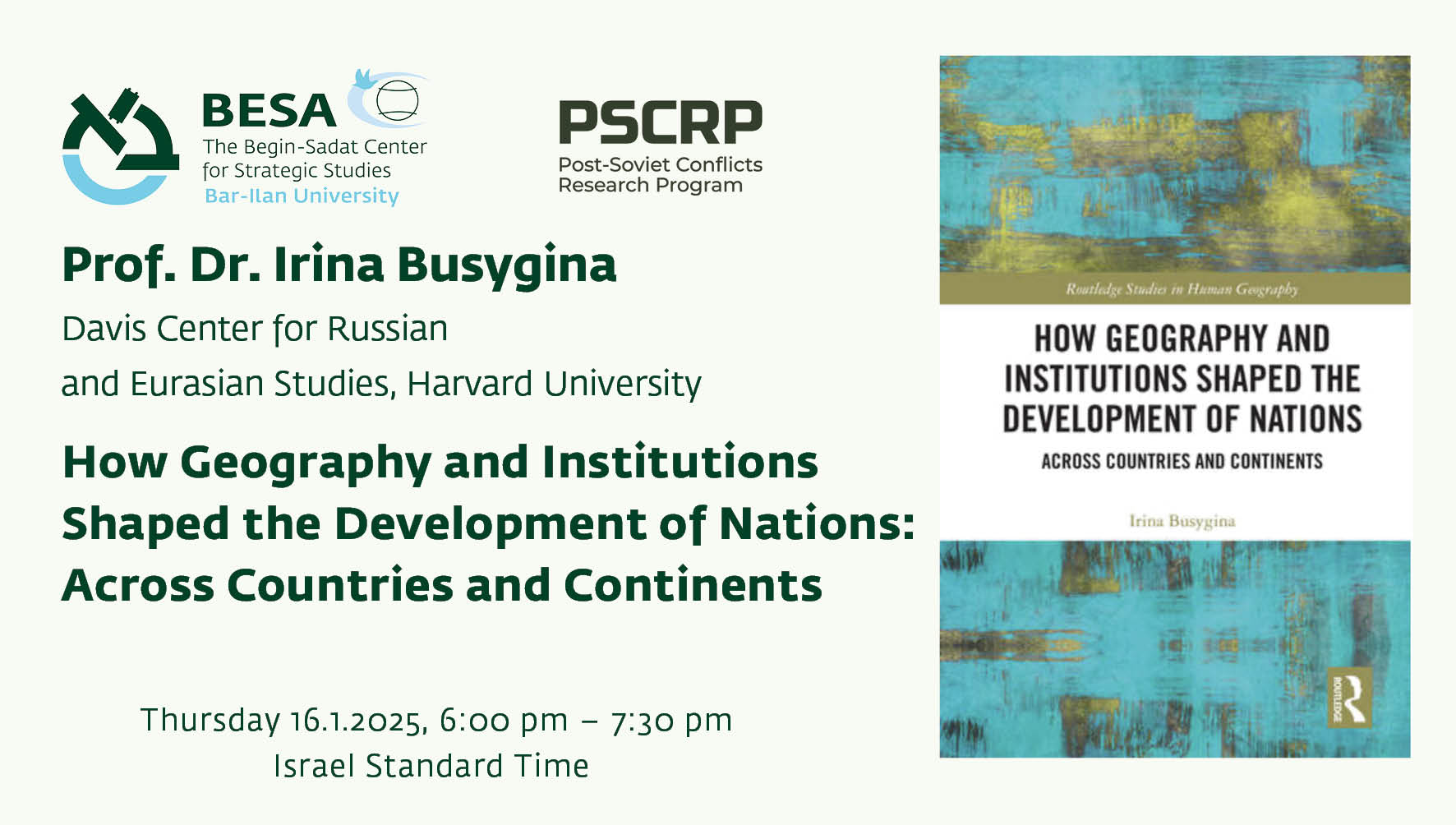
On Thursday, Jan 16, 2025, the Post-Soviet Conflicts Research Program at the BESA Center organized a virtual discussion of the new book by Prof. Dr. Irina Busygina, “How Geography and Institutions Shaped the Development of Nations: Across Countries and Continents” (Routledge, 2024).
The monograph analyzes the intersection of institutions and geography on the examples from various parts of the world, and the impact that different combinations of institutional and geographical systems have on nations’ development. The website of Routledge divides the book structurally into two parts. The first part examines the main contributions to the understanding of development under the influence of geographic and institutional factors, as well as state’s geographic attributes and borders as geographic institutions. The second part immerses the reader in empirical material, presenting various cases on different continents in different historical periods.”
Prof. Dr. Vladimir (Ze’ev) Khanin, the Head of the PSCRP, greeted the audience, introduced the speaker, and commented on the program’s mission in relation to the book’s focus. After this, Dr. Petr Oskolkov, who was moderating the discussion, gave the floor to Irina Busygina. She briefly introduced her book’s main ideas and the problems covered, as well as commented on her personal incentives to write it – mainly, to bring the geographic factors back into the debates about the role of institutions and developmental trajectories, while balancing between the poles of geographic determinism and indeterminism. Prof. Busygina paid special attention to the case of Russia, placing that country’s geographical institutions in the context of political development, the “unlimited state” concept, and the disputes about “what it means to be a normal country.”
The author’s introduction was followed by a vivid discussion. The participants, who represented leading universities and think tanks of Israel, the United States, France, and other countries, asked questions about the optimal configuration of a country’s borders, specifics of the spatial clustering approach to the Israeli situation, separatism potential and risks, factors influencing the “localization” of institutions, etc.
Prof. Dr. Irina Busygina is a Research Scholar at the Davis Center for Russian and Eurasian Studies at Harvard University, where she leads the Initiative for Analyzing Post-Soviet Reform Proposals. She is also a researcher at the Centre for Eastern European and International Studies in Berlin, where she works on the project The Implications of War for Russia’s Center-Regional Relations and Territorial Stability. Her research focuses on comparative federalism, regionalization, and decentralization in authoritarian countries of the post-Soviet space, as well as on Russian foreign policy. Irina Busygina is particularly interested in the role of institutions in authoritarian settings.