Perspectives Papers

Perspectives Papers provide analysis from BESA Center research associates and other outside experts on the most important issues pertaining to Israel and the Middle East.

View Archive

In today’s fast-paced technological environment, defense systems can no longer rely solely on internal R&D. Open innovation—systematically engaging with startups, academia, and civilian tech sectors—has become a strategic necessity. The distinct cases of the US and Israel suggest that diverse models can serve a shared imperative: to leverage civilian innovation in order to maintain national security and a technological edge.
Though an increasing number of states plan to recognize a Palestinian state, no such action—even in large numbers—can confer sovereignty. Under international law, statehood is “independent of recognition by the other states.” Such juridical status is based on Montevideo Convention (1933) requirements of (a) a permanent population; (b) a defined territory; (c) a government; and (d) the capacity to enter into relations with other states. In the specific matter of Israel, recognizing a Palestinian state would undermine a core provision of the Oslo Accords and corollary Arafat-Rabin commitments not to alter the status of territory prior to formal agreement on permanent status. Such premature recognition would also be at odds with the status of the EU and other states as witnesses to the Oslo Accords, and with the multiple endorsements of those Accords expressed in UN resolutions. Acts of recognition in this matter would prejudge the outcome of negotiations that were never completed because of relentless Palestinian terrorism, and would violate the Natural Law origins of international law.
The Israel National Cyber ​​Directorate (INCD) recently published an update of the country’s cyber security strategy. While the new strategy develops and updates the principles of its 2017 predecessor, it differs in its fundamental concept. The new version derives from broad national objectives in the cyber domain and focuses on protecting the means of securing core national processes and infrastructure. It addresses issues such as how to define the whole of national cyber security and how to deal with the technological supply network. The document is also influenced by the Iron Swords War in several ways. The strengths of the INCD should be built to the point that it can position itself as a leading part of the governmental and national cooperation network that will be required for implementation.
Since October 2023, Israel’s primary strategic vector has been a campaign against its enemies in the region. This campaign is nearing its end. In the coming months, the open security issues of Gaza and Iran will be decided. The next strategic vector should be a reorientation of the national focus from a security-level “strike force” to a national-level “prime force”, as David Ben-Gurion did after the War of Independence. Israel should turn its attention to five “national projects”: a public transportation network, a computing network, advanced computing infrastructure, a health and welfare response to population growth, and a longstanding relevant and strong security force.
The Israeli intelligence system failed to understand the significance of the gender-based violence committed by Hamas on Israeli citizens during the October 7 attack. Raw information was not converted into meaningful insights that could have aided in strategic and operational decision-making. The failure stemmed in part from a lack of information, but also from an inability to analyze the information that was available, identify patterns, and prevent errors arising from cognitive bias and methodological obstacles. Hamas used gender-based violence as a deliberate strategy intended to cause severe harm to Israeli civilians, undermine Israelis’ sense of social security, and sow terror within Israeli society. Israeli intelligence failed to identify Hamas’s intentions prior to the attack and subsequently failed to deal effectively with the denials of Hamas and its supporters in the international system.
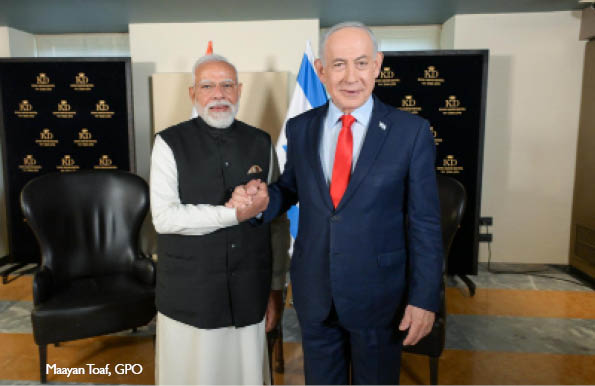
In May 2025, following a deadly terrorist attack on Pahalgam in Kashmir, India suspended the Indus Waters Treaty with Pakistan, conducted strikes deep within Pakistani territory, and declared that any future terrorist attack would henceforth be considered an act of war. These measures reflect a doctrinal shift from a policy of deterrence to one of “compellence”, or coercion. India has also unveiled unprecedented upgrades to its military capabilities that are part of a comprehensive organizational reform. India is positioning itself as a global military and technological power that is operating under a sovereign and independent strategy. This shift in India’s doctrinal approach reflects a continuation of its response to Hamas's attack on Israel on October 7, 2023. According to Indian nationalists, Israel’s response to Hamas’s massive assault served as inspiration for an uncompromising policy towards Islamic terrorism.
In September 2023, the IMEC initiative was announced. IMEC is an economic corridor that will connect India, the Middle East and Europe, with the support of the United States. This initiative has the potential to change the face of global trade and transportation. The corridor is expected to strengthen economic, transportation and energy ties among the countries and serve as a digital bridge between continents. IMEC offers Israel a strategic opportunity to position itself as a transit hub between Asia and Europe and strengthen its regional ties – but the initiative faces geopolitical challenges that require strategic planning and smart regional cooperation.
It is the obligation of every state to enforce the law of nations. This means there is a universal legal responsibility to support Israel’s ongoing counter-terrorism operations in the Middle East. Though it may appear that these operations sometimes break humanitarian international law, it is the jihadists’ use of human shields and location of military facilities within schools and hospitals that is responsible for the resulting harm to civilians. These actions, which constitute a violation of international law called “perfidy”, threaten not only Israel but the global legal order itself.
On March 30, 2025, Greek Prime Minister Kyriakos Mitsotakis met with President Isaac Herzog and Prime Minister Benjamin Netanyahu in Jerusalem. Fifteen years after the historic visit to the Israeli capital by then-premier George Papandreou, which paved the way for the ongoing Greek-Israeli friendship, the two countries are continuing to advance their strategic partnership. The necessity for closer ties with the Jewish State has become a critical element of Greek foreign and military policy, and there is political consensus on the value of the relationship. New defense synergies that will likely complement older agreements are currently on the agenda.

Accessibility Toolbar