BESA Center Perspectives Paper No. 2,394, July 8 , 2026
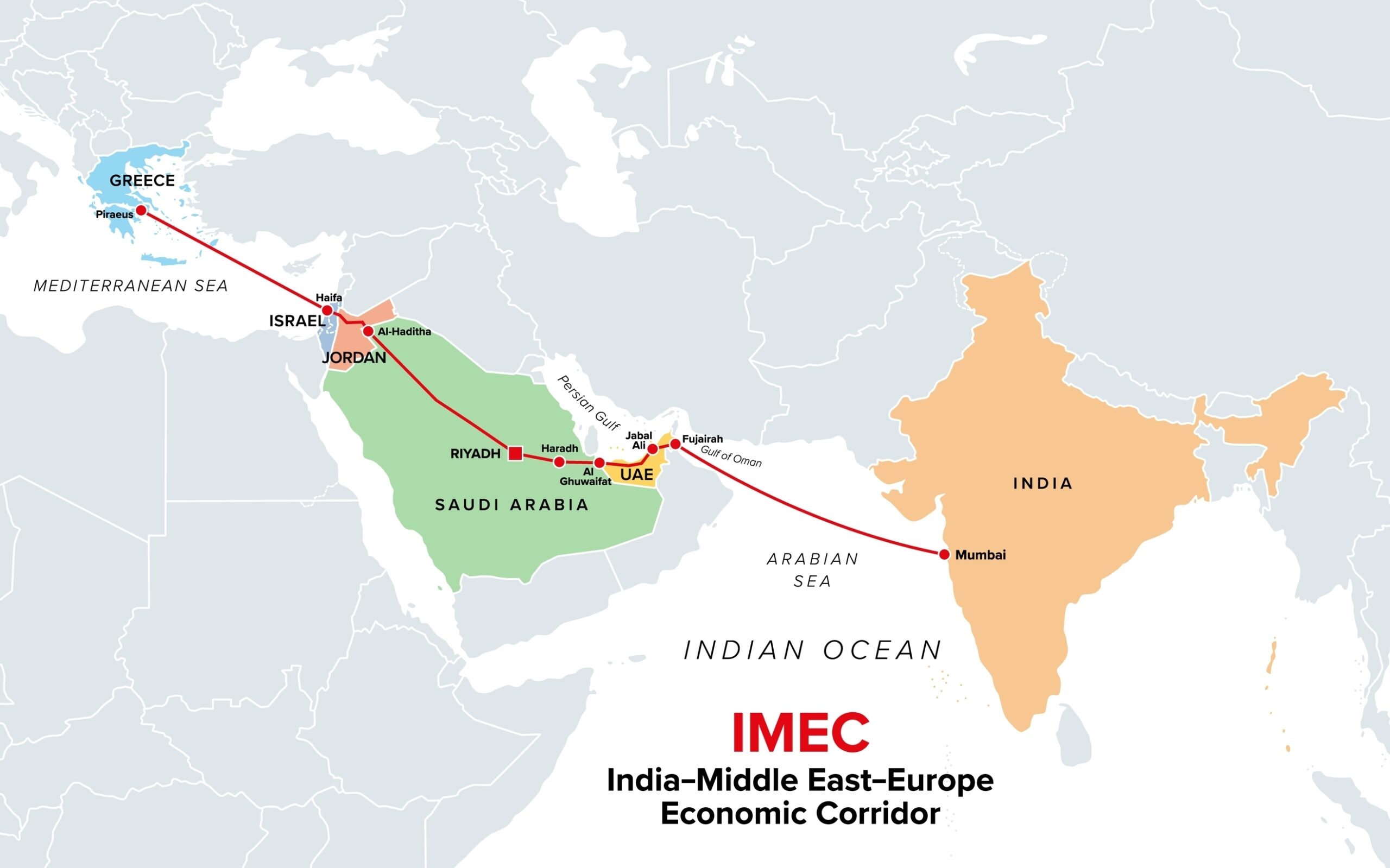
EXECUTIVE SUMMARY: The India-Middle East-Europe Economic Corridor (IMEC) is a seminal connectivity initiative linking India, the Middle East, and Europe. For it to succeed, its infrastructure, routes, ports, and chokepoints must be effectively protected. This applies across the maritime space stretching from the Indian Ocean to the Eastern Mediterranean. Attacks on commercial shipping in the Red Sea, persistent tensions around the Strait of Hormuz, and the growing vulnerability of undersea infrastructure have highlighted the security challenges facing contemporary trade networks. In the current security environment, Greece, Israel, and India occupy key positions along the corridor. Together, they form a maritime chain linking the Indo-Pacific to Europe via the Eastern Mediterranean. The convergence of their strategic interests, geographic locations, and maritime capabilities lays the foundation for a new security architecture conducive to the wider objectives of the IMEC. Through naval cooperation, maritime domain awareness, critical infrastructure protection, and professional military education, these three countries have an opportunity to shape a more resilient East-West corridor extending from Mumbai to Souda Bay.
Geography as strategic advantage
Geography remains one of the most enduring ingredients of national power. India occupies a central position in the Indian Ocean, through which a substantial share of global trade and energy passes. India’s Maritime India Vision 2030 explicitly identifies maritime connectivity, shipping, and port infrastructure as drivers of national development and strategic influence. Israel similarly occupies a key location between the Mediterranean and the Middle East, and its ports, energy infrastructure, and proximity to regional corridors make it an increasingly important bridge between Europe and Asia. Greece controls a strategic maritime gateway connecting the Mediterranean, the Black Sea, and continental Europe. Its geopolitical footprint is further amplified by shipping: Greece possesses the world’s largest merchant fleet, with nearly 5,800 vessels. This constitutes more than 19% of global tonnage and approximately 61% of the EU-controlled fleet. This gives Greece an unparalleled strategic advantage for European autonomy, resilience, and maritime security.
These three states form a continuous maritime arc extending from Mumbai to Haifa and from Haifa to the entire Eastern Mediterranean. As geopolitical tensions continue to affect traditional supply chains, this arc is becoming an increasingly critical route between Asia, the Middle East, and Europe.
The security imperative
Recent developments have exposed the vulnerability of global maritime networks. Since 2023, attacks on commercial shipping in the Red Sea have forced vessels to reroute around Africa, increasing costs and disrupting supply chains. Tensions around the Strait of Hormuz continue to remind policymakers that a considerable share of global energy exports still passes through a narrow, vulnerable maritime chokepoint. Thus, the strategic value of the Strait of Hormuz extends far beyond the Gulf region.
For Greece, maritime security is inextricably tied to national prosperity, European resilience, and the stability of global trade. Greek shipping remains the world’s leading cross-trading fleet. Its strategic significance is particularly evident in oil tankers and LNG carriers, where Greece holds a dominant global position. More than 98% of the Greek-owned fleet capacity serves trade between third countries. Greek-owned vessels made more than 175,000 port calls in 171 countries in 2025. As noted, Greek shipping accounts for 61% of the EU-controlled fleet and thus constitutes a core asset for the EU’s autonomy, energy security, food security, and supply-chain resilience.
For Israel, the protection of offshore energy infrastructure has evolved into a strategic priority. The development of major natural gas fields has strengthened Israel’s energy security and turned the Eastern Mediterranean into a pivotal energy-producing region. It has also elevated maritime security to one of the key parameters of national security planning. The protection of offshore platforms, subsea pipelines, and maritime access is directly associated with Israel’s national resilience, regional energy cooperation, and potential future exports to Europe. Israel’s offshore energy sector is overseen by the Ministry of Energy and Infrastructure, which regulates exploration and production activity and supervises work programs, safety and environmental standards, infrastructure development, and production data. Through its Energy at Sea framework and the Israeli Ministry of Energy’s Petroleum Repository, Israel provides structured information on offshore and onshore oil and gas activities. This underscores the strategic significance of maritime energy for national resilience, regional cooperation, and exports to Europe.
India’s maritime aspirations are clearly articulated in Maritime India Vision 2030 (MIV 2030), a comprehensive national strategy designed to transform the country into a leading sea power. MIV 2030 was formulated with the objective of propelling India to the forefront of the global maritime sector. It identifies more than 150 initiatives across 10 main categories spanning the entire Indian maritime sector, including port infrastructure, logistics efficiency, technology, shipbuilding, inland waterways, sustainability, maritime cooperation, and seafarer training. In strategic terms, this vision reflects India’s wider ambition to link economic growth, maritime capacity, and influence across the Indian Ocean region and beyond.
As India seeks to strengthen its economic connectivity with Europe and maximize its influence across the Indo-Pacific and the Indian Ocean, the Eastern Mediterranean region assumes growing strategic value as a gateway linking Asia, the Middle East, and Europe. Greece and Israel provide India with reliable maritime partners situated along important sea lines of communication and emerging economic corridors, including the IMEC. This cooperation strengthens the linkages between the Indo-Pacific and European markets while supporting resilient trade, energy, and logistics networks.
The maritime dimension of the IMEC
Much of the public discourse about the IMEC has focused on ports, railways and logistics infrastructure. Yet the maritime dimension may ultimately prove more crucial than the physical assets. The corridor depends on secure maritime routes from the Indian Ocean to the Mediterranean. Without effective maritime security, infrastructure investment alone cannot guarantee connectivity.
Greece, Israel, and India could gradually forge a partnership revolving around maritime domain awareness, intelligence sharing, anti-submarine warfare, cybersecurity, unmanned systems, and critical infrastructure protection. Such cooperation would not necessarily morph into a formalized trilateral military alliance. Rather, it would offer a pragmatic framework anchored in common interests and shared strategic concerns. Over time, these initiatives could evolve into a broader maritime security network that supports the IMEC’s general mission.
One promising milestone would be the establishment of a Greece-Israel-India Maritime Task Force in the Eastern Mediterranean. This scheme should not be construed as a standing multinational armada. Instead, it could involve rotational deployments, coordinated naval exercises, maritime surveillance, and strategic port visits. The purpose would be to enhance interoperability, strengthen maritime situational awareness, and showcase a collective commitment to regional stability. Such a framework would mirror existing multinational maritime cooperation initiatives while avoiding the political complexities of formal alliance structures.
The strategic triangle: Souda Bay, Limassol, and Haifa
The geographical configuration of the Eastern Mediterranean provides an ideal foundation for deeper naval cooperation. Souda Bay in Crete is among the most important naval facilities in the Mediterranean. Its deep-water port, strategic location, and extensive support infrastructure make it an operational hub for NATO, the US, and allied maritime forces. Cyprus, with Limassol as a central maritime node, occupies an equally crucial position at the crossroads of Europe, the Eastern Mediterranean, and vital trade routes linking the Mediterranean to the Suez Canal and the Red Sea. Further east, Haifa is both a major commercial port and a key component of Israel’s maritime security architecture.
Souda Bay, Limassol, and Haifa form a strategic triangle that can support maritime operations, logistics, joint exercises, surveillance, and crisis-response activities across the Eastern Mediterranean. Regular deployments linking these three locations would provide valuable operational experience, boost maritime situational awareness, and reinforce the maritime dimension of the IMEC. Port visits, joint drills, and coordinated patrols would foster habits of cooperation and demonstrate the growing strategic connection between the Eastern Mediterranean and the Indo-Pacific.
Training and interoperability: The role of the NMIOTC
Effective maritime cooperation entails common procedures, shared operational concepts, and professional familiarity among participating forces. The NATO Maritime Interdiction Operational Training Centre (NMIOTC), located within the Hellenic Navy’s Souda Naval Base in Crete and accredited by NATO’s Allied Command Transformation, is the only NATO education and training facility dedicated to the maritime domain. Its mandate focuses on combined training for NATO forces and partners in support of maritime interdiction operations, including surface, sub-surface, aerial surveillance, and special operations activities.
Within a prospective Greece-Israel-India strategic triangle, training could include maritime interdiction operations, boarding procedures, protection of merchant shipping, counterterrorism at sea, maritime operational law, cybersecurity, unmanned systems integration, and critical infrastructure protection. But the strategic value of the NMIOTC is not confined to professional training. It brings Greece to the forefront of the professional military education and interoperability architecture that could underpin an IMEC maritime security framework.
Protection of critical maritime infrastructure
The protection of critical maritime infrastructure is emerging as a defining security challenge in the 21st century. Modern economies depend on undersea cables, offshore energy facilities, LNG terminals, ports, and digital communication networks. NATO’s Alliance Maritime Strategy emphasizes maritime security, the protection of critical undersea infrastructure, and enhanced maritime situational awareness.
In these sectors, Greece, Israel, and India possess complementary capabilities and converging interests. Undersea cables, pipelines, offshore platforms, LNG terminals, and port systems are no longer purely commercial assets; they are strategic nodes susceptible to sabotage, hybrid pressure, and coercive signaling. Cooperation in underwater surveillance, autonomous systems, data collection, maritime intelligence, wargaming, and seabed monitoring would strengthen resilience while supporting the security of the IMEC and the wider maritime commons.
An additional practical step would be the creation of a Greece-Israel-India observatory on hybrid threats. This would serve as a permanent analytical and early-warning mechanism focused on maritime hybrid activities, cyber threats, disinformation, sabotage risks, and threats to shipping or undersea infrastructure. By combining open-source intelligence, maritime domain awareness, and expert liaison, it could ensure attribution, crisis anticipation, and regular strategic evaluations for policymakers.
Conclusion
The strategic implications of the IMEC will ultimately be measured not by the volume of investment it will attract but by its ability to operate securely in periods of both peace and turmoil. Connectivity and security are closely intertwined. Without credible protection of waterways, energy infrastructure, and digital networks, even the most ambitious connectivity projects remain vulnerable to disruption. India, Israel, and Greece possess complementary strengths that enable them to address this challenge. India brings economic weight and maritime reach across the Indian Ocean. Israel serves as a bridge between the Gulf and the Mediterranean. Greece offers strategic access to Europe, a world-leading maritime sector, a highly competent and well-equipped naval force, and key naval infrastructure centered around Souda Bay. Together, these three nations can bolster a maritime partnership along one of the 21st century’s most important – and most sensitive – maritime corridors.
The Greece-Israel-India axis would lend the IMEC greater strategic depth. By linking the Indian Ocean, the Gulf, the Eastern Mediterranean, and Europe through dependable partners, the corridor would rest not only on physical infrastructure but also on ports, naval facilities, maritime domain awareness, training centers, and political coordination. This would render the IMEC more resilient to disruption, coercion, and hybrid pressure. Proposals for closer naval engagement, regular deployments linking Souda Bay, Cyprus, and Haifa, and expanded use of the NATO Maritime Interdiction Operational Training Centre should therefore be perceived not as isolated initiatives but as core elements of judicious security planning. These measures would foster interoperability, improve maritime resilience, and guarantee the protection of critical infrastructure across the IMEC.
As geopolitical rivalries increasingly shift towards the maritime domain, the Eastern Mediterranean and the Indo-Pacific are becoming parts of a unified strategic space. In this context, synergies among Greece, Israel, and India are both a practical response to the security challenges emanating from and shaping the region and a substantive contribution to the long-term stability of the maritime corridors connecting Europe, the Middle East, and Asia.
Athanasios Drivas is a Commander in the Hellenic Navy and Deputy Commandant, Hellenic Navy Naval War College.
Prof. Vasileios Syros is a faculty member at the MSc Leadership: Ethics and Politics at the University of Athens and an Honorary Adjunct Fellow at the National Maritime Foundation (India).
DISCLAIMER
The views expressed in this article are personal and do not bind the Hellenic Navy General Staff (HNGS), nor do they reflect its policy or decisions.
BESA Center publications and research are made possible
in part thanks to the generosity of Saul Koschitzky and family