BESA Center Perspectives Paper No. 2,385, May 14, 2026
EXECUTIVE SUMMARY: The April 2026 meeting between South Korean President Lee Jae Myung and Indian Prime Minister Narendra Modi marks a shift in India-South Korea relations from economic engagement to strategic resilience amid a fragmenting international order. While the longstanding economic partnership, highlighted by the 2009 Comprehensive Economic Partnership Agreement, laid the groundwork for cooperation, current geopolitical tensions, including the war in the Persian Gulf, emphasize the need for enhanced collaboration in energy security, advanced manufacturing, and maritime stability. Both nations recognize the importance of diversifying partnerships to mitigate strategic vulnerabilities. Ultimately, the success of this partnership will hinge on institutionalizing cooperation and converting strategic intent into tangible industrial and technological advancements.
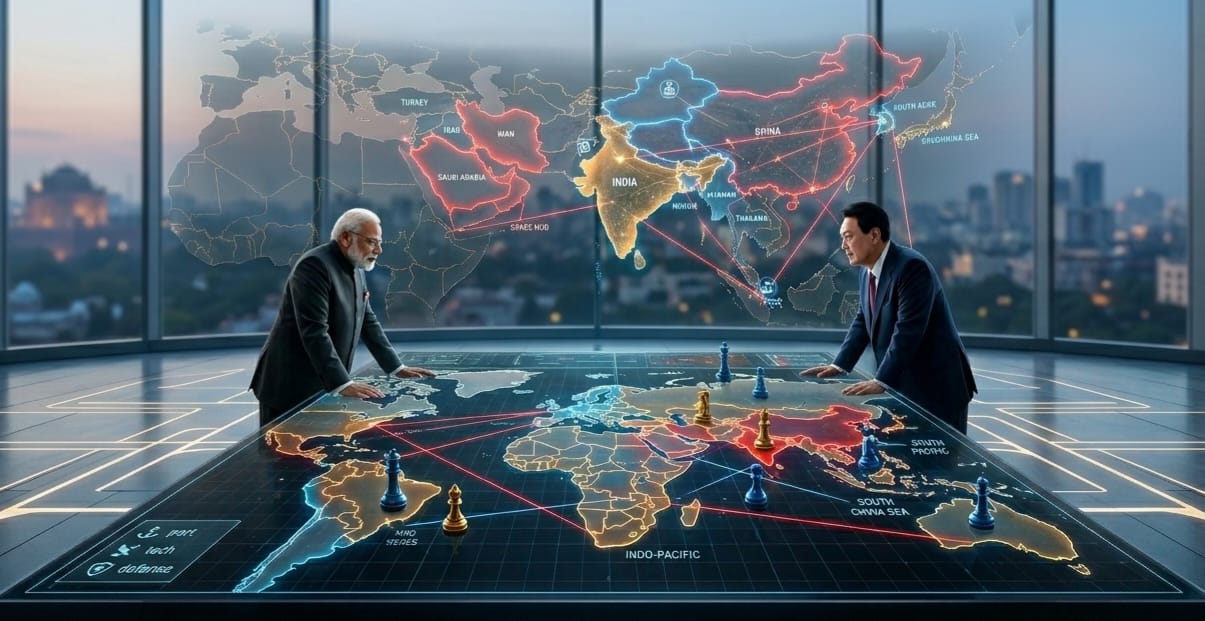
The April 2026 state visit of South Korean President Lee Jae Myung to India and his meeting with Prime Minister Narendra Modi in New Delhi demonstrate a significant geostrategic shift in India–South Korea relations. The visit took place against the backdrop of an increasingly unstable international environment: the war in the Gulf, growing security uncertainty in Asia, the intensification of great-power competition, and the need for middle powers to diversify partnerships beyond traditional alliance structures. For both Seoul and New Delhi, the meeting reflected a shared recognition that economic cooperation, energy security, industrial resilience, and maritime stability can no longer be separated from national security.
The economic dimension of the relationship has long served as the foundation for bilateral cooperation. The India-South Korea Comprehensive Economic Partnership Agreement (CEPA), signed in 2009 and implemented in 2010, reflected the countries’ desire to deepen trade ties in a changing global economy. For Seoul, India represented a major emerging market and an important gateway to the Global South. For New Delhi, South Korea offered advanced manufacturing capabilities, capital, technology, and industrial expertise that could support India’s long-term economic modernization.
However, the April 2026 visit suggests that the relationship is now moving beyond conventional trade. The two leaders agreed to work toward expanding bilateral trade from approximately $27 billion to $50 billion by 2030 and to upgrade their CEPA to address new areas of cooperation. These include clean energy, nuclear energy, semiconductors, critical minerals, steel, shipbuilding, artificial intelligence, and advanced manufacturing. This shift reflects a broader transformation: India and South Korea are not merely trying to trade more; they are trying to reduce their strategic vulnerability through economic interdependence.
The war in the Persian Gulf has sharpened this logic. It demonstrated the extent to which major Asian economies remain vulnerable to disruptions in oil and gas supplies, maritime routes, and insurance and shipping costs. Both India and South Korea are highly exposed to energy-market volatility. India imports much of its crude oil while South Korea’s industrial economy is heavily dependent on imported energy and seaborne trade. In this context, cooperation in clean energy, nuclear power, carbon markets, and critical resources is not simply an environmental or commercial agenda. It is part of a wider strategy of energy security and strategic resilience.
The relationship also reflects a changing balance of alliances. South Korea continues to regard its alliance with the United States as a central pillar of its security and diplomacy. The presence of US forces on the Korean Peninsula remains vital to Seoul’s deterrence posture, especially against North Korea. However, South Korea understands that reliance on Washington alone is no longer sufficient in a more fragmented strategic order. Disagreements between Seoul and Washington, including over the level of support South Korea is expected to provide in crises such as the war with Iran, have reinforced the need to broaden South Korea’s strategic partnerships. The Global Pivotal State strategy provides Seoul with a framework for expanding its diplomatic and economic reach beyond Northeast Asia.
India fits well into this strategic logic. Unlike South Korea, India is not a treaty ally of the United States. It continues to preserve strategic autonomy while deepening cooperation with the United States, Japan, Australia, Israel, France, the Gulf states, and other partners. India is an attractive partner for Seoul as it is not part of a rigid alliance bloc but is a central actor in the Indo-Pacific, the Indian Ocean, and the Global South. For India, South Korea offers a technologically advanced partner that can contribute to Make in India, Atmanirbhar Bharat (India’s self-reliance initiative), supply-chain diversification, and defense-industrial modernization.
Security is becoming an increasingly important layer of India-South Korea relations. Both countries face direct and indirect threats from state and non-state actors. India faces persistent pressure from China along the Line of Actual Control, cross-border terrorism linked to Pakistan, and growing Chinese activity in the Indian Ocean. South Korea faces the direct military threat of North Korea while also navigating China’s economic and strategic influence. Both countries are also vulnerable to threats to sea lines of communication, including disruptions in the Persian Gulf, the Arabian Sea, and the wider Indo-Pacific. The mining of maritime routes, attacks on commercial shipping, and risks to energy flows during Operation Epic Fury demonstrated that maritime insecurity in the Gulf can have direct consequences for Asian economies.
This is why cooperation between shipbuilding and port equipment deserves special attention. India’s dependence on Chinese-made port infrastructure and maritime equipment creates a strategic vulnerability. South Korea’s advanced shipbuilding industry can help India develop local capacity in maritime manufacturing, port modernization, and naval-industrial infrastructure. Such cooperation would serve both economic and security goals: it would support India’s aspiration to become a stronger maritime-industrial power while giving South Korea a deeper stake in the Indian Ocean region.
At the same time, the partnership should not be overstated. The central challenge is implementation. India-South Korea relations have often produced ambitious declarations without fully realizing their potential. India remains dissatisfied with the trade imbalance under CEPA, especially South Korea’s large trade surplus. Non-tariff barriers, rules-of-origin disputes, regulatory uncertainty, land acquisition difficulties, high logistics costs, and uneven export competitiveness continue to constrain the relationship. Korean investment in India has been significant, especially through companies such as Samsung, Hyundai, and LG, but much of it remains oriented toward the Indian domestic market rather than export-led manufacturing.
Technology transfer is another constraint. South Korean firms are likely to protect high-value intellectual property in semiconductors, advanced manufacturing, shipbuilding, green technologies, and defense-related production. India, meanwhile, has an uneven record in absorbing deep technology and translating foreign investment into domestic value addition. Without stronger supplier ecosystems, stable regulation, and predictable industrial policy, India may attract Korean manufacturing without necessarily acquiring the technological depth required to move up global value chains.
The April 2026 Lee-Modi meeting should therefore be understood as a strategic opportunity rather than a completed transformation. The relationship has strong geopolitical logic: both countries seek diversification, resilience, and reduced exposure to China. Yet its success will depend less on summit diplomacy than on the ability of both governments to institutionalize cooperation through trade reform, industrial integration, technology absorption, and maritime security coordination.
Ultimately, India-South Korea relations are moving from commercial complementarity toward strategic resilience. The partnership will not replace South Korea’s alliance with the United States; nor will it turn India into part of a formal anti-China bloc. Rather, it represents selective de-risking: a pragmatic effort by two Asian powers to reduce vulnerability, strengthen supply chains, and build new forms of cooperation in a more unstable Indo-Pacific and West Asian strategic environment.
The real test of the partnership will not be whether India and South Korea can announce ambitious targets but whether they can convert strategic convergence into industrial capacity, technological depth, and maritime resilience.
Dr. Alon Levkowitz is a senior lecturer and Chair of the Asian Department at Bar-Ilan University and a senior research fellow at the Begin-Sadat Center for Strategic Studies.
Dr. Lauren Dagan Amos is a member of the Deborah Forum, a lecturer, and a researcher in the Department of Political Science and the Security Studies Program at Bar-Ilan University. She specializes in Indian foreign policy.