PSCRP-BESA Reports No 173 (December 24, 2025)
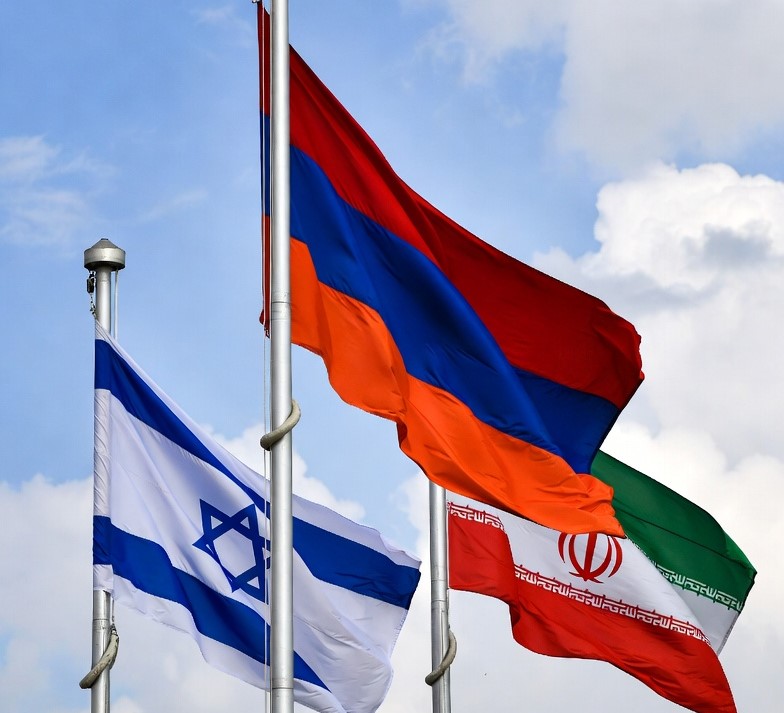
A working visit to Israel by Armenian Deputy Foreign Minister Vahan Kostanyan on November 27 triggered a sharp reaction in Iran. Particular concern was caused by the fact that Israeli media placed special emphasis on the topic of the “Trump Corridor,” or, as it is called in Azerbaijan, the Zangezur Corridor, which would create a route from Central Asia to Europe bypassing Iran and Russia. Armenian officials have now been forced to justify themselves, demonstrating a still-persistent vassal loyalty.
Iran’s reaction to Armenia’s recent diplomatic signaling toward Israel and the West reveals deep strategic anxiety rooted in geography, regime security, and long-standing regional red lines. The visit by Kostanyan, although framed in Yerevan as a limited diplomatic engagement, was perceived in Tehran as part of a broader and dangerous trajectory: Armenia’s gradual drift away from exclusive dependence on Iran and Russia and toward Western and Israeli political, security, and technological networks.
For Iran, Armenia occupies a uniquely sensitive position, as it is considered a vital geopolitical asset. It is Iran’s only direct land bridge to the Eurasian Economic Union and—critically—a buffer preventing the emergence of a continuous Turkic corridor linking Azerbaijan to Nakhichevan and onward to Turkey. Any Armenian realignment that weakens Tehran’s influence in the region therefore triggers alarm far beyond routine diplomacy. Even the slightest sign of Israeli involvement inflames Iranian fears of an isolation scenario—Turkic countries to the north and east, Israelis and Arab states to the south.
Iranian media commentary following Kostanyan’s visit to Israel was telling. Outlets such as Tehran Times, Eghtesad, Tabnak, and Mehr News explicitly linked Armenia’s outreach to Israel and the West with the threat of the Trump/Zangezur Corridor. In Iranian strategic thinking, this corridor is not merely a transport project. It is viewed as an existential threat that could sever Iran’s direct access to Armenia, reduce Tehran’s leverage in the Caucasus, and facilitate greater Israeli, Turkish, and Western penetration along Iran’s northern border.
From Tehran’s perspective, the corridor is part of a larger containment architecture. Iranian analysts increasingly frame it as a geopolitical extension of U.S. and Israeli pressure—one that would encircle Iran from the north just as sanctions and military pressure constrain it from the west and south. In this narrative, Armenia’s current engagement with Israel—however modest in practical terms—feeds suspicions that Yerevan could be drawn into hostile intelligence, surveillance, or logistical arrangements targeting Iran.
This anxiety has translated into pressure. Iranian officials and media have issued repeated warnings that any change to internationally recognized borders in the region is unacceptable. Behind closed doors, Tehran has aggressively pushed Yerevan to publicly reaffirm loyalty and restraint.
Here are several examples:
December 17 – Mehr News, controlled by the Islamic Propagation Organization (IPO) and a long-time disseminator of IRGC messaging, described the fears connected to the visit: “During a recent meeting between Armenia’s Deputy Minister of Foreign Affairs and the Director General of the Ministry of Foreign Affairs of the Zionist regime, the parties discussed cooperation in the fields of high technology, medicine, agriculture, and tourism. These are precisely the areas that Israel typically uses as instruments of soft, long-term influence. Its objectives are:
- Closing the chain of Israeli influence in the South Caucasus.
Israel has long maintained a presence in Azerbaijan. A warming of relations with Armenia creates the possibility of forming a ‘triangular corridor of influence’ along Iran’s borders. - Penetration through low-cost but highly effective development projects.
Projects in modern agriculture, healthcare, or crisis management are far from being purely technical. As a rule, they involve a prolonged presence of experts, the formation of institutional networks, stable contacts, and the creation of new communication channels. In a number of countries, such mechanisms have served as a foundation for intelligence, economic, or political penetration. - Yerevan’s limited ability to change its foreign policy course.
After the military defeats of 2020 and 2023, Armenia is searching for alternatives to its traditional foreign policy pillars. This structural need turns Israel into a ‘window of opportunity’ for Yerevan. - Gradual distancing from traditional axes and a shift in the balance along Iran’s borders.
The deeper Armenia’s cooperation with Israel becomes in sensitive areas—from agriculture and healthcare to education and crisis management—the further Yerevan moves away from its traditional foreign policy alignments.”
December 19 – The Tabnak agency, linked to former IRGC commander-in-chief Mohsen Rezaei, hinted at possible Iranian countermeasures: “The TRIPP initiative has also affected Iran’s usually calm relations with its neighbor Armenia. Although Armenia seeks to reduce Iran’s concerns, its consent to the creation of a U.S.-managed corridor in such close proximity to the heart of Iran inevitably generates tension. Iran views Armenia as a vital route to Europe and a protective shield against the growing influence of its Turkic-speaking neighbors; any sign of Armenia’s inclination toward Western influence causes alarm among Iran’s leaders, accompanied by a heavy heart and a suspicious gaze. Iran is assessing its future options, which may include covert efforts to slow the construction of this corridor or extensive use of diplomatic consultations with Armenia.”
Similar hints were voiced by the regime’s mouthpiece, Tehran Times: “Without doubt, the central focus of Kostanyan’s talks with Israeli officials concerned the ‘Trump Route,’ otherwise known as the Zangezur Corridor… Engaging in direct consultations with Israel, without sufficient regard for Tehran’s considerations, signals Yerevan’s prioritization of foreign policy alignment with the West and the United States. Kostanyan’s trip, in fact, offers a clear picture of Armenia’s foreign policy trajectory: a country that, in pursuit of economic and geopolitical goals, does not place Iran’s security concerns at the forefront, while simultaneously seeking to expand the influence and support of external partners. Consequently, this move could intensify regional tensions and further complicate the security balance in the Caucasus. It also heightens the sensitivity of Iran’s role in countering projects such as the Zangezur Corridor.”
The result of this pressure has been a visible rhetorical retreat by Armenian officials. Statements from Yerevan increasingly describe Iran as Armenia’s “main ally” and “strategic partner,” language clearly intended to reassure Tehran and de-escalate tensions. Iranian media widely circulated these statements, in particular to demonstrate to the domestic audience that the regime has the situation with Armenia under control.
Tasnim News, one of the IRGC’s principal media outlets, published an extensive interview with Armenia’s ambassador to Iran, Grigor Hakobyan: In particular, it stated that “relations between Armenia and Iran have always been distinguished by such a quality of mutual respect, trust, and good-neighborliness that gives them unique value in the region… these relations are developing not only within the framework of ordinary conditions and motivations, but also with a specific purpose and perspective—to acquire a strategic character.”
Regarding the Trump Route, Hakobyan noted: “It should be emphasized that throughout this entire process Yerevan has remained faithful and committed to an atmosphere of friendship and mutual trust, has officially taken into account Tehran’s vital interests, and has conducted active negotiations on ongoing developments at various levels. It should be noted that these principles have always been the foundation and key pillars for both Armenia and the Islamic Republic of Iran, and their preservation fully corresponds to the interests of both countries.”
The relatively reformist outlet Eghtesad provided details of a meeting between Armenia’s ambassador in Tehran and Ali Akbar Velayati, adviser to Iran’s Supreme Leader on international affairs. Velayati directly told Hakobyan of Iran’s disagreement with what he called the “Trump plan for the Caucasus”—a transit route envisaging the connection of Azerbaijan with Nakhichevan through southern Armenia. “Armenian officials rejected these concerns, emphasizing that this is a commercial project that takes into account the vital interests of neighbors, including Iran. Vice-Speaker of Armenia’s National Assembly Ruben Rubinyan stated that this project is not an alternative name for the Zangezur Corridor and that no extraterritorial corridor through Armenian territory will be created,” the outlet quoted the Armenian diplomat as saying.
December 21 – Mehr News, in turn, reported that the Iranian Islamic Coalition Party and the Prosperous Armenia Party signed a cooperation agreement. “The development of such party and parliamentary ties is viewed as a complement to official diplomacy and as a factor in deepening and enhancing the resilience of interstate relations. This memorandum can create a foundation for expanding exchanges between political parties, media representatives, and civil society institutions of the two countries,” the outlet noted.
In this context, it is worth recalling the above-mentioned Mehr publication about Israel’s “soft influence”—in essence, the alliance between the two parties represents a kind of Iranian response to the “Israeli plans.”
Most likely, Armenia’s behavior reflects its constrained position rather than ideological alignment. Given limited trust in Russia and only nascent Western support, Yerevan cannot afford open confrontation with Iran. Apologetic messaging toward Tehran following the Israel visit underscores Armenia’s fear of Iranian retaliation—whether through economic pressure, diplomatic obstruction, or covert destabilization.
In sum, Iran’s fear is not about a single diplomatic visit. It is about losing strategic depth in the South Caucasus. Any Armenian move toward Israel or the West, however symbolic, is interpreted in Tehran through the lens of regime security and encirclement. The TRIPP/Zangezur Corridor remains the focal point of this anxiety, and until that issue is definitively resolved, Iran will continue to pressure Armenia to remain firmly within Tehran’s geopolitical comfort zone—even as Armenia quietly searches for alternatives.
PSCRP team