PSCRP-BESA Reports No 164 (November 15, 2025)
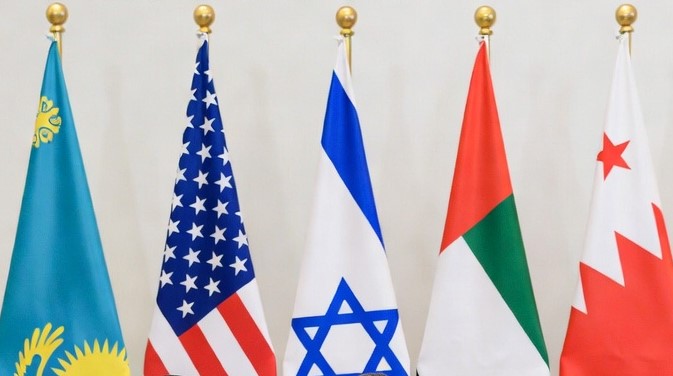
Kazakhstan’s decision to join the Abraham Accords did more than place its signature on yet another international agreement. It re-arranged the mental map of Eurasia. To put it plainly, this marks the first time a post-Soviet, Muslim-majority nation has formally stepped into a framework designed to normalize ties between Israel and countries of the broader Muslim world. This shift isn’t just geographic; it is psychological and strategic. Kazakhstan has placed itself in a new diplomatic constellation where Israel is not a distant concern of the Middle East, but a practical partner in Central Asia’s security and development future.
The First Post-Soviet Muslim-Majority State to Join
Central Asia’s Muslim-majority republics differ significantly from most of the Islamic world. Years under the Soviet system produced societies where secular statehood, high educational attainment, and technocratic elites became dominant. These governments have long faced the delicate task of warding off transnational Islamist currents — the sort that thrive in regions with weak institutions and disaffected populations. Kazakhstan’s leadership understands perfectly well that radicalization is not merely a theoretical threat but a creeping reality. Joining the Accords is therefore a strategic inoculation, signaling not only openness to Israel and the United States, but an explicit rejection of extremist ideologies. It says, in diplomatic plain-speak, that militant Islamists will find no fertile ground here.
The move projects Kazakhstan as a responsible international actor that understands how security and prosperity actually work. By linking itself to Israel and the United States, Astana is positioning the country as a secular, open, investment-friendly state. This sends two simultaneous messages: to Western investors, that this is a safe environment tied to globally trusted partners; to radicals, that the state is aligned with formidable allies capable of supporting counter-extremism efforts. The result is not charity but mutual benefit. Stability leads to capital inflow, capital inflow leads to improved living standards, and improved living standards reduce the appeal of violent ideologies. Everyone wins, except those hoping for chaos.
Uzbekistan and Azerbaijan: The Pivotal Link
Kazakhstan is hardly the only post-Soviet state to recognize the advantages offered by the Accords’ framework. Uzbekistan and Azerbaijan have been exploring their own accession for some time (https://www.wsj.com/opinion/expand-the-abraham-accords-to-azerbaijan-and-beyond-armenia-middle-east-asia-020f605f). Their motives are straightforward. Peace and economic integration aren’t some abstract ideals — they translate into supply chains, ports, and railways. The Middle Corridor, the route connecting Central Asia to Europe through the Caspian and the South Caucasus, is quickly becoming a critical artery for Eurasian trade. One major reason: it sidesteps Russia and Iran, neither of whom are exactly known for making commercial transit a carefree, trust-filled experience. For Europe, starved of reliable alternatives to Russian energy and transport networks, the corridor is a lifeline. For Central Asia, it is a gateway to capital and markets. Kazakhstan’s participation in the Accords strengthens and legitimizes this Eurasian trade continuum.
Azerbaijan’s potential accession is particularly significant. The country already maintains close strategic ties with Israel, particularly in the realm of defense cooperation. Its position along the Caspian and South Caucasus makes it an indispensable link in the Middle Corridor. Folding Azerbaijan into the Accords would create a nearly unbroken corridor of secular, investment-oriented Muslim-majority nations extending from the Mediterranean to the borders of China. This is not simply geopolitics. It is the sketch of a new economic geography.
Outdated Laws Need a Clean Sweep
Still, Washington has a habit of being its own worst enemy. Outdated legislation, relics of a different era, continues to hamper American engagement in the region. The Jackson-Vanik Amendment, originally intended to pressure the USSR over Jewish emigration, technically still applies to countries like Kazakhstan — a holdover so bureaucratically absurd that it borders on caricature. Meanwhile, Section 907 of the Freedom Support Act continues to restrict U.S. assistance to Azerbaijan despite significant diplomatic progress, including U.S.-brokered talks between Baku and Yerevan. These policies now work against American strategic interests.
To put it plainly: if Washington intends to counter Russia and China in Central Asia, it should stop tying its own shoelaces together. Congress has already begun discussing legislation to repeal Jackson-Vanik with respect to Kazakhstan’s new alignment. That momentum should be encouraged.
For years, the criticism has been that the United States all but abandoned Central Asia, leaving a vacuum filled by Moscow and Beijing. Kazakhstan’s accession to the Abraham Accords changes that trajectory. It signals that Central Asia is not a forgotten frontier but a region where American partnership still matters — and where the future balance of Eurasian power is being quietly assembled.
There is real work ahead. Agreements are merely paperwork until reinforced by consistent policy, economic investment, diplomatic attention, and cultural understanding. But make no mistake — this is not a symbolic gesture. Kazakhstan has just opened a new corridor of cooperation between the Muslim world and Israel, and between Central Asia and the West. If the United States is wise enough to follow through, the region may finally step into a more stable and prosperous era.
We’re not simply watching the next stage of an existing policy unfold. The underlying geography of alliances is shifting. The routes of trade, the partners of security cooperation, the assumptions about where the Muslim world aligns — all of it is being rearranged.