
PSCRP-BESA Reports No 173 (December 23, 2025)
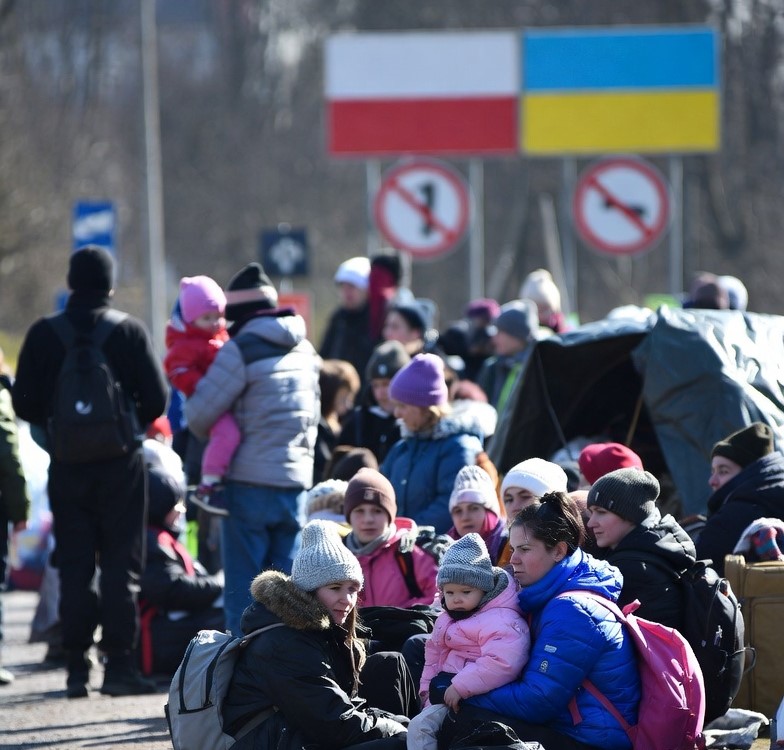
With the start of Russia’s full-scale armed invasion of Ukraine in February 2022, Poland became one of the most important destinations for Ukrainian emigration, including a relatively small but statistically noticeable Jewish component. Over the almost four years that have passed since then, the author, in his capacity as an emissary of the Jewish Agency, has repeatedly visited Polish cities such as Warsaw, Lublin, Łódź, Poznań, and Chełm, where a significant share of Jewish and other migrants from Ukraine have settled. In that same year, 2022, almost immediately after the outbreak of the war in Ukraine, the author interacted with hundreds of refugees from Ukraine for whom Poland served as a transit point on the way to Israel, and later took part in Jewish Agency events attended by people of Jewish origin from Ukraine, Belarus, and other post-Soviet states who did not go to Israel or (as many also did) to Central Europe, but instead remained in Poland.
As is well known, Poland as a country has played an important role in the history of the Jewish people. Before the Holocaust, Jews constituted a very significant share of its population. Thus, according to the 1931 census, 9.76% of Poland’s inhabitants (more than 3 million people) professed Judaism, and 8.56% named Yiddish as their native language. In 1939, Jews made up 29.1% of Warsaw’s population. The Holocaust and subsequent waves of mass emigration of surviving Jews from Poland (primarily to Israel) led to the situation in which today Jews constitute a numerically insignificant and highly assimilated minority. At the same time, in Warsaw and in other Polish cities, for historical reasons, there are many streets and other sites bearing the names of Jewish figures, memorial plaques with inscriptions in Yiddish and Hebrew, and so on.
According to most estimates published since the 1970s and up to the present day, the number of Jews in Poland does not exceed 5,000 people. This figure is based on data from the country’s secular and religious Jewish organizations, above all the Social and Cultural Association of Jews in Poland (TSKZ), founded in 1950, and the Union of Jewish Religious Communities in Poland, founded in 1993. However, during the population census conducted in 2021—that is, literally on the eve of Russia’s full-scale invasion of Ukraine and the influx of refugees from that country, including Jews, into Poland—17,156 residents of Poland identified themselves as Jews. This discrepancy is apparently explained by the fact that most Jews living in the country do not take part in the activities of Jewish organizations and do not maintain contact with them, or—what seems more likely—are not officially registered with them. I have also heard claims according to which officially registered Jewish communities and organizations in Poland for a long time did not seek to attract new members and even obstructed their admission, since membership in a community conferred certain rights to Jewish communal property.
After the fall of the communist regime and the country’s democratization, a process began of a return to Jewish roots among part of the fully assimilated descendants of Jews (as a rule of mixed origin), whose parents or even grandparents had identified themselves as Polish Christians or passed themselves off as such. Since the early 2000s, an Israeli organization, “Shavei Israel,” has been actively supporting this process, using with regard to them the term “hidden Jews of Poland”. Estimates of the number of “hidden Jews,” that is, Poles who have Jewish ancestors, range from 50,000 to 100,000, and sometimes even more, which, however, is not very much in the context of Poland’s population (about 37 million people). The reliability of such estimates is low, since “hidden Jews” in most cases do not have documents confirming their connection to Jewry. Be that as it may, there is an observable influx of “hidden Jews” returning to their roots (in particular through undergoing Orthodox or Reform conversion) into Jewish communities and organizations, among whose young activists they may already constitute a majority. In Poland—mainly in Warsaw—there also live several hundred Israelis, many of whom have obtained Polish citizenship as descendants of repatriates from that country.
Despite its small size, the Polish Jewish community has an extensive network of religious and secular communal institutions. In addition, Jewish Community Centers (JCCs) supported by the Joint operate in Poland. In 2022, after the start of Russia’s full-scale invasion of Ukraine and the arrival in Poland of Jewish refugees from Ukraine, the Jewish Agency opened its representative office in Warsaw, working primarily with a Russian-speaking population entitled to Israeli citizenship under the Law of Return. The bulk of this population did not remain in Poland and already in 2022, less often in 2023, repatriated to Israel or (to a much lesser extent) emigrated to other EU countries.
Experts estimate the total number of people currently living in Poland who originate from the post-Soviet space and have Jewish roots at between 5,000 and 10,000. Such a wide range in estimates is due—just as in the case of the “lost Jews of Poland”—to the absence of objective data. Far from all people from the post-Soviet space who are entitled to Israeli citizenship under the Law of Return identify themselves as Jews or express their Jewishness in one form or another. Like Polish Jews, they live primarily in Warsaw and its suburbs, but there are also small groups in other Polish cities, from Gdańsk in the north to Kraków in the south, and from Wrocław in the west to Przemyśl in the east. Nevertheless, given the rather limited human resources of present-day Polish Jewry, the addition of several thousand people from the post-Soviet space is very significant. The total number of Russian-speaking people (not only refugees from Ukraine) who in one way or another are in contact with local Jewish communities and the Jewish Agency is estimated at about 3,000.
The Joint’s JCCs initially made special efforts to integrate Russian-speaking Jews into their activities. At present, the need for this is felt much less acutely. The overwhelming majority of people from the post-Soviet space have already mastered the Polish language to a degree sufficient to participate in communal events. Since Polish is a Slavic language, acquiring it at a conversational level does not present great difficulties for Russian speakers, especially if, in addition to Russian, they also speak Ukrainian or Belarusian, whose vocabulary has much more in common with Polish than Russian does (according to expert estimates, about 70% of people from the post-Soviet space entitled to Israeli citizenship under the Law of Return are citizens of Ukraine, and another quarter are citizens of Belarus). Nevertheless, Russian still remains the preferred language of communication for the majority of them (although I have also encountered individual Jewish refugees from Ukraine who prefer to communicate in Ukrainian). The Warsaw representative office of the Jewish Agency conducts its events predominantly in Russian. Undoubtedly, a noticeable role in attracting a significant group of people from the post-Soviet space to the Reform community of Warsaw was played by the fact that its rabbi, Stas Wojciechowicz, an Israeli born in Uzbekistan, is fluent in Russian.
In communicating with many non-Jewish refugees from Ukraine living in Poland, I could not help but notice a wary, and sometimes openly hostile, attitude on the part of almost the majority of them toward Russians as such, regardless of the latter’s political views. However, within the Jewish milieu, attitudes toward the small number of Jews originating from Russia are generally absolutely tolerant. It can be argued that the Russian language functions within the Jewish community of people from the post-Soviet space as a consolidating factor.
Nevertheless, it cannot be said that the language issue is completely absent. While in integration into local Jewish communities the language barrier does not constitute a serious obstacle for people from the post-Soviet space, this is not the case with regard to professional careers. Obtaining virtually any highly qualified and, accordingly, well-paid position requires, among other things, a high level of proficiency in Polish. At present, the majority of adults from the post-Soviet space do not command Polish at a high level and are engaged in unskilled or low-skilled labor. An exception is made up of the small number of employees of international firms who possess English and use it in their work. Nevertheless, it can be assumed with a high degree of confidence that over time some of the newcomers from the post-Soviet space will acquire Polish to a sufficiently high level to be able to engage in qualified work corresponding to their professional training received in their countries of origin. Already now, children and young people, as a rule, speak Polish fluently, studying in Polish-language schools and universities, and will undoubtedly be able to integrate successfully in Poland if they remain in the country.
Poland is also convenient for people from Ukraine and Belarus because of its geographical proximity to their countries of origin, where they have relatives, property, and so forth. However, while many Ukrainian citizens living in Poland (but not men of conscription age) from time to time or even regularly visit Ukraine, the situation with citizens of Belarus is different. Most of them left their country of origin after the suppression of mass protests against the regime of Alexander Lukashenko in the second half of 2020–early 2021. For them, visiting their country of origin is extremely unsafe, and they generally refrain from such trips.
This is directly connected with the problems faced by people from Belarus living in Poland who are entitled to Israeli citizenship under the Law of Return and seek to repatriate to Israel. As a condition for issuing a visa, “Nativ” requires from them, among other things, documents that can only be obtained by traveling to Belarus, since the Belarusian embassy in Poland does not issue them. And traveling to Belarus for very many of them, as already noted, is dangerous. This constitutes a significant obstacle to the repatriation of Belarusian citizens living in Poland to Israel.
According to estimates by staff of the Warsaw representative office of the Jewish Agency, people from Belarus make up about half of all repatriates currently arriving in Israel from Poland. This is despite the fact that there are almost three times fewer of them than people from Ukraine. The heightened interest of people of Jewish origin from Belarus in repatriation to Israel is connected with the specifics of their legal status in Poland. Whereas refugees from Ukraine were granted a preferential status by the Polish authorities, commonly referred to as “protection,” people from Belarus are not only in Poland “on general grounds,” like immigrants from other non-EU countries, but also often encounter an extremely wary attitude from Polish authorities, who regard Belarus as a hostile state closely allied with Russia.
At present, among refugees from Ukraine there is active discussion of the decision by the Polish authorities to abolish the preferential “protection” status in spring 2026 and to equalize their status with that of other immigrants from non-EU countries. It can be expected that this will to some extent push those among them who are entitled to Israeli citizenship under the Law of Return toward repatriation to Israel.
Summing up, it should be noted that Israeli state institutions are not making sufficient efforts to stimulate the repatriation of Jews from the post-Soviet space who are in Poland. In addition to the already mentioned problem with documents, which concerns only people from Belarus, there is also the issue that Israeli consuls very rarely visit Warsaw. As an alternative, potential repatriates are offered visits to Nativ offices in Riga or Chișinău. However, traveling from Poland to Riga with the whole family for a consular check (sometimes more than once) entails serious expenses (tickets, hotel, loss of workdays). In the case of Chișinău, this is compounded by the need to leave the EU, which in certain situations may negatively affect the legal status of potential repatriates from the point of view of the Polish authorities. The Jewish Agency’s representative office in Warsaw is today the most important institution working with Russian-speaking potential repatriates (and with potential repatriates in general), but it does not have sufficient resources. According to expert estimates, aliyah from Poland currently amounts to about 10 repatriates (mostly Russian-speaking) per month. This is significantly below the aliyah potential from this country.