
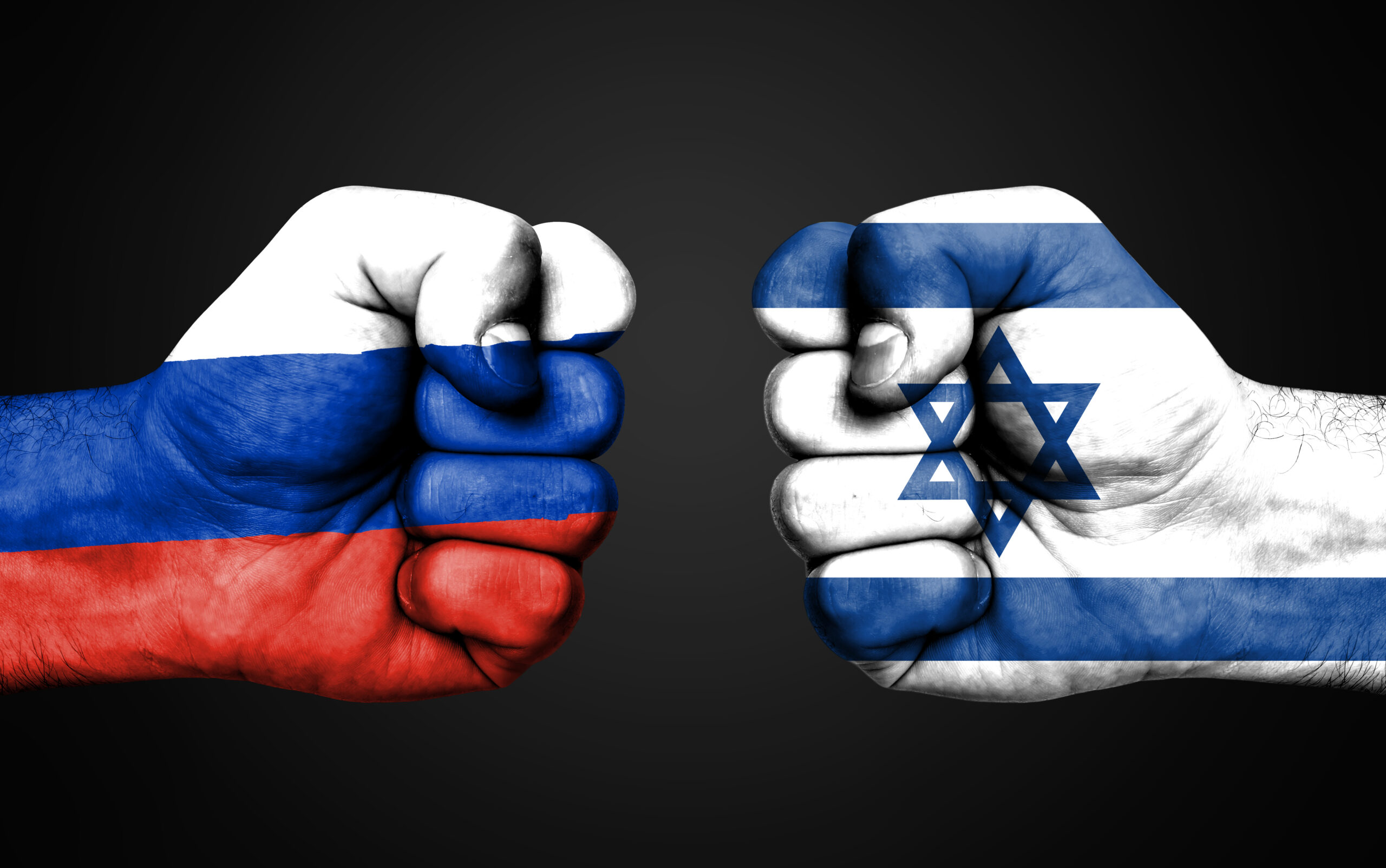
PSCRP-BESA Reports No 131 (May 14, 2025)
Russia has always been a country of significant interest to Israelis, partly because a substantial portion of Israeli Jews have familial roots in either Tsarist Russia or the USSR. On the one hand, Russia — as the successor to the USSR, which led the anti-Western camp during the Cold War — has long been perceived by Israeli society as a force with fundamentally opposing interests. Such views persist among much of Israel’s intellectual and political elite today. On the other hand, at the level of public consciousness, Russia has never been considered an “inherent” enemy of Israel.
The renewed interest in Russia in the early 2000s stemmed from two key developments: Moscow’s “return” to the Middle Eastern arena as a significant player directly affecting Israel’s interests, and the successful integration of the “Great Aliyah” (Jewish repatriation) from the late USSR and post-Soviet states. Over a third of this aliyah consisted of immigrants from Russia, contributing to a sharp increase in cultural, familial, and emotional-historical ties between citizens of the two countries. These factors influenced public opinion in both nations — an element their leaders had to consider, albeit to varying degrees, when shaping bilateral relations.
Since Benjamin Netanyahu’s return to power in February 2009, the intensification of Israel’s foreign policy toward Russia has been evident across nearly all levels — from intergovernmental and interparliamentary contacts to joint commissions on trade, economic and cultural cooperation. This approach marked a radical departure from the policies of previous governments (including Netanyahu’s first term), which focused primarily on strengthening ties with Russian Jews, encouraging their immigration to Israel, importing energy resources, and providing only lukewarm diplomatic and legal support for Israeli businesses in the Russian market. Vladimir Putin’s visit to Israel in May 2012, which Israeli authorities deemed highly significant, solidified this “new trend” in bilateral relations.
This intensification is typically explained by two main factors. First, Israel’s desire to find alternative spots of support amid strained relations with the United States following the Obama administration’s pressure on Israel as part of its reevaluation of Middle East policy. Second, the Israeli political establishment’s recognition of Russia’s growing influence in political and economic-strategic processes directly tied to Israel’s interests in both the “small” (the Arab-Israeli conflict zone) and “greater” (from the Maghreb to Central and South Asia) Middle East.
Reactions to these processes within Israeli political, media, business, and analytical circles were mixed. These circles —along with Israeli society as a whole — quickly split into two camps, each interpreting the Middle East implications of the “new reading” of Russian geopolitical and economic interests quite differently. The “Kremlin pessimists” continued to suspect that the Kremlin’s new course was de facto reinforcing a pro-Arab and therefore anti-Israeli bias in Moscow’s strategy. It was expected that, as Russia sought to reclaim its status as a major world power — and increasingly entered into political confrontation with the U.S. and the West in general — it would eventually revert to the global political models and perceptions of the late Soviet era, including a view of Israel as a potential adversary due to its strategic partnership with the U.S.
Their opponents — the “Kremlin optimists” — believed Russia’s assurances that it was returning to the Middle East not as a bearer of ideology, but for purely pragmatic reasons. From this perspective, Russian military supplies to Israel’s enemies — Syria and Iran (including weapons that, despite numerous agreements and assurances from the Russian side, often ended up in the hands of Hezbollah and other terrorist organizations in southern Lebanon) — were seen as “nothing more than business.” According to this view, Russia’s shifting policies toward these regimes were simply a matter of price — in the most basic and transactional sense of the word. https://ridl.io/russia-and-israel-the-end-of-special-relations/
Amid these dynamics, the community of immigrants from the former USSR — often referred to as “Russian Israel” — served as a kind of reference group for Israeli elites and society. For example, the introduction of a visa-free regime with Russia in 2016 (and later with Ukraine and Belarus) was adopted by the Israeli government primarily at the insistence of the Yisrael Beiteinu party, which represents the interests of Russian-speaking voters. Yisrael Beiteinu made visa-free travel a condition for joining the ruling coalition.
At the time, the political, diplomatic and economic benefits of this step were far from obvious to most Israeli leaders. However, politicians could not ignore the sentiments and demands of the nearly one-million-strong community of former Soviet immigrants, which at various times accounted for 13% to 16% of the electorate — and often played a decisive role in determining the success or failure of candidates for prime minister and several Israeli parties in national elections. For Israeli politicians, “good relations with Russia” are seen as a key to securing the support of the Russian-speaking electorate, though the community’s actual views are far more nuanced.
Do “Russian” Israelis Need Russia?
Between 2009 and 2017, the sociological agencies Mutagim and PORI, following a program proposed by the author of this article, conducted a series of four surveys among Russian-speaking Israelis. These surveys measured, among other things, attitudes toward the idea of an Israeli-Russian strategic partnership. The results indicate that this topic was quite relevant to respondents: only about 10% — peaking at 17% in 2015 — refrained from expressing an opinion on the issue.
However, support for shifting away from the U.S. in favor of partnerships with other strategic allies, including Russia, remained limited — ranging from 4−5% to just over 10%. Roughly two to three times as many respondents held the opposite view, asserting that “Russia’s interests will primarily lie in the Arab world, so the reliability of its partnership with Israel will always be questionable.” Among immigrants from Moscow and St. Petersburg, this view was nearly 1.5 times more prevalent than among those from other regions of Russia.
“Russian” Israelis clearly understood that, in the existing global political context, Israel could not pursue a policy of “permanent neutrality”. As a result, the share of “isolationists” advocating for “equidistance from various global centers of power” remained low, fluctuating between 15% and 20%. At the same time, the majority of former Soviet immigrants did not believe that an unconditional partnership with the U.S. was Israel’s only foreign policy option.
The most popular stance — garnering votes from between one-third and nearly half of post-Soviet immigrants — was the view that Israel should “strengthen and expand its relations with Russia, but not at the expense of its special relationship with the U.S.” Fluctuations in support for this position (ranging from 8% to 12% across the four survey waves) were attributed to both external and internal factors, including frustration with the Obama administration’s pro-Arab stance, the arrival of a large group of immigrants following Russia’s annexation of Crimea and the war in eastern Ukraine, the introduction of visa-free travel, and other events.
No significant differences were observed among supporters of different parties or among representatives of various waves of aliyah from the former USSR on this issue. The exception was a slightly higher share of “Kremlin optimists” among immigrants from Russia who arrived during the post-default era of the late 1990s — many of whom were motivated to emigrate to Israel primarily by economic considerations. Additionally, a higher proportion of this group returned to Russia after the crisis there had subsided.
Overall, the data demonstrate that the community of former Soviet immigrants is not characterized by so-called “ex-patriotism of political consciousness” — that is, an orientation toward their country of origin or identification with its political interests. Studies of immigrants from the former USSR show that the vast majority (for example, nearly 70% of respondents in a PORI survey conducted in March 2017) consider themselves “to a large extent” or “exclusively” Israeli. The share of those who do not identify as Israeli has rarely exceeded 20% in surveys, a trend observed not only among ethnic Jews but also among their family members of mixed or non-Jewish background. Early 1990s expectations — voiced by some left-wing and Arab circles — that the secular and partially non-Jewish immigrant population would weaken Israel’s Jewish character have not been borne out.
“Russian Israel” as a Party to the Conflict
A 2014 study, conducted shortly after Russia’s annexation of Crimea, revealed that the “Russian” Israeli community was almost evenly split on the issue. One segment supported one side in the conflict, while the other sympathized with neither Russia nor Ukraine — had no opinion at all. Among those who did take a side, support for Ukraine outnumbered support Russia by a ratio of two to one. However, only about 10% of respondents advocated for active Israeli support for either side, with a slight preference for Kyiv. By 2017, that share had declined to just 5%.
Differences in opinion were influenced by length of residency in Israel and country of origin. Immigrants from 1988−1989 — often former activists in the Jewish movement in the USSR — tended to hold pro-Ukrainian views, seeing Russia as the heir to the empire they had once resisted and fled. Pro-Ukrainian sentiments were also common among immigrants who began arriving in the early 2010s, particularly those from major cities who were socially established, relatively young, and part of the first (“Crimean”) wave of “Putin’s Aliyah” from both Russia and Ukraine.
Among immigrants from Ukraine, active pro-Ukrainian positions were far more common than pro-Russian ones. Among those from Russian-speaking regions of eastern Ukraine — primarily Jewish immigrants from the 1990s and early 2000s — supporters of Kyiv outnumbered those backing pro-Russian separatists by nearly four to one. However, two-thirds of respondents in 2017 supported neither side or expressed no interest in the issue.
At first glance, Russia’s full-scale invasion of Ukraine in February 2022 appears to have radically altered this picture. The shock felt by citizens of many countries was shared by Israelis — especially as one of the first consequences of the conflict was the emergence of tens of thousands of Jewish refugees in Europe for the first time since World War II. In March 2022, over 70% of Israelis told researchers at the Israel Democracy Institute (IDI) that they were following events in Ukraine “very closely” or “fairly closely”, with an even higher share—85%—among Russian-speaking Israelis. Two-thirds of Israelis overall, and three-quarters of Russian-speaking Jews, blamed Russia’s leadership for starting the war, while the share attributing blame to Kyiv fell within the margin of error.
Israeli civil society — particularly its organized and informal Russian-speaking segment — enthusiastically mobilized material aid for Ukrainians and engaged in pro-Ukrainian public diplomacy. Pro-Kremlin groups, meanwhile, remained largely invisible, especially after Hamas’s attack on October 7, 2023, when Russia adopted an anti-Israel stance, at least at the declarative level.
However, there is another aspect of this issue — namely, the relationship between Israeli and Ukrainian leadership following the start of Russia’s full-scale invasion. Israel immediately condemned the invasion and, from the first weeks, provided Ukraine with extensive humanitarian and material aid, as well as diplomatic and political support. While Israel did not officially join the Western economic sanctions against Russia, it also took no steps to help circumvent them. Although Israel is not a NATO member and does not serve as an official guarantor of Ukraine’s security, it supplied protective gear, certain defensive systems, and non-lethal weaponry. According to Israeli leaders, these actions demonstrated the country’s commitment to Ukraine and its people. However, Kyiv did not consider Israel’s support sufficient.
At the same time, about 60% of Israelis — and slightly more among former Soviet immigrants — who participated in the aforementioned 2022 IDI study fully or mostly supported the Israeli government’s approach to the war in Ukraine. Similar sentiments were observed in subsequent periods. According to a 2024 study, the results of which were kindly shared with the author by its initiator, Elina Bardach-Yalov, roughly one-third of surveyed former Soviet immigrants — half as many as seven years earlier — supported neither side in the Russia-Ukraine conflict and believed Israel should not intervene. A similar share expressed passive support for Ukraine (and very few for Russia). Only a quarter believed Israel should openly support Ukraine, while just 1−3% favored Russia. This time, differences between “veteran” immigrants and members of “Putin’s Aliyah” were minimal.
In other words, the Soviet and post-Soviet heritage of immigrants — including those from the most recent “war aliyah” from Russia — once again proved less significant than their Israeli experience, contrary to stereotypes. While they were not lobbyists for unconditional Israeli-Russian cooperation, they were, at certain points (especially during the Russian-Israeli rapprochement of the 2010s), quite willing to serve as a key bridge for rationally structured cooperation. However, they hardly saw themselves as a local branch of the “Russian world.” Over the three decades since the start of the “Great Aliya”, Russian-speaking immigrants have largely integrated into Israeli society and adopted its dominant system of values and political beliefs.
The previous version of this article was published in Riddle Magazine under the title “From Aliyah to Diplomacy”