
PSCRP-BESA Reports No 205 (May 23, 2026)
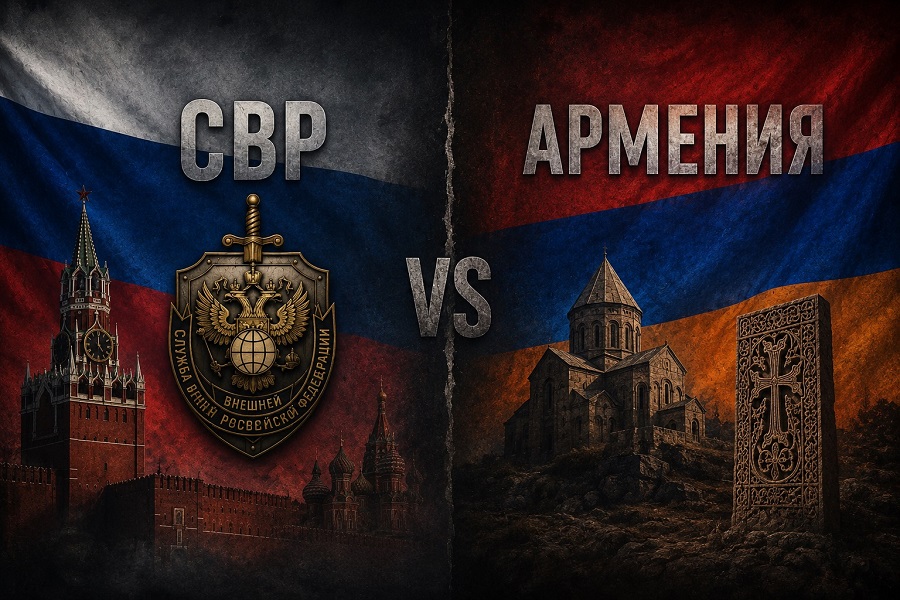
With Armenian parliamentary elections set for June 7, Moscow has activated an unusually wide operational spectrum against Yerevan — ranging from clerical intelligence assets and a resident SVR station to a paid foreign lobbyist reportedly financed by Russian-based oligarchs and, most recently, a filmed death threat against Prime Minister Nikol Pashinyan. What looks, in isolation, like a series of domestic political pressures is, on closer inspection, a coordinated effort to replace a pro-Western government with one more amenable to Moscow’s preferences in the South Caucasus.
The Church as a Cover: SVR Connections in the Armenian Apostolic Church
France’s intelligence community has periodically surfaced its assessments through unofficial channels, and Intelligence Online — a Paris-based newsletter with a long record of relaying information from French security services — reported in May 2026 that Armenian authorities are now conducting close surveillance of the Armenian Apostolic Church ahead of elections.
According to that account, Yerevan’s National Security Service (NSS) suspects the Church, led by Supreme Patriarch and Catholicos Karekin II, of facilitating Moscow’s attempts to manipulate the June 7 vote. The focus of suspicion is Karekin II’s brother, Archbishop Ezras Nersisyan, whom the NSS alleges was recruited by the KGB in the 1980s and has since continued to work for Russian foreign intelligence.
The allegation gained traction when Metropolitan Anthony of Volokolamsk, head of the Moscow Patriarchate’s Department for External Church Relations, paid a discreet visit to Nersisyan in Moscow. The metropolitan himself has long been suspected of working for Russia’s SVR: in 2023 he awarded a Swedish priest an SVR medal accompanied by a personal message from the service’s director, Sergey Naryshkin.
Pashinyan drew the connection publicly in December, telling parliament that he does not need a Catholicos who will obey a “lieutenant-colonel from a foreign special service.” The remark was pointed enough that no elaboration was required: the implication was that the Church’s senior leadership is, in practice, an extension of Russian intelligence work inside Armenia.
Three ecclesiastical sites are now under active NSS surveillance. The first is the Holy See of Etchmiadzin, which authorities already raided in June 2025 to arrest Archbishop Mikael Ajapahyan using the NSS’s Alpha counterterrorism unit. The second is the Cathedral of the Holy Mother of God in Gyumri, the northern city that also hosts Russia’s 102nd military base — and from which Ajapahyan had called for a military coup against the Yerevan government. The third is Yerevan’s Church of the Intercession of the Most Holy Mother of God, headquarters of the Russian Orthodox Diocese of Armenia, established in 2023 with the backing of Metropolitan Leonid of Klin, described in intelligence circles as the “Prigozhin in a cassock” for his ties to the late Wagner founder.
The Station: SVR, GRU, and FSB Officers Embedded in the Russian Embassy
An investigation published by The Insider in May 2026 identified the principal Russian intelligence officers working in Yerevan and traced their command structure back to Moscow. The report establishes that the information campaign against Pashinyan is coordinated by a newly created Presidential Directorate for Strategic Partnership and Cooperation, established after the previous directorate’s head, Dmitry Kozak, was removed following a failed attempt to influence Moldova’s elections in 2025.
The directorate’s new head is Vadim Titov, a former Rosatom official and ally of Sergei Kiriyenko, the first deputy chief of the Russian presidential administration. The day-to-day handlers for the Armenia portfolio are Valery Chernyshov, who previously served at a Russian military base in Abkhazia before joining military intelligence and teaching sabotage tradecraft to GRU officers, and his deputy, Colonel Dmitry Avanesov, who received advanced training at the FSB’s Moscow Institute focused on national security assessment.
At the embassy itself, The Insider identified the SVR’s resident as Alexei Myshlyavkin, listed officially as the trade representative. Myshlyavkin trained at the SVR Academy and served in the directorate that handled illegals for espionage across the South Caucasus before arriving in Yerevan in November 2020. In Moscow, Pashinyan has been assigned the operational codename “Boroda” (Beard), and Russian intelligence has been systematically collecting material intended to compromise him.
Myshlyavkin’s deputy is Sergei Katin, who listed SVR Military Unit 33949 as his official employer on a loan application. The FSB is represented by embassy adviser General Sergei Kivachuk and First Secretary Vitaly Kucheruk, who served in the FSB directorate for the Baltic Fleet before Yerevan and is regularly observed at the Russian 102nd military base in Gyumri, where he meets agents. A source in Russia’s security services told The Insider that Kucheruk was part of an operational group targeting Armenia’s Foreign Intelligence Service chief, Kristinne Grigoryan. The GRU’s presence in Yerevan is represented by Vyacheslav Proshkin, nominally Rosatom’s representative overseeing the Soviet-era Metsamor nuclear plant, who previously served in a Defense Ministry center that finances covert nuclear-related intelligence programs.
Rossotrudnichestvo, Russia’s cultural outreach agency, rounds out the soft-power layer. Its Russian House in Yerevan holds seminars and summer camps for young Armenians promoting the message that Armenia’s future lies with Russia, and shows films about “Ukrainian Nazism.” The agency was recently handed to Igor Chaika, son of former Prosecutor General Yury Chaika and a figure sanctioned by the U.S. Treasury and the EU in 2022 for his role in routing Kremlin funds to pro-Russian parties during Moldova’s elections.
The Lobbyist: A Former ICC Prosecutor, Russian Oligarch Money, and a Campaign to Unseat Pashinyan
The operation against Pashinyan is not confined to Yerevan or to the more conventional instruments of Russian intelligence. In late April 2026, leaked video recordings surfaced showing Luis Moreno Ocampo, former chief prosecutor of the International Criminal Court, and his son Tomas discussing plans to remove the Armenian prime minister from office.
In the recordings, Luis Ocampo describes placing a former aide to EU foreign policy chief Josep Borrell inside the European Parliament, through whom he intends to “correct European policy,” apply pressure on Commission President von der Leyen, and coordinate with the Armenian lobby in the United States. Tomas Ocampo is more direct: describing a meeting with activists, businesspeople, and Nagorno-Karabakh Armenians, he states flatly that the goal of the network is to “remove Pashinyan.”
Reporting by Azerbaijani and regional outlets, citing the original Minval Politika disclosures, identified the financial backers of the Ocampo operation as Armenian oligarchs based in Russia, prominently including Samvel Karapetyan and Ruben Vardanyan. Karapetyan, founder of the Strong Armenia electoral bloc and currently under arrest in Armenia on charges of money laundering and incitement to seize power, is reported to have listed the FSB as his employer on a 1999 passport application. Vardanyan, separately, was jailed in Azerbaijan following the 2023 collapse of the Nagorno-Karabakh enclave.
The structural logic of the arrangement is not difficult to reconstruct. Ocampo, having left the ICC under a cloud of scandal, reinvented himself as a legal advocate for Armenian causes. That work brought him into contact with a diaspora donor network heavily concentrated in Russia. The political objective — displacing Pashinyan before the June 7 elections — aligns neatly with the Kremlin’s own stated preferences, expressed by Putin directly during Pashinyan’s April visit to Moscow, when the Russian president said pro-Russian forces should be permitted to participate in Armenian elections. By routing the effort through a figure nominally associated with international law and EU institutions, the campaign acquires a degree of cover that a direct Russian intervention would not enjoy.
The Threat: A Filmed Assassination Warning and Its Political Context
On May 17–18, 2026, a video began circulating online showing five masked men armed with what appeared to be AKS-74U assault rifles. Addressing Pashinyan directly, one of the masked figures warned: “We know where and when you are going… you must answer for your every step.” The men spoke in the Karabakh dialect, accused Pashinyan of surrendering the enclave to Azerbaijan, and urged Armenians not to vote for him.
Armenia’s Investigative Committee opened a criminal case on charges of preparation for murder, computer sabotage — the video was broadcast by hacking into a restricted network — and illegal trafficking of firearms. The committee described the content as containing “a real danger of murder against the Prime Minister” in connection with his political activities.
Pashinyan himself responded during a campaign event, challenging those behind the video to remove their masks. He named Samvel Karapetyan, Gagik Tsarukyan, and former presidents Serzh Sargsyan and Robert Kocharyan as those he believed responsible, drawing a connection between the masked men’s rhetoric and statements previously made by those figures. Tsarukyan, who leads the Prosperous Armenia party in fierce opposition to Pashinyan, carries a 1979 conviction for robbery and gang rape; a Niva vehicle belonging to Pashinyan, then a newspaper editor, was blown up in central Yerevan in 2004, and Pashinyan accused Tsarukyan of ordering the attack. That criminal case remains unsolved.
Armenian political analysts, quoted in regional media, noted that the footage may not have been recorded on Armenian soil and pointed to Russia as a possible location of origin. Whether or not that assessment is correct, the timing — three weeks before polling day, against a backdrop of documented SVR activity inside the country — places the video squarely within the established pattern of Russian pre-election interference.
The broader picture is one of layered, mutually reinforcing pressure. Clerical networks with documented intelligence connections hold influence in key ecclesiastical sites. A fully staffed SVR station, augmented by FSB and GRU personnel, operates under diplomatic cover at the Russian Embassy. A former international jurist, funded by oligarchs with Kremlin ties, works to mobilize EU institutions and the American Armenian lobby against the sitting government. And a filmed death threat, disseminated through a hacked broadcast, tells Armenian voters directly what is expected of them on June 7.
Armenia’s trajectory since 2018 — the Velvet Revolution, the pivot toward the European Union, the suspension of participation in the CSTO, and the peace negotiations with Azerbaijan — represents exactly the kind of reorientation that Moscow has consistently sought to reverse across the post-Soviet space. The methods now visible in Yerevan are not novel; what is notable is their density, their simultaneity, and the extent to which they have been exposed before election day rather than reconstructed afterward.
Postscriptum: Regulatory Pressure as a Political Instrument
In the third week of May 2026, two Russian regulatory agencies moved against Armenian exports in rapid succession. On May 20, Rosselkhoznadzor, the federal agricultural watchdog, announced a temporary ban on all cut flowers from Armenia, effective May 22, citing 135 instances of quarantine pests detected in 96.2 million units of flower products imported since the beginning of the year. Two days later, on May 22, Rospotrebnadzor, the consumer-safety agency, suspended imports and banned the circulation of Jermuk mineral water, Armenia’s most recognizable export brand, alleging elevated levels of bicarbonate ions, chlorides, and sulfates.
Rosselkhoznadzor also signaled that its concerns extended beyond flowers to Armenian vegetables and fruits more broadly, with the agency’s head stating that inspectors had found problems across multiple agricultural categories. The flower ban takes effect while a Rosselkhoznadzor delegation is conducting on-site inspections of Armenian greenhouse operations — a process whose duration and outcome remain open-ended.
The sequencing was noted by Russian independent media. The Moscow Times reported that the flower ban followed directly on a statement by Security Council Secretary Sergei Shoigu, who had just characterized Armenia’s recent conduct as “unambiguously unfriendly” toward Moscow. Shoigu’s grievances included Armenia’s hosting of Ukrainian President Volodymyr Zelensky at the European Political Community summit in Yerevan in early May, Yerevan’s accession to the International Criminal Court — which has issued an arrest warrant for Putin — and what he described as the deliberate deterioration of conditions for Russian businesses operating in the country.
Kommersant reported the Jermuk ban separately, noting that Rospotrebnadzor had already imposed a partial suspension on the brand in late April, blocking 338,000 bottles from circulation, before extending the prohibition to all imports on May 22.
The deployment of phytosanitary and food-safety regulations as a foreign policy instrument has a well-documented history in Russia’s relations with neighboring states. Georgian wine was banned in 2006, following Tbilisi’s deteriorating relationship with Moscow; Moldovan wine faced equivalent measures during periods of tension; Ukrainian products have been subject to rolling restrictions since 2014. The pattern is consistent: technical regulatory findings arrive in clusters, shortly after political friction, and tend to resolve — or not — in proportion to the target government’s diplomatic posture rather than to the underlying product quality.
In the Armenian case, the timing is particularly pointed. Rosselkhoznadzor had been warning of potential flower restrictions since the summer of 2025, providing enough procedural cover to make the May 22 announcement look administrative rather than political. But the simultaneous action on Jermuk water, the expansion of concerns to vegetables and fruit, and the fact that both measures landed on the same day as Shoigu’s hostile statement — two and a half weeks before Armenia’s parliamentary elections — drains the coincidence of any residual plausibility. Regulatory pressure of this kind does not change votes directly; it is intended to communicate to Armenian business constituencies, and to the electorate through them, what the cost of the current government’s foreign-policy orientation will continue to be.
PSCRP team