BESA Center Perspectives Paper No. 2,399, August 2, 2026
EXECUTIVE SUMMARY: The dynamics of the US-Iranian issue are the product of the clash between Donald Trump’s approach to business negotiations, which involves promoting a state of instability as the basis for advancing a deal until its signing and then following up with stable implementation, and the approach of the Iranian regime, which is to prolong negotiations until the deal conforms as much as possible to its own ideological and strategic vision and then eroding it as much as possible after signing. There is a fundamental asymmetry between these two approaches. Trump will have to decide whether to resume the war until an agreement is imposed, resume the war until Iran loses its capabilities, continue applying pressure without war until a reasonable agreement is achieved, or leave the Iranian regime in its current state as it internally collapses. Trump and his team need to end their deliberations on this question, which serve the Iranians, and reach a decision as to which of these is the preferred option.
It is widely believed that the United States under President Trump has encountered unexpected challenges from Iran and is now improvising without a plan. This argument, which is based on the human desire for stability and certainty, especially in existentially important strategic spheres, misses the actual dynamics taking place between Trump and the Iranians.
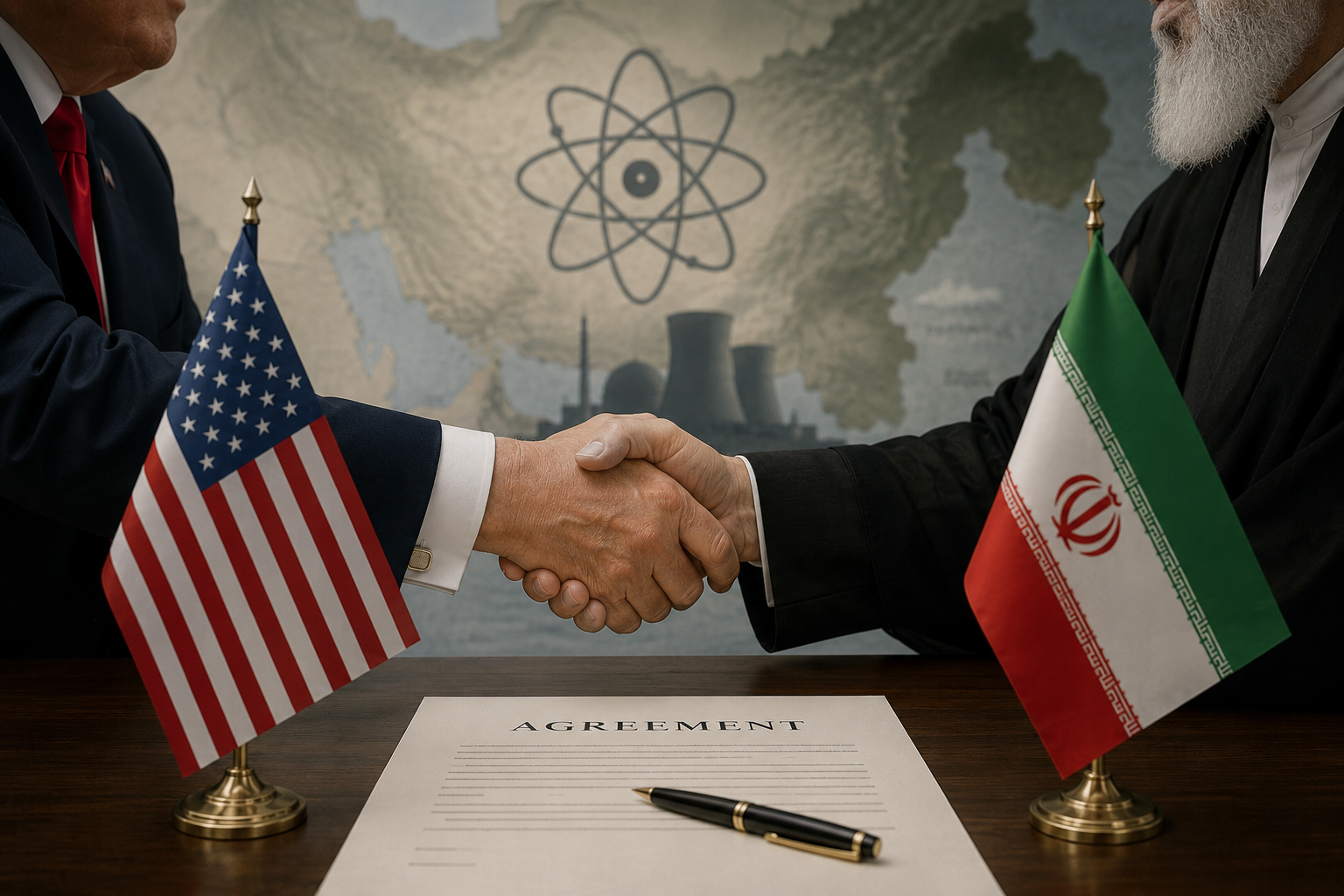
The dynamics we are witnessing are the result of the encounter between Trump’s approach to business negotiations, which promotes a state of instability as the basis for advancing a deal until its signing and then its stable implementation (“the handshake” as the beginning of trust and joint work), and the approach of the Iranian regime, which is to prolong negotiations until the deal conforms as much as possible to its ideological and strategic vision and then erode its implementation as much as possible in accordance with that vision after signing (“the handshake” as a starting point for the continued malign shaping of reality).
Understanding this dynamic is critical to the ability to assess the situation and formulate policy that corresponds to reality, rather than designing policy and taking action on the basis of unrealistic wishful thinking.
Trump’s “Art of the Deal”
Donald Trump has a very clear approach to business and dealmaking. He detailed it in his books and has not changed his approach to strategic issues during his presidency. His approach differs fundamentally from the realist conception of international relations and therefore generates antagonism among experts. Nevertheless, it currently shapes international discourse and is likely, over time, to change the way states manage regional and global issues.
Trump’s approach can be summarized as the “art of the three balls.” When approaching negotiations with an adversary, business or otherwise, who is also a potential partner, he throws three metaphorical balls in the air:
- A small ball: A deal focused on assets held by the stakeholders (the purchase of a partnership in a hotel, say, or halting a nuclear project). Usually, the initial offer will be very low in order to provide Trump with flexibility in negotiations.
- A big ball: To challenge the other side and create additional opportunities, Trump simultaneously raises an idea for an ambitious and large-scale project (the construction of a new casino, for example, or the immigration/Gaza reconstruction plan, or regime change, or high tariffs).
- A medium ball: An offer by the owner of an asset in which Trump is interested, or by a third party, for a deal that lies between the small ball and the big ball. It will be promoted by the other party, while Trump will gain significantly from it (i.e., the construction of a new hotel, a deal concerning the Hormuz Strait, or “fair” trade agreements for the United States).
Once the three balls are in the air, a tough bargaining process begins, one that Trump has described extensively in his books. The process includes sticks (legal claims, public influence campaigns, the use of force) and carrots (emphasizing the profitability of the deal for the other side, offering additional forms of cooperation, and so on). The negotiation process is proactive and at times dynamic, with the aim of bringing the opposing side or sides to a decision.
The outcome is the signing of a deal, after which the parties become business partners committed to implementing the project (“the handshake”). If none of the “balls” matures into a possible agreement, the entire venture can be abandoned and replaced by a new one (see the “cooling off” of the Greenland annexation issue).
The art of Iranian negotiation
In the case of the US-Iran conflict, the other side is occupied by an adversary who is not a business actor and does not operate according to the logic Trump expects or that characterizes most business entities and governments around the world.
Iran is run by an extremist regime that is engaged in a determined struggle to preserve its internal stability and aggressively and uncompromisingly advance its ideological and strategic objectives. There is no asset that cannot be relinquished to advance these objectives. This applies at the most personal level (the Supreme Leader can become a martyr, and a new leader will emerge who will continue to advance the same doctrine) and at the national level (national infrastructures can be sacrificed, regardless of the consequences to the domestic population, as long as they are not critical to achieving the objectives).
In addition, no method of action is considered illegitimate. The ends justify the means. This means every tactic is acceptable: development of nuclear weapons, the use of terrorism, the use of missiles for terrorist purposes, violent and murderous repression of the domestic population as well as other populations, deception and fraud in negotiations, influence operations and fake narratives targeting audiences, particularly the domestic audience, subversion, the instigation of violence and civil wars, and more.
Ultimately, Iran will reach an agreement only when its back is against the wall (“drinking the poisoned cup”). Even then, clauses will be inserted that will allow it to advance its objectives the day after the agreement is signed. Among other things, Iran categorically refuses to discuss issues that are not at the core of the other side’s demands and forces it to retreat from them. Examples include the missile and regional subversion issues in the nuclear agreement and in the current memorandum of understanding.
In the final stage before signing, Iran extracts from the other side—which it knows is eager to get the deal done—seemingly symbolic concessions that then become the basis for negative conduct the day after. Secretary of State John Kerry fell into this trap in the Obama-era nuclear agreement, and Vice President J.D. Vance fell into it in the memorandum of understanding. In the latter case, he agreed to vague formulations regarding the opening of the Strait of Hormuz that enabled the Iranians to withdraw from their apparent commitments.
Unlike President Trump’s approach, according to which an agreement is the beginning of a constructive partnership, the Iranians’ object is to begin undermining the agreement and acting to advance their unchanged hostile objectives immediately after the deal is signed.
This fundamental asymmetry between Trump’s approach and the Iranian approach does not allow for a Zone of Possible Agreement (ZOPA)—neither in terms of the issues themselves nor in terms of the fundamental context of what an agreement is and what it represents.
After the United States and Israel had significantly weakened the Iranian regime, its leadership, its malign capabilities, and the economic infrastructure upon which it relies, Trump offered the Iranians a deal that, from his perspective, was a “dream agreement”: I am willing to share with you the economic profits from the Strait of Hormuz, despite the fact that it is an international waterway open to all; in return, you will give up your nuclear ambitions. Trump put a win-win deal on the table under which the regime would recover and economically revitalize Iran in exchange for relinquishing a central component of its ideological objectives: nuclear deterrence as the basis for pursuing the realization of its maximalist ambitions.
For the Iranians, what Trump was offering was in fact another means by which they could advance their original objectives. The Hormuz issue became a defensive and bargaining line for preserving their aspirations in the nuclear sphere, which they are unwilling to abandon. The Hormuz–nuclear deal also removed from the agenda the threat posed by other central instruments of Iranian coercion—namely missiles and regional subversion—which were pushed out of the discussion.
Trump was interested in a temporary deal, despite the gap between the two approaches that on the surface appeared impossible to bridge, in order to gain calm until the midterm elections. The Iranians, meanwhile, needed to channel economic oxygen to regime supporters and stabilize them.
At this point, opportunistic mediators from Pakistan and Qatar entered the picture. They acted solely to advance their own objectives. Through verbal acrobatics and by exploiting the willful blindness of the heads of the American negotiating team, they succeeded in formulating a memorandum of understanding whose entire purpose was to suspend the confrontation. Even in this memorandum, the Iranians succeeded in inserting conditions at the last moment that advanced their objectives in the continuation of negotiations, including on the nuclear issue.
This fragile structure did not survive more than a few days. Iran immediately began to erode the agreement by exploiting its major loopholes, and Trump consequently came to understand—as he expressed publicly—that he was negotiating with con artists who were not interested in a genuine “handshake” agreement. As a result, the Americans returned to a policy of siege and limited warfare in order to increase pressure on Iran, to which the Iranians responded with “missile guerrilla warfare” against regional states and American assets.
The options available to the Americans
The Americans must decide whether they are willing to enter into another broad confrontation or to pursue an agreement with Iran. This decision leads to four possible alternatives:
- “The Poisoned Cup”: Strike Iran repeatedly—after the midterms?—until the regime understands that it faces destruction and, as a result, agrees to sign an agreement that corresponds with the American position. The advantage for the Americans is achieving the clear objective of denying Iran nuclear capabilities (and addressing additional issues). The disadvantage is that it is unclear how much force will be required and for how long.
- “The Failed State”: Inflict severe damage on Iran and its capabilities and let the regime deal with the consequences, which would include needing to invest considerable resources in preserving its stability. The advantage for the Americans is that the outcome does not depend on the Iranians (there is no need for an agreement). The disadvantage is that the core issues will not be resolved, and continued enforcement will be required (see: “The Principle of Partial Governance,” BESA Center Perspectives Paper No. 2326, January 26, 2025).
- “The Rolling Agreement”: Avoiding a comprehensive military operation while continuing to apply pressure, including periodic military pressure, on Iran until a reasonable agreement is reached. The advantage for the Americans is avoiding a full-scale war and maintaining a relatively reasonable strategic situation over time. The disadvantage is that this may prove a very lengthy process, extending beyond the two remaining years of Trump’s term.
- “Disintegration”: Disengaging from Iran, except for enforcing against problematic behavior, and leaving the regime to confront its problems until it disintegrates from within or becomes incapable of advancing its objectives. The advantage for the Americans is that they can redirect attention to other issues. The disadvantage is that the Iranian issue will not be resolved, and a certain allocation of resources and attention will still be required to continue managing it. This option resembles Trump’s approach of abandoning a venture.
The main considerations that will likely guide the Americans in deciding which approach to adopt are the severity of the global energy crisis; the political timetable (the midterm elections and the two years remaining until the end of Trump’s term); the cost of the response for regional partners and the cost of warfare for the US military; the extent of the regime’s internal disintegration and its control over the country; and the desire to redirect attention to other issues. The relative weight and prioritization of these considerations will shape the American decision.
The Americans need to focus their efforts, as their hesitation about which strategy to adopt serves Iran, whose strategy is based on attrition, deception, and stalling. It is also important that Trump depart from his usual practice and lower his public profile when addressing the issue, because Iranian jihadist rhetoric—even if it is, in practice, hollow and empty of substance and unsupported by genuine capabilities—sounds more powerful than the threats of a businessman.
In conclusion, it is important to understand the dynamic between the dealmaking art of the New York real estate businessman and the persistent extreme ideology of the Islamic regime in Tehran. Only such an understanding will lead to the examination of realistic alternatives and to decisions suited to the challenge.
Col. (res.) Shay Shabtai is a senior researcher at the BESA Center and an expert in national security, strategic planning, and strategic communication. He is a cyber security strategist and a consultant to leading companies in Israel.
BESA Center publications and research are made possible
thanks to the generosity of Saul Koschitzky and family