
PSCRP-BESA Reports No 219 (July 23, 2026)
By Boris Ginzburg
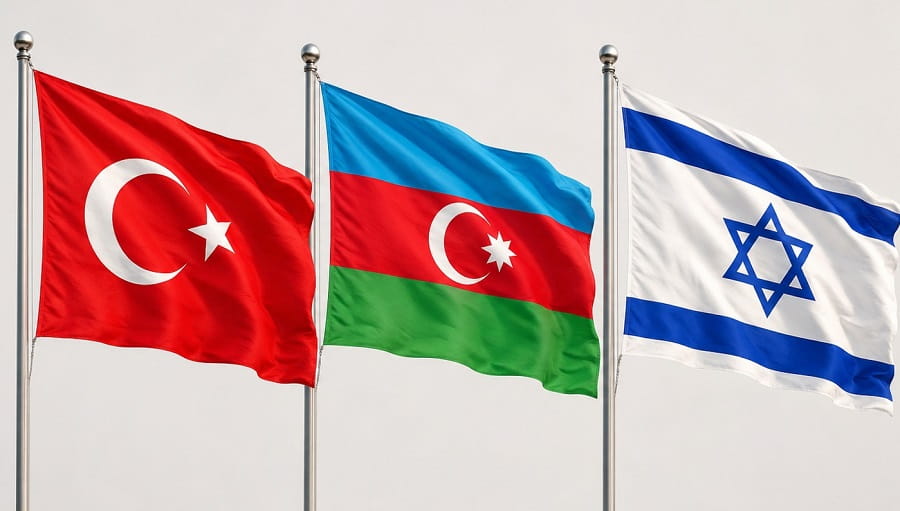
One of the geopolitical aftermaths of the Hamas terrorist attack on Israel on October 7, 2023, is the deteriorating bilateral relations between Israel and Türkiye. The South Caucasus state of Azerbaijan, which considers both states its closest allies, unsurprisingly once again serves as a mediator between the two antagonists. Drawing on expert interviews and qualitative data, this paper will be the first to illuminate these mediation efforts in greater detail. Focusing on Azerbaijan’s mediation formats and policies enables analysts to gauge the current state of Israeli-Turkish relations more precisely. In addition to generating policy recommendations for Jerusalem at the end, this analysis will also highlight why Jerusalem and Baku should consider Germany a constructive additional component in the Azerbaijani-led mediation efforts between Israel and Türkiye.
Talk to My Friend
Since the Hamas terrorist attack on Israel on October 7, 2023, the Turkish government around President Recep Tayyip Erdoğan has hardened its rhetoric against the Jewish state to such a degree that it openly fantasizes about invading Israel and capturing Israel’s capital Jerusalem. Unsurprisingly, such rhetoric multiplies Israeli concerns that a Türkiye-led Sunni axis might replace the plummeting Iran-led Shia axis. One state, however, sees both countries as its most important allies: Azerbaijan. Therefore, it is unsurprising that Baku often served as a mediator between the two states. The Azerbaijani President Ilham Alijew first officially mentioned Azerbaijani involvement in such initiatives in April 2025 during an address at the Azerbaijani Diplomatic Academy (ADA) in April 2025 when he stated:
“Both countries [Israel and Türkiye] are close friends of Azerbaijan. […]. As it is already known, though we never made it public ourselves, but already it has been circulated quite broadly. The first successful reconciliation between Türkiye and Israel was to a certain degree facilitated by Azerbaijan. […]. But I would say that Azerbaijan was number one in this process. Again, it was behind the scenes. We never made it public. […] We just wanted to help our ally and brother Türkiye and our friend Israel to rebuild their relationship.”
These Azerbaijani mediation efforts, especially after October 7, 2023, deserve more attention, as their format and procedures reveal much about the current state of Israeli-Turkish relations and, more broadly, about the trilateral relations among Baku, Ankara, and Jerusalem. Drawing on expert interviews and qualitative data, this analysis will be the first to illuminate these mediation efforts in greater detail, focusing on their formats. By doing this, this BESA paper will formulate policy recommendations for Jerusalem at the end. Moreover, it will showcase why Baku and Jerusalem should consider Germany as a constructive additional component in the Azerbaijani-led mediation efforts between Israel and Türkiye.
Azerbaijan and its Mediation Efforts in the Israeli-Turkish Conundrum since October 7, 2023
Since Israel’s creation in 1948, Türkiye always managed to be a reliable strategic partner of the Jewish state, while at the same time supporting Palestinian statehood and a so-called “Two-State Solution.” Although Erdoğan’s rise to power since the early 2000s and his departure from Atatürk’s secularism produced the first eruptions in bilateral relations, a radical qualitative change occurred after October 7, 2023. Erdoğan replaced his pro-Palestinian stance with an open pro-Hamas stance. This circumstance became particularly evident by hosting parts of the Hamas politburo in Türkiye and labeling this internationally recognized Islamist terrorist organization “freedom fighters.” Considering the poor state of the Turkish economy, the flourishing corruption practices, and high youth unemployment in the country, it is nothing new in world history that leaders with such domestic problems play the Anti-Zionism and Anti-Semitism card to distract from their domestic problems. As was often the case in human history, anti-Semitism helps such governments to create a rally-around-the-flag effect among the actually economically and politically unsatisfied citizenry in support of their government. Interestingly, one can observe a similar development in the left-wing Pedro Sánchez -led minority government in Spain. The latter cannot escape continuous political, economic, and corruption scandals, yet has proclaimed itself the West’s alleged moral compass – especially when it comes to Middle East affairs.
Taking notice of the rising tensions, Azerbaijan has conducted several mediation initiatives between Israel and Türkiye between 2008 and 2010, in 2018, and between 2022 and today. These helped ease Israeli-Turkish tensions. Yet, after regular periods, these disagreements erupted repeatedly. Because of this, some observers express skepticism towards Baku’s mediation initiatives. This critique often states that, although Baku has made several mediation attempts between Israel and Türkiye since 2008, relations between Jerusalem and Ankara have always returned to disputes. Thus, doubts could emerge about the effectiveness of these Azerbaijani mediation efforts. At first glance, this could seem like a legitimate critique, yet another perspective on this issue might be more crucial.
Independently of each other, Azerbaijani and Israeli experts familiar with this matter point out that the Azerbaijani mediation initiative should not be seen as the ultimate panacea for Israeli-Turkish disagreements. Rather, they constitute ad hoc measures to de-escalate tensions between Jerusalem and Ankara, aiming to prevent them from spilling over into an open military conflict. The establishment of a direct communication line between the Turkish and Israeli militaries in Syria via Azerbaijani diplomacy in May 2025 is one such instance. It aims to help both states avoid unintended clashes in post-Assad Syria.
The Mediation Formats as an Expression of the Current State of Affairs between Jerusalem and Ankara
Strikingly, the changed Turkish attitude towards Israel since October 7, 2023, is also reflected in the way the Azerbaijani-mediated Israeli-Turkish talks proceed. Throughout 2025, most of these talks proceeded only indirectly. Allegedly, only in one of the discussion rounds in 2025 did both antagonists manage to talk directly to each other. This situation exemplifies once more the often-mentioned current low point in Israeli-Turkish relations. If one considers that in September 2023 Azerbaijani officials managed to organize a personal meeting between Erdoğan and the current Israeli Prime Minister Benjamin Netanyahu in New York on the sidelines of the annual UN General Assembly and compares it to the above-mentioned current situation where both sides mostly do not manage to sit in one room anymore, this deterioration of relations becomes even more evident.
What is also interesting is that these talks are allegedly not conducted at the level of the foreign ministries, but rather directly through the presidential offices of Azerbaijan and Türkiye, as well as the Israeli Prime Minister’s Office. Although this is not an unusual practice in international relations, the fact that the highest hierarchical levels of the executive branches in all three states deal personally with this issue shows how much weight all three involved parties (Azerbaijan, Türkiye and Israel) place on the current tensions between Israel and Türkiye.
For Azerbaijan, this is a particularly delicate issue, as it fears that an escalation between its two most important allies could put it in a political dilemma. This concern is one of the reasons why Baku tries so relentlessly to calm the waters between Jerusalem and Ankara again and again. As discussions with Azerbaijani experts reveal, for Baku, the best-case scenario would be a strong, stable trilateral strategic partnership among Azerbaijan, Türkiye, and Israel.
Conclusion: Policy Recommendations for Jerusalem
As the author of this analysis mentioned in his previous BESA paper, discussions with Israeli and Azerbaijani experts highlight in a repeated manner how both sides view the current Turkish-Israeli relations as simultaneously the biggest risk (should the Turkish-Israeli relations further deteriorate) and the biggest (economic and security-related) opportunity for the Azerbaijani-Israeli strategic partnership (as soon as the tensions between Ankara and Jerusalem calm down). The points above showed what these mediation initiatives look like and, more importantly, what they tell about the seriousness of the current tensions between Israel and Türkiye.
As the Middle East security order is still evolving after the ongoing crumbling of the Iran-led Shia axis, new (potential) conflict zones between Middle Eastern states emerge, making it profoundly difficult to say with guarantee that the Azerbaijan-led mediation efforts in Israeli-Turkish relations will succeed. Thus, this analysis calls for a dualistic Israeli foreign policy approach by extending an open hand and a fist towards Ankara. Such an approach could consist of Israel’s expressed readiness to de-escalate further its relations with Türkiye if Ankara shows a gesture of goodwill –for instance by giving up its holding of a protective hand over the living rest of the Hamas politburo members residing in Türkiye) (“the open hand”). In parallel and until then, precautionary measures should remain the call of the hour for Israeli foreign policy as well (“the fist”) – especially when it comes to Erdoğan’s Neo-Ottoman aspirations, which are also seen critically by Baku and other predominantly Muslim states in the region. Additionally, Israeli foreign policy should consider the following points in this regard:
- Differentiating between Turkish Domestic and International Rhetoric: Although the current Turkish foreign minister, Hakan Fidan, has tempered his tone toward Israel in a recent media appearance on July 10, 2026, stating that Ankara is not in conflict with Israel, but rather with the current Israeli government, analysts should register Fidan’s mood change with utmost caution. Fidan made this statement to a foreign media platform (The National). In interviews with domestic media outlets, the Turkish foreign minister’s rhetoric is exactly the opposite. This fact became clear just one week before his interview for “The National” when he described in an interview for CNN Türk that the “[…] [Israeli] people have become a burden that humanity can no longer bear.” Moreover, as the analysis above showed, even if Fidan is truly committed to de-escalation, Israel should keep in mind that the foreign ministries of both states are not the primary actors in the crisis management of the Israeli-Turkish tension, but the presidential and prime ministerial administrations of the respective countries. Thus, it remains unclear how much political weight Fidan’s de-escalation statements truly have.
- The Repercussions of Reducing the Role of National Foreign Ministries in Crisis Management: Circumventing or reducing the role of national foreign ministries and their diplomats in the crisis management of Israeli-Turkish relations risks missing the opportunity to fortify the relationship between Israel and Türkiye. Elected officials come and go, and the same applies to their staffers within their administrations. Diplomats, however, remain in their profession, often throughout their careers. States should view such binding measures and contacts between the diplomatic personnel of all involved states as a political investment in the future, especially given that some of these diplomats might later assume political offices. Their collective experience in dealing with “the other side” might be an important trust base on which future Israeli-Turkish relations can operate.
- Keeping the New Syrian Regime out of Lebanon: Although US President Donald Trump hinted in June 2026 that he would like the new regime in Syria (instead of Israel) to fight against the Shia terrorist organization Hezbollah in Lebanon, Jerusalem should be aware of the risks this might entail. As the new Syrian regime is closely aligned with and highly dependent on Ankara, the danger might arise that Türkiye might use the Islamist militias around the new Syrian leader, Abu Mohammad al-Julani, as a proxy to increase its influence in Lebanon. Indeed, such a scenario showcases once more the security risk for Israel of inadvertently replacing the former Iran-led Shia crescent with a Türkiye-led Sunni crescent.
- Strengthening the Hellenic Alliance further: As a precautionary measure, Israel should expand the existing security ties within the Hellenic Alliance, namely the already-established security partnership among Israel, Greece, and Cyprus, to counterbalance Turkish influence in the Eastern Mediterranean and gain bargaining chips vis-à-vis Ankara. Moreover, the issue of Cyprus, with its since 1974 Turkish-occupied northern part, presents one of several other unexploited loopholes (like the Kurdish issue) allowing Israel to highlight the contradictions within Ankara’s international demeanor – especially concerning Ankara’s constant condemnation of Israel’s security policies in the Palestinian territories. Here, a newly recalibrated and more profoundly designed Israeli public diplomacy than before (by relying also on international expertise) can highlight the hypocrisy of Turkish foreign policy and the ignorance of the current paradoxical international liaison between Islamism and left-wing self-proclaimed progressivism in many Western states.
- Germany and the Azerbaijani-Led Mediation Efforts in the Strained Israeli-Turkish Relations: Germany should be considered an additional pillar of support for these mediation efforts. Not only is Berlin, due to its past dark role in Jewish history, now one of the strongest allies of Israel, but it is also the home of the largest Turkish diaspora in the world (approximately 3 million people, of which 1,5 million are German citizens with voting rights). Therefore, similar to Azerbaijan, an escalation of the current Israeli-Turkish relations might also put Germany in a very precarious position. For Azerbaijan, this would allow it to deepen its ties with the biggest economy in Europe. For Germany, it would be a step toward stepping up its role as a peace facilitator. Several German officials practice self-criticism by pointing out that Germany has lost its past role as a mediator between Israel and the Lebanese government. However, it seems the officials in Berlin have not yet recognized that the Israeli-Turkish tensions might be even more significant to them than the Israeli-Lebanese issue, as it could also affect very sensitive German domestic issues. Furthermore, for Israel, it would be an opportunity to strengthen an important ally, such as Germany, on the international stage. This goal might be particularly important now, as Germany suffered an international blowback in June 2026 in its failed quest to secure a non-permanent seat on the UN Security Council. In addition to miscommunication between Germany and other EU states seeking such seats (Austria and Portugal), an anti-German campaign by Russia among UN members from the so-called Global South, driven by Berlin’s siding with Ukraine, also contributed to Germany’s defeat. However, an additional reason for Germany’s unsuccessful application lies in its open support for the Jewish state’s security. Thus, strengthening the international role of an ally like Germany also has advantageous implications for Jerusalem.
Boris Ginzburg is a political scientist at the Institute for East European Studies (Politics Department) at the Freie Universität Berlin (Germany).