
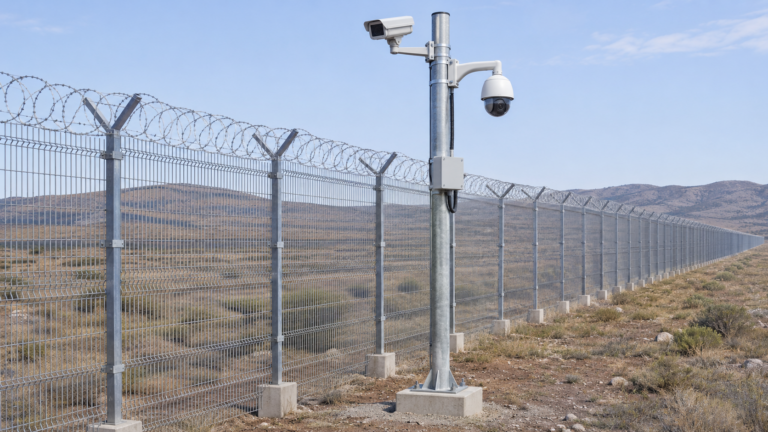
The Hamas-led attack on Israel on October 7, 2023, offers a consequential lesson for countries investing in technology-intensive border security. Over many years, Israel had developed a sophisticated combination of physical barriers, surveillance sensors, communications, and remotely operated defensive systems along the Gaza border. The attackers nevertheless succeeded in disrupting that architecture by employing coordinated methods, including drones and simultaneous breaches. The significance of this failure extends beyond the particular circumstances of Gaza, as another adaptive adversary can target the links that turn observation into operational action. This tension can be thought of as the Smart Border Paradox. Integration enhances surveillance and coordination, but can also magnify the effects of disruption when essential functions share technical or organizational dependencies. To examine this problem, we propose a Detection–Communication–Interpretation–Decision–Response (D-CIDR) framework that evaluates the entire operational chain rather than individual equipment. India's Comprehensive Integrated Border Management System (CIBMS) provides a comparative application across very different border environments. The argument is not for less technology, nor for directly transplanting Israeli arrangements elsewhere. It is for resilient integration: diversified sensing, alternative communications, sound intelligence judgment, defined local authority, robust physical response, and realistic exercises under degraded conditions. Border security should ultimately be assessed by the mission capability it retains when challenged, not solely by its performance under normal conditions.