PSCRP-BESA Reports No 67 (July 05, 2024)
On June 30, 2024, the Georgian national football team lost 4:1 to Spain in 1/8 final of the UEFA European Championship. In most countries, such a defeat would be considered a failure, and in some countries — a national tragedy. But in Georgia, the players were welcomed as heroes. Why? Because reaching the final part of the championship was a dream come true for most people in the country, and reaching 1/8 final was nothing short of a miracle.
People react to events depending on their expectations, and this applies not only to the sport of football, but also to politics. In Georgia, despite its modest standard of living, the rights and freedoms of citizens are generally safeguarded and respected. The exception was the first years of independence, when the country was ruled by a criminal junta. The majority of citizens associated the improvement of living standards and development of the country with European integration enshrined in the Constitution. Everyone was confident in the irreversibility of this process, but reality forced some adjustments.
In April, the ruling party introduced a bill on “foreign influence,” causing consternation. The Georgian Dream had a chance to win a solid majority in the elections, and returning to a law that had been abandoned a year earlier due to protests seemed illogical. This led to mass protests unprecedented in Georgia’s history.
The question “why?” has become the main focus of Georgian politics. Bidzina Ivanishvili, the founder and honorary chairman of the Georgian Dream, said at the rally that before he took over the country was ruled from outside and a certain global war party wants to destroy Georgia. He presented himself and his party as saviors amidst the world geopolitics and said that Georgia is not loved in Europe, but it will come there anyway. This was a de facto statement of a change of foreign policy course. The work of the parliament in passing anti-democratic laws was part of this change.
Now is the time to answer the question: Why? A simple explanation: Ivanishvili and his party want to rule forever, and this is incompatible with the course towards Europe. It is impossible to rule forever, but hardly anyone from Ivanishvili’s entourage will dare to remind him of this. In fact, there must be another good reason that forced him to leave his comfort zone. And that reason can only be Moscow.
Historically, Georgia has always been problematic for Moscow. Despite bribing the elite, Georgia remained a hotbed of resistance to the empire. After the collapse of the Soviet Union, Georgia would not have attracted much attention were it not for its geographic location. Georgia blocks the East-West corridor, bypassing Russia and Iran, so Russia has always sought political control over it, often in a crude and inept manner.
In the early nineties, the Russian Federation failed to dismember Georgia into states under its control. Thanks to the international influence of Eduard Shevardnadze, the U.S. and Europe thwarted these plans, but Georgia fell temporarily under Russian influence. Shevardnadze and Azerbaijani leader Heydar Aliyev then played a grandmaster’s game: Aliyev had the oil; Shevardnadze had the territory for transportation. The Baku-Supsa and Baku-Tbilisi-Ceyhan projects laid the foundation for the independence of Georgia and Azerbaijan from Russia. Moscow also failed to capitalize on the 2003 Rose Revolution, although the inexperienced Saakashvili seemed more amenable than Shevardnadze.
Moscow tried to negotiate the following things with Saakashvili:
- No withdrawal of Russian troops from the bases in Batumi, Akhalkalaki and Vaziani, which was stipulated in the 1999 treaty at the OSCE summit in Istanbul. This meant the loss of Russia’s military presence in the western part of the South Caucasus and the creation of transportation corridors for energy resources bypassing Russia from Azerbaijan and Central Asia.
- Transfer of Georgia’s transportation infrastructure under Russian control, including the railroad. It was planned to create the South Caucasus Railway, which would have united the railroads of Georgia, Armenia and Azerbaijan with access to Georgian seaports.
- Control over the ports of Poti and Batumi was part of Moscow’s plan to regain control of the South Caucasus. Russia helped Tbilisi regain sovereignty over Adjara, where the then ruler Aslan Abashidze handed over the Batumi oil terminal to the Danes. Chechen oil was also exported through Batumi.
- Russia also demanded the purchase of the North-South pipeline, which transported gas to Georgia and Armenia. Although it only transported Russian gas, buying the pipeline gave Moscow the opportunity to create its own gas transportation project to Turkey. This would have increased Georgia’s dependence on Russian gas and hindered the Baku — Tbilisi — Ceyhan project, preventing the transportation of energy resources from Central Asia bypassing Russia.
After Adjara was returned to Tbilisi’s control, Saakashvili refused to sell the North-South gas pipeline to Russia, which triggered an armed conflict in the Tskhinvali region in 2004, an economic blockade and war in August 2008, after which Russia recognized the independence of Abkhazia and South Ossetia. These events led to the severance of diplomatic relations and stagnation in Georgian-Russian relations.
Since the 2012 electoral revolution, Russia has restricted itself to unfreezing trade relations with Georgia and some formative operations. These include the renegotiation of the North-South gas agreement with Armenia in 2016, the opening of a railroad through Abkhazia in 2017, and the increased presence of Russian business in Georgia’s economy.
After February 2024, Russia found itself under sanctions and logistically isolated from the West. Under such circumstances, it has become critical for Moscow to develop an independent logistics ecosystem, especially in the South Caucasus, which provides access to the Middle East and the Mediterranean.
Russia’s diminishing influence in Azerbaijan after Baku ended the Karabakh conflict, by returning its territory, and negative public opinion in Armenia became a challenge for Moscow. Under these circumstances, Georgia has become a key region capable of restoring Russia’s influence.
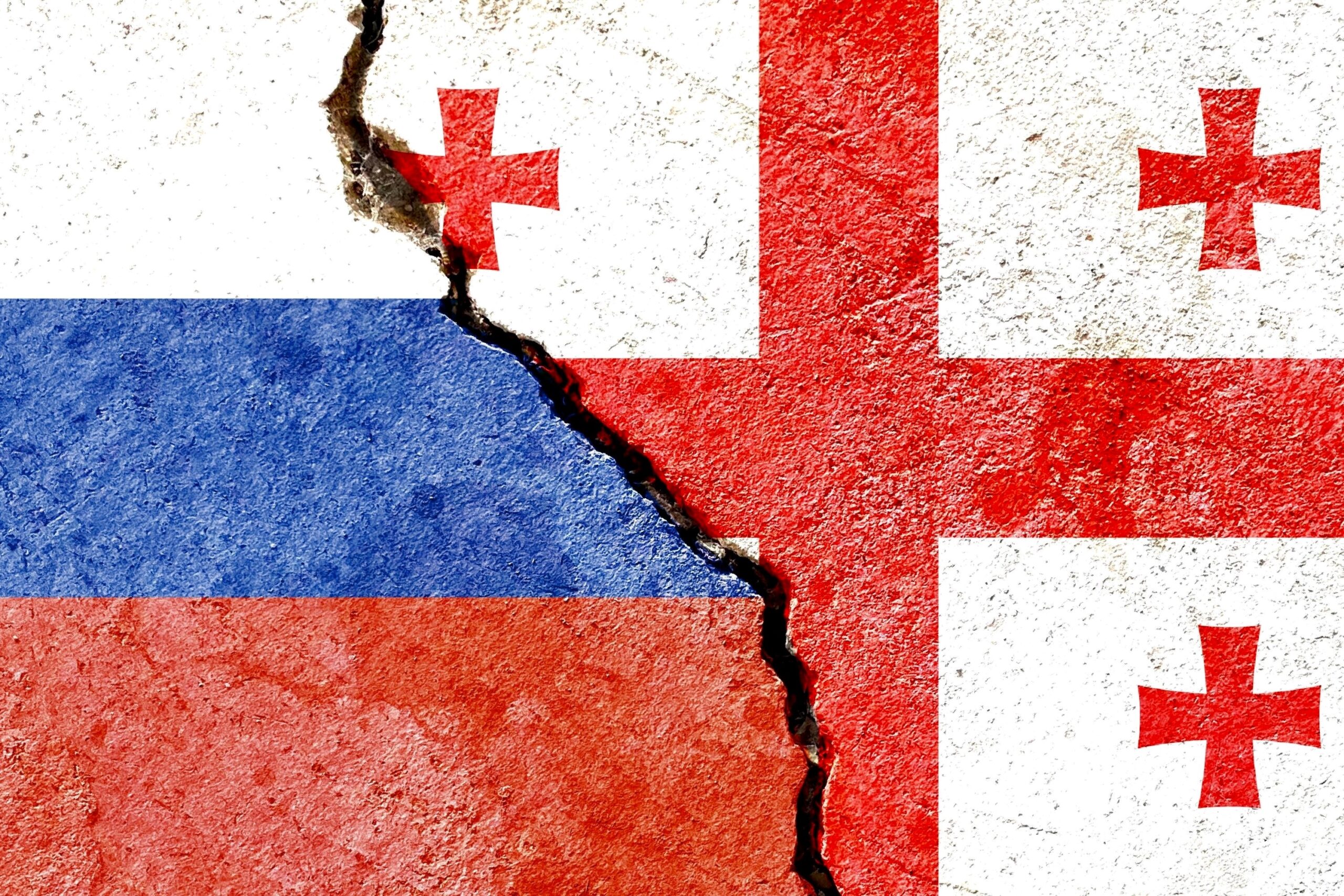
The Russian Federation has already begun to restore its influence in Georgia through the formation of a political crisis brought about by the Georgian authorities. This has led to increased tensions between Tbilisi and its Western allies. Moscow is actively exploiting this situation, probably playing a role in shaping the crisis.
Short-term goals:
- To create an illusion in the minds of the Georgian authorities through their allies in the West (Hungary, Slovakia) that the collective West will not break off relations with Georgia and that public opinion will be led to believe that it is possible to be a European country and be friends with Russia.
- Breaking off relations with the West by intensifying internal repression and rigging elections. Political isolation of Georgia.
- Expansion of trade and economic partnership between Russia and Georgia within the framework of the Russian ecosystem of survival under sanctions. Development of trade and financial schemes West — Georgia — Russia (EAEU countries).
- Participation of Russian companies in major infrastructure projects, especially in the transportation and energy sectors.
- Increased presence of Russian capital in Georgia, growth of Russian assets, especially in the banking and financial sector.
- Georgia’s withdrawal from the Ukraine Defense Contact Group (UDCG, also known as the Ramstein group).
- Changing the Georgian media mainstream narrative and public opinion on the war in Ukraine.
- Removing the syndrome of aversion to Russia, among other things, through the formation of the image of an enemy among Georgians on the basis of Turkophobia and Islamophobia, with reliance on specific representatives of the Georgian Orthodox Church (GOC).
Medium-term goals:
- Launching a railroad through Abkhazia that will provide access to the Georgian ports of Poti and Batumi, as well as to the Tbilisi-Kars railroad connecting Georgia and Turkey, with the prospect of using the deep-water port of Anaklia as a backup port for Novorossiysk.
- Breakdown of relations with SOCAR and return to monopoly gas supplies from Russia.
- Georgia’s rejection of European and Euro-Atlantic integration at the institutional level, amendment of the Constitution.
- Restoration of diplomatic relations with Georgia against the background of negotiations on the unification of the “three countries of the South Caucasus” into a federation or confederation.
Long-term goals:
- Transfer to concession of the railroad and the ports of Poti and Batumi by Georgia.
- Return of Russian military bases to Vaziani, Batumi and Akhalkalaki.
- Georgia’s accession to the EAEU and CSTO.
- The unification of Georgia, Abkhazia, South Ossetia and Adjara into a confederation or federation, and Georgia’s accession to a union state.
Russia has long been developing plans to strengthen its influence in Georgia, and today they are close to materialization. The main goal is to strengthen its influence in the country, and how Russia gets Ivanishvili to do it is not really important. The protests in Georgia are aimed at opposing this turn.
As a result, Georgia falls under Russian influence, although this is not technically formalized. The reaction of the West, including the U.S. and Europe, has been hurtful, but without a clear political opposition in the country, they have little support, despite the support of the population. It is difficult to make predictions in such a situation. Protests will continue even after the elections. The future remains uncertain but very interesting.