

25 December 2023 – 4 January 2024
WHAT HAS HAPPENED?
Gaza:
Over the past two weeks the fighting in Gaza City and its northern suburbs, Beit Hanoun, Beit Lahia and Jabalia, has decreased significantly and the IDF has withdrawn five of its brigades from the area. What fighting is occurring involves small-scale guerrilla-style attacks (sporadic hit-and-run strikes) by the remnants of Hamas personnel still remaining.
Fighting continues to be intense in Khan Yunis, but there too, Hamas tactics have moved from trying to hold ground to trying to ambush or raid Israeli forces with small teams.
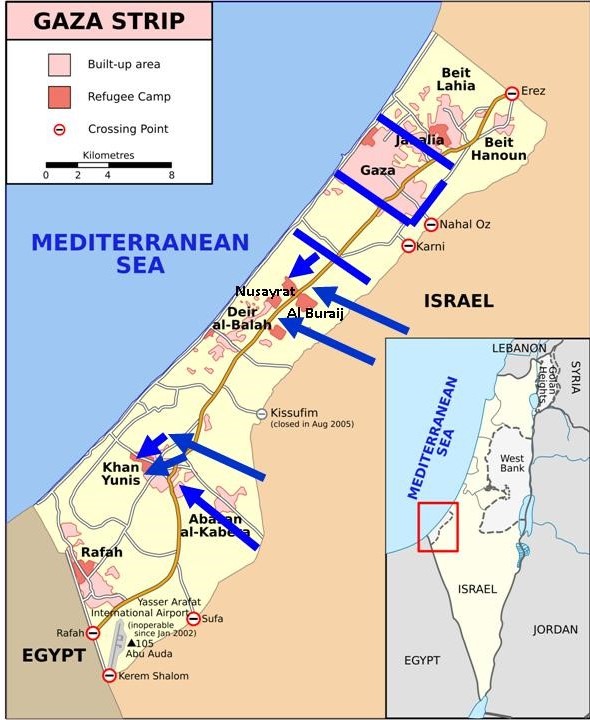
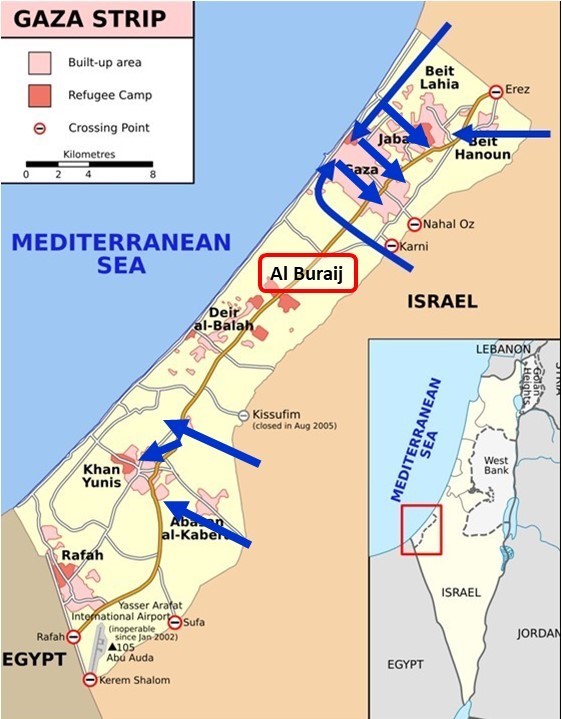
Around the middle of last week, Israeli ground forces entered the conglomeration of built-up areas in central Gaza (see Deir al-Balah – Al Buraij on the map). From the start, resistance was not as strong as it was in Gaza City or Khan Yunis.
The reduced intensity of the fighting can be seen in Israeli casualty figures, with 23 killed in 11 days versus 40 in the previous 11 days. Total Israeli fatalities in Gaza have now accumulated to 173. The IDF also reported that a couple of weeks ago it tried and failed to free a kidnappee who was killed in the attempt.
Israel has declared a change in strategy: it is reducing the intensity of its operations and reconfiguring them as counter-guerrilla operations. However, according to Israeli officials the war should continue for another six months at least.
During the first seven weeks of fighting inside Gaza, the IDF neutralized more than 30,000 bombs of various sizes. In Iraq and Afghanistan NATO forces used the term IEDs (Improvised Explosive Devices), but in Gaza the “I” (Improvised) is inaccurate. These are factory-manufactured bombs of various types. The majority are fragmentation against infantry (equivalent to the American Claymore but usually two or three times bigger), while the others are hollow charges against armored vehicles, self-forming slugs against armored vehicles, and simple high explosives for collapsing buildings on top of whoever is inside. There were also some improvised types, such as kitchen gas canisters placed inside “innocent” vehicles parked at the sides of roads. Most were remote-controlled by wire with TV cameras aimed at the sites so the operators could hide elsewhere and set off the bombs when Israeli troops approached the locations.
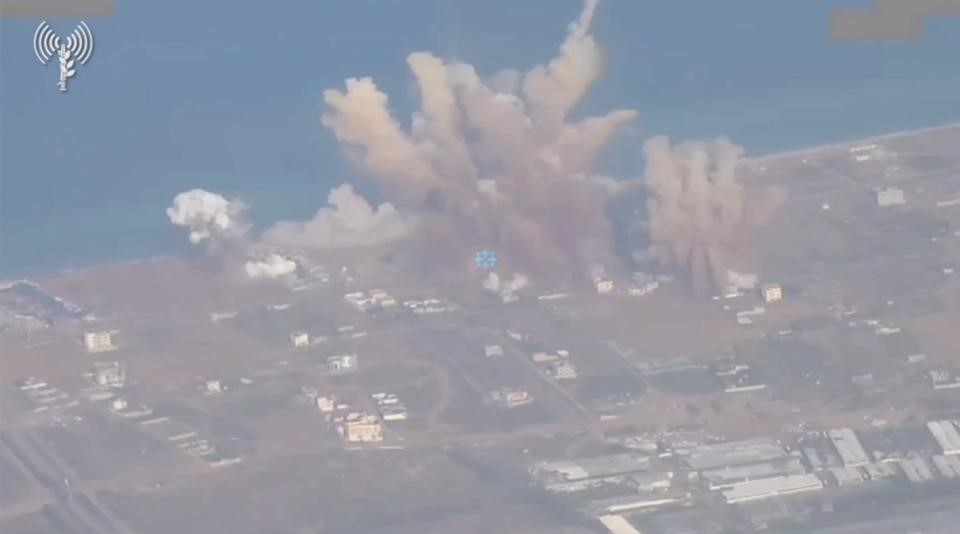
Destruction of a Hamas underground complex.
Note the extent of the complex relative to building sizes
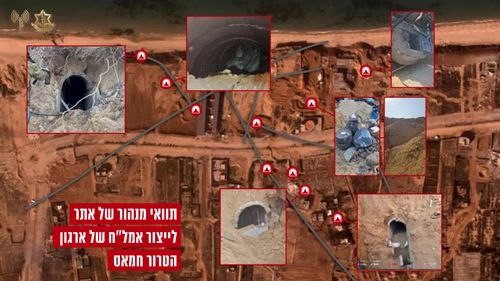
Map of tunnels (gray lines) overlaid on satellite photograph. The red circles are tunnel entrances
According to the mayor of Rafah, the southernmost city in Gaza, there are roughly 1.3 million refugees in his district. If he is not exaggerating, this means the majority of the Palestinians moving from northern Gaza, central Gaza and Khan Yunis have arrived in the southern tip of Gaza.
Hamas-affiliated channels have been calling for a campaign of Egyptian citizens in Sinai (south of Gaza) to break the siege of Gaza. The implication is that they want the Gaza-Egypt border to be opened, something the Egyptian government refuses to do. Egypt has even posted military units near the border to prevent Palestinians from crossing it.
Hamas is still firing rockets into Israel – mostly near Gaza but also towards Beersheva, Ashdod and the Tel Aviv areas, and once towards Jerusalem. The number of total launches per day is fairly small, involving at most a few dozen and usually fewer, so to achieve maximum effect they are attempting to launch them in concentrated salvos. The total number of rockets fired so far is approaching 11,000. Occasionally one of the rockets gets through the Iron Dome interception system and causes damage, but the number of people being hurt by them is minimal. In most cases there have been no injuries.
Lebanon:
The exchange of fire on the Israel-Lebanon border has escalated over the past 11 days. In the last update there were reports of Hezbollah withdrawing some of its troops from the border. This was apparently a tactical withdrawal to reduce casualties incurred from Israeli strikes and counterstrikes. The Israeli strikes have also escalated both in number and in distance of targets from the border. Whereas previously, most of the Israeli strikes were responses, more are now preemptive in nature.
Another Israeli was killed in Hezbollah attacks, increasing Israeli casualties on the Lebanese border to 12 killed (two of them civilians) since 7 October and several dozen wounded. Hezbollah has increasingly used explosive drones in its attacks. These have two advantages over guided anti-tank missiles. First, they have a longer range, which protects the launch crew from Israeli detection and counterstrike and enables strikes on targets further inside Israel. Second, they can be directed to attack targets hidden from view from Lebanese terrain. Hezbollah flies surveillance drones into Israel to find targets hidden from sight and then sends explosive drones to hit them. All told, since the beginning of the war Hezbollah has fired approximately 1,500 rockets and exploding drones into Israel.
The IDF has begun dropping leaflets warning the population of southern Lebanon that Hezbollah might use their homes as bases from which to launch attacks against Israel and suggesting that they prevent this from happening.
Hezbollah has admitted to 148 of its personnel killed (13 of them in Syria). An IDF source claimed the true number is 160. The number of wounded is not known. In addition, it has been revealed that the Hezbollah established and has been operating a unit of Palestinians and that this unit, whose casualties have not been disclosed by Hezbollah, has suffered a few dozen fatalities too (this could be the source of the discrepancy in the numbers given above).
On 2 January, one of the top leaders of Hamas was killed in a strike in Beirut near the headquarters of Hezbollah. The strike was attributed to Israel. The person killed, Salah al-Arouri, was deputy head of the Hamas political bureau and one of the founders of Hamas’s military wing. He was also wanted by the United States, which offered $10 million in 2018 for information leading to his arrest. The Hamas operations officer for south Lebanon was killed in the same strike as well as another five Hamas members of various ranks. Al-Arouri’s mother was interviewed on Al-Jazeera, where she said, “This is a joy. He wished for a holy death for a long time. He told me that all his friends had already achieved this and that he had been left behind, late. He wanted very much to die like this. His sister said there was no better way to die.”
Other Lebanese and Lebanese-based Palestinian organizations have also participated in exchanges of fire with Israel and at least 14 of their members have been killed. One Lebanese soldier was killed accidentally and three were wounded in an IDF strike for which Israel issued a formal apology to the Lebanese government.
Syria:
Exchanges of fire from the Syrian border continued since the last update but were still minimal, especially compared to the Lebanese front. Since the beginning of the war, Iranian proxies and Hezbollah stationed in Syria have fired a few hundred rockets into Israel and Israel has responded with airstrikes and tank fire. There have been no Israeli casualties on this front, but a number of Hezbollah personnel (accumulating to 13), Iranian proxies, Syrians and Iranians have been killed or wounded.
IDF aircraft apparently attacked an Iranian military delegation to Syria, killing an unclear number of them (one report claims 11; the Iranians deny this but have provided no other figure). They included a brigadier general (a one-star general in American parlance) who was one of the commanders operating the various Iranian proxy forces stationed in Syria. He was the third Iranian of this rank killed in Syria in December.
Approximately 25 Syrian soldiers have been killed in Israeli strikes, as well as an unspecified number of members of various militias that launched rockets, mortar bombs and exploding drones towards Israel.
Judea and Samaria:
The fighting in Judea and Samaria continues with the IDF intensifying its raids, especially in the Jenin area (the northern edge of Samaria). Each IDF entry into Palestinian towns faces different intensities of resistance, including bombs dug under roads (which are cleared by bulldozers that tear up the asphalt), rifles, grenades, and improvised hand-thrown bombs as well as petrol bombs.
The Palestinians claim that almost 5,000 people have been arrested but the official Israeli number is only 2,450, of whom 1,210 belong to Hamas and the others to other groups. The discrepancy is apparently because the Palestinians count anyone who was detained even if they were released after interrogation. Approximately 300 terrorists have been killed.
There has also been an increase in the number of violent altercations between Palestinian and Israeli civilians over agricultural property rights (field boundaries, grazing rights). There are escalating reports in Western media and mentions by Western politicians of Israeli settler violence against Palestinians in Judea and Samaria. All these reports continue to ignore the attacks by Palestinians on the Israelis living there. An Israeli police report claims that the number of incidents initiated by Israelis has actually decreased over the past two months.
Yemen:
The Houthis have continued to launch missiles and long-range explosive drones towards Israel, but their main effort has shifted to disrupting shipping lanes passing by Yemen in the Red Sea. So far there have been approximately 25 attacks. A number of ships were hit and more were fired upon but escaped being hit. Various American, French and other naval vessels have shot down exploding drones and missiles fired towards the ships.
Because the Red Sea is so narrow, it is not possible for ships to avoid sailing near Yemen. The Red Sea’s entire width is within range of Houthi missiles and exploding drones. In order to protect the ships passing through, the US has organized an international flotilla that includes 22 states (excluding France, Spain and Italy, which refuse to participate). It is not yet clear if the flotilla’s remit will be solely to try to shoot down missiles and drones or also to conduct offensive actions against the Houthis.
A Houthi attempt to board a Danish ship was thwarted as the security personnel returned fire and called for assistance. An American attack helicopter intervened and sank three of the four Houthi boats, killing ten of the attackers.
Another apparent first was a Houthi attempt to hit a ship with a remote-controlled exploding boat. The attack apparently failed.
Iran:
On 3 January, there was a terrorist attack on a memorial procession for Qassem Suleimani, the commander of the Iranian Quds forces who was killed by the US in 2020 for planning attacks on American forces in the Middle East. Eighty-four people were killed and more than 200 wounded. There were two suicide bombers, the first attacking the procession and the second attacking ten minutes later while first responders were working to collect the wounded.
The following day ISIS claimed responsibility for the attack. It then called on Muslims around the world to kill Jews everywhere.
Official notification by ISIS of its responsibility for the terrorist bombing in Iran.
It claims 300 Iranians killed or wounded.
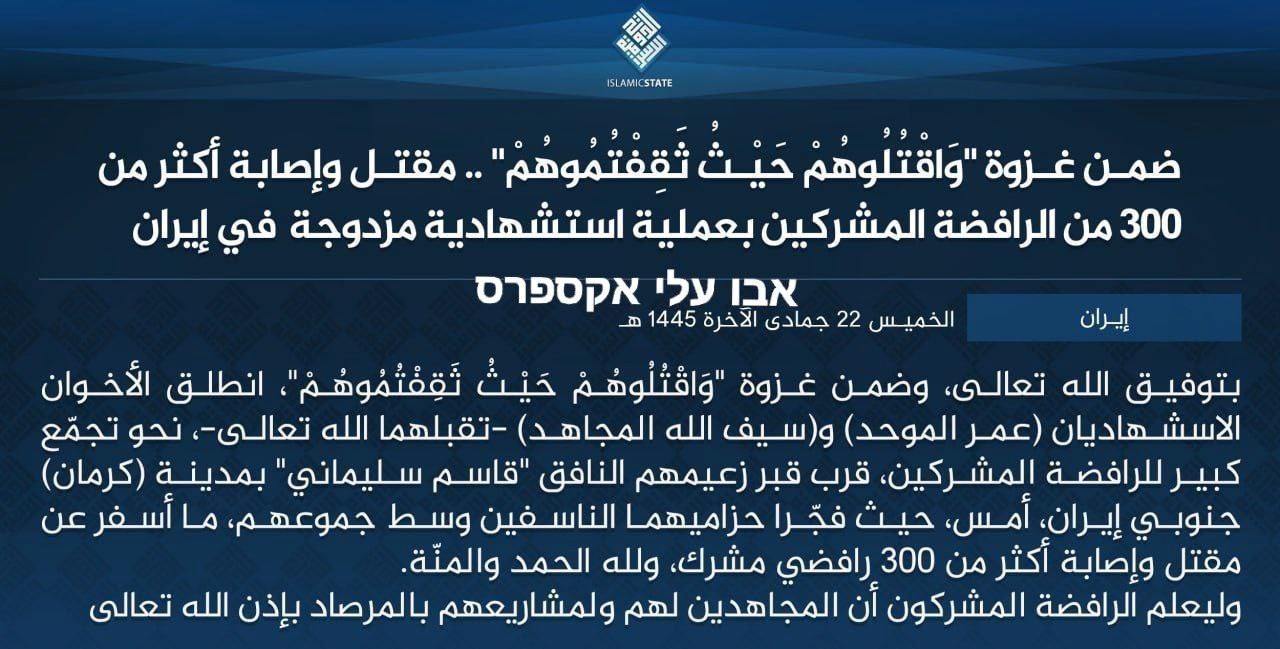
Source: Israeli blogger Abu Ali Express
Despite ISIS’s claim of responsibility, the Iranians officially continue to blame Israel and call the ISIS declaration a fake. But they have also announced an operation to seal Iran’s border with Afghanistan, which ISIS uses as its base of operations in the area.
A caricature published in Iran showing Israel launching an ISIS suicide bomber at the procession
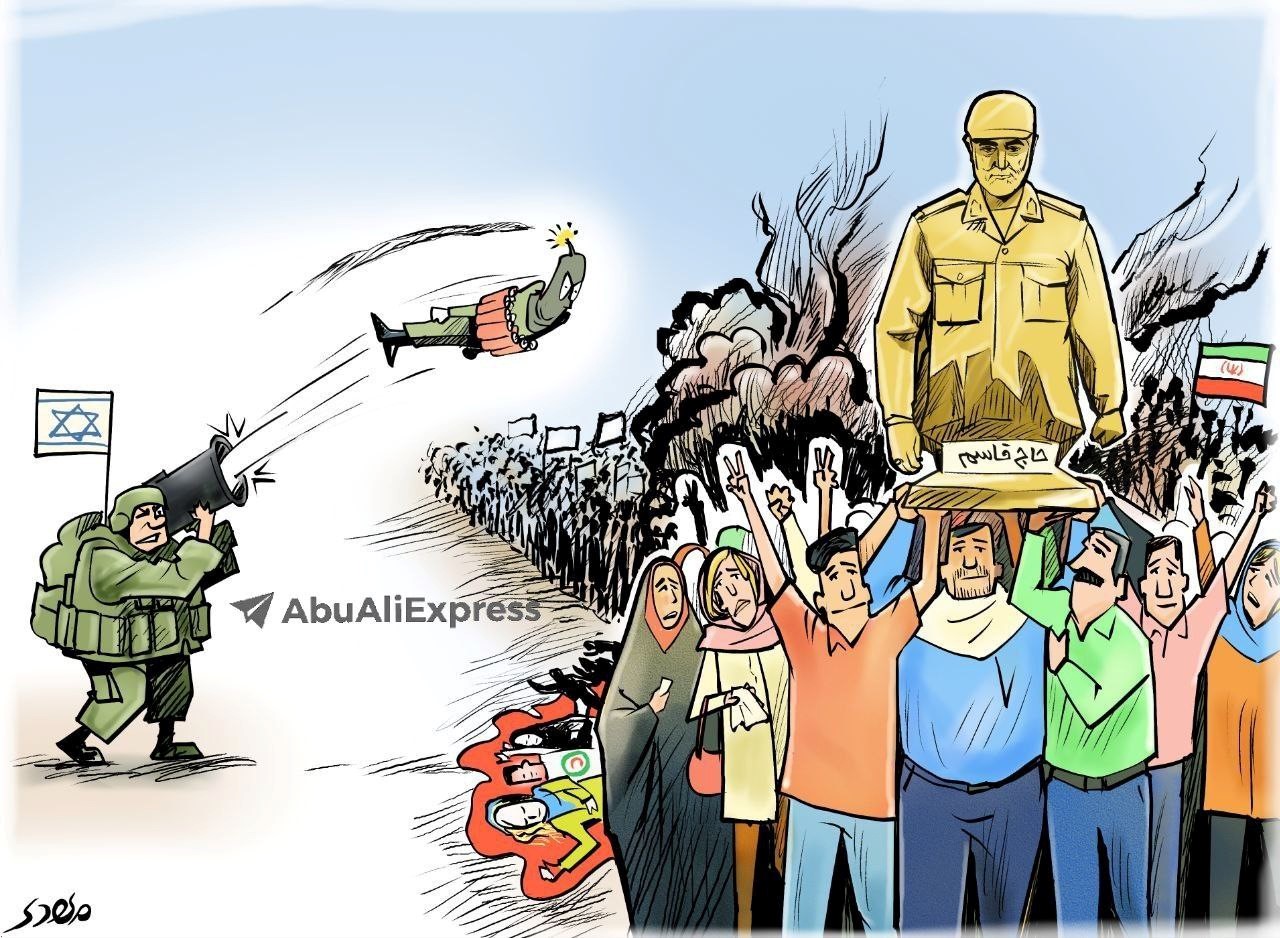
Source: Israeli blogger Abu Ali Express
Iraq and Syria – US forces:
Pro-Iranian Iraqi Shiite militias continue to attack American bases in Iraq and Syria with rockets and exploding drones. Since 18 October, there have been at least 118 such strikes. There are currently approximately 2,500 American troops in Iraq and 900 in eastern Syria.
The US military has responded with airstrikes on suspected militia locations and has killed an unspecified number of them. This week they also killed a higher-ranking officer in one of the pro-Iranian militias. This prompted an angry rebuke from the Iraqi government, which labelled it “a blatant aggression” as well as “a dangerous escalation and assault… The Iraqi armed forces hold the global coalition forces responsible for this unwarranted attack.” The government declared the convening of a committee to plan the end of the American military presence in Iraq.
Israeli casualties:
The total for the single day of 7 October is 1,140, which includes civilians, military, police, firefighters, medical personnel, etc. There are still some people unaccounted for, and some of the people kidnapped to Gaza were dead when taken or have died in captivity and are still not confirmed as dead.
There are still almost 130 kidnapped Israelis (since the last update a few more of the missing were confirmed to have been kidnapped) and nine non-Israelis in Gaza. How many of them are alive and how many dead is not known, though the current estimate is that at least 19 are dead.
In addition, 19 Israeli civilians have been killed in Hamas rocket attacks.
As of 13 December, a total of 507 IDF soldiers had been killed on all fronts since and including 7 October (the number for 7 October is periodically updated as more are confirmed killed who had been listed as missing).
The total number of Israeli wounded is approximately 11,600. The number of IDF regulars and reservists wounded on all fronts together is at least 2,000, of whom approximately 300 were severely wounded and the rest moderately or lightly wounded.
Initially the number of Israelis who were forced to leave their homes in 64 villages and towns along the borders with Gaza and Lebanon reached approximately 250,000. Over the past couple of weeks many have returned home, though the exact figure is not clear. The official evacuees still number approximately 218,000. Some of the industrial and agricultural sites near the Gaza border that were abandoned in the first days have resumed work.
Palestinian casualties:
The Gaza Health Ministry, which is controlled by Hamas in its role as the government of Gaza, claims that so far approximately 22,440 Gazans have been killed and approximately 57,600 wounded. They do not differentiate between personnel of Hamas and other terrorist organizations and civilians, but according to one source, at least 8,500 of them belonged to Hamas or the other militias (an increase of 500 since the last update).
WHAT NEXT?
As far as Israel is concerned, the war’s overall objective has not changed: the destruction of Hamas. As yet there is no end-by date, but that could change if the US, for its own external or internal policy reasons, decides to pressure Israel to desist.
According to Israeli officials, as Hamas resistance diminishes and its tactics change, Israel is gradually changing its strategy in Gaza from all-out regular warfare to a counter-guerrilla offensive. The expectation is that this will have to continue for at least six more months. As a reminder, Operation Defensive Shield in 2002 in Judea and Samaria was a major operation that changed the trend of the Palestinian terror offensive that began in September 2000 and gradually escalated to the point that it was regularly inflicting ever-growing casualties on Israel. Defensive Shield lasted about six weeks, but after that period, the IDF repeated the same modus operandi in a series of smaller repetitive offensive operations over the next three and a half years before the Palestinian terror offensive was finally beaten. The number of attacks on Israelis – and, more importantly, the number of Israeli casualties – dropped from a height of 7,500 attacks and roughly 2,000 killed and wounded per year to approximately 4,000 attacks and 1,000 casualties per year and then to approximately 2,000 attacks and 300 casualties in 2006. The general consensus in Israel is that this is roughly the direction in which the fighting will progress, though of course with different numbers and hopefully for a shorter period.
The situation in Lebanon is in flux. Hezbollah’s partial withdrawal of troops from the border was a reorganization for renewed operations based on different tactics (answering the question in my last update). However, the IDF exploited it to escalate slightly, and Hezbollah’s new tactics have not had an appreciable positive effect for them in terms of reducing their casualties while increasing Israeli casualties. They have promised a more vigorous offensive following the killing of a high-ranking Hamas official on their doorstep, but it remains to be seen whether they will follow through or it was just rhetoric.
Another open issue is the policy of the international flotilla to protect the Red Sea commerce lanes. Will it only react defensively or will it also attack Houthi launchers? This question remains open. So far it has acted only defensively, but there have been reports of preparations for offensive actions.
And last: how will Iran react to the terrorist attack during the memorial procession for Suleimani? They blame Israel (despite ISIS having taken responsibility) and threaten retaliation, but at the same time, Supreme Leader Khameini has spoken of “strategic patience”.
***
14-24 December 2023
WHAT HAS HAPPENED?
Gaza:
IDF Chief of Staff visiting units inside Gaza
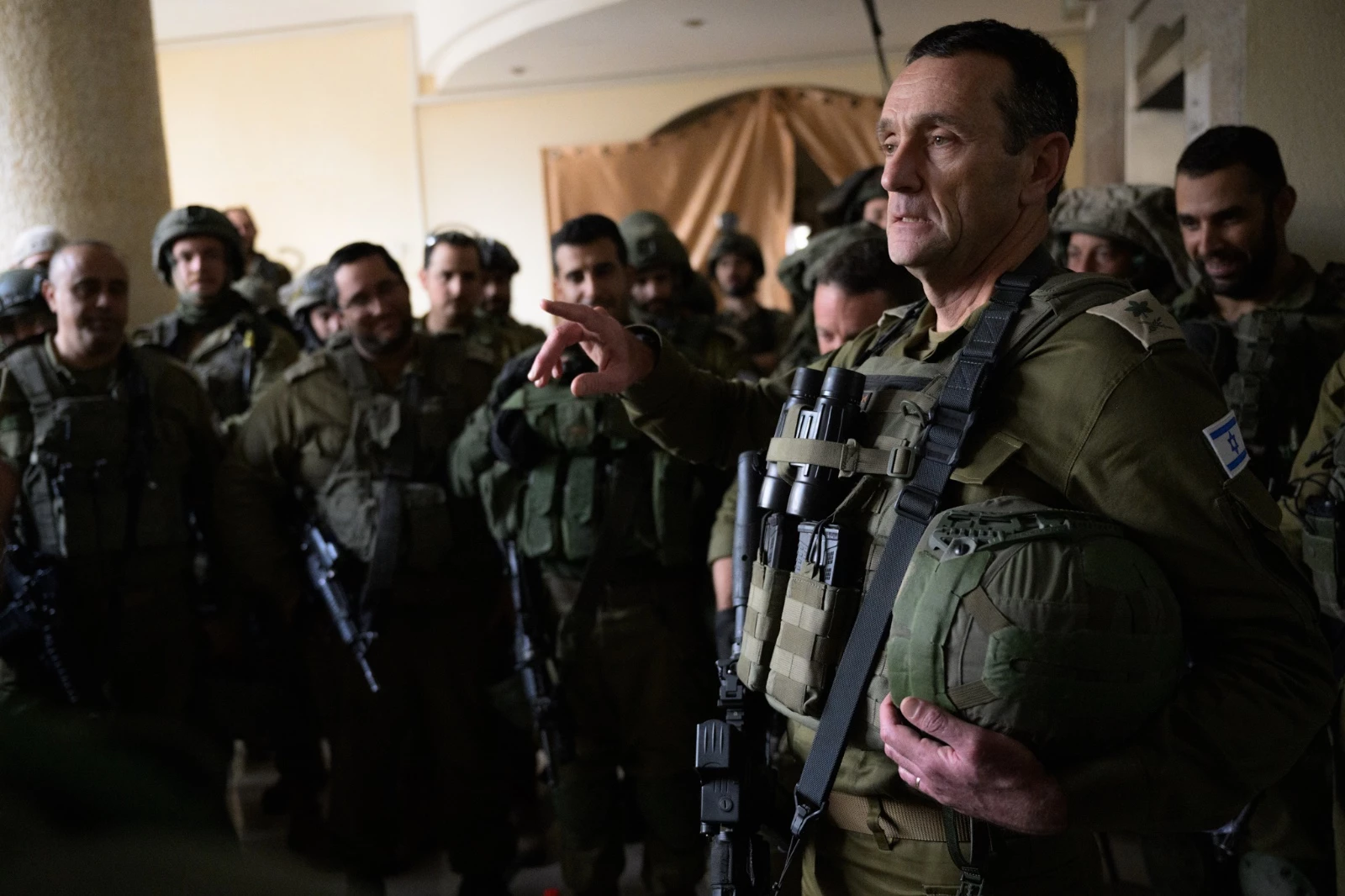
The fighting in Gaza City itself has been intense for most of the days since the last update, but that intensity has gradually declined over the last couple of days. The assessment is that the majority of the terrorists in the eastern neighborhoods of Gaza City have either been killed, have surrendered, or have fled. The current fighting by Hamas is more guerrilla-style (sporadic hit-and-run strikes) than attempts to hold ground.
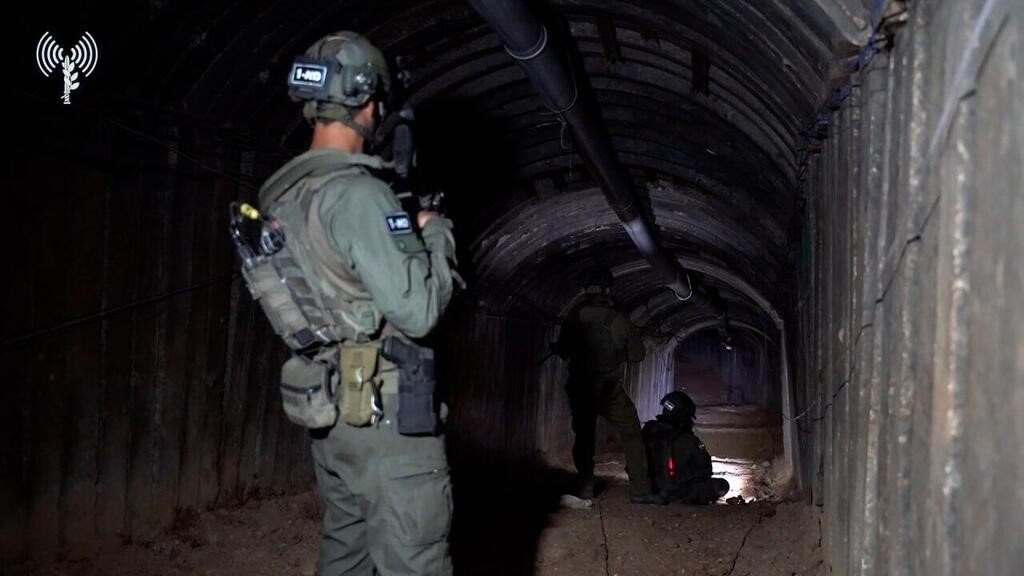
However, in Khan Yunis, fighting continues to be intense. Over the past 11 days, 40 Israeli soldiers have been killed, bringing the current total of Israeli soldiers killed in Gaza to approximately 155. The bodies of seven people kidnapped by Hamas on 7 October (both soldiers and civilians) have also been discovered, five of them in one tunnel investigated by IDF engineer units.
A large tunnel found and investigated by the IDF
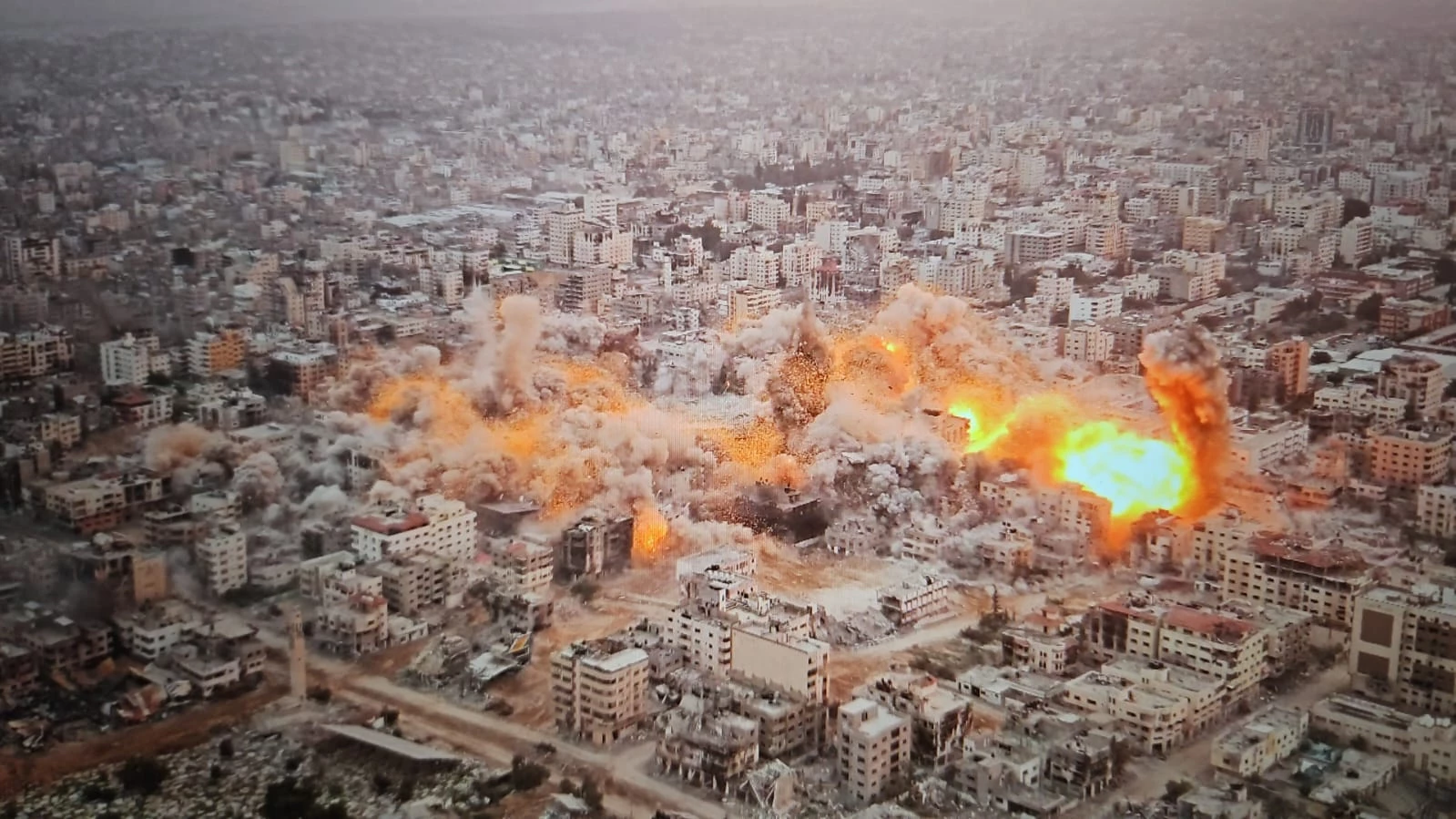
A large tunnel exploded by the IDF
Note the path of the explosion above ground
According to Palestinian reports, the IDF is reducing its presence in Gaza City. Some areas have been left altogether. At the same time, they reported that IDF aircraft dropped leaflets over the al-Buraij area telling residents to evacuate. This suggests that the IDF intends to begin operations in a new area of the Gaza Strip. Three days after the first leaflets were dropped, the Palestinians reported the first Israeli air strikes in the region.
Hamas is still firing rockets into Israel – mostly towards the area close to Gaza, but also towards Beersheva, Ashdod, and the Tel Aviv area, and once towards Jerusalem. The number of total launches per day has been fairly small, at most a few dozen and usually fewer. To achieve maximum effect, Hamas has been launching them in concentrated salvos.
The total number of rockets fired at Israel so far is approximately 10,600. Occasionally one of the rockets gets through the Iron Dome interception system and causes damage, but the number of people getting hurt during these attacks has been minimal. One rocket fired at Jerusalem overshot the target and landed in Ramallah, which is in the Palestinian Authority.
On Friday, 15 December, the IDF accidently killed three Israeli kidnappees who had escaped their captors. The incident occurred during an engagement between an IDF unit and terrorists in an area where no civilians had been sighted for more than a week. The IDF unit set up an ambush for the terrorists that included a sniper located at a distance on one side. The sniper saw glimpses of people moving inside the ambush location and fired at them. Only after the bodies were recovered was the mistake discovered.
Many rumors and incomplete information have been published about this incident. The kidnappees were carrying a white sheet that was not visible to the sniper but was visible to other troops observing from a different angle. It should be noted that the IDF has experienced encounters with terrorists who were carrying white flags in order to get close to Israeli troops while wearing suicide vests or to draw the soldiers in their direction so as to expose them to Palestinian snipers. A video filmed by a reconnaissance dog in one of the houses in the area had recorded people speaking Hebrew, but again, there have been incidents in which terrorists used recordings of children and women calling for help in Hebrew to lure IDF troops into booby-trapped houses.
There have been increasing incidents of violence around the supply of humanitarian support to Gaza. On 24 December Hamas police shot and killed a child who approached the aid trucks. In retaliation, the family of the child attacked the Hamas police station and set it on fire and is demanding revenge on the police officer responsible. The family has published his photograph on social media.
Lebanon:
The exchange of fire on the Israel-Lebanon border continues, sometimes escalating and sometimes decelerating. Another Israeli soldier has been killed on this front since the last update, bringing Israeli casualties on the Lebanese border to 11 killed since 7 October and a few dozen wounded.
The IDF began dropping leaflets to the population of southern Lebanon warning them that Hezbollah may try to use their homes as bases from which to launch attacks against Israel and suggesting that they prevent this from occurring.
Hezbollah fatalities have accumulated to least 130 (nine of them in Syria). The number of wounded is not known. In addition, it was learned that Hezbollah has established and is operating a unit of Palestinians. That unit, whose casualties have not been declared by Hezbollah, has suffered a few dozen fatalities as well.
Over the past 48 hours there have been reports that Hezbollah is withdrawing some of its forces from the border with Israel. It is not clear if this withdrawal is permanent or a temporary measure to give it time to rethink its strategy and tactics.
Infographic published by Hezbollah showing its operations against Israel by type of weapon used and target (Hezbollah does not mention its attacks on Israeli villages)
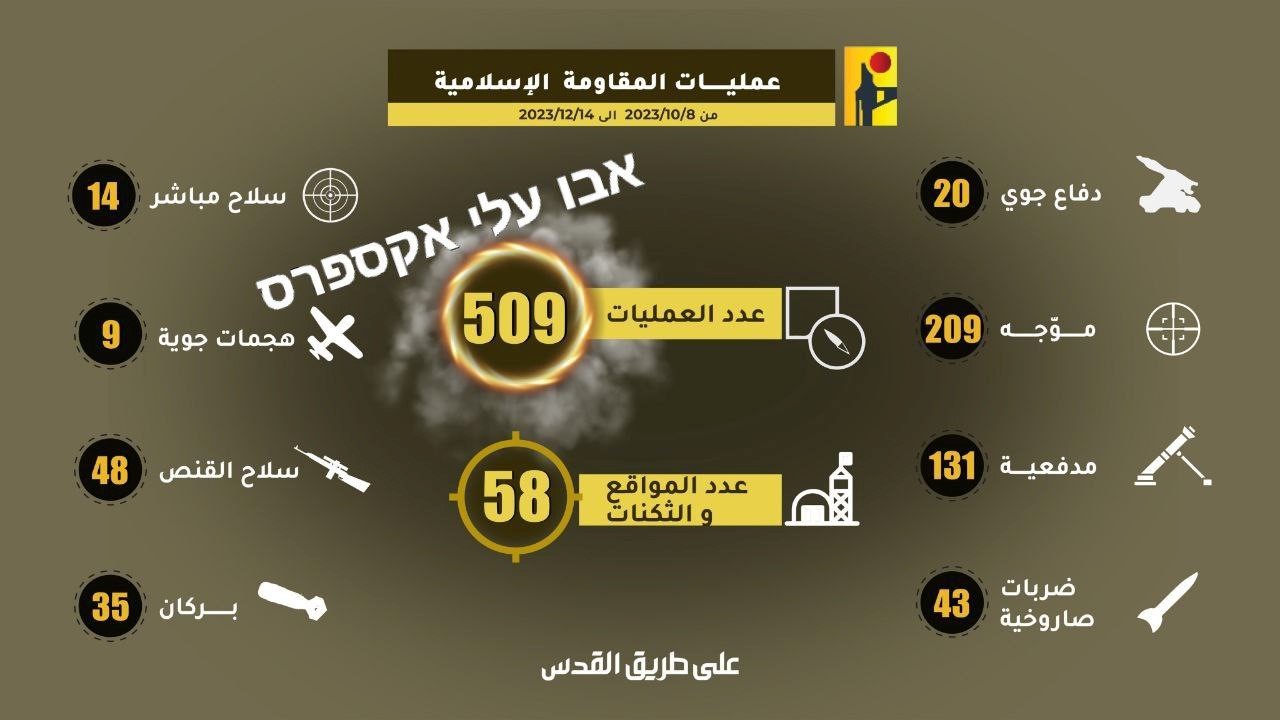
Attacks include: 20 anti-aircraft missiles, 209 anti-tank missiles, 131 cannon shells, 43 rocket salvos (multiple rockets per salvo), 14 direct fire weapons, 9 explosive drone strikes (some involving multiple drones), 48 sniper shots, and 35 large rockets.
Source: Israel blogger Abu Ali Express
Other Lebanese and Lebanon-based Palestinian organizations have participated in exchanges of fire, and at least 14 members of those groups have been killed as well. One Lebanese soldier was killed accidentally and three were wounded in an IDF strike, for which Israel has issued a formal apology to the Lebanese government.
Syria:
Exchanges of fire across the Syrian border have continued since the last update but remain minimal, especially when compared to the Lebanese front. Iranian proxies and Hezbollah stationed in Syria have fired rockets into Israel and Israel has responded with airstrikes and tank fire. There have been no Israeli casualties on this front, but nine Hezbollah personnel, members of Iranian proxies, Syrians and Iranians have been killed or wounded.
IDF aircraft attacked an airport near Damascus causing damage and a temporary cessation of flights. The bombs were focused on warehouses that were storing weapons transfers from Iran.
Judea and Samaria:
The fighting in Judea and Samaria continues, with the IDF intensifying its raids especially in the Jenin area (the northern edge of Samaria). Each IDF entry into Palestinian towns faces varying intensities of resistance, including bombs planted under roads (which are cleared by bulldozers that tear up the asphalt), rifles, grenades, and improvised hand-thrown bombs as well as petrol bombs.
The Palestinians claim that at least 4,400 people have been arrested but the official Israeli number is only 2,450, of whom 1,210 belong to Hamas and the others to other groups. The discrepancy is apparently because the Palestinians count anyone who was detained even if they were released after interrogation. Approximately 300 terrorists have been killed. Among the killed were a 14-year-old and a 17-year-old who were using a scooter to transport a bomb that detonated accidentally. The Palestinians constantly use teenagers and children as young as 12 to carry out military activities and then report that the IDF has killed children (anyone under 18).
There has also been an increase in the number of violent altercations between Palestinian and Israeli civilians over agricultural property rights (field boundaries, grazing rights). There are escalating reports in Western media and mentions by Western politicians of Israeli settler violence against Palestinians in Judea and Samaria, but none of these reports mention the attacks by Palestinians on the Israelis living there. An Israeli police report claims that the number of incidents initiated by Israelis has actually decreased over the past two months.
The Palestinian Authority in Judea and Samaria (the West Bank) does not have access to the sea. All imports cross through Israel. In the Israeli port of Ashdod, security forces discovered an attempt to smuggle thousands of weapons parts into Palestinian Authority territory as well as tools for forging coins. These items were hidden inside a weaving machine.
Yemen:
The Houthis have continued to launch missiles and long-range explosive drones towards Israel, but their main effort has shifted to disrupting shipping lanes passing by Yemen in the Red Sea. So far there have been approximately 20 attacks. A number of ships were hit and others were fired upon but escaped being hit. American, French and other naval vessels have shot down some of the exploding drones and missiles fired at the ships.
It is not possible for ships in the Red Sea to avoid sailing near Yemen because the sea is fairly narrow. Its entire width is within range of Houthi missiles and exploding drones.
The US has organized an international flotilla to intervene and protect the ships passing through, but it is not yet clear if it will only try to shoot down missiles and drones or will also conduct offensive actions against the Houthis.
A growing number of shipping companies have said that because of the threat, they will cease transiting through the Red Sea and Suez Canal, which connects the Red Sea to the Mediterranean.
In addition to the ongoing Houthi missile and drone threat, there has been another important development on the high seas. On 24 December, a ship sailing in the Indian Ocean, far away from the Red Sea, was hit by an exploding drone. The drone was apparently launched from Iran itself. This adds a completely new dimension to the conflict as until now the Iranians have not participated directly and instead used their proxies to participate.
Iran:
Though it has not participated in actual combat, Iran has conducted aggressive cyber actions against Israel. It has attempted to disrupt an assortment of public services, including hospital computer networks. It has also tried to acquire intelligence by attempting to penetrate government, military, academic, and strategic think-tank computer systems. Iran has also published vitriolic statements on Israeli social media and news-media talk-backs purporting to be the opinions of Israelis of differing political views, but always expressed in extreme language designed to spread rumors and aggravate tensions among Israelis.
On 17 December Iran suffered a cyberattack attributed to Israel in which the computers of 70% of all the petrol stations in the country stopped functioning, preventing use of the pumps. Israeli has not responded to the accusation, but a group calling itself The Crazy Sparrow published a statement that said: “Khamenei, playing with fire has a cost. We warned you a month ago that we would make you pay for your provocations. This is just a taste of what we are capable of doing.“[1]
Iraq and Syria – US forces:
Pro-Iranian Iraqi Shiite militias continued to attack American bases in Iraq and Syria with rockets and exploding drones. They have conducted more than a hundred strikes with these weapons since 18 October.
The US military has responded with airstrikes on suspected militia locations and has killed an unspecified number of them.
An Iraqi pro-Iranian militia launched an exploding drone from western Iraq towards Israel. The drone flew over Jordan (located in between Israel and Iraq) and was shot down by the Jordanian army.
Israeli casualties:
Currently the total for the single day of 7 October is 1,140, which includes civilians, military, police, firefighters, and medical personnel. There are still people unaccounted for, and the number of people kidnapped to Gaza who were either dead when taken or have died in captivity remains unconfirmed.
There are still approximately 125 kidnapped Israelis (a few of the missing have been confirmed to have been kidnapped) and 9 non-Israelis in Gaza. How many of them are alive and how many dead is not known, though the current estimate is that at least 19 are dead.
In addition, 19 Israeli civilians have been killed in Hamas rocket attacks.
As of 13 December, a total of 486 IDF soldiers have been killed on all fronts since and including 7 October (the number for 7 October is periodically updated as more are confirmed killed who were listed as missing).
The total number of Israeli wounded is approximately 11,000. The number of IDF regulars and reservists wounded on all fronts together is at least 1,700, of whom about 270 were severely wounded and the rest moderately or lightly wounded.
Initially the number of Israelis who were forced to leave their homes in 64 villages and towns along the borders with Gaza and Lebanon reached approximately 250,000. Over the past couple of weeks, many have returned home, though the exact figure is not clear. The official evacuees still number approximately 218,000. Some of the industrial and agricultural sites near the Gaza border that were abandoned in the first days of the war have resumed work.
Palestinian casualties:
The Gaza Health Ministry, which is controlled by Hamas in its role as the government of Gaza, claims that approximately 20,400 Gazans have been killed so far and approximately 54,000 wounded. They do not differentiate between personnel of Hamas and other terrorist organizations and civilians, but according to one source, at least 8,000 of them belonged to Hamas or the other militias.
WHAT NEXT?
The overall objective – the destruction of Hamas – has not changed as far as Israel is concerned. As yet there is no end-by date, but that could change if the US, for its own internal or external policy reasons, decides to pressure Israel to desist.
Meanwhile, the fighting in Gaza City is winding down, though it is not over. The fighting in Khan Yunis is in full swing and it appears that the IDF is preparing to attack the area between Khan Yunis and Gaza City.
The situation on the other fronts currently offers more questions than answers.
The situation in Lebanon is in flux. Is Hezbollah’s partial withdrawal of troops from the border a sign of de-escalation, or just a reorganization for renewed operations based on different tactics?
Another open issue is the policy of the international flotilla being assembled to protect the Red Sea commerce lanes. Will it only react defensively, or will it also attack the Houthi launchers?
And lastly: Is the Iranian attack in the Indian Ocean only a single shot action, or does it presage a new continuous threat bypassing the international flotilla in the Red Sea? Iranian rhetoric has been aggressive, involving threats to shipping in the Hormuz Straits if the international flotilla attacks the Houthis. Almost all the oil coming from the Persian Gulf oil fields passes through the Hormuz Straits. Striking those ships could be a massive escalation that would threaten oil supplies to Europe and other parts of the world, as well as causing a spike in oil prices with all the attendant damage to economies around the globe. Iran’s goal in making these threats is to create enough international pressure on Israel to force it to halt its operations against Hamas.
Document found by the IDF in Khan Yunis detailing the money spent by Hamas in 2022 on concrete and doors, apparently for the tunnels
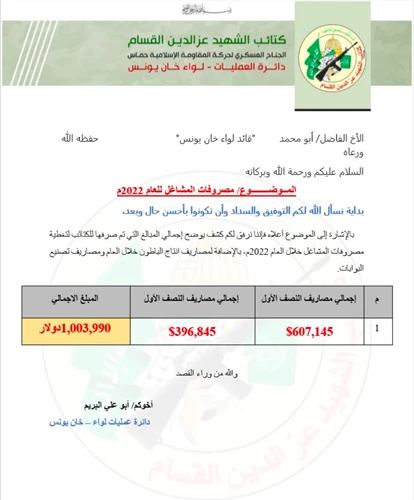
The sums are:
First half year: $607,145
Second half year: $396,845
Total Sum: $1,003,990
[1] Amir Rapaport, Israel Defense, 22 December 2023, https://www.israeldefense.co.il/node/60694.
***
7 – 13 December 2023
WHAT HAS HAPPENED?
Gaza:
Since the renewal of the fighting, its intensity has increased with many more firefights between IDF and Hamas units. IDF units inside Gaza City have attacked the eastern neighborhoods. These are the neighborhoods Hamas expected the IDF to strike first, as they are closest to the border and therefore manned by the strongest Hamas units. Originally, the orientation of their defenses was also to the east, but given the time taken by the IDF to reach those units and the time gifted to Hamas by the ceasefire, the Hamas units were able to reorient their dispositions westwards.
This is especially important with regard to Hamas’s choice of which locations to booby-trap. The majority of Israeli casualties over the past week were caused by bombs that were hidden in buildings and in the streets. On the other hand, over the last couple of days there has been an increase in the number of Hamas personnel who are surrendering, though this does not yet represent a major collapse of the resistance.
There have been inaccurate media reports that the vast majority of the surrenderers were uninvolved civilians. This is an exaggeration of a single case in which Hamas fighters were intermixed with civilians. The IDF checked them all and released the non-Hamas people. The number of Hamas terrorists captured up to a couple of days ago, including those captured on 7 October, is more than 500, most of whom were captured in the past two weeks.
Another element making the fighting inside Gaza City more difficult for the IDF is that many of the civilians who preferred not to move south are concentrated in the eastern neighborhoods. Hamas has increased its attempts to use them either as human shields and as unarmed assailants sent towards Israeli troops either to accost them, acquire intelligence on their positions, or camouflage Hamas terrorists trying to get closer to the Israeli positions. Some Gazan civilians who attempted to move away from Hamas positions were shot by Hamas fighters. The increased presence of civilians has reduced the IDF’s ability to use artillery, airstrikes and tank cannon fire to support its infantry, thus incurring greater risks that in some cases have resulted in more IDF casualties.
In Khan Yunis – the second front opened by the IDF – the situation is similar to that in eastern Gaza. A few days after the Israeli units surprised Hamas by quickly bypassing Kahn Yunis from the north and then entering it from the northwest as well as from the north and east, the Hamas units had gradually reorganized and the resistance was stronger.
The IDF conducted a few operations based on intelligence in attempts to locate and release hostages. One of these operations found the bodies of an Israeli civilian and a soldier.
An entrance shaft to the tunnels found in a ruined schoolroom
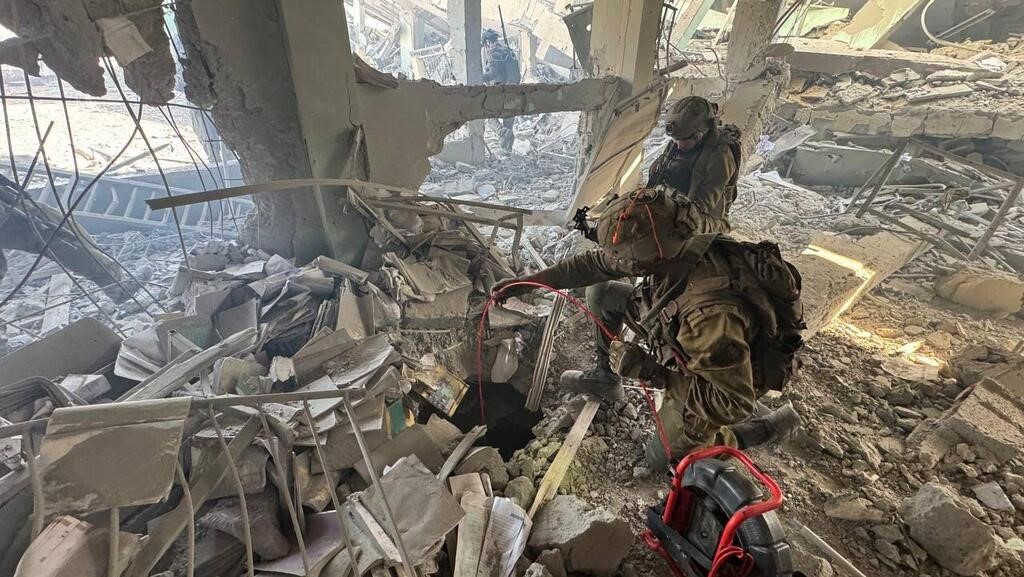
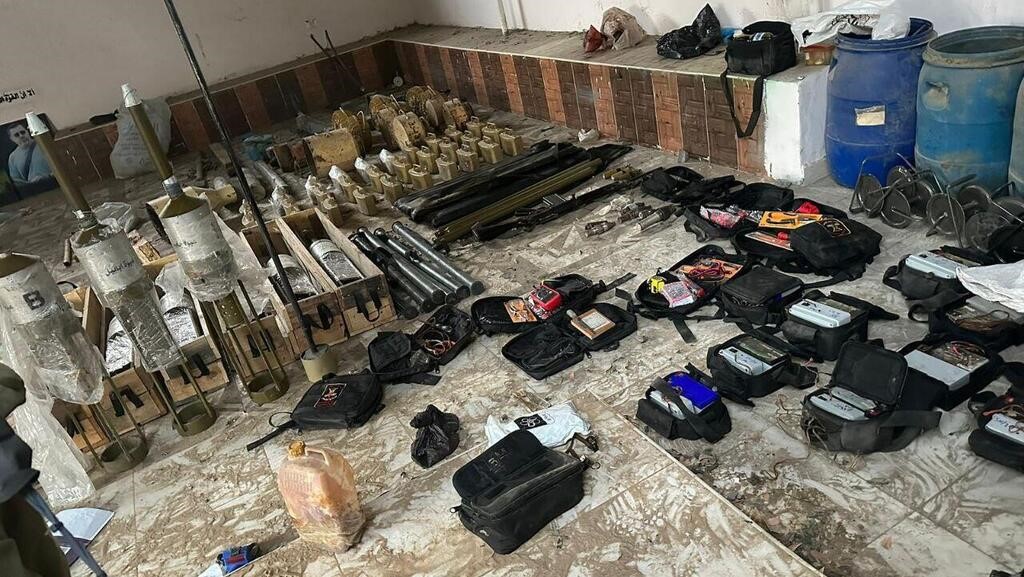
Rockets, small arms, bombs, and other equipment found in other rooms of the same school:
Palestinian terrorists dressed in civilian clothes who are armed with rifles and RPG launchers
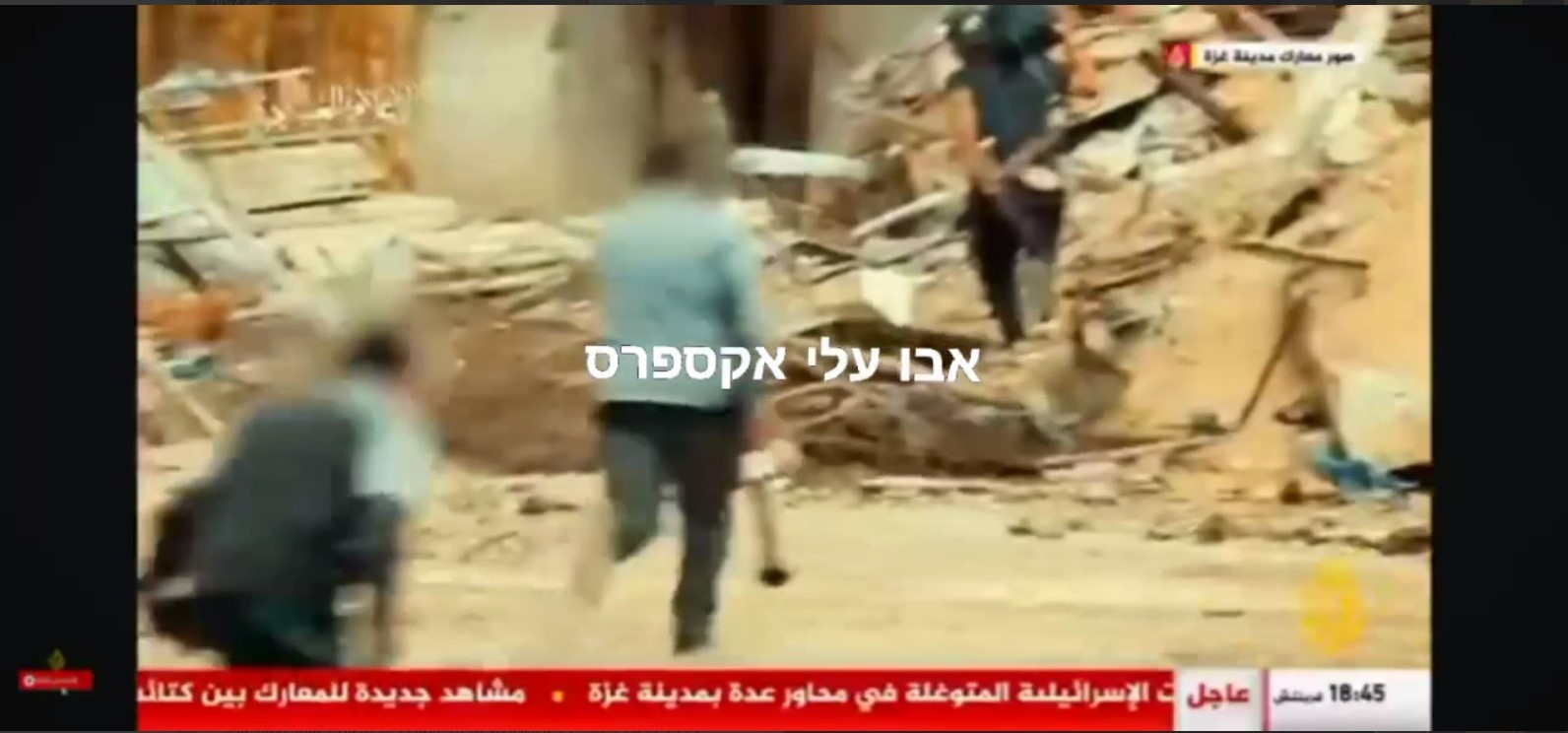
Screenshot from Israeli blogger Abu Ali Express
It was rumored and has now been officially reported that the IDF has placed large pumps and pipes in the sea and has begun to transfer seawater into some of the captured tunnels. In theory, the seawater will course through the tunnel system forcing the terrorists to either come out or drown. However, it is not yet clear if this will work. Many physical factors could make this completely ineffective, effective for only a portion of the tunnel system, or very effective. In any case, published reports indicate that it will take a few weeks to complete the operation even if it is completely successful.
Hamas is still firing rockets into Israel. They are aiming at areas mostly close to Gaza, but also at Beersheva and the Tel Aviv area. They have placed some of their rocket launchers next to the tent-camps set up for the civilians evacuated from northern Gaza. The total number of rockets fired at Israel so far is approximately 10,600.
As a result of the escalating intensity of the fighting, Israeli casualties have grown considerably. The current total of Israeli soldiers killed in Gaza alone is roughly 115. A complication in working out the exact number is that over the past few days the IDF has reported the deaths of a few soldiers who were wounded over the past month of fighting and only recently succumbed to their wounds. Also, the IDF has confirmed the deaths of a few soldiers who had been missing since 7 October. The bodies of a dead Israeli civilian (a 27-year-old woman abducted from the Nova music festival) and a dead soldier, also kidnapped on 7 October, were recovered inside Gaza. More missing civilians and soldiers were also confirmed to have been kidnapped into Gaza, some alive and some dead. A Tanzanian national who came to Israel to study agriculture was also confirmed to have been killed. The IDF has published that the number of wounded soldiers evacuated by helicopter from Gaza is approximately 600 while others (the number was not given) were evacuated by ambulance (generally signifying lighter wounds).
The Jordanians have continued to supply the hospital they donated to Gaza with para-drops of equipment. Four such operations have been conducted so far. The Jordanian cargo-aircraft conducting the para-drops fly through Israel.
An increasing number of Palestinians in Gaza are publicly berating Hamas for its actions. The activities that are being criticized by Gazans include Hamas’s theft of humanitarian assistance, especially food, being brought into Gaza for the civilians. In one interview on Al-Jazeera (the Qatari television company on its Arabic channel), an elderly Gazan woman complained that Hamas is not sharing the food fairly. The interviewer tried to interrupt and claim that the amount of food entering Gaza is small in any case, to which she responded by shaking her finger (see below) and saying, “No, it is all going to their homes, to Hamas personnel.”
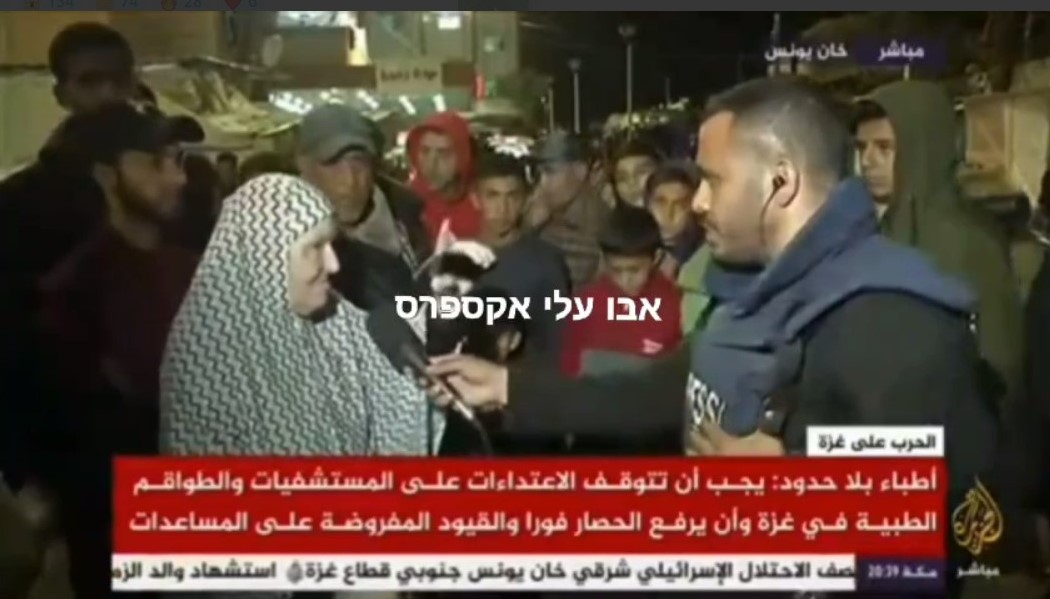
Screenshot from Israeli blogger Abu Ali Express
A short video published by another Gazan shows armed men shooting at people approaching a truck carrying food. According to the photographer, the armed men were Hamas personnel and at least one civilian was killed by them.
Lebanon:
The exchange of fire on the Israel-Lebanon border continues, sometimes escalating and sometimes ebbing. An Israeli farmer was killed by a Hezbollah-launched guided anti-tank missile that hit his car. Hezbollah has also been using UNIFIL bases (the United Nations force that was supposed to monitor the border and prevent Hezbollah from being there) as cover for their launch teams: they deploy beside the outer fence of the UNIFIL bases and launch from there. If the IDF counters it risks hitting UN troops, and in a couple of cases UN troops have indeed been wounded.
The depth of Hezbollah’s attacks into Israel have increased. Initially they attacked targets up to four or five kilometers from the border, but over the past week or so, they have doubled that distance. Israel has added targets further inside Lebanon in response.
Including the Israeli civilian killed this week, Israeli casualties on the Lebanese border have been 11 killed since 7 October and a few dozen wounded.
Hezbollah fatalities have accumulated to least 101 (nine of them in Syria). The number of wounded is not known.
Other Lebanese and Lebanon-based Palestinian organizations have participated in the exchanges; they have lost at least 14 of their members. One Lebanese soldier was killed accidentally and three wounded in an IDF strike, for which Israel issued a formal apology to the Lebanese government.
Syria:
Exchanges of fire across the Syrian border have escalated over the past week but are still minimal, especially when compared to the Lebanese front. Iranian proxies and Hezbollah personnel stationed in Syria have fired rockets into Israel and Israel has responded with airstrikes and tank fire. There have been no Israeli casualties on this front, but nine members of Hezbollah as well as some Iranian proxies, Syrians and Iranians have been killed or wounded.
Cyprus:
The authorities in Greek Cyprus arrested a terrorist cell planning to attack Israelis visiting the island. The initial information for the arrest was provided by Israeli intelligence. The cell was organized and funded by Iran.
Judea and Samaria:
The fighting in Judea and Samaria (the West Bank) continues with the IDF intensifying its raids, especially in the Jenin area (the northern edge of Samaria). Each IDF entry into Palestinian towns faces varying intensities of resistance, including bombs placed under roads (which are cleared by having a bulldozer tear up the asphalt), rifles, grenades, and various improvised hand-thrown bombs as well as petrol bombs.
At least 4,000 terrorists have been arrested so far and nearly 300 killed – most in IDF raids, and some while attempting to attack Israeli civilians or soldiers. Most of the fighting is occurring in the northern area of Jenin, though there is fighting across all of Judea and Samaria.
There has also been an increase in the number of violent altercations between Palestinian civilians and Israeli civilians over agricultural property rights (field boundaries, grazing rights). There are escalating reports in Western media and mentions by Western politicians of Israeli settler violence against Palestinians in Judea and Samaria. All these reports ignore the attacks by Palestinians on the Israelis living there.
Yemen:
The Houthis have continued to launch missiles and long-range explosive drones towards Israel, but their main effort has shifted to disrupting shipping lanes passing by Yemen in the Red Sea. In addition to attempting to capture ships, the Houthis have also fired at them, hitting one and setting it on fire. They claim all the targets are ships heading to Israel with merchandise, but the owners of the ship that was hit claim it was heading to Italy.
The US is debating the creation of an international flotilla to protect ships passing through the Red Sea. It is not possible for ships to avoid sailing near Yemen because the Red Sea is fairly narrow, and its entire width is within range of Houthi missiles and exploding drones.
Iraq and Syria – US forces:
Pro-Iranian Iraqi Shiite militias continued to attack American bases in Iraq and Syria with rockets and exploding drones. So far, since 18 October, there have been approximately 95 strikes with rockets and explosive drones.
The US military has responded with airstrikes on suspected militia locations and has killed an unspecified number of militants.
Israeli casualties:
The total Israeli death toll for the single day of 7 October is now 1,130, which includes civilians, military, police, firefighters, medical personnel, etc. There are still some Israelis who are unaccounted for, and some of the people kidnapped to Gaza were dead when taken or have died in captivity but are not yet confirmed dead.
There are still approximately 125 kidnapped Israelis (a few of the missing have been confirmed to have been kidnapped) and nine non-Israelis in Gaza. How many of them are alive and how many dead is not known, though the current estimate is that at least 19 are dead.
In addition, 19 Israeli civilians have been killed in Hamas rocket attacks.
As of 13 December, a total of 444 IDF soldiers have been killed on all fronts since and including 7 October (the number for 7 October is periodically updated as more are confirmed killed who were listed as missing).
The total number of Israeli wounded is approximately 10,039. The IDF has also released a total of wounded IDF soldiers. Including 7 October, the number of wounded soldiers on all fronts together is approximately 1,600. Of these 255 were severely wounded and the rest moderately or lightly wounded.
The number of Israelis who were forced to leave their homes in 64 villages and towns along the borders with Gaza and Lebanon has reached approximately 250,000. As the fighting proceeds in Gaza, about half have returned to villages and towns that are currently considered less threatened. Some of the industrial and agricultural sites near the Gaza border that were abandoned in the first days have resumed work.
Palestinian casualties:
The Gaza Health Ministry, which is controlled by Hamas in its role as the government of Gaza, claims that approximately 18,600 Gazans have been killed so far and nearly 50,600 wounded. They do not differentiate between personnel of Hamas and other terrorist organizations and civilians.
WHAT NEXT?
Fighting has escalated in Gaza and increased only slightly on the Lebanese and Syrian borders.
Though the battle for eastern Gaza City is still far from over, there are signs that the strength of the resistance in that area is beginning to wane. When the fighting there does abate, it is very likely that the IDF will shift more forces from Gaza City to the southern areas – either reinforcing the forces fighting in Khan Yunis or adding another area, which could be the residential area between Gaza City and Khan Yunis or the area between Khan Yunis and the Egyptian border around the city of Rafah. The latter seems less likely because the latest announcements by the IDF to the civilians of Khan Yunis have told them to move in that direction.
The overall objective – the destruction of Hamas – has not changed as far as Israel is concerned. As yet there is no end-by date, but that could change if the US, for its own external or internal reasons, decides to pressure Israel to desist.
The fighting on the other fronts, though slightly escalating, is largely static. Hezbollah and Iran seem content with the current situation.
In Yemen and the Red Sea, the attacks on merchant shipping appear to be escalating. The threat is not only against Israel, as at least one of the attacked ships had no connection to Israel. This waterway is crucial to the US and other states because it leads to the Suez Canal. Approximately 22,000 ships use this passage every year, or 12% of all maritime traffic. Rerouting around South Africa is possible but would add approximately 3,500 nautical miles of distance and an additional 8-12 days of travel time for the ships, which would greatly increase shipping prices and therefore the cost of the products they carry. Whether the US, Europe and Egypt (where revenues from ships crossing the Suez Canal over the past year amounted to $9.4 billion, making shipping crucial to its struggling economy) will be willing to accept this cost or will decide to respond militarily to the Houthi attacks remains to be seen.
***
27 November – 6 December 2023
WHAT HAS HAPPENED?
Gaza:
On 1 December the ceasefire ended. Officially it was supposed to end at 7:00 AM unless an extension was agreed to, but at 5:42 AM, Hamas initiated attacks, fired rockets into Israel, and conducted ground raids inside Gaza. Violations of the ceasefire by Hamas had already occurred on previous days, but only inside Gaza. On 28 and 29 November they conducted a number of raids and ambushes of Israeli troops. Approximately half a dozen Israeli soldiers were wounded in these attacks, as were an unpublished number of the Hamas terrorists conducting them.
Both sides used the ceasefire to prepare for the next round. The pause was more useful for Hamas, as it gave it time to reorganize, redeploy and try to learn lessons on why it had failed to halt the Israeli offensive or inflict much more massive casualties upon it. As a result, the fighting since the end of the ceasefire has been much more intense than it was in the days before the ceasefire came into effect.
The IDF also exploited the ceasefire to continue scouring the ground it had captured in previous weeks to make sure no tunnel entrances or above-ground hideouts had been missed, as well as to explode more of the entrances that had been discovered earlier but not yet destroyed. So far 800 tunnel entrances have been discovered, of which 500 have been destroyed. Large caches of arms and other materiel were found and destroyed or taken for study inside Israel. Many of these arms were found in hospitals, mosques, schools, an UNRWA compound, and in private homes (including under children’s beds). The discovery of arms inside the UNRWA compound is not a surprise, as many of UNRWA’s local workers are Hamas personnel.
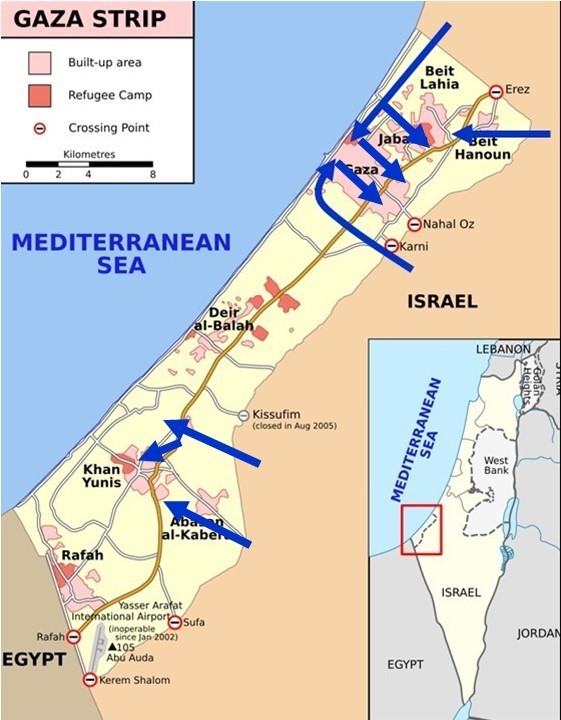
The renewed IDF offensive is now entering areas in eastern Gaza City that had not been attacked before. These are areas the IDF deliberately avoided in the first days of the war because they are the closest to the border with Israel, held by the strongest Hamas units, and better fortified than the areas of western Gaza that the IDF initially attacked. This too has escalated the intensity of the fighting since the end of the ceasefire. Hamas had expected the IDF units to attack east to west directly from the border into Gaza City and had prepared accordingly. Instead, the IDF bypassed those areas and attacked with one prong south of them to the sea and then turned north to attack into the western areas of the city, with another prong along the coast from the north entering the western part of the city before turning east.
IDF ground forces have also attacked southern Gaza for the first time in this war. During 4-6 December, according to Palestinian reports, the IDF surrounded the city of Khan Yunis from three directions – east, north and west – leaving the southern direction open for the evacuation of civilians. As with previous IDF attacks, the ground operation began with an armored force breaking through Hamas defenses. A high quality infantry force was then sent in to complete the ring and begin raiding Kahn Yunis itself.
The following is a map published in the Arab media purporting to show the extent of the IDF advance around Khan Yunis ( red areas with yellow borders).
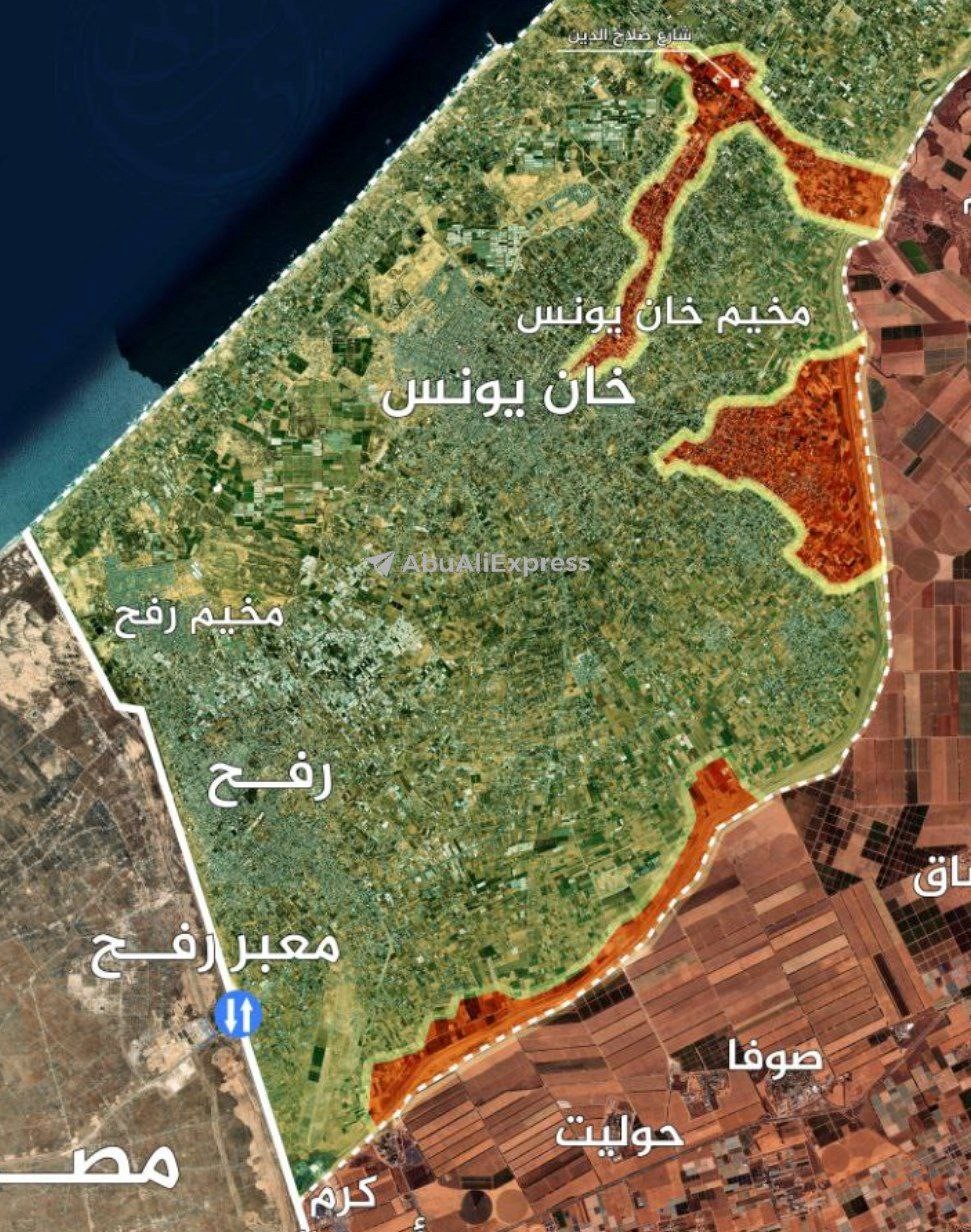
Source: Israeli blogger Abu Ali Express
The IDF had already begun, a few days before the ceasefire, to attempt to convince the population of Khan Yunis (by dropping flyers, using Arabic-speaking personnel at the IDF Spokesperson’s office to give directions via radio channel, calling Khan Yunis residents by telephone, etc.) to move west towards the coast and south towards the city of Rafah. Many people came back during the ceasefire, so this IDF effort was renewed as soon as the ceasefire broke down. The IDF gave the population 24 hours to move before the first IDF units would begin moving west on the roads north of Khan Yunis (according to reports in Gazan social media that showed long-range videos of IDF armored vehicles moving there). It is generally thought that the proportion of population to leave Khan Yunis is smaller than the proportion that left Gaza City, so IDF actions there will have to be handled more carefully to reduce Palestinian civilian casualties.
Photograph by a Palestinian of an IDF flyer calling on the population of the Khan Yunis area to evacuate
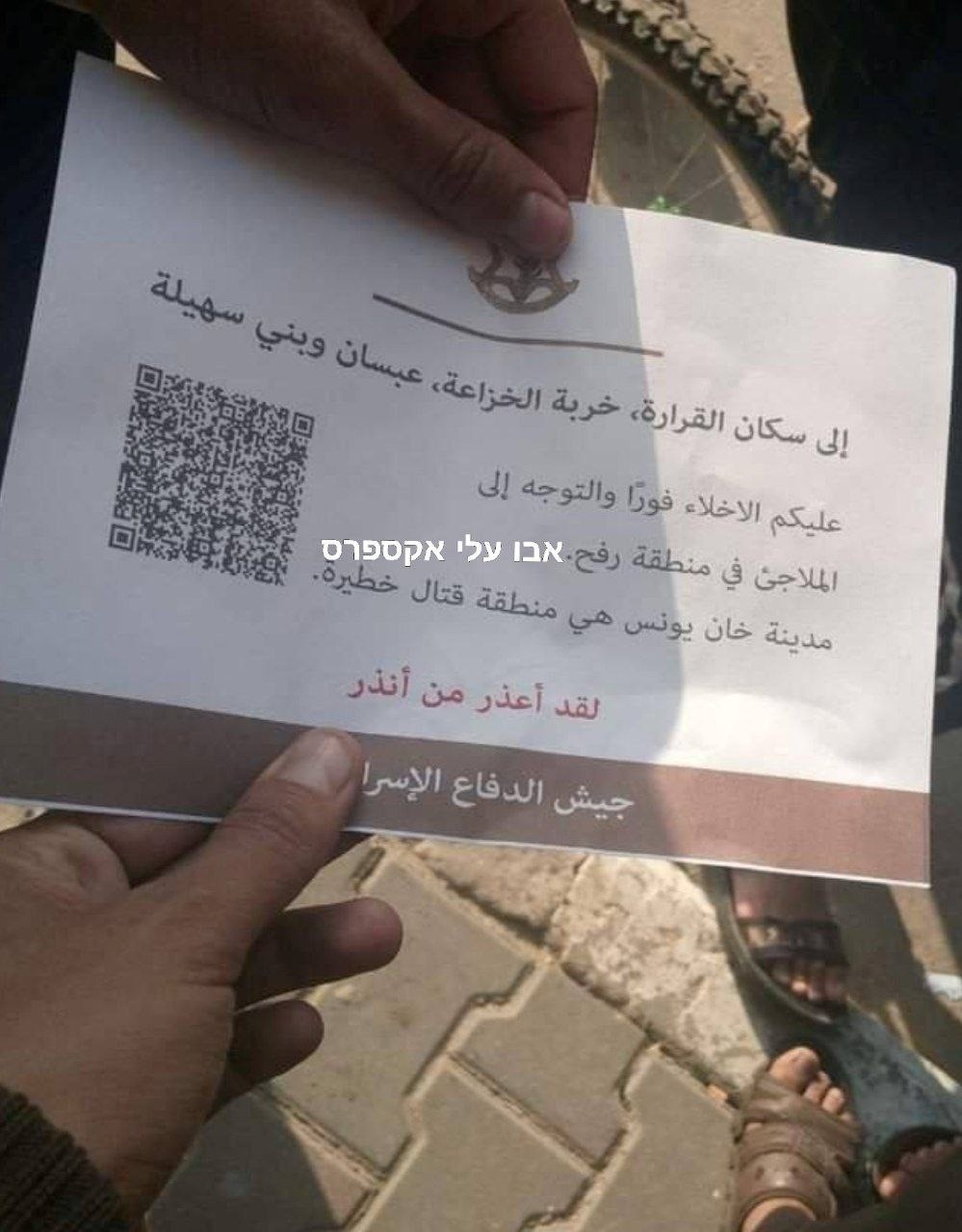
Source: Israeli blogger Abu Ali Express
According to the latest reports, IDF units around Khan Yunis have begun conducting small raids inside the city proper.
Since the renewal of fighting, the Israeli air force has been conducting 200-250 strikes per day, mostly in support of the ground troops. The other strikes are against targets located by the intelligence services. Thus, in one of the strikes, the commander of the Shujaiya battalion in eastern Gaza City was killed in an underground command post, together with some of his staff and other personnel, based on intelligence collected over the past couple of weeks on the tunnel infrastructure.
As the fighting continues there is a slow but steady increase in IDF casualties. As of 6 December, 15 soldiers had been killed since the renewal of fighting on 1 December, for a total of 78 killed in Gaza to date. The total number of IDF wounded has not been officially updated. I had earlier estimated, using partial information, that the number is approximately ten times the number of killed, but this may be a bit high.
Screenshot from video released by Palestinian Islamic Jihad of its fighters in combat with Israeli troops in Khan Yunis. The figure on the right is using an RPG and the figure on the left is armed with an AK-47 assault rifle. Note the civilian clothing:
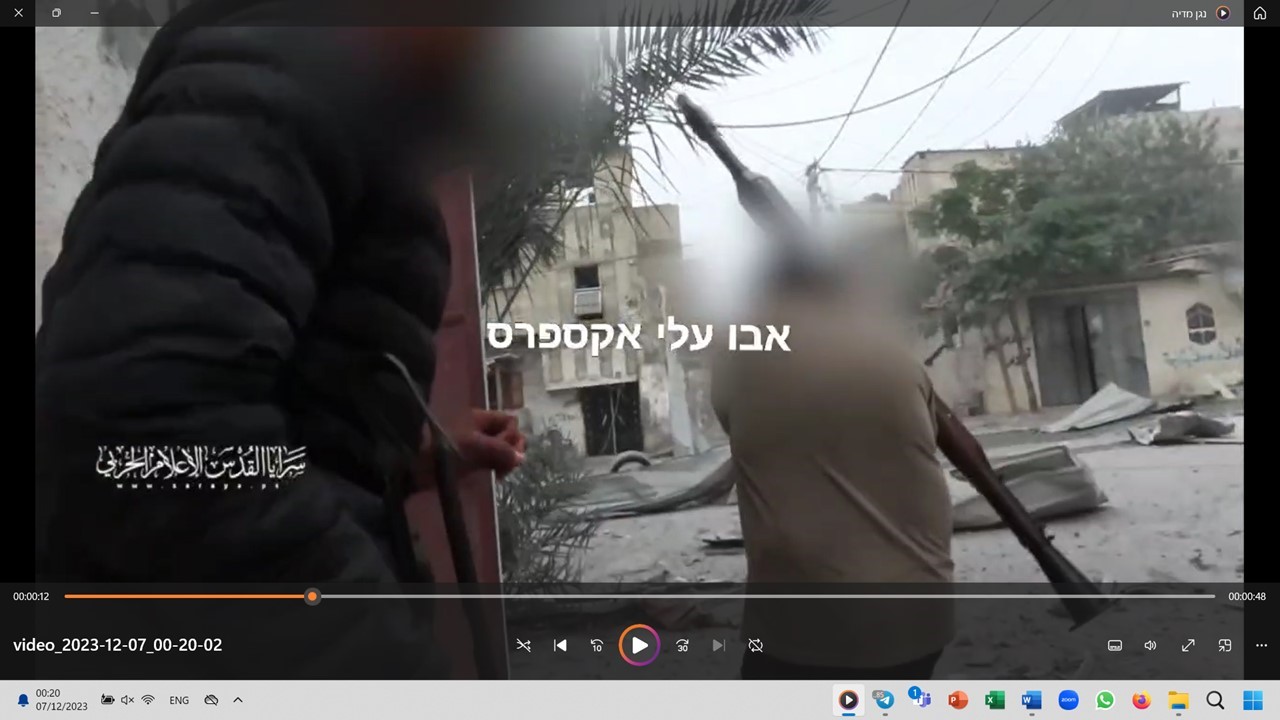
Source: Israeli blogger Abu Ali Express
Since the end of the ceasefire Hamas has again increased the frequency and number of rockets it is firing. It is aiming especially at central Israel, Tel Aviv and the surrounding towns, and the city of Beersheva in the central Negev. However, even at this increased frequency the firings are much fewer than they were in the first days of the war. One theory to explain the increase is that Hamas hoped to restart the fighting with a shock to the Israelis. Another is that it reflects the pressure Hamas is under to use its rockets before it loses them, particularly in view of the IDF’s attack into the area of Khan Yunis in southern Gaza.
The total number of rocket launches from Gaza towards Israel to date is nearly 10,500, of which more than 1,200 have fallen inside Gaza. One overflew Israel and landed on a farm near the Palestinian town of Bethlehem, south of Jerusalem.
During the ceasefire, Israeli police caught a few more Gazans hiding inside Israel after having entered in the initial attack on 7 October. They had reached a Bedouin village and found two families willing to hide them. The heads of these families have been arrested too. During the 7 October attack, approximately 40 Bedouins were deliberately killed by Hamas terrorists and four were kidnapped to Gaza (two of whom, a teenaged brother and sister, were returned in the exchanges, while their father and elder brother are still in Gaza). Some Bedouin villages have also been hit by rockets fired from Gaza. The fact that these two families were willing to hide possible Hamas terrorists will no doubt create friction between them and the clans who suffered casualties.
Lebanon:
Hezbollah ceased its attacks on Israel during the ceasefire in Gaza and renewed them when the fighting in Gaza resumed.
All together, Hezbollah has fired more than 1,000 rockets, anti-tank missiles and explosive drones at Israel since 7 October. Since the renewal of fighting there have been a couple of dozen attacks in total. Ten Israelis have been killed in the fighting on this front since 7 October, almost all in the first couple of weeks. Several dozen Israelis have been wounded, but the precise number has not been published.
The IDF responded with a counter-escalation, using manned aircraft, drones, artillery and tanks, which gradually increased Hezbollah casualties.
Hezbollah fatalities have accumulated to least 90 (six of them in Syria). The number of wounded is not known.
Other Lebanese and Lebanon-based Palestinian organizations have also participated in the exchanges of fire, resulting in the deaths of at least 14 of their members. One Lebanese soldier was killed accidently and three wounded in an IDF strike, and Israel has issued a formal apology to the Lebanese government.
The population of southern Lebanon has responded to the escalation by moving north. The largest estimate is that approximately 100,000 civilians have abandoned the villages within 15 kilometers of the border with Israel. However, because no one is organizing this movement, the numbers are estimates at best. Unlike Hamas, Hezbollah tends to use the local population as camouflage (by, for example, hiding military equipment in their homes) but does not use them as human shields. Thus, when fighting escalates, they do not compel residents to stay but rather let them leave. Hezbollah has declared that it will pay compensation to Lebanese civilians whose property and livelihood have been harmed. It is probable that many of those who left returned during the ceasefire, but again, the numbers are not known.
Syria:
On the Syrian border there have been only a few incidents so far – rocket launches and so on – and they were responded to with tank fire, artillery and air strikes.
Air strikes have also been conducted at targets well inside Syria, around the capital Damascus (about 60 kilometers from the border) as well as further inside. These strikes are aimed mostly at supplies being sent from Iran to Hezbollah through Syrian airports.
Judea and Samaria:
The fighting in Judea and Samaria continued unabated during the ceasefire in Gaza. However, despite Hamas’s hopes for a full-strength surge in attacks on Israel, a significant escalation has not occurred beyond the ranks of the usual groups. Israeli security forces have responded with ‘police’ raids to arrest terrorists. So far at least 2,000 terrorists have been arrested (Palestinian sources claim more than 3,365) and more than 255 killed – most in IDF raids, and some while attempting to conduct attacks on Israeli civilians or soldiers. Most of the fighting is occurring in the northern area of Jenin, though there is fighting across all of Samaria and Judea (the West Bank).
There has also been an increase in the number of violent altercations between Palestinian and Israeli civilians over agricultural property rights (field boundaries, grazing rights). There are escalating reports in Western media and mentions by Western politicians of Israeli settler violence against Palestinians in Judea and Samaria. All these reports continue to ignore the attacks by Palestinians against the Israelis living there.
Yemen:
The Houthis have continued to launch missiles and long-range explosive drones towards Israel. The rate of fire has gone down from the first few days, and in some instances, they declared launches that nobody saw. All the actual missiles and explosive drones they have launched were intercepted by IDF anti-missile defenses, US ships, and in at least one case by Saudi anti-missile defenses. (The Houthis have attacked Saudi Arabia many times in the past with missiles and explosive drones, and the shortest aerial route from Yemen to Israel passes over a portion of Saudi Arabia.)
On 3 December the Houthis fired missiles and explosive drones at three ships in the Red Sea, claiming they were Israeli (apparently none of them were). Two were hit. One was severely damaged and the other suffered light damage.
Iraq and Syria – US forces:
Pro-Iranian Iraqi Shiite militias continued to attack American bases in Iraq and Syria with rockets and exploding drones. So far, there have been at least 75 such strikes since 18 October. The number of American casualties is one killed (apparently from cardiac arrest caused by an attack) and at least 56 wounded, with injuries ranging from minor wounds to traumatic brain injuries.
The US military has responded with air strikes on suspected militia locations and has killed an unspecified number of them.
Israeli casualties:
There are still some people unaccounted for, but it appears that all or virtually all the bodies of Israelis killed in the initial attack inside Israel have been found. The total numbers of Israelis and non-Israelis[1] killed on the first day of the attack has been reduced as body parts are being connected to bodies and some missing people have been found alive (including individuals thought to be dead who turned out to have been kidnapped). On the other hand, since my last update, 13 more who had been declared missing have been found to have died, or information has been found that they were killed and their bodies taken to Gaza. The total killed on the single day of 7 October is now 1,125, including civilians, military, police, firefighters, medical personnel, etc. There are still some unaccounted for, and some of the people kidnapped to Gaza were dead when taken or have died in captivity.
There are still approximately 130 kidnapped Israelis (including two of the four kidnapped Israeli Bedouins) and nine non-Israelis in Gaza. How many are alive and how many dead is not known.
In addition, 19 Israeli civilians have been killed in Hamas rocket attacks.
As of 6 December, a total of 411 IDF soldiers have been killed on all fronts since and including 7 October (the number for 7 October is periodically updated as more are confirmed killed who were listed as missing). The norm in Israel is not to publicly report people killed until their families have been notified. This can take time (if, for example, a family member is abroad, or for other reasons), so public notification is sometimes a day or two after the fact. Given that some of the missing are probably dead, the precise number might be a bit more.
The total number of Israeli wounded is approximately 10,039.
The number of Israelis who have been forced to leave their homes in 64 villages and towns along the borders with Gaza and Lebanon has reached approximately 250,000. As the fighting proceeds in Gaza about half have returned to villages and towns that are currently considered less threatened. Some of the industrial and agricultural sites near the Gaza border that were abandoned in the first days have resumed work.
Palestinian Casualties:
The Gaza Health Ministry, which is controlled by Hamas in its role as the government of Gaza, claims that so far approximately 16,500 Gazans have been killed, nearly 44,000 have been wounded, and 6,000 are missing. They do not differentiate between personnel of Hamas and other terrorist organizations and civilians.
WHAT NEXT?
The truce has ended, both sides have renewed their activity, and the fighting has been some of the most intense since the start of the war.
Though the IDF has not finished clearing northern Gaza, Israel has widened its operations to include Khan Yunis, where the second-largest concentration of Hamas forces is located after the Gaza City area. To do this it has introduced a fifth division into the fighting. If the Israeli force continues to advance to the sea, it will cut the Gaza Strip into four sections (see map at the beginning of this update).
The overall objective – the destruction of Hamas – has not changed as far as Israel is concerned. As yet there is no end-by date, but that could change if the US, for its own internal or external policy reasons, decides to pressure Israel to desist.
As things now stand on the Lebanese border, it appears that Hezbollah is satisfied with maintaining the status quo of small-scale fighting.
[1] Among the civilians killed were tourists, agricultural workers from Thailand working in the fields of the farming villages, and home nurses, also from abroad.
***
17 – 26 November 2023
WHAT HAS HAPPENED?
Gaza:
The most important new event in the war in Gaza is the temporary ceasefire agreement that came into effect in the early morning of 24 November. However, to maintain chronological focus, I will discuss the ceasefire further down after describing the previous events since the last update.
From 17 to 23 November most of the fighting in Gaza continued to be focused on the western neighborhoods near the sea. The media focus was of course on Shifa Hospital as the IDF helped the management evacuate residents, patients and staff and then slowly combed the grounds to locate entrances to Hamas’s underground facilities and find materials (weapons, documents, computers, etc.) in the hospital rooms themselves. One terrorist was caught hiding in the hospital morgue inside a body bag. Others exploited the IDF’s delayed entry into the hospital – which had been put into effect to prevent casualties among patients and staff – to escape by camouflaging themselves as patients and staff. Others escaped through the tunnels leading from the hospital into the subterranean network that extends into areas the IDF has not yet reached inside the city, or perhaps even into southern Gaza.
The body of a third Israeli hostage was found inside a building near Shifa Hospital. She had arrived at the hospital alive and was filmed, with others, by the hospital’s CCTV system. The kidnappers took advantage of the delay in entry by the IDF into the hospital to transfer hostages to other locations the IDF has not yet reached.
IDF units conducted several raids into central and eastern areas of Gaza City but did not capture or hold ground there.
In the southern Gaza Strip the IDF continued to conduct airstrikes on specific targets – Hamas senior staff and commanders and also infrastructure including housing, command posts, storehouses and combat positions. Residents of the eastern neighborhoods (the closest to Israeli territory) of Khan Younis, the second-largest city in the Gaza Strip and located in the south, were told to move west in order to prevent civilian casualties. Many have moved, but some have not.
Hamas casualties have been in the thousands, but apart from the growing list of commanders who are being hunted and killed by the IDF, there is no reliable number. Among the higher ranking Hamas officers killed are the commander of one of the five brigades (Hamas’s largest field unit), his deputy, and the commander of Hamas’s rocket forces. They were probably killed a couple of weeks ago, but Hamas only just published news of their deaths. These are in addition to many battalion commanders, staff officers and other deputy commanders and some senior political leaders (though not yet the most senior).
Although the loss of commanders disrupts the conduct of combat by Hamas units, it is not disruptive enough to halt them because the missions and doctrine are simple enough for independent sub-units to continue to fight. They can proceed even if coordination between them is impaired and they cannot organize large combined operations. While at first, Hamas actions against Israeli units involved dozens of men, over the past couple of weeks most have been conducted by much smaller groups of three to ten at most. In addition to killed and wounded Hamas personnel, at least 300 have been captured and interrogated for information that has assisted IDF troops in locating command posts, combat positions, storage sites and tunnel entrances. So far some 400 tunnel entrances have been exploded by IDF units and others, hidden in cellars, have been buried by collapsing the buildings above them.
As the fighting has continued there has been a slow but steady increase in IDF casualties. By 24 November (the day before the ceasefire) 63 IDF personnel had been killed since the beginning of the ground operation in Gaza (including soldiers who were wounded earlier and have since died of their wounds). This is 19 more since my last update. The total number of IDF wounded has not been updated officially. I previously estimated, using partial information, that the number of wounded is approximately ten times the number of killed, but this may be a bit high.
Hamas continues to fire rockets into Israel though the daily average has lessened dramatically. Because of this decrease, the total to date is still only just more than the 9,500 (of which 3,000 occurred in the first four hours) that I reported in my last update. Of these, approximately 1,150 fell inside Gaza.
There are two likely reasons for the dramatic reduction in the rate of rocket fire:
- The advance of the IDF has brought its troops to many of the traditional launch sites and many launchers and stored rockets have been destroyed.
- Hamas wants to conserve ammunition for a longer war as its stores are being depleted. Hamas had considerably fewer rockets than Hezbollah. Hezbollah is reported to have approximately 150,000 rockets, whereas Hamas and the other groups together had somewhere between 15,000 and 20,000 (a very rough estimate) on 7 October. In addition to the rockets already fired, many more were lost through being destroyed or captured in storage sites.
Inside Israel, two terrorists who entered on 7 October and had been hiding ever since in a derelict house about 25 kilometers inside Israel were found and captured. The house was near the Bedouin town of Rahat in the Negev. Given the fury of the Bedouins over the deliberate slaughter by Hamas terrorists of more than 40 of their people on 7 October, which is reflected only partly in the official proclamation of a blood feud with Hamas, these two were lucky to have been found by the Israeli security forces. Another two terrorists who had been hiding separately were captured in similar circumstances over the past month (one surrendered a couple of days after running out of food and water and was in bad physical shape). The Israeli police are working on the assumption that more terrorists are still hiding in various places, perhaps even further inside Israel, and are conducting sweeps and intelligence operations to look for them. According to copies of orders found on the bodies of terrorists killed in the first two days of the war, Hamas was planning to infiltrate a few dozen men to hide inside Israel for the purpose of conducting attacks later. So far, no further attacks have been conducted by Hamas inside Israel.
The ceasefire was supposed to begin on 23 November but was delayed for 24 hours, beginning on 24 November. So far, as of midnight on 26 November, 66 kidnappees have been released – 45 Israelis (including those released earlier in the war), and the rest Thais and Filipinos who were in Israel for work. This leaves 175-180 hostages still trapped in Gaza. Not all are in the hands of Hamas: some are held by Palestinian Islamic Jihad and some by individuals who do not officially belong to any group. It is not known how many of these hostages are alive.
Approximately 120 Palestinians have been released from Israeli custody in exchange for the released hostages. One is a teenager who was under house arrest; his electronic location anklet has been removed.
During the release process Hamas made several attempts to change the agreed-upon rules and delay releasing hostages to gain more for each one. On 25 November, after Hamas declared it was not going to release the hostages promised for that day, Israel stated that if they were not be released by midnight, the IDF would resume its aerial and ground offensives. Hamas released the promised hostages a few hours later.
Meanwhile, the ceasefire is tenuous, with incidents occurring throughout. There is a bitter joke in Israel that during a lunch break people eat lunch; during a smoking break people smoke; and during a fire break (the literal Hebrew translation of “ceasefire”) people keep firing. Hamas is exploiting the ceasefire to reorganize its defenses and possibly also prepare a series of surprise attacks. This is how it behaved in previous wars. Thus, during the 2014 war, which lasted 50 days, there were 11 ceasefires. Some never actually happened because Hamas terrorists opened fire within a couple of hours of their intended beginning. Some ended early because Hamas opened fire several hours before they were supposed to end.
Over the past three days Hamas has tried to push Palestinian civilians towards IDF positions and hide behind them in order to take ground without fighting, gather intelligence on IDF positions, or create incidents that cause the IDF to kill or wound the civilians. Also, there have been attempts by civilians who had moved away from the danger areas at the behest of the IDF to return to those areas on the assumption that the war is over. Because IDF units cannot differentiate between ‘innocent’ civilians, civilians actively assisting Hamas, and Hamas terrorists who are hiding their weapons, they call on the people to move back and stay away from their positions. Sometimes, they have to employ small-arms fire aimed at the ground or into the air to make the point clear and in some cases to wound in the leg if the ‘civilians’ do not listen and appear about to try to overwhelm the IDF unit. Coming out into the open to physically block the movement of civilians is too dangerous for the IDF. In the past, Palestinians have exploited such attempts by placing snipers to shoot the IDF soldiers who exposed themselves in this way – often shooting from within the crowd so that return fire might hit civilians, or to give the armed individual, if hit, the chance to hide the gun and claim that he too is an unarmed civilian.
Meanwhile, hundreds of trucks carrying petrol, food and medical supplies are entering Gaza from Egypt.
Lebanon:
Prior to the ceasefire the number of Hezbollah attacks per day had roughly doubled, and they were attacking targets a few kilometers further inside Israel than previously. They are using a mix of guided anti-tank missiles, short-range large-warhead rockets and mortars, and lighter longer-range rockets as well as ‘suicide’-drones carrying payloads of a few dozen kilograms of explosives. The advantage of the latter over ordinary rockets or missiles is that the drones can fly in circular routes to reach targets hidden by ridges that block the direct flight paths of rockets and missiles. These can be detected by small reconnaissance drones (hard to detect and hard to hit) that can peek over onto the other side of a hill. These techniques and the countermeasures have been used by both sides in Ukraine. Contrary to some of the sensational reporting from there, they do not constitute a revolution in warfare, but they do add one more capability that has to be addressed.
All together the number of rockets, anti-tank missiles and explosive drones fired by Hezbollah since 7 October is more than 1,000.
So far ten Israelis have been killed in the fighting on this front since 7 October. Several dozen Israelis have been wounded, but the precise number has not been published.
The IDF responded with a counter-escalation involving manned aircraft, drones, artillery and tanks that gradually increased Hezbollah casualties. On 22 November the IDF managed to kill five members of the Hezbollah Special Forces, including a commander and the son of a prominent member of Hezbollah’s political wing. Hezbollah responded with a much heavier bombardment the following day – 20 targets with 45-50 rockets, missiles and explosive drones – but almost half of those weapons fell inside Lebanon. Unlike in Gaza, where more than 10% of rockets fired routinely fail to cross the border into Israel, this is very uncommon with Hezbollah attacks.
Hezbollah fatalities have accumulated to least 85 (six of them in Syria). The number of wounded is not known.
Other Lebanese and Lebanon-based Palestinian organizations have participated in exchanges of fire and at least 13 of their members have been killed.
The population of southern Lebanon has responded to the escalation by moving north. The highest estimate is that approximately 100,000 civilians have abandoned the villages within 15 kilometers of the border with Israel. However, as no one is organizing this movement, the numbers are guesstimates at best. Unlike Hamas, Hezbollah tend to use the civilian population as camouflage (hiding military equipment in their homes) but not as human shields. When fighting escalates they do not attempt to compel civilians to stay, but rather let them leave. Hezbollah has declared that it will pay compensation to the Lebanese civilians whose property and livelihood have been harmed.
When the truce with Hamas went into effect there a couple more incidents occurred on the Lebanese border, but then Hezbollah too ceased its attacks.
Syria:
On the Syrian border there have been only a few incidents so far, involving rocket launches and so on. These were responded to with various means, including tank fire, artillery and airstrikes. At least ten militia members and Syrian army soldiers have been killed in these strikes.
As noted above, six Hezbollah personnel were also killed in Syria. Hezbollah has had a permanent presence in Syria for more than two decades. Until 2011, this presence consisted of administrative personnel who were responsible for transporting supplies sent from Iran via the Syrian airports. In 2012 Hezbollah began sending combat units to assist Assad in defeating the rebellion against his regime. The exact number is not known, but at least 2,000 Hezbollah personnel were killed during the Syrian civil war and many more wounded. Hezbollah exploited Assad’s gratitude for its assistance by setting up positions near the border with Israel in order to conduct attacks into Israel. Israel responded with airstrikes and tank fire directly targeting Hezbollah personnel – but also targeting Syrian regime troops as a message to Assad to control Hezbollah or risk a heavier Israeli attack that would indirectly assist the rebellion. Hezbollah attacks from Syria ceased. However, over the past couple of years the group has resumed activity in Syria by preparing its infrastructure for renewal.
There are reports from the Syrian opposition that more pro-Iranian militia units have arrived near the Israeli border with Syria.
Judea and Samaria:
The fighting in Judea and Samaria continues unabated and has been unaffected so far by the ceasefire in Gaza. However, despite Hamas’s hopes for a full-strength surge in attacks on Israel, an escalation has not occurred beyond the ranks of the usual groups. Israeli security forces have responded with ‘police’ raids to arrest terrorists. So far at least 2,000 terrorists have been arrested and approximately 210 killed – most in IDF raids, and some while attempting to conduct attacks on Israeli civilians or soldiers. Most of the fighting is occurring in the northern area of Jenin, though there is fighting across all of Samaria and Judea (the West Bank).
There has also been an increase in the number of violent altercations between Palestinian civilians and Israeli civilians over agricultural property rights (field boundaries, grazing rights).
There are escalating reports in the Western media and mentions by Western politicians of Israeli settler violence against Palestinians in Judea and Samaria. All these reports and comments ignore the attacks by Palestinians against the Israelis living there. At their height, the number of Israeli settler attacks on Palestinians in Judea and Samaria (none of which is backed by the Israeli government, which sends police and soldiers to halt them and often arrests Israeli perpetrators) is miniscule compared to the attacks by Palestinians in Judea and Samaria or from Judea and Samaria on Israelis.
The following are the official Israeli security forces annual data for attacks by Palestinians on Israelis and Israeli casualties since 2015 in such attacks (i.e., these data do NOT include attacks from Gaza). These attacks include petrol bombs, car-ramming, stabbings, shootings, and bombs of various sizes and types. Most of these attacks fail; i.e., they do not cause Israeli casualties. Note that adding stone-throwing incidents would at least treble the number of attacks, but these are counted only when they cause casualties (those struck by stones are rarely killed but often wounded):
2015 – 2,558 Palestinian attacks – 29 Israelis killed, 430 wounded.
2016 – 1,536 Palestinian attacks – 17 Israelis killed, 253 wounded.
2017 – 1,582 Palestinian attacks – 18 Israelis killed, 150 wounded.
2018 – 1,430 Palestinian attacks – 16 Israelis killed, 83 wounded.
2019 – 1,346 Palestinian attacks – 10 Israelis killed, 66 wounded.
2020 – 1,320 Palestinian attacks – 3 Israelis killed, 46 wounded.
2021 – 2,135 Palestinian attacks – 5 Israelis killed, 222 wounded.
2022 – 2,613 Palestinian attacks – 29 Israelis killed, 134 wounded.
January to August 2023 = 1,702 Palestinian attacks – 32 Israelis killed, 108 wounded.
The full numbers for September and onward have not been published.
Inside Israel:
Approximately 620 investigations have been conducted by the police against Israelis (all Arab-Israelis, as far as I have been able to see) for posts inciting and encouraging terror by glorifying the 7 October attack on Israel. Of these, 86 cases have been filed for prosecution so far.
Yemen:
The Houthis have continued to launch missiles and long-range explosive drones towards Israel. The rate of fire has gone down from the first few days and in some cases, they declared launches that nobody saw. All the actual missiles and explosive drones they have launched have been intercepted by IDF anti-missile defenses, US ships, and in at least one case Saudi anti-missile defenses. (The Houthis have attacked Saudi Arabia numerous times in the past with missiles and explosive drones, and the shortest aerial route from Yemen to Israel passes over a portion of the kingdom.)
On 19 November a Houthi force landed on a ship sailing in the Red Sea near Yemen and captured it. The ship is owned by an Israeli company, though there were no Israelis onboard.
On 26 November another ship owned by an Israeli company was captured by the Houthis. This second ship was recaptured by a United States naval force.
Turkey:
There is a report that Turkey is organizing a flotilla of up to 1,000 civilian ships carrying protesters (including children) to sail to Gaza. It is not yet clear whether the report is true or, if true, accurate in the details. (If there is a flotilla, the number of ships seems exaggerated.)
Iraq and Syria – US forces:
Pro-Iranian Iraqi Shiite militias continued to attack American bases in Iraq and Syria with rockets and exploding drones. Since 18 October, there have been more than 60 such strikes. The number of American casualties is one killed (apparently from cardiac arrest caused by an attack) and at least 56 wounded, with injuries ranging from minor wounds to traumatic brain injuries.
The US military has responded with airstrikes on suspected militia locations and at least one strike on a vehicle carrying members of one of the militias.
Israeli Casualties:
There are still a number of people unaccounted for, but it appears that all or nearly all the bodies of Israelis killed in the initial attack inside Israel have been found. A 12-year-old girl, murdered on 7 October with her brother and aunt in Kibbutz Beeri, was finally identified on 19 November. Currently there are still pieces of bodies that have not been definitely identified because they are so badly damaged (in some cases it is difficult to identify them even with DNA tests). Some of the body parts might belong to previously identified mutilated bodies that are missing parts.
The total numbers of Israelis and non-Israelis[1] killed on the first day of the attack has been reduced as body parts are being connected to bodies and some missing people have been found alive (including people thought to be dead who turned out to have been kidnapped). The current death total for the single day of 7 October is 1,112 all together, including civilians, military, police, firefighters, medical personnel, etc. There are still some people unaccounted for.
Approximately 175-180 kidnapped Israelis and non-Israelis remain hostages in Gaza. It is not known how many of them are alive and how many dead. Sixty-six have been released and three have been confirmed dead. About a few more there have been reports that they died (including the father of a colleague of the writer of this update). However, the veracity of these reports is suspect. One woman reported dead some days ago by Palestinian Islamic Jihad was released alive in the first batch of hostages. Whether this was just a clerical error or a deliberate act of psychological warfare (Palestinian Islamic Jihad said she had died because Israel was delaying the exchange) is not fully clear.
In addition, 19 Israeli civilians have been killed in Hamas rocket attacks.
The total number of Israeli wounded is approximately 9,038.
The number of Israeli soldiers killed in the fighting on all fronts put together, not including the fighting in the first couple of days, is approximately 75, with perhaps seven to ten times that many wounded.
The number of Israelis who have been forced to leave their homes in 64 villages and towns along the borders with Gaza and Lebanon has reached approximately 250,000. There are debates on returning some of them to areas that are now less threatened. Some of the industrial and agricultural sites near the Gaza border that were abandoned in the first days have resumed work.
Palestinian Casualties:
The Gaza Health Ministry, which is controlled by Hamas in its role as the government of Gaza, claims that so far, approximately 14,500 Gazans have been killed, 35,000 wounded and 7,000 are missing. They do not differentiate between personnel of Hamas and other terrorist organizations and civilians.
Hamas leaders are repeatedly stating to their people that they have achieved a great victory. However, rival organization Fatah used the numbers published by Hamas of casualties and damage to create a propaganda “bill” for the “victory” detailing Palestinian casualties, damage to houses, and damage to the Gazan economy, but providing a discount for the 150 prisoners released from Israel (thanks to blogger Abu Ali Express, who found this image on Palestinian social media):
WHAT NEXT?
After achieving a four-day truce by releasing some of the hostages, Hamas is now trying to lengthen that truce by offering more. Whether they mean it or this is just a ploy to lower IDF readiness has yet to be seen. As noted, they have attempted in the past to conduct operations to test the Israelis and improve the prospects for their own attacks.
According to declarations by Israel’s political leadership, the final objective has not changed: destroy Hamas as a viable functioning organization capable of renewing its governance over Gaza and threatening Israel. Lengthening the truce poses two threats to this objective:
- That Hamas is exploiting the break in fighting to improve its capabilities – reorganizing units to rebuild the command structure (given the large numbers of killed and wounded commanders the Israelis have hunted down), learning lessons to improve methods, redeploying to prepare to face the Israeli attackers, etc. Of course, the same applies to the IDF, but the difference in situation at the beginning of the truce means Hamas stands to gain more than the IDF.
- That a too lengthy truce will become permanent and halt Israel completely, whether because of the evolution of an internal debate on the desirability of continuing the war with its attendant costs in lives and damage to the economy, or external pressure by the United States and other Western states because they want to end the current ’round’ of fighting for whatever reason.
It should be remembered that up to this point, the IDF has fought only the two northern brigades out of a total of five Hamas brigades, and it has not yet completely destroyed them. As a propaganda move, Hamas released one batch of hostages in the center of Gaza City with a sort of military ‘parade’ around the transfer site to the Red Cross. The point was to convey the message, “Look at us – we still control most of the city and are a viable military force!”
As things now stand on the Lebanese border, it seems Hezbollah is satisfied to maintain the status quo of small-scale fighting or even to convert the current truce into a more or less permanent ceasefire. If and when fighting resumes in Gaza, Hezbollah will have to decide if it too wishes to resume the attrition along the border or not. At the moment they are exploiting the quiet to replenish, collect intelligence and learn lessons from the fighting to improve its achievements when fighting resumes.
[1] Among the civilians killed were tourists, a number of agricultural workers from Thailand working in the fields of the farming villages, and several home nurses, also from abroad.
**
The Gaza Terror Offensive – 13-16 November 2023
Dr. Eado Hecht, a senior research fellow at the BESA Center, is a military analyst focusing mainly on the relationship between military theory, military doctrine, and military practice. He teaches courses on military theory and military history at Bar-Ilan University, Haifa University, and Reichman University and in a variety of courses in the Israel Defense Forces.