

13-16 November 2023
WHAT HAS HAPPENED?
Gaza:
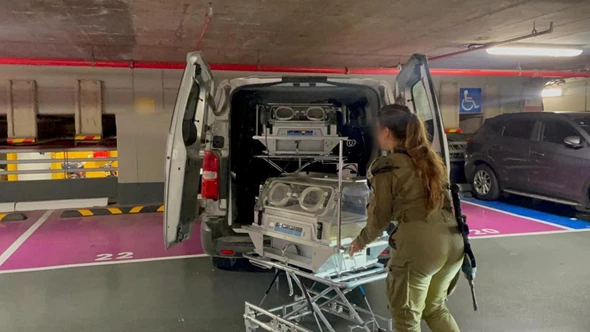
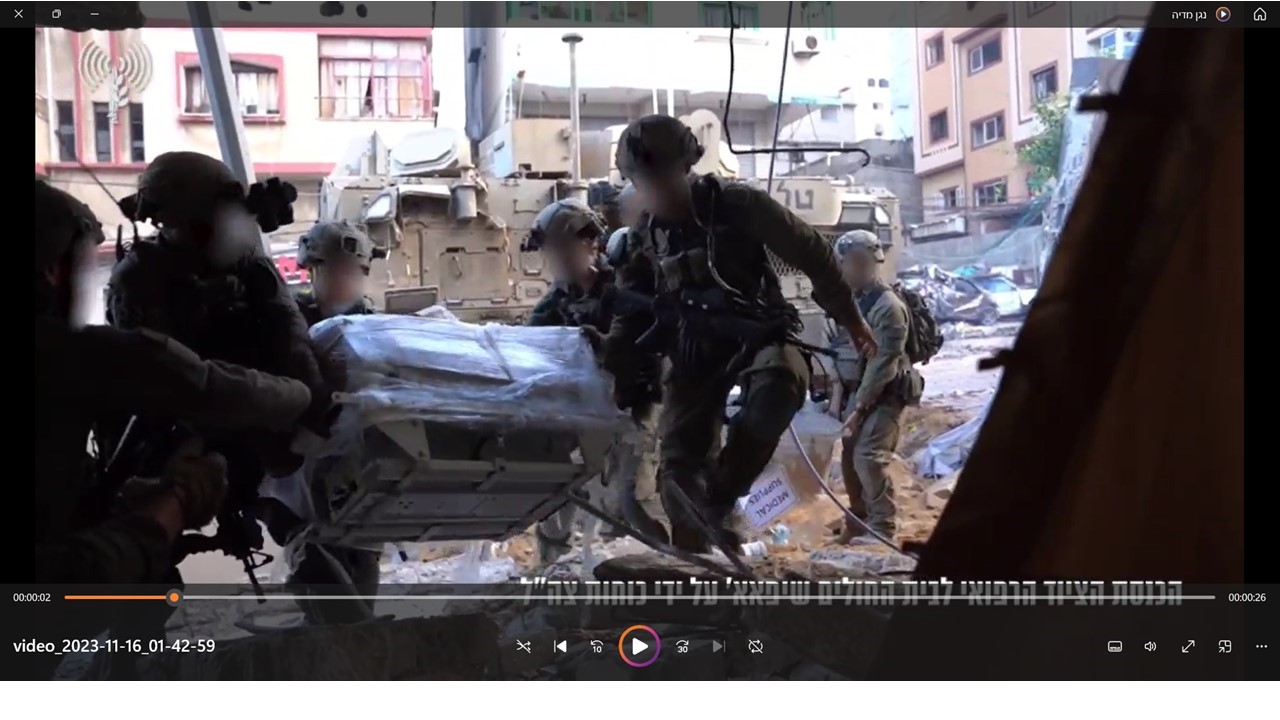
During the night of 14-15 November, more than an hour after informing the hospital management of its intention to do so, an IDF unit entered the grounds of Shifa Hospital. It did not go through the entire hospital – only to specific sites. The unit found and collected large amounts of abandoned weapons (including in the MRI room), communications equipment, and computers used by Hamas. Meanwhile, the IDF also provided the hospital with incubators and respirators for children as well as artificial milk for babies and other medical materials. Five terrorists were killed on the perimeter of the hospital before the IDF unit entered the grounds. The Palestinians are reporting that the IDF arrested some 200 people on the hospital grounds. The IDF unit completed the operation towards the evening of 15 November and left the grounds of the hospital.
On 16 November the IDF returned to Shifa Hospital. In a building adjacent to the hospital it found the body of one of the Israeli women kidnapped on 7 October. More weapons and a car rigged with a bomb were also found inside the hospital grounds.
Information acquired on one of the kidnapped soldiers who was wounded in the initial attack proves that she died, either in captivity or en route to Gaza. (Hamas kidnapped dead bodies as well as the living. Some of them were dumped inside Gaza and some are still missing.)
Loading a van with incubators to be sent to Shifa Hospital
Screenshot from video of IDF soldiers unloading medical supplies from their armored vehicles at Shifa Hospital
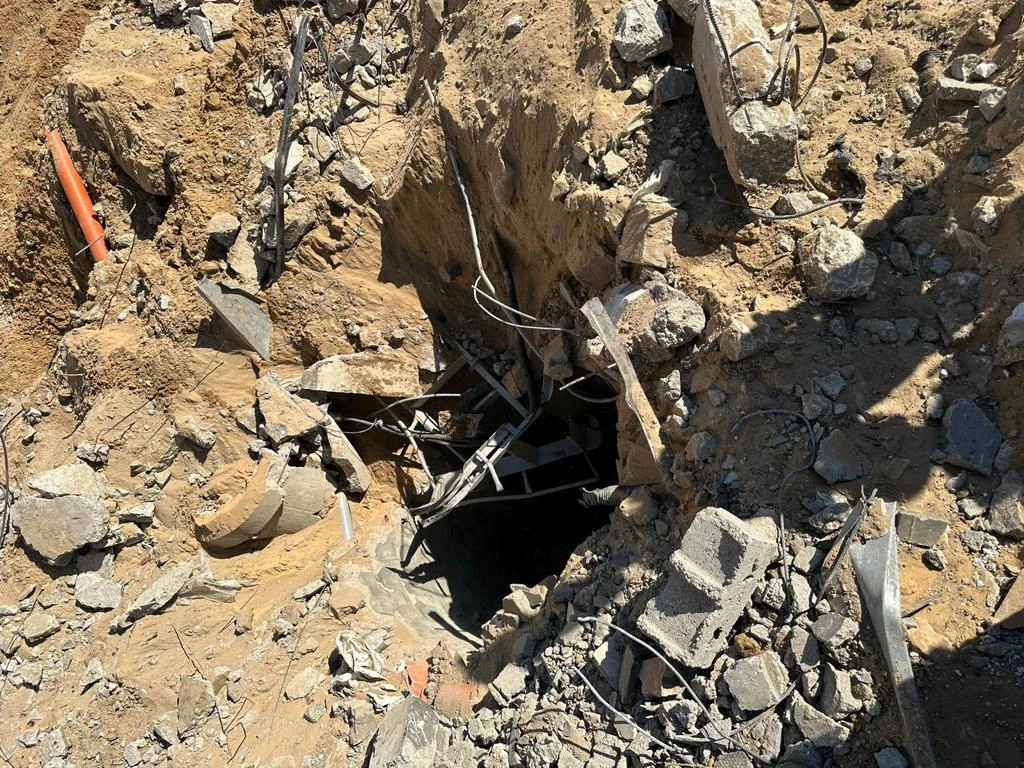
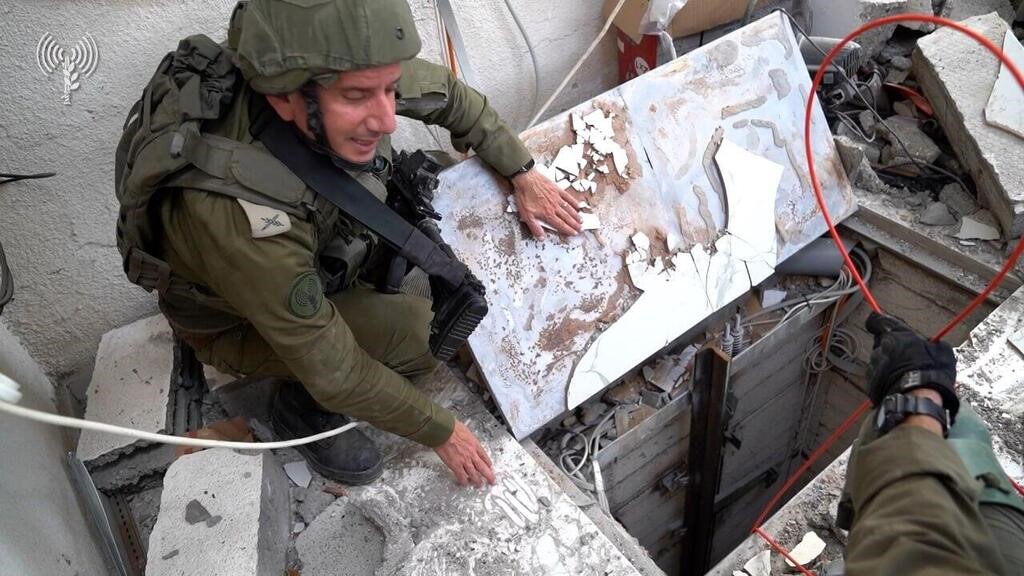
Entrance to a tunnel shaft found on the grounds of Shifa Hospital after the cover hiding it was demolished
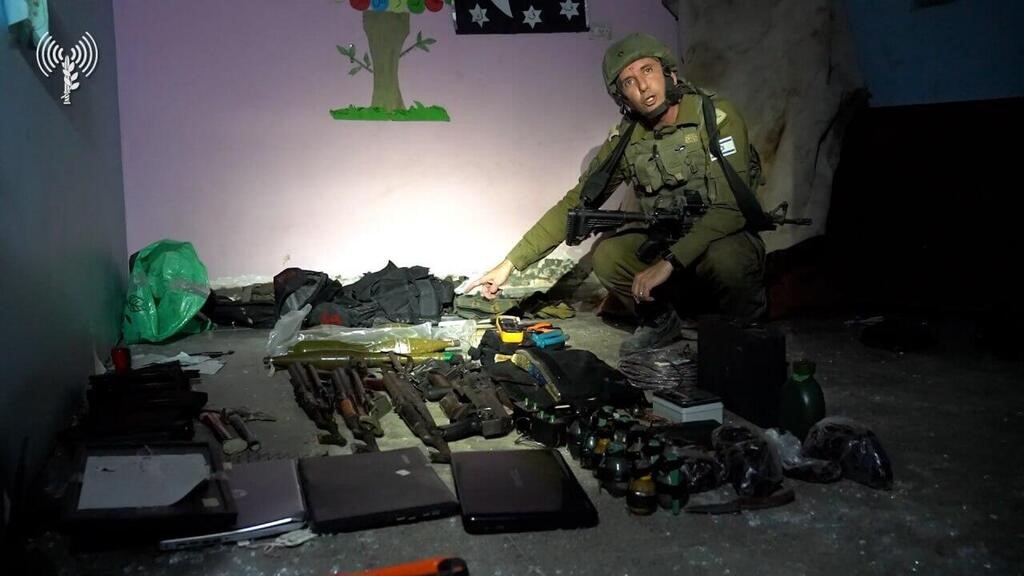
Weapons found at Rantisi Hospital a couple of days ago
A tunnel entrance on the Rantisi Hospital grounds
A terrorist with an RPG anti-tank rocket launcher
at the entrance to Al-Quds Hospital (in red circle)
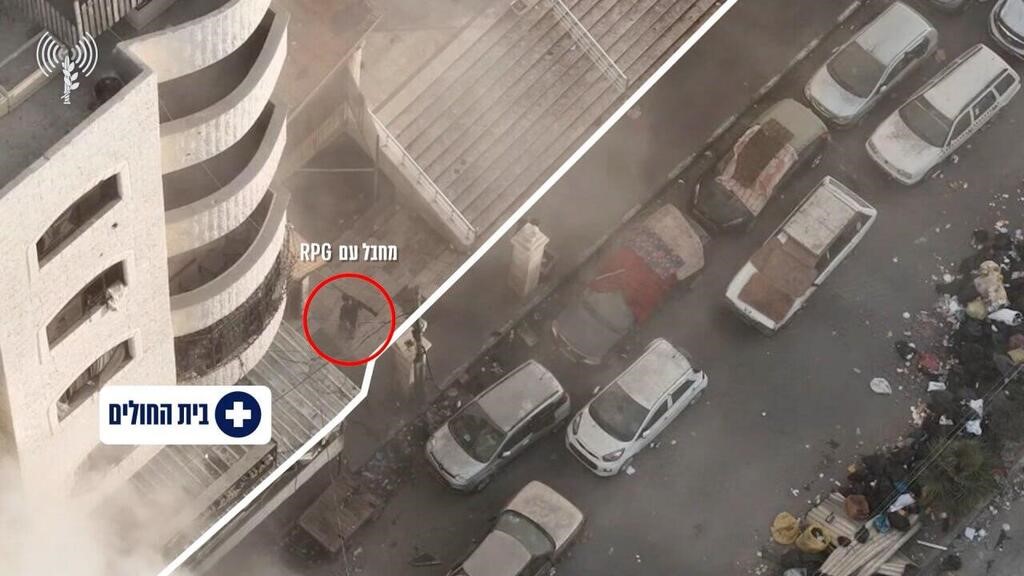
21 terrorists were killed on the perimeter and in the grounds of Al-Quds hospital.
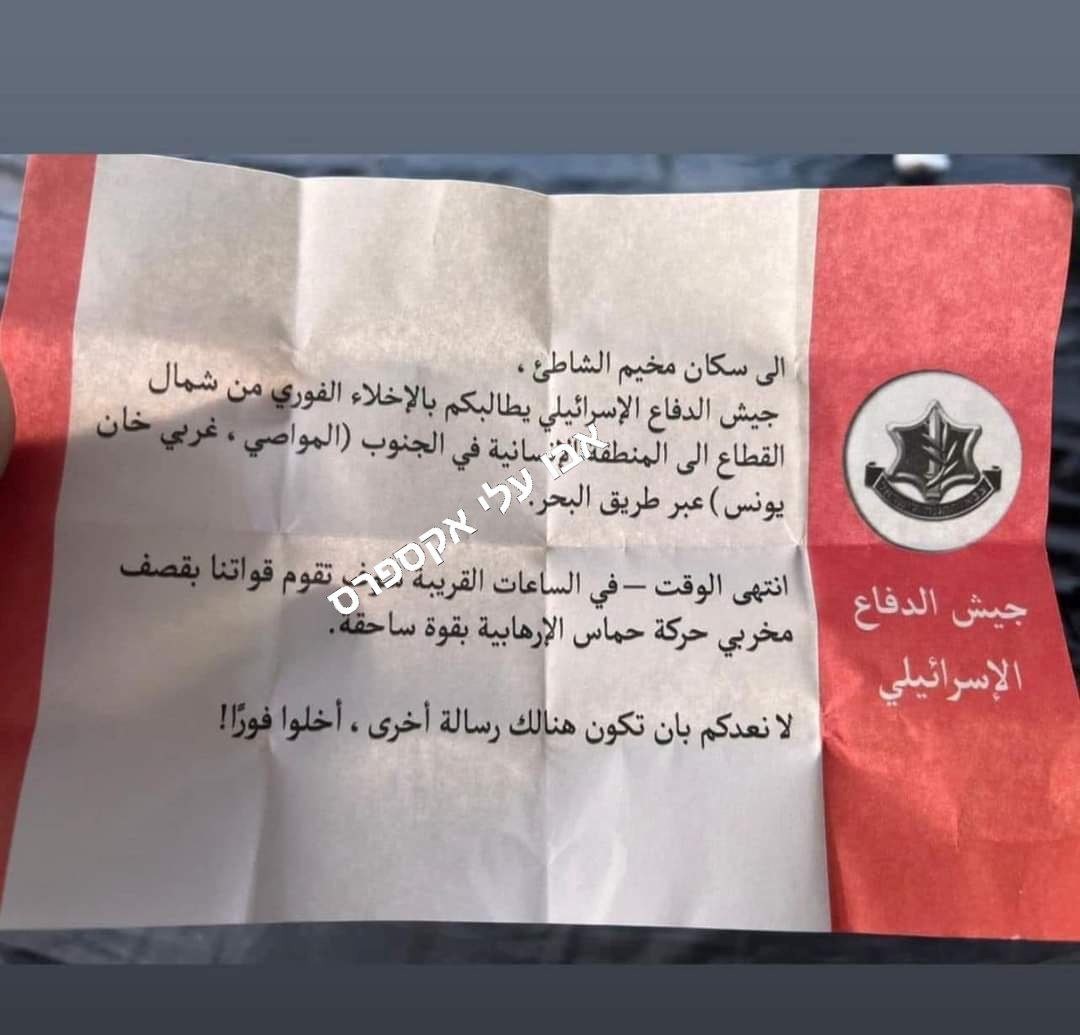
During the day, the IDF dropped flyers over the eastern portions of Khan Yunis in southern Gaza telling the population to move eastward, away from the border.
I have been asked to respond to the following:
On the news here, whenever a journalist says something about how the IDF has told civilians to leave northern Gaza, the journalist typically follows that with a statement about how there are IDF attacks in the south of Gaza and therefore no place is safe and the civilians have no place to go.
This is not accurate. Yes – the IDF has been bombing targets in the southern area of the Gaza Strip too, ever since the first days of the war, but these are all specific targets based on intelligence. There is NO general area bombing anywhere in Gaza – not even in the current main battlefield in and around Gaza City, which is almost empty of civilians. All bombings are based on intelligence or a soldier on the ground sighting a military target, which is then reviewed and cross-checked by both intelligence and legal advisors. Telephone and text message warnings are given in advance to the areas around planned strikes. When a larger area is involved, leaflets are dropped in advance with enough time for the population to move. The actual damage from a specific strike is a single building. Directly adjacent buildings might suffer some damage but are not destroyed, and any building that is not directly adjacent to the target building is unharmed.
Some journalists and bloggers are using the term ‘carpet-bombing’ to describe IDF activity. This term refers to a technique developed in the Second World War by the British and American air forces in which large groups of aircraft (from hundreds to more than a thousand) flew over an area and dropped huge numbers of unguided bombs on it so the entire area was demolished. The Israeli air force does not use this technique. Each strike involves a specific aircraft dropping a single guided bomb on a specific point. If more are needed, the process is repeated separately so collateral damage is minimized.
If what the journalists are claiming were true, the number of casualties would be vastly greater than what the Gaza Health Ministry claims – and as their numbers are neither confirmed nor credible, they are likely to already be an exaggeration of the reality. And as I have written repeatedly, Hamas does not differentiate combatant casualties from the general population.
Since the ground operation began there has been a gradually increasing transfer of humanitarian assistance into Gaza through Egypt. On 15 November the first gasoline tanker truck entered southern Gaza.
The IDF has provided more general information on Hamas:
The Gaza Strip is divided into five regions, each called a brigade.
Each brigade has four to six battalions for a total of 140 companies, including the companies belonging to the special forces who conducted the attack on 7 October.
Each battalion is responsible for holding one neighborhood. The size of the area it controls depends on the topography.
In northern Gaza there are two brigades: the Gaza City brigade, which is the largest with about 9,000 terrorists; and the North Gaza brigade, with about 5,500 terrorists. The IDF has been attacking two or three of these battalions at a time.
The white lines are the boundaries between the brigades.
The pink lines are the boundaries between the battalions.
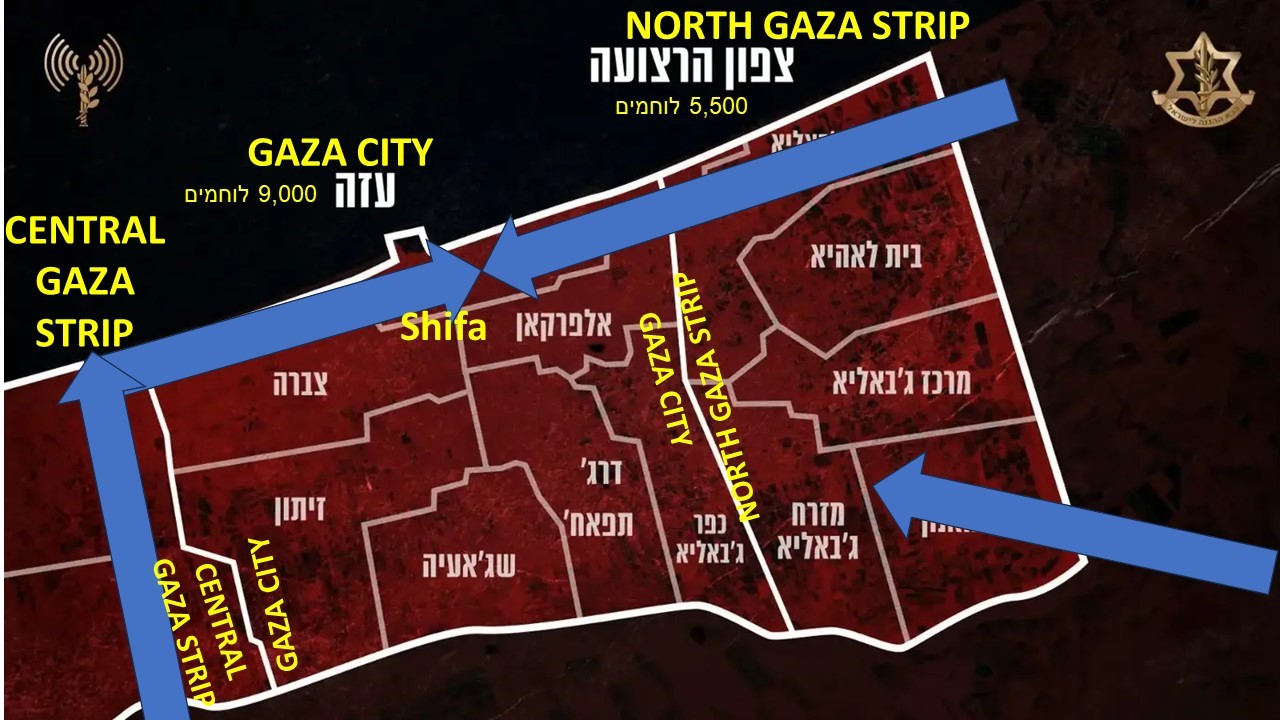
During the fighting, IDF ground units have reported killing large numbers of Hamas terrorists and capturing a few dozen. The numbers are obviously not precise because when someone fires from a window and a tank shell is fired back, no one goes to check how many terrorists were hit. This is especially true of terrorists killed inside the tunnels, which, when located, are bombed from the air with ground-penetrating bombs.
As the fighting continues there is a slow but steady increase in IDF casualties. By midday on 16 November, 54 IDF personnel had been killed since the beginning of the ground operation in Gaza. The total number of IDF wounded has not been updated. Until now, based on partial reports, I have estimated roughly 10 wounded for every IDF soldier killed, but today I read something that suggests that this ratio might be a bit too high. Until the IDF publishes an official number I cannot be sure.
Hamas continues to fire rockets into Israel though the daily average has lessened. The total to date is approximately 9,500 (of which 3,000 were fired in the first four hours). Of these, approximately 1,150 have fallen inside Gaza. The rate of fire has been drastically reduced over the past few days (only about a dozen per day), probably for two reasons:
- The advance of the IDF has brought its troops to many of the traditional launch sites and many launchers have been destroyed.
- Hamas wants to conserve ammunition for a longer war as stores are being used up. The organization started the conflict with considerably fewer rockets than Hezbollah (which has 130,000 to 150,000, depending on the source).
Lebanon:
Over the past few days Hezbollah has been reporting approximately half a dozen attacks per day against Israel. These include sniping with guided anti-tank missiles, rockets and explosive drones. Among the regular rockets there have also been some carrying warheads weighing 300 to 500 kilograms each.
So far 10 Israelis have been killed in the fighting on this front since 7 October. Several dozen Israelis have been wounded, but the precise number has not been published.
Israel has responded with increased attacks of its own involving artillery, air strikes and tank fire. Hezbollah fatalities have accumulated to least 76 (seven of them in Syria). The number of wounded is not known.
Other Lebanese and Lebanese-based Palestinian organizations have also participated in the exchanges and at least 10 of their members have been killed too.
There are reports of tens of thousands of Lebanese moving north, away from the border with Israel. Unlike Hamas, Hezbollah has tended to use the population as camouflage (hiding military equipment in their homes) but not as human shields. When fighting escalates, they do not attempt to compel civilians to stay the way Hamas does but rather lets them leave.
Syria:
On the Syrian border there have been only a few incidents so far (rocket launches, etc.). These have been responded to with various means including tank fire, artillery and air strikes. At least 10 militia members and Syrian army soldiers have been killed in these strikes.
As noted above, six Hezbollah personnel were also killed in Syria. Hezbollah has had a permanent presence in Syria for more than two decades. Until 2011 these were administrative personnel involved in transporting supplies sent from Iran via the Syrian airports. In 2012 Hezbollah began sending combat units to assist Assad in defeating the rebellion against his regime. The exact number is not known, but at least 2,000 Hezbollah personnel were killed during the Syrian civil war and many more were wounded.
Hezbollah exploited Assad’s gratitude for their assistance by setting up positions near the border with Israel in order to conduct attacks into Israel. Israel responded with air strikes and tank fire directly targeting Hezbollah personnel but also targeting Syrian regime troops as a message to Assad to control Hezbollah or risk a heavier Israeli attack that would indirectly assist the rebellion. Hezbollah’s attacks from Syria ceased, but over the past couple of years the group has resumed preparing the infrastructure needed to renew such attacks.
There are reports from the Syrian opposition that more pro-Iranian militia units have arrived near the Israeli border with Syria.
Judea and Samaria:
In Judea and Samaria (the West Bank), Palestinian attacks on Israelis have increased somewhat but despite calls from the Hamas leadership to escalate, they have not surged. Israeli security forces have responded with ‘police’ raids to arrest terrorists. So far almost 2,000 terrorists have been arrested and approximately 195 killed – most in IDF raids, and some while attempting to conduct attacks on Israeli civilians or soldiers. Today, for example (16 November), three Palestinians drove up to a checkpoint south of Jerusalem and opened fire. An Israeli soldier was killed and six other soldiers and civilians were wounded. The three attackers were killed when other soldiers returned fire.
After spending a few days conducting offensive operations in Jenin, the IDF seems to be conducting similar operations in other cities of Judea and Samaria.
There has also been an increase in the number of violent altercations between Palestinian and Israeli civilians over agricultural property rights (field boundaries, grazing rights).
Yemen:
The Houthis have continued to launch missiles and long-range explosive drones towards Israel. The rate of fire has gone down from the first few days. In some cases, they have declared launches that nobody has seen. All the actual missiles and explosive drones they have launched have been intercepted by IDF anti-missile defenses, US ships (including one on 15 November), and in at least one case by Saudi anti-missile defenses. The Houthis have attacked Saudi Arabia numerous times in the past with missiles and explosive drones and the shortest aerial route from Yemen to Israel passes over a portion of Saudi Arabia.
Iraq and Syria – US forces:
Pro-Iranian Iraqi Shiite militias continued to attack American bases in Iraq and Syria with rockets and exploding drones. So far, since 18 October, there have been more than 55 strikes with rockets and explosive drones. The number of American casualties is one killed (apparently from cardiac arrest caused by an attack) and at least 45 wounded.
The US military has responded with air strikes on suspected militia locations.
Israeli Casualties:
There are still a number of people unaccounted for, but it appears that all or nearly all the bodies of Israelis killed in the initial attack inside Israel have been found. One more body was found this week but it has not yet been identified. Currently there are still pieces of bodies that have not been definitely identified because they are so badly damaged (in some cases there are problems identifying them with DNA tests). Some of the body parts might belong to previously identified mutilated bodies that are missing parts.
Also, some of the missing have been confirmed to be among the kidnapped Israelis in Gaza.
So far, of the Israelis and non-Israelis[1] killed and missing from the initial Hamas attack, approximately 880 civilians and approximately 370 soldiers, policemen and firefighters have been identified. There are still approximately 235 kidnapped Israelis and non-Israelis in Gaza (how many are alive and how many dead is not known). Five have been released and two have been confirmed dead.
In addition, 19 Israeli civilians have been killed by Hamas rocket attacks.
The total number of wounded is approximately 7,260.
The number of Israeli soldiers killed in the fighting since 8 October on all fronts put together is approximately 65 with perhaps seven to ten times that many wounded.
The number of Israelis who have been forced to leave their homes in 64 villages and towns along the borders with Gaza and Lebanon has reached approximately 250,000.
Palestinian Casualties:
The Gaza Health Ministry, which is controlled by Hamas in its role as the government of Gaza, claims that so far approximately 11,550 Gazans have been killed and almost 30,000 wounded. They do not differentiate between personnel of Hamas and other terrorist organizations and civilians.
They have also reported that 1.5 million of the purported 2.2 million Gazans have left their homes, 42,000 buildings have been destroyed or damaged to the extent that they are no longer habitable, and 223,000 houses have been damaged. Ninety-five government buildings and 74 mosques have been destroyed.
Convention of the Organization of Islamic Cooperation on the War:
As expected, all the speakers at the conference criticized Israel, some with more severe terminology (such as Iran and Turkey) and some with less (such as the United Arab Emirates). However, no actual concrete steps were declared publicly and it seems that none were decided upon privately either. The states that have agreements with Israel are either refusing to break off relations or evading the issue.
WHAT NEXT?
A report denied by Iran claims that when Haniya, one of the Hamas leaders, met Iranian Supreme Leader Khamenei this week, he was told that because Hamas did not coordinate the attack on Israel with Iran, Iran and Hezbollah would not assist Hamas.
Gaza City is almost empty of civilians with huge numbers having left for the southern areas of the Gaza Strip over the past week.
After operating around and inside a number of hospitals in western Gaza City, the IDF seems to be preparing to advance eastward. The final objective has not changed: to gradually comb the entire city street by street, house by house and tunnel-entrance by tunnel-entrance in order to find, kill or capture Hamas personnel. So far, despite heavy casualties, Hamas has been willing to keep on fighting. The number of those surrendering has been very small. If that continues, this will be a long arduous process and casualties on both sides will definitely increase greatly.
Hamas seems to still be hoping to incite a major escalation in Judea and Samaria, but so far this does not seem to be working. This is likely due to several factors: Israel’s escalated counteractions, the general shock of the populace at the unfolding events, and the fact that the ruling Palestinian faction in Judea and Samaria, Fatah, sees Hamas as an enemy and is quite happy to see it decimated. (Of the approximately 2,000 people arrested or killed by the IDF in its counter-terrorist operations in Judea and Samaria, more than 60% are Hamas personnel.)
The majority of the Arab states are making public declarations in favor of the Palestinians but in fact are doing very little to nothing (depending on the state) to help them. Even humanitarian aid from the Arab states has been minimal, and public demonstrations in favor of the Palestinians in the Arab states are generally fewer and smaller than those in Europe and America. Saudi Arabia has stated, while going through the motions of caring about the Palestinians, that the normalization process with Israeli will continue. Hamas spokesmen have voiced frustration and disappointment with the responses of Hezbollah, Iran and its proxies in particular but with the Muslim world in general. In both Nasrallah’s speeches he spent considerable time giving excuses for not joining the war (at least for now).
There has been some discussion abroad and in the Israeli media about ‘the day after’ – what will be done with Gaza to prevent a recurrence. The US has suggested a plan that includes handing Gaza back to the Fatah-controlled Palestinian Authority. Initially, when asked if Fatah would be willing to return to rule Gaza after the war, a high-ranking Fatah official said it would not, because it would be deemed to have “ridden to power on the tanks and aircraft of the IDF”. However, over the past week they seem to have changed their minds. President Abbas has declared his willingness to reaccept authority over Gaza, but is demanding Israeli concessions in Judea and Samaria in return. Israel’s initial official response to this option was to say that because Fatah did not condemn the Hamas attack, it is not a viable partner, and in any case it is too early to plan seriously for the day after. First we have to win the war.
[1] Among the civilians killed were tourists, a number of agricultural workers from Thailand working in the fields of the farming villages, and a number of home nurses, also from abroad.
***
7-12 November 2023
WHAT HAS HAPPENED?
Gaza:
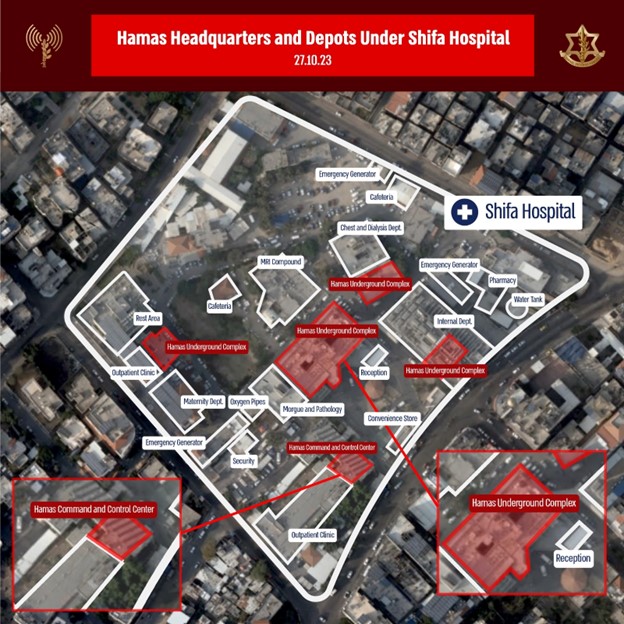
Over the past six days, Israeli forces have gradually entered deeper into Gaza City, mostly in the direction of known strongpoints of Hamas but also combing general areas. The focus, from the news reports, seems to be first the neighborhoods closest to the beach, cutting the city off from the sea, and approaching the areas traditionally reported as locations of the higher headquarters of Hamas inside the city. During previous operations, it was determined that the supreme leadership of Hamas is located in fortified underground offices under Shifa Hospital.
All hospitals, neighborhood clinics and mosques in Gaza have had underground offices and storage sites built underneath them that are connected to the tunnel systems that crisscross the city underground. In previous confrontations, the IDF generally did not bomb hospitals, clinics or mosques. Furthermore, except in exceptional circumstances, it did not enter them with ground troops. In 2014, one neighborhood clinic that was entered exploded on the IDF unit. The building had had bombs hidden permanently in the walls and floors even as it was being used to treat patients in peacetime.
The movement of the IDF in Gaza is extremely slow because every building has to be checked before entry for explosive booby-traps. Most have been rigged. This includes residential buildings, public service buildings, etc.
Hamas forces are continuing to conduct raids on IDF units beyond the city perimeter by exiting from hidden tunnel openings. The IDF units are searching for these openings and destroying them.
The IDF has not published an estimate of Hamas casualties except to claim that the majority of the Palestinian fatalities are combatants and not civilians. In other words, the combatants number in the thousands. Hamas disguises its combatants as civilians by having most of them dress in civilian clothes. That way, when they are killed or wounded, they look like civilians in photos and videos taken by Hamas.
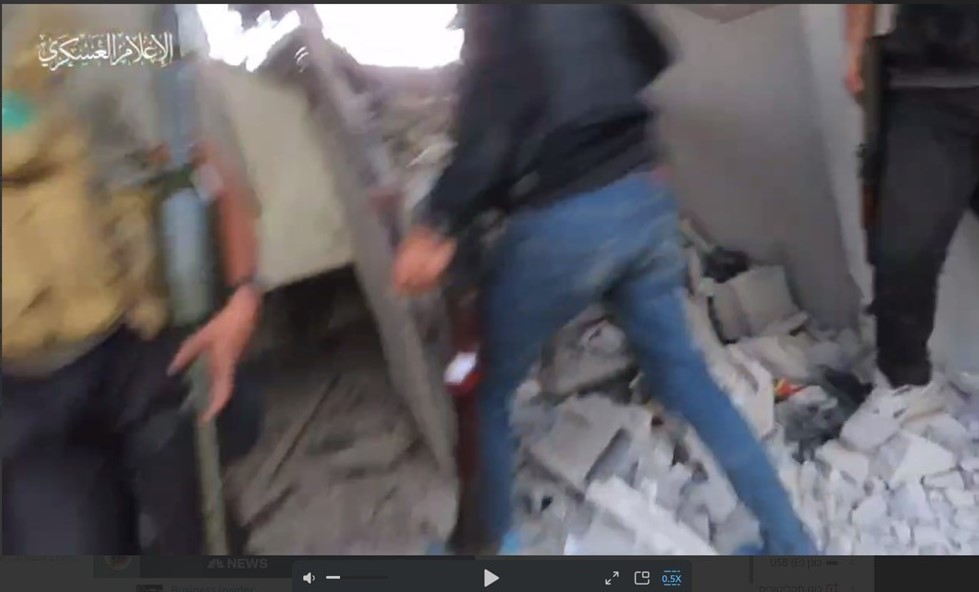
Screenshot from a Hamas video of the fighting.
Note the civilian clothes: jeans, T-shirts and jackets.
As the fighting continues, there has been a slow but steady increase in IDF casualties too. By midday on 12 November, 47 IDF personnel had been killed since the beginning of the ground operation in Gaza. The total number of IDF wounded has not been updated, but from occasional references in daily news reports it appears to be about ten times the number of wounded.
Hamas continues to fire rockets into Israel, though the daily average has lessened. The total to date is approximately 9,500 (of which 3,000 were fired in the first four hours). Of these, approximately 1,150 have fallen inside Gaza (including one on Shifa Hospital on 11 November). For the first time, the report also explicitly mentions the launch of “tens” of explosive drones fired from Gaza.
The rate of fire has been drastically reduced over the past few days – probably for two reasons:
- The advance of the IDF has brought its troops to many of the traditional launch sites and many launchers have been destroyed.
- Hamas wishes to conserve ammunition for a longer war as the stores are being used up. Hamas had considerably fewer rockets than Hezbollah.
The number of civilians leaving Gaza has grown considerably. Over the past week, nearly 200,000 have walked past the Israeli checkpoint on the eastern road leading south. However, that still leaves a couple of hundred thousand in north Gaza. All told, since the beginning of the war, the IDF has dropped approximately 1.5 million flyers urging the population to move away from probable objectives, sent 6 million voice messages, 4 million text messages, and an unpublished number of phone calls warning of impending strikes on specific buildings to the people living within the danger zone of each strike.
A topic Hamas has been harping on for almost two weeks is that the hospitals are running out of fuel and are losing the electric power critical to providing care. However, every photograph and video taken inside the hospitals shows the electricity still working. The IDF published a conversation that proves that there are hundreds of thousands of liters of petrol in Hamas stores, including in underground stores beneath the hospitals. Furthermore, donations of medical supplies are reaching the hospitals inside Gaza City, as they are being allowed through by the IDF. Thus, on 8 November trucks carrying medical supplies arrived and unloaded in Shifa Hospital. Donations from other Arab countries have also been let in, including a second paradrop of medical supplies flown by the Jordanian air force through Israel.
Many of the hospitals in northern Gaza are being evacuated of patients and of people who came there looking for a safe haven in the knowledge that Israel does not attack hospitals. However, as the fighting has neared these hospitals, the IDF has requested that they evacuate their patients and staff because the underground floors were being used by Hamas for weapons storage, command posts, and tunnel entrances. At Rantisi Hospital, the local Hamas company commander held approximately 1,000 Gazan civilians hostage to prevent the IDF from attacking the hospital. When IDF units closed in on the hospital, he and a group of his men moved to the nearby Al-Buraq school, which had already been evacuated, where they were located and killed. Inside the school grounds the IDF found weapons stores and a manufacturing site as well as a tunnel entrance.
Currently the same process is being repeated at Shifa, the most famous hospital in Gaza, which houses the largest Hamas underground area. That is where the Hamas high command was located in all previous wars, though this time it is likely that they have all fled to southern Gaza. The IDF has delayed approaching the hospital to allow its evacuation and has even offered to help move non-ambulatory patients and provide fuel for the hospital electricity generators. The offer was refused. As with a previous event, a failed rocket launch struck the hospital grounds and Hamas tried to claim it was an Israeli bomb.
Hamas also claims Israeli has attacked ambulances. The IDF responded that the only ambulances attacked were those being used to drive Hamas combat personnel on their missions (i.e., NOT wounded). Given that Hamas combat personnel are often wearing civilian clothes, they are discovered through intensive intelligence work. Furthermore, it has been revealed that Hamas has a unit of many fake ambulances for transporting its personnel (not injured or sick) and equipment. Hamas established this unit to take advantage of Israel’s known reluctance to shoot at ambulances.
Lebanon:
On the Lebanese border there has been a gradual escalation in Hezbollah attacks, both in the number of rockets fired and in the size of the models used (they are now much bigger, with 300-500 kilogram warheads). Hezbollah is also using exploding drones. On 12 November 22 Israelis were wounded in a Hezbollah attack, including a group of civilians working on repairing electricity infrastructure not far from the border. One was critically injured and five more suffered less critical injuries. So far 10 Israelis have been killed in the fighting on this front since 7 October.
Israel has responded with increased attacks of its own. Hezbollah fatalities have accumulated to least 72 (seven in Syria). The number of wounded is not known.
Nasrallah has again spoken publicly and not said much. However, one of his deputies promised to escalate to all-out war if they think Hamas is on the verge of being totally defeated.
Other Lebanese and Lebanese-based Palestinian organizations have also participated in the exchange of fire and at least 10 members of these groups have been killed.
There are reports of tens of thousands of Lebanese moving north, away from the border with Israel. Unlike Hamas, Hezbollah has tended to use the population as camouflage but not as human shields – so when fighting escalates they do not attempt to compel them to stay, but let them leave.
Syria:
On the Syrian border there have been only a few incidents so far, including rocket launches, etc. These have been responded to with various means including tank fire, artillery and air strikes.
An Iraqi Shiite organization located in Syria launched drones at Eilat. One hit a school and one was shot down. School was in session at the time it was hit, but because of the location of the hit, nobody was hurt. Israel responded with air strikes on targets in Syria and stated to the Assad regime that it would be held responsible for any more attacks originating in Syria.
Judea and Samaria:
In Judea and Samaria too, Palestinian attacks on Israelis have increased somewhat. However, despite calls from the Hamas leadership to escalate, they have not surged. Israeli security forces have responded with ‘police’ raids to arrest terrorists.
Over the past few days, the IDF has conducted a series of raids into Jenin. The roads entering the city had bombs planted underneath them by the terrorist organizations and were then covered over with asphalt. Apparently the IDF had intelligence on this, so its raiding force advanced behind armored bulldozers that tore up the asphalt and revealed the bombs. They were then detonated safely.
So far, approximately 1,600 terrorists (approximately 930 of them from Hamas) have been arrested and approximately 183 killed in Judea and Samaria, mostly in IDF raids. Some were arrested or killed while attempting to conduct attacks on Israeli civilians or soldiers.
There has also been an increase in the number of violent altercations between Palestinian civilians and Israeli civilians over agricultural property rights (field boundaries, grazing rights).
Yemen:
The Houthis have continued to launch missiles and long-range explosive drones towards Israel. The rate of fire has gone down from the first few days and over the past few days, many launches were verbal only (they were declared, but no launches actually took place).
An exo-atmospheric ballistic missile was shot down by an Israeli Arrow-3 defensive missile.
Iraq and Syria – US forces:
Pro-Iranian Iraqi Shiite militias continued to attack American bases in Iraq and Syria with rockets and exploding drones. The number of American casualties is one killed (apparently from cardiac arrest caused by an attack) and at least 45 wounded.
The US military has responded with air strikes on suspected militia locations.
Israeli Casualties:
There are still a number of people unaccounted for, but it seems that all or virtually all the bodies of Israelis killed in the initial attack inside Israel have been found. Currently there are still body parts that have not been definitely identified because they are so badly damaged (in some cases rendering DNA tests inconclusive). Some of these body parts might belong to previously identified mutilated bodies that are missing parts.
Also, some of the missing have been confirmed to be among the kidnapped Israelis in Gaza.
So far, of the Israelis and non-Israelis[1] killed and missing from the initial Hamas attack, approximately 880 civilians and approximately 370 soldiers, policemen and firefighters have been identified. Approximately 235 are among the kidnapped in Gaza (how many alive and how many dead is not known). Five have been released.
In addition, 19 civilians have been killed in the rocket attacks.
The total number of wounded is approximately 7,260.
The number of Israeli soldiers killed in the fighting since 8 October on all fronts together is approximately 60 with perhaps almost ten times as many wounded.
The number of Israelis who have been forced to leave their homes in 64 villages and towns along the borders with Gaza and Lebanon has reached approximately 250,000.
Palestinian Casualties:
The Gaza Health Ministry, which is controlled by Hamas in its role as the government of Gaza, claims that so far approximately 11,100 Gazans have been killed and approximately 28,000 wounded. They do not differentiate between personnel of Hamas and other terrorist organizations and civilians. They also claim that this number includes more than 4,000 children. Apart from the fact that all the numbers are propaganda-based and neither verifiable nor credible, “children” includes anyone up to the age of 18 – and since Hamas actively employs teens as combatants, this includes quite a number of terrorists. This is also true of the women and elderly who often serve in Hamas as scouts or suicide-bombers. There is a history of supposedly innocent people of all ages approaching IDF soldiers to ask for help and actually carrying suicide bomb-vests under their clothes or trying to lead the soldiers into explosive booby-traps or ambushes. The IDF spokesperson claims that the majority of the casualties are Hamas personnel or personnel of other armed groups, but has not elaborated.
The latest report on displaced Palestinians gives the number at approximately 1 million. This includes the vast majority of the population of northern Gaza, whom the IDF told to leave and head south. Simultaneously with providing the above number to the UN, another Hamas spokesperson tried to claim that there are still 900,000 out of 1.1 million Palestinians in northern Gaza and that this proves the IDF attempt to move the population south has failed. This is yet another example of the contradictions in Hamas rhetoric.
Organization of Islamic Cooperation Convention on the War:
As expected, all the speakers at the conference criticized Israel, some with more severe terminology (such as Iran and Turkey) and some with less (such as the United Arab Emirates). However, no concrete steps were declared publicly and it seems that none were decided privately either. The states that have agreements with Israel are all either refusing to break off relations or are evading the issue.
WHAT NEXT?
Hezbollah did indeed change its mind, re-escalating after a few days of reduced attacks. It seems that the new level is very likely to become the norm unless the IDF finds a way to hit back strongly. So we will have to wait and see if Hezbollah maintains the new level of fighting and whether the IDF counter-escalates.
The IDF is still waiting for civilians to leave Gaza City and the civilians seem to be leaving in ever-growing numbers, so the IDF will probably continue to maintain pressure but not escalate its advance into the depths of the city. The final objective has not changed: to gradually comb the city itself, street by street, house by house, and tunnel-entrance by tunnel-entrance in order to find, kill, or capture Hamas personnel. So far, Hamas seems to be willing to keep on fighting despite heavy casualties. The number of those surrendering has been very small. If so, this will be a long, arduous process and casualties on both sides will increase greatly.
Hamas seems to still be hoping to incite a major escalation in Judea and Samaria (the West Bank), but so far this does not seem to be working. This is due to Israel’s escalated counter-actions and the general shock of the populace at the unfolding events – but also to the fact that the ruling Palestinian faction in Judea and Samaria, Fatah, sees Hamas as an enemy and is quite happy to see it decimated. (Of the almost 1,800 people arrested or killed by the IDF in its counter-terrorist operations in Judea and Samaria, more than 60% are Hamas personnel.)
The majority of the Arab states are making public declarations in favor of the Palestinians but in fact are doing little to nothing (depending on the state) to help them. Even humanitarian aid from the Arab states is minimal, and public demonstrations in favor of the Palestinians in the Arab states are generally fewer and smaller than those in Europe and America. Saudi Arabia has stated that the normalization process with Israeli will continue. This is while the Arab states go through the motions of caring for the Palestinians as described above in the paragraph on the emergency meeting of the Organization of Islamic Cooperation to discuss a regional response to the war.
Hamas spokesmen have voiced their frustration and disappointment in the responses of Hezbollah, Iran and its proxies in particular but of the Muslim world in general. In both of Nasrallah’s speeches he spent considerable time making excuses for not joining the war – at least for now.
There has been some discussion abroad and in the Israeli media about ‘the day after’ – that is, what will be done with Gaza to prevent a recurrence. The US has suggested a plan that includes handing Gaza back to the Fatah-controlled Palestinian Authority. Initially, when asked if Fatah would be willing to return to rule Gaza after the war, a high-ranking Fatah official said it would not, as it would be deemed to have “ridden to power on the tanks and aircraft of the IDF”. However, over the past week they seem to have changed their mind. President Abbas has declared his willingness to reaccept authority over Gaza, but demands Israeli concessions in Judea and Samaria in return. Meanwhile, the IDF seems to have concentrated most of its efforts in the past week in and around the town of Jenin. After achieving a satisfactory conclusion there it is likely to focus on other locations of escalation.
Israel’s initial official response to this option was to say that because Fatah refused to condemn the Hamas attack, it is not a viable partner; and in any case, it is too early to make decisions or plan seriously for the day after. First we have to win the war.
[1] Among the civilians killed were tourists and a number of agricultural workers from Thailand working in the fields of the farming villages.
***
3 – 6 November 2023
WHAT HAS HAPPENED?
Gaza:
Over the past four days, Israeli forces have gradually tightened the noose around Gaza City and have begun to conduct raids into the outskirts. These raids are directed at known strongpoints of Hamas.
Meanwhile, Hamas forces are attempting to exploit the hidden tunnel exits in the open ground outside the city to attack the Israeli forces deployed there. They have been publishing quite a number of short video clips of their raids on Israeli troops and positions. These clips purport to show their successes. They have had some successes, but many of the clips are cut before the actual result of the attack is shown. Thus, for instance, they claim to have destroyed 27 IDF tanks, armored personnel carriers and bulldozers and to have “eliminated dozens of Israeli soldiers” over the past two days. A few armored vehicles have indeed been damaged including one or two destroyed, but in most cases, these attacks failed. The clip shows the anti-tank rocket exploding, but is then cut before showing that the explosion did not in fact damage the target, usually because it was intercepted by the Israeli active protection system. After each raid the Hamas attackers rush back to their tunnel exits. The IDF troops follow them to locate the tunnels and employ various means to destroy them.
Hamas fighters have suffered heavy casualties as Israeli troops discover their hideouts and destroy them. In a number of cases entire tunnel sections were destroyed with a barrage of ground-penetrating bombs that killed large numbers of Hamas personnel hiding in them. The ability to do this requires an accurate trace of the tunnel. In these cases, tunnels were located by capturing documents in Hamas headquarters the IDF had raided. The IDF has also been hunting Hamas commanders and has killed quite a few of them.
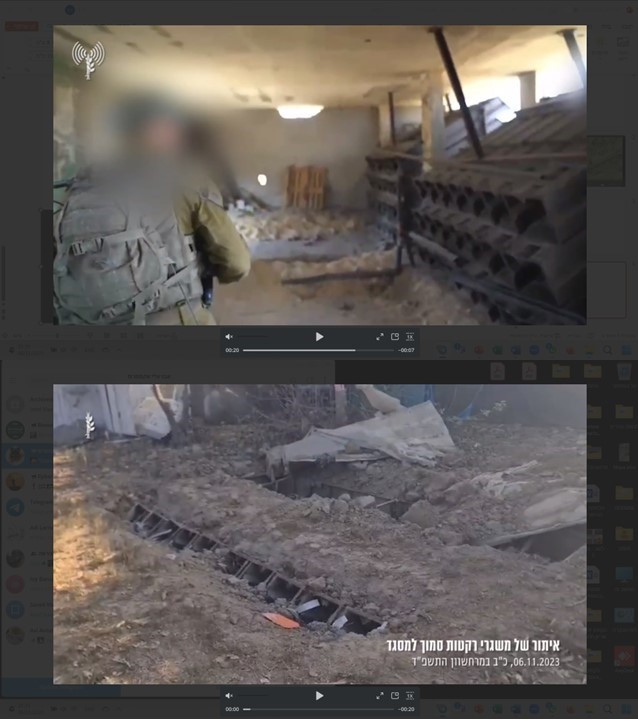
Top photograph: Hamas rocket launchers discovered in a Boy Scouts den. They are permanently emplaced in an open section of the wall to shoot from inside the building.
Bottom photograph: Half-buried rocket launchers in the yard next to a mosque.
The IDF has not published an estimate of Hamas casualties except to claim that the majority of the Palestinian fatalities are combatants and not civilians. They number in the thousands.
A couple of days ago the IDF finally released its own casualty figures so far. As of today, they amount to approximately 300 injured and 31 killed.
Hamas continues to fire rockets into Israel though the daily average has lessened. The total to date is approximately 9,000, of which approximately 1,000 fell inside Gaza. Also, for the first time, they fired two rockets with a range of more than 100 kilometers. The claimed range was 250 kilometers, but the actual distance to the targets was less than half that. Neither hit its target.
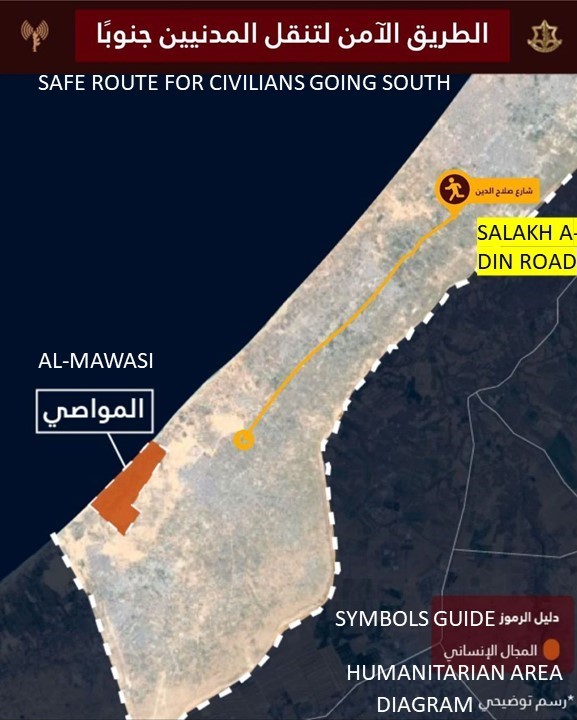
Over the past three days the IDF has repeatedly called on civilians still in Gaza City to evacuate to the south of the Gaza Strip. All roads going south are now controlled by IDF units, so each day the IDF declares specific hours for travel along one of the roads. A checkpoint has been set up to check the identity of those passing through in order to catch Hamas personnel trying to escape with the civilians. On the first day the road was opened, Hamas troops fired at the area of the checkpoint, threatening the lives of the Gazan civilians themselves.
One of the flyers dropped by Israeli aircraft with an explanation for the population on which route to use to evacuate:
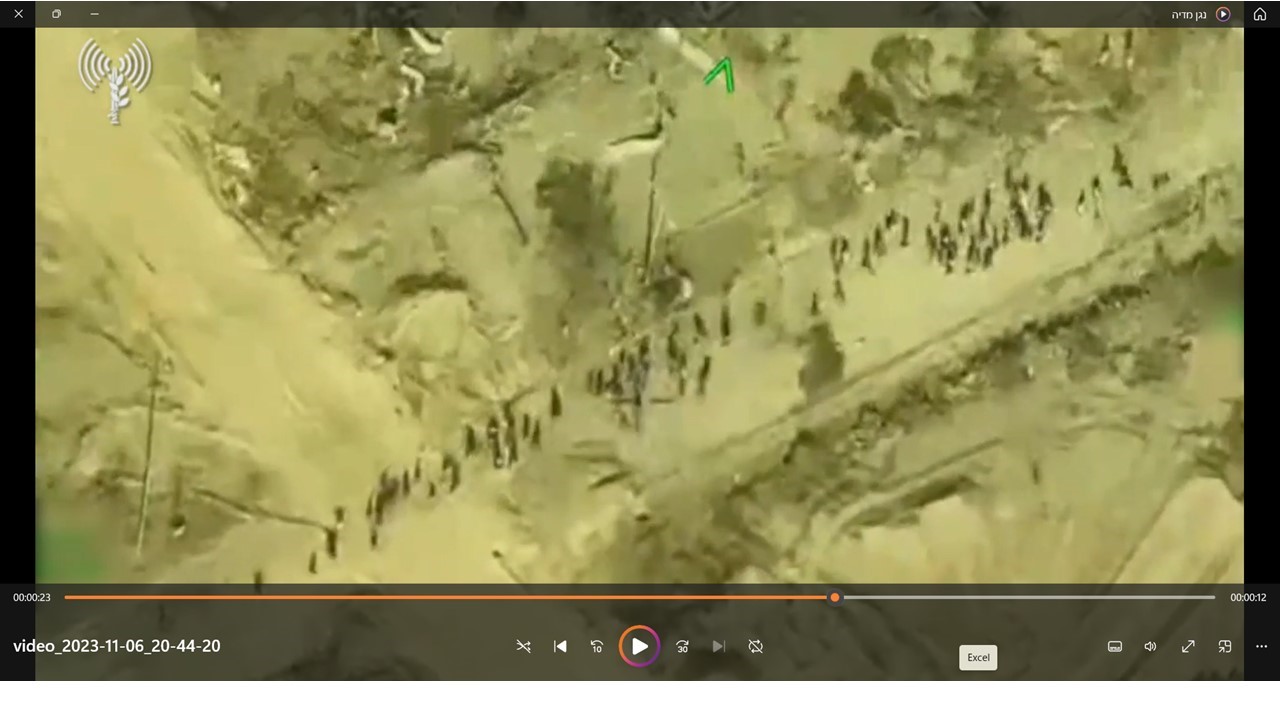
Screen shot from an IDF drone video feed of Gazan civilians walking south.
A reporter from ‘The Arabic Television’ standing a couple of kilometers south of the IDF checkpoint on Salakh a-Din road interviews a woman who came from Gaza City:
A topic that Hamas has been harping on for over a week is that the hospitals are running out of fuel and are losing electrical power critical to providing care. However, every photograph or video from inside the hospitals they claim are affected shows the electricity still working. The IDF published a conversation that proves that there are hundreds of thousands of liters of petrol in Hamas stores, including in underground stores beneath the hospitals.
Hamas also claims Israeli has attacked ambulances. The IDF responded that the only ambulances attacked were those being used to drive Hamas combat personnel on their missions (i.e., NOT wounded). Given that Hamas combat personnel are often wearing civilian clothes they are discovered through intensive intelligence work.
Israel allowed the Jordanian air force to parachute medical supplies in Gaza. To reach Gaza the Jordanian military transport aircraft had to fly through Israel.
Meanwhile, new information on the initial Hamas attack into Israel has shown that a number of the participants in the attack were Gazans who were allowed to work inside Israel (a total of almost 20,000 such permits were granted). Others who did not participate in the actual attack did serve as collectors of intelligence on the Israeli defenses they passed along the border and worked in the Israeli agricultural villages.
The family of a Bedouin Arab who was murdered by Hamas during the 7th October attack has declared a blood feud and is offering US$1,000,000 for information on the killers’ identities. According to the family, the entire tribe organized a donation drive and raised the money to enable the execution of the feud. In such cases the usual process is that the family of the murdered person kills the killer/killers or a third party mediates compensation depending on the case. If not mediated successfully, such feuds can last generations.
Lebanon:
On Friday 3rd November, Hassan Nasrallah, the chief of Hezbollah, gave a speech that had received heavy build-up as it was expected to dictate Hezbollah’s policy with regard to the current war. I listened to it – it was boring. Nasrallah opened by hailing the Hamas success on 7th October but then explained at length why Hezbollah is not doing more to assist it by joining in the war at full strength, much to the disappointment of the Palestinians.
A new trend in Hezbollah attacks has begun, however. It is using larger rockets with much heavier warheads, but maintaining more or less the same targets. The Israeli response was also much more powerful, and Hezbollah fatalities are now at 63. In addition to attacking the Hezbollah units conducting the attacks, the IDF has apparently been attacking Hezbollah sites throughout southern Lebanon to a distance of at least 10 kilometers from the border.
In addition to Hezbollah, Palestinian groups have participated in the fighting in Lebanon and have suffered nine killed.
On 6th November Hamas forces in Lebanon fired some 30 rockets into Israel. There were no casualties. Such a large barrage would not have been possible without Hamas permission.
Syria:
On the Syrian border there have been only a few incidents so far – rocket launches etc. These were responded to via tank fire, artillery and air strikes.
Judea and Samaria:
In Judea and Samaria Palestinian attacks on Israelis have increased somewhat, but despite calls from the Hamas leadership to escalate, they have not surged. Israeli security forces have responded with ‘police’ raids to arrest terrorists. So far approximately 1,350 have been arrested and approximately 160 have been killed either attempting to attack Israelis or resisting arrest with firearms. The majority are Hamas personnel, but there are also Palestinian Islamic Jihad and Fatah personnel. Today, 6th November, a high-ranking Hamas military commander was killed in an Israeli raid in Tulkarem. Also killed was a commander in a Fatah-affiliated terrorist group[1] whose father is a brigadier general in the official Palestinian Authority security forces.
A 16-year-old Palestinian walking by two Israeli police personnel in Jerusalem suddenly attacked them with a knife, killing the policewoman and wounding the policeman. Other police personnel at the scene shot and killed the attacker. This brings the number of Israelis killed in Judea and Samaria to three.
There has also been a slight increase in the number of violent altercations between Palestinian civilians and Israeli civilians over agricultural property rights (field boundaries, grazing rights).
Yemen:
The Houthis have continued to launch missiles and long-range explosive drones towards Israel. The rate of fire has gone down from the first few days and none has succeeded in hitting Israel (though they claim to have succeeded).
Attacks on US Forces in Iraq and Syria:
Pro-Iranian Iraqi Shiite militias continued to attack American bases in Iraq and Syria with rockets and exploding drones. The total number of such attacks since the beginning of the current Israel-Hamas war is more than 30 so far. The number of American casualties is one killed (apparently from cardiac arrest caused by an attack) and approximately 30 wounded.
Attempts to Attack Israelis Abroad:
According to a high-ranking Israeli security official, over the past few months (i.e., including a number of months prior to the current war), a few dozen attempts to attack Israelis and Jews abroad have been thwarted. The Office for Counter Terrorism has issued a strong warning to Israelis to delay all travel abroad.
Israeli Casualties:
There are still a number of people unaccounted for, but it seems that all or nearly all the bodies of Israelis killed in the initial attack inside Israel have been found. Currently there are still a few hundred bodies that have not been definitely identified because they are so badly damaged (in some cases there are problems identifying the bodies even with DNA tests). Also, some of the missing have been confirmed to be among the kidnapped Israelis in Gaza.
The current count of Israelis killed is more than 1,400 (of whom approximately 400 are soldiers, police and firefighters) with more than 6,900 wounded. This includes the Israelis killed or wounded in the fighting that followed the initial Hamas attack, but almost all were killed or wounded on the first day. Also, the current count of hostages confirmed kidnapped to Gaza is 241 (one less, after the identification of another dead person who former information had suggested was in Gaza). It is not known how many of the hostages are still alive.
The number of Israelis who have been forced to leave their homes in 64 villages and towns along the borders with Gaza and Lebanon has reached approximately 250,000.
Palestinian Casualties:
The Gaza Health Ministry, which is controlled by Hamas in its role as the government of Gaza, claims that so far approximately 10,050 Gazans have been killed and approximately 24,000 wounded. They do not differentiate between personnel of Hamas and other terrorist organizations and civilians. They also claim that this number includes more than 4,000 children. Apart from the fact that all the numbers are propaganda-based and not verifiable or credible, the children include anyone up to the age of 18. Since Hamas actively employs teens as combatants, in fact this includes quite a number of terrorists. This is true also of women and elderly people who often serve in Hamas, often as scouts or suicide-bombers. There is a history of supposedly innocent Palestinians of both sexes and all ages approaching IDF soldiers to ask for help and actually carrying suicide bomb-vests under their clothes, or trying to lead IDF soldiers into explosive booby traps or ambushes. The IDF spokesperson claims that the majority of the casualties are Hamas personnel or personnel of other armed groups, but has not elaborated.
The claim of 32,000 wounded published on 2nd November was apparently a typographical error in the Gaza Health Ministry report. The next day they reduced it to 23,000.
The latest report on displaced Palestinians gives the number at approximately 1 million. This includes the vast majority of the population of northern Gaza who were told by the IDF to leave and head south. When providing this number to the UN, a Hamas spokesperson tried to claim that there are 900,000 of 1.1 million Palestinians still in northern Gaza and that this proves the IDF attempt to move the population south has failed. This is one more example of the contradictions in Hamas rhetoric.
WHAT NEXT?
Following Nasrallah’s mellow speech on 3rd November, the tension, though not the fighting (as described above), has been reduced. However, this does not mean Hezbollah will not change their minds later. Iran too seems (publicly) more interested in stopping Israel’s offensive on Hamas than widening the fighting to new fronts. However, it must be taken into consideration that this might be an attempt to get Israel to lower its guard before a sudden escalation once they have completed their preparations, which will require them to move more forces into Syria and Lebanon. Therefore, Israel is still holding its forces in high readiness along the borders with these two states and retaliating aggressively to every attack.
Since there is more civilian traffic evacuating Gaza City and the IDF seems intent on allowing it while maintaining pressure on Hamas, the next few days will probably see only a gradual advance into the city. But as I wrote previously, it seems the IDF intends to gradually comb the city itself, street by street, house by house and tunnel entrance by tunnel entrance in order to find, kill or capture Hamas personnel. If so, this will be a long arduous process and casualties on both sides will definitely increase greatly.
Hamas seems to be planning to maintain its presence in Gaza, though a few of its personnel were captured by the IDF trying to leave Gaza among the civilians as mentioned above. It claims to have stored enough food, water and equipment to continue fighting a long time – hopefully until Israel’s allies stop supporting it and demand an Israeli withdrawal from Gaza because of the civilian casualties inflicted during the fighting. In the meantime, it hopes to inflict many casualties on Israeli troops by raiding and ambushing them through popping up out of the tunnels or the many above-ground hiding places it has prepared among the tens of thousands of buildings in Gaza.
Hamas seems to still be hoping to incite a major escalation in Judea and Samaria (the West Bank), but so far this does not seem to be working. This is due in part to Israel’s escalated counter-actions and the general shock of the populace at unfolding events, but also to the fact that the ruling Palestinian faction in Judea and Samaria, Fatah, sees Hamas as an enemy and is quite happy to see it decimated. (Of the approximately 1,500 people arrested or killed by the IDF in its counter-terrorist operations in Judea and Samaria, more than 60% are Hamas personnel). However, when asked if Fatah would be willing to return to rule Gaza after the war, a high-ranking Fatah official declared that it would not, because the group would be deemed to have “ridden to power on the tanks and aircraft of the IDF”.
The majority of the Arab states are making public declarations in favor of the Palestinians but in fact are doing little to nothing (depending on the state) to help them. Even humanitarian aid from the Arab states has been minimal, and public demonstrations in favor of the Palestinians in the Arab states are generally fewer and smaller than those in Europe and America.
ADDITIONAL TOPICS
Deep-Fake Propaganda:
Since the outbreak of the war, the amount of false information and fake content on the internet has reached new heights. Much of this content is created using deep-fake applications based on artificial intelligence. The fact that any internet user is now able to create synthetic content has made the issue of public diplomacy especially complex. It is vital, therefore, that there be a deep understanding both of the phenomenon and ways to confront the challenges it poses.
See article: https://www.inss.org.il/publication/war-deep-fake/
Proportionality:
One of the topics that many anti-Israel commentators use is the principle of “proportionality” in international law. Supposedly, because Hamas killed “only” 1,400 Israelis, Israel’s response, which has killed more, is disproportional.
This is a distortion of that legal concept. Proportionality in international law does not mean that if someone slaps my face I am only allowed to respond by slapping his. It means that my action must be proportionate to the need to prevent that person from slapping me again. If a counter-slap is sufficient, then that is proportionate. If kicking him is required because a slap won’t stop him from doing it again, then that is proportionate.
The following was written for me by a legal expert:
Israel’s right to self-defense under international law following the attack by Hamas on October 7 is beyond question, but many take a mistaken view of the limits placed on that right by the principle of proportionality in the international law of armed conflict.
Proportionality in this context does not mean, as many suppose, that defensive military action must be limited so as to cause “only” proportionate harm to the enemy. Thus, the number of casualties or the damage caused to non-military targets is not in itself an indication of disproportionality.
What the principle does require is that the military action, when targeting a particular military target, should not proceed if the information available indicates that the probable collateral damage to civilians and non-military targets would be excessive in relation to the military advantage expected from the military action.
This is therefore a more nuanced and fact-sensitive equation than is commonly understood.
Thus, for example, the warnings to residents in Gaza to remove themselves to the south are highly relevant given the need and legal right to target and destroy Hamas assets which have been embedded in residential and civilian environments.
Application of the correct definition of proportionality in international law is therefore of the utmost importance in assessing the legality, and indeed the morality, of current Israeli military action and any further action that is undertaken in the future.
[1] Fatah continues to play a double game: officially it denounces terrorist attacks and employs the official Palestinian Authority security forces (all Fatah members) to prevent it, while at the same time it maintains a terrorist organization that belongs to it but is deemed separate and independent for the sake of deniability.
***
29 October – 2 November 2023
WHAT HAS HAPPENED?
Gaza:
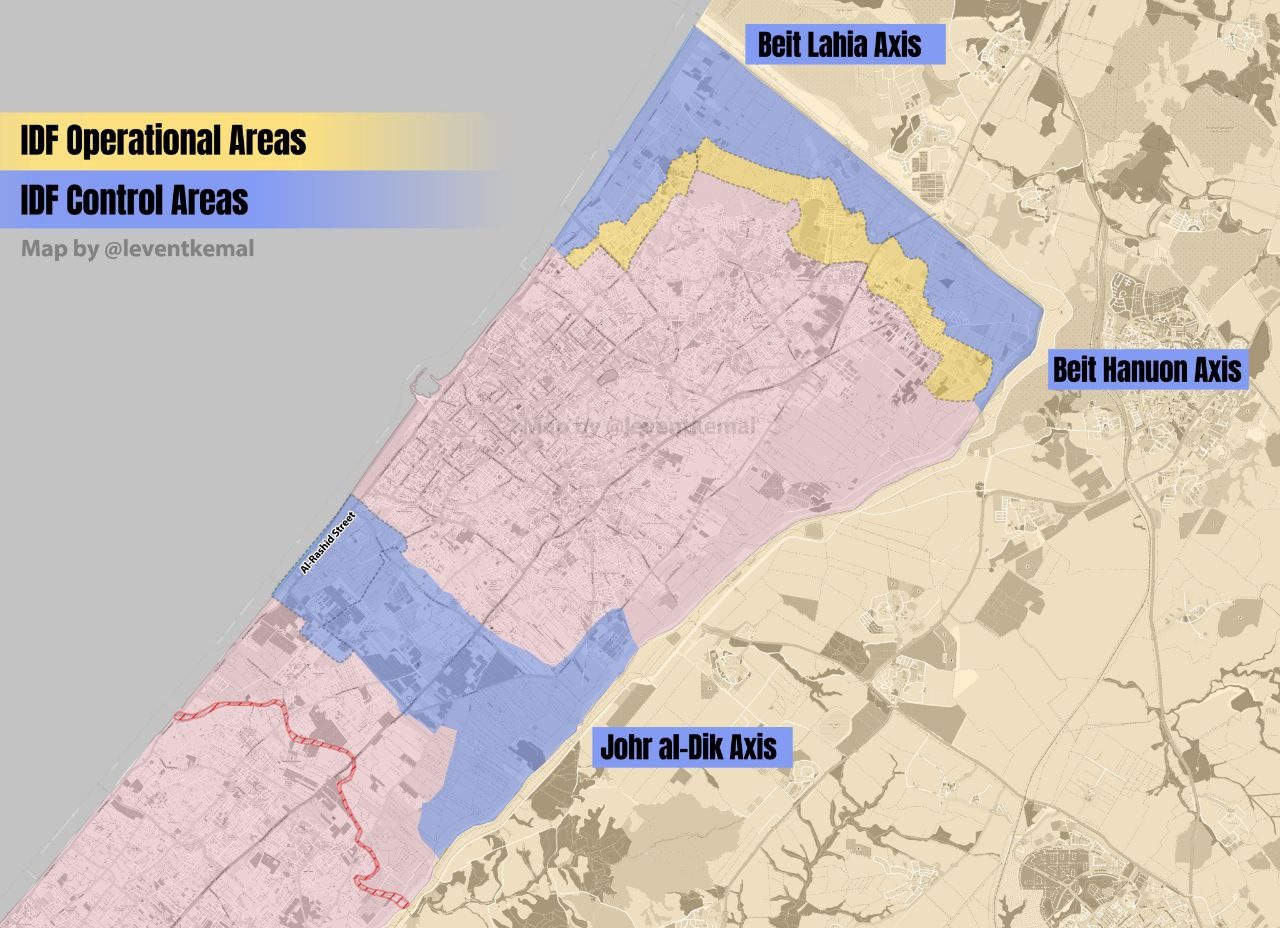
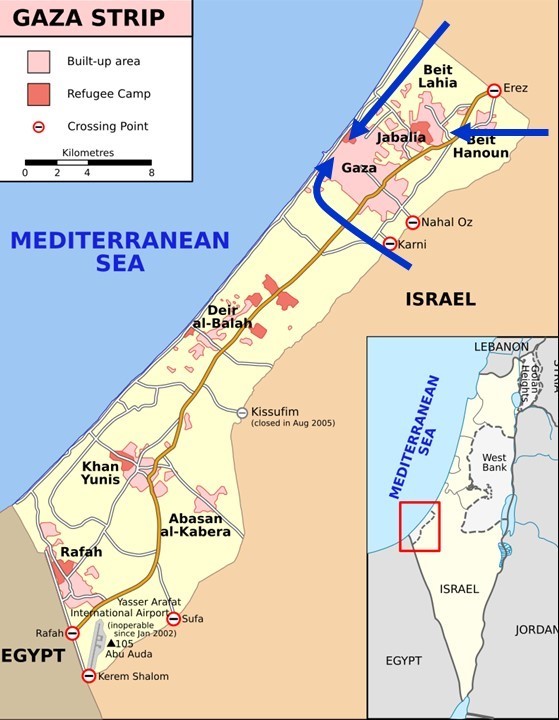
Turkish newspaper map of situation on 2nd November. (the red line marks the boundary the IDF requested the Palestinian civilians to cross going south)
As noted in my last update, during the night of 27-28 October a new chapter began in the war – the IDF ground offensive. Over these six days, the IDF advanced into Gaza from three directions: initially from the northwestern corner along the coast (what the Turkish newspaper in the image above calls the Beit Lahia axis); the following night also from the northeastern corner (what the Turkish newspaper calls the Beit Hanoun axis), and on Sunday also from the east just south of the city of Gaza (what the Turkish newspaper calls the Johr al-Dik axis), cutting off Gaza City (the northern third of the Strip) from the rest of the Gaza Strip. Over the past 24 hours Palestinian reports have suggested that IDF units are entering the edges of Gaza City itself along the coast from north and south.
A Turkish newspaper published the above map based on Palestinian reports. The IDF has not published a map of its own and I am not sure how accurate the Turkish map is, but it is probably close enough to give the general idea.
The initial advance through the open ground between the border and the built-up areas was conducted behind a rolling barrage that destroyed many of the bombs hidden in the ground. Underneath this open area is a warren of tunnels with many hidden openings. The Hamas fighters let the IDF troops pass, then climbed out of the tunnels to attack them from behind or from the flanks. They also attempted to fire long-range anti-tank missiles from high-rise buildings inside Gaza that overlook the open areas and to send armed drones against the Israelis. In the majority of cases these attacks failed. After a few days of fairly light fighting, the intensity of the fighting escalated considerably on 31st October as the IDF reached the outskirts of the built-up areas.
So far the IDF has reported the deaths of 18 of its soldiers and a couple of dozen wounded (the exact number of wounded has not been published). A few bulldozers (leading the advance to clear underground bombs and other obstacles), one tank and one APC have been heavily damaged. In most cases, the Israeli active defense system mounted on these vehicles intercepted the missiles and rockets before they hit.[i] Behind the leading units advancing to the city, other units are scouring the ground to find the hidden entrances to the tunnel complex in order to destroy them and block the ability of the Hamas forces to use them.
Hamas casualties are not clear because the official Hamas reports are not credible and they deliberately hide military casualties among the civilian casualties. However, they are clearly very high (I would rather not speculate). Many of the Hamas personnel that have been killed were hiding underground when their positions were hit with ground-penetrating bombs (bombs that explode only after penetrating a certain distance into the ground). Also, many Hamas personnel have switched from uniforms to civilian clothing.
[i] This system is like a miniature ‘Iron Dome’ for protecting individual vehicles from rockets and missiles.
While the Israeli ground forces are advancing the air force is continuing to strike targets located by IDF intelligence all over the Gaza Strip, especially in the northern third. There is a deliberate hunt going on for senior Hamas commanders and more than a dozen have been reported killed. All together, since the beginning of the war, the Israeli air force has struck some 12,000 targets with a wide variety of ordnance – from ground-penetrating bombs to regular bombs dropped by manned aircraft to small accurate missiles launched by drones and anti-tank missiles launched by helicopters.
The IDF has also launched a campaign to acquire information on the kidnapped people (note that the number of confirmed kidnapped has grown to 242). Flyers dropped all over the Gaza Strip state that anyone who is holding kidnappees, alive or dead, or has information on their whereabouts will be provided with payment and safe passage for them and their families if they hand them over to the IDF. Conversely, whoever is found to be holding women or children and does not hand them over will be killed.
Hamas propaganda has reported time and again that the fuel necessary to operate the electricity generators in the hospitals has run out and that this will create a humanitarian disaster. Every time, photographs from the hospitals mentioned collected from social media show that the electricity is still on. The following screenshot shows the Indonesian Hospital (named after the country that donated it) half an hour after the Gaza Health Ministry declared the electric generators to be no longer working (collected by Israeli blogger – Abu Aly Express):
Also, the IDF published an intercepted telephone conversation between a Hamas battalion commander and the director of the Indonesian Hospital in which the commander describes taking 1,000 liters of fuel from the hospital stocks.
Meanwhile, Hamas and the other Gazan groups have continued to fire rockets all over central and southern Israel. Since the beginning of the war, they have fired more than 8,500 rockets. Approximately 1,000 of these were fired in the past 7 days. About 10% of the rockets fell inside Gaza.
Hamas allowed several hundred residents of Gaza with foreign citizenship to leave today via Egypt, and several hundred trucks carrying humanitarian supplies crossed into Gaza from Egypt over the past week.
Lebanon:
Since the beginning of the war, Hezbollah has conducted a total of 98 attacks into Israel, almost all involving anti-tank missiles. Nine Israelis were killed – almost all soldiers.
After losing at least 51 men in skirmishes along the border, Hezbollah escalated its attacks on 2 November. Instead of just firing guided anti-tank missiles at specific targets, it launched salvos of rockets at nearly 20 different targets. These included the Israeli town of Kiryat Shmona and a number of villages. Most of the Israeli population has been evacuated south in the past two weeks.
Hezbollah also fired a surface-to-air missile at an Israeli aircraft, but missed. Hezbollah has a variety of medium surface-to-air missile launchers. The exact types and numbers available have not been published, but they are known to include Russian models and Iranian copies of Russian models. A report was published suggesting that the Russian Wagner mercenary group has offered to supply more such systems to Hezbollah.
Israeli aircraft, drones, attack helicopters, artillery and tanks returned fire at the anti-tank teams and rocket launchers and also attacked Hezbollah infrastructure located near the border with Israel (despite that area supposedly having been cleared of any Hezbollah presence and supposedly monitored as such by UNIFIL [United Nations Interim Force in Lebanon]).
Palestinian groups have also have participated in the fighting in addition to Hezbollah and have suffered nine killed.
An Iranian proxy group called Imam Hussein, stationed in Syria, has started crossing into Lebanon to reinforce Hezbollah. The group numbers some 6,000 fighters from various countries (Nigeria, Mali, Niger, Lebanon and Afghanistan). It was originally placed in Syria to help the Assad regime quell the rebellion against it. It has already conducted a number of attacks on Israel via the Syrian border. They have about 5,000 infantrymen and approximately 1,000 operators of drones, surface-to-surface missiles and surface-to-air missiles.
Syria:
On the Syrian border there have been only a few incidents so far, including rocket launches etc. These were responded to with various means – tank fire, artillery and air strikes.
Air strikes have also been conducted on Syrian airports through which Iran is supplying equipment to Hezbollah and other proxy forces.
Iranian proxy forces in Iraq have also declared a mobilization in preparation to cross the border into Syria in order to fight Israel. These number up to 170,000 personnel, divided into 67 different groups under the umbrella organization of Al-Khashad a-Sha’aby (The Popular Mobilization Forces). It is not clear how many can actually be sent to Syria. This will depend on the logistical capability of the Iranians. The attackers of American forces in Iraq and Syria over the past two weeks have come from these groups. Most of these groups are just light infantry, but some also have tanks, armored personnel carriers and artillery.
Judea and Samaria:
In Judea and Samaria too, Palestinian attacks on Israelis have increased somewhat. But despite calls from the Hamas leadership to escalate, they have not surged. Israeli security forces have responded with ‘police’ raids to arrest terrorists. So far approximately 1,155 have been arrested and approximately 130 have been killed either attempting to attack Israelis or resisting arrest with firearms.
So far two Israelis have been killed and a number wounded in the attacks by Palestinians and raids by the IDF to capture specific individuals.
There has also been a slight increase in the number of violent altercations between Palestinian civilians and Israeli civilians over agricultural property rights (field boundaries, grazing rights). In one case a Palestinian was killed and the Israeli killer was arrested by the Israeli police.
Yemen:
The Houthis have continued to launch missiles and long-range explosive drones towards Israel. A number were shot down by Israeli air defenses, including an F-35 fighter jet and the Israeli Arrow anti-missile system.[2]
On 2 November the Houthis declared that they had fired a large number of explosive drones that hit targets in Israel, but no such drones actually reached Israel or were reported intercepted by any other party along the way (Saudi Arabia, the US Navy and Egypt).
Dagestan:
In Dagestan, a Muslim province of Russia, a passenger aircraft from Israel landed en route to central Russia. A large group of locals broke into the airport and attempted to hunt down and lynch the “Jewish” passengers in retaliation for the war in Gaza. The Russian police managed to find and protect the Israelis and evacuate them from the airport without harm, but it took a few hours to retake control of the airport.
Israeli Casualties:
There are still a number of people unaccounted for, but it appears that all or virtually all the bodies of Israelis killed in the initial attack inside Israel have been found. There are still a few hundred bodies that have not been definitely identified because they are so badly damaged (in some cases there are also problems of DNA identification). Also, some of the missing have been confirmed to be among the kidnapped Israelis in Gaza.
The current count of Israelis killed is more than 1,400 (of whom approximately 400 are soldiers and police) with more than 5,500 wounded. This includes the Israelis killed or wounded in the fighting that followed the initial Hamas attack, but virtually all were killed or wounded on the first day. Also, the current count of hostages confirmed kidnapped to Gaza is now 242. How many of them are still alive is not yet known. Another four were released as part of the discussions on allowing humanitarian aid into Gaza from Egypt. One was found and rescued by Israeli forces.
195,000 Israelis (an increase of 70,000 since last week) have been forced to leave their homes in 64 villages and towns along the borders with Gaza and Lebanon.
Palestinian Casualties:
The Gaza Health Ministry, controlled by Hamas in its role as the government of Gaza, claims that nearly 9,100 Gazans have been killed so far and approximately 32,000 wounded. They do not differentiate between personnel of Hamas and other terrorist organizations and civilians.
The reported number of killed has gone up by a few hundred every day, but the reported number of wounded has jumped by 10,000 from 22,000 on 1 November to 32,000 on 2 November. No explanation has been offered for this jump.
The latest report on displaced Palestinians gives the number at approximately 1 million. This includes the vast majority of the population in northern Gaza which the IDF told to leave and head south (though video and photographs from Gaza City show that a large civilian presence remains). It might include some areas of southern Gaza where Hamas has major installations that are being attacked from the air by the IDF.
WHAT NEXT?
The IDF has completely surrounded the city of Gaza and cleared most of the territory around it. There is still some traffic from Gaza going south and it seems the Israelis are allowing more civilians to leave the city. IDF units have begun to enter the edges of the city itself.
It appears that the IDF intends to comb the city itself, street by street, house by house, and tunnel entrance by tunnel entrance in order to find, kill or capture Hamas personnel. If that is indeed the plan, this will be a long, arduous process and casualties on both sides will definitely increase greatly.
Meanwhile, everyone is looking north to see what Hezbollah, Iran and the other Iranian proxy organizations will do. Will they maintain the current level of fighting more or less, or will they escalate? The probability of their deescalating seems small. The casualties suffered by Hezbollah appear to have surprised it, and it is looking for new ways to operate to reduce them without “letting Israel off the hook”. It is probably banking on Israel not wanting to conduct a two-front war while threatening massive retaliation if Hezbollah does in fact escalate. This is essentially a deadly game of Chicken.[3]
It appears that Hamas is still hoping to incite a major escalation in Judea and Samaria (the West Bank), but so far this does not seem to be working.
The majority of the Arab states are making public declarations in favor of the Palestinians but in fact are doing nothing to very little (depending on the state) to help them. Even humanitarian aid from the Arab states has been minimal. The public demonstrations in favor of the Palestinians in the Arab states are generally fewer and smaller than those in Europe and America.
[1] This system is like a miniature ‘Iron Dome’ for protecting individual vehicles from rockets and missiles.
[2] Similar to the Iron Dome but designed to counter long-range high-altitude (including exo-atmospheric) missiles.
[3] A ‘game’ in which two car drivers drive towards each other at high speed and the one to swerve first loses. If neither swerves, they crash head-on in what is probably a fatal collision for both.
***
October 19-28, 2023
WHAT HAS HAPPENED?
In regard to military activities, the past ten days can be roughly divided into three chapters.
During the first six days, the IDF collected its ground troops around Gaza and conducted refresher training for them while the air force conducted an intense offensive against all known terrorist targets in Gaza, above ground and below ground. Each day a few hundred targets were bombed totaling more than 6,500 over the past three weeks (200-400 targets per day).
Above-ground targets include apartments in civilian buildings that were reserved for military use by the various military organizations in Gaza. Underground targets are the warren of tunnels dug by Hamas for storage, travel, command posts and fighting positions. The IDF is also seeking and killing the command chain of the Hamas forces – both senior (for example, the deputy head of the Hamas intelligence organization) and mid-level (for example, battalion commanders and their deputies).
Many of the entrances to these tunnels are underneath the hospitals of Gaza. Hamas placed them there deliberately, knowing the IDF would not directly attack a hospital. The IDF Spokesperson released an aerial photo of Shifa Hospital on which is marked the locations of Hamas underground sites beneath the various buildings. During Operation Protective Edge in 2014, the main command post for senior Hamas leadership was located here.
Then for three nights (25-27 October), IDF ground forces began conducting combined infantry, tank and combat-engineer raids into Gaza. These had two separate missions: to prepare the way for the coming ground offensive (i.e., scour the terrain for enemy explosive devices and combat positions, hit Hamas positions near the border causing them casualties, gain experience, and weaken enemy morale); and to collect the bodies of Israelis who were killed and dumped in the fields beyond the border.
These raids have faced only weak resistance causing very few Israeli casualties. Hamas et al are probably concentrating their forces inside the urban terrain a couple of kilometers beyond the border and waiting for the main offensive.
The Gazans are continuing their rocket salvoes into Israel all the way to Tel Aviv. On the morning of October 27, for example, there were three salvos at the greater Tel Aviv area and three Israelis were wounded by a rocket that penetrated the Iron Dome defense system. The total number of rockets fired from Gaza over the past three weeks is more than 7,500. Of these, about 10% fell inside Gaza (like the rocket that hit the hospital and that was falsely attributed by Hamas to Israel).
During the night of October 27-28, a new chapter began, the details of which are not yet clear at time of writing. An Israeli government spokesperson hinted that this was a new stage in the war. A much larger force of the IDF than was used on previous nights entered Gaza and the Gazans reported much heavier aerial and artillery fire supporting this incursion. Also, it appears that unlike previous ground actions, the IDF force did not withdraw before morning but instead is still several kilometers inside Gaza.
Lebanon:
On the Lebanese border, after evacuating Israeli civilians living within five kilometers of the border (28 villages and towns), the IDF transitioned from merely responding to Hezbollah attacks to actively hunting the Hezbollah anti-tank missile launcher teams conducting them using manned aircraft, armed drones, tanks and artillery. The latest report (from Hezbollah) states that as of midday on October 27, 46 Hezbollah personnel had been killed since the beginning of the war. The number of wounded is not known.
Palestinian groups in Lebanon have tried to add their fire to the attacks on Israel. Seven of their members have been killed in the exchanges.
There have been reports of an internal battle in a Palestinian refugee camp in Lebanon between supporters of Hamas and supporters of Fatah. According to the reports, the rivals used not only rifles but also machine guns and mortars and very likely (though not mentioned specifically) RPG rockets against each other.
Syria:
On the Syrian border there have been only a few incidents so far. Rocket launches and so on have been responded to with various means, including tank fire and artillery and air strikes.
Air strikes have also been conducted on Syrian airports through which Iran is supplying equipment to Hezbollah and other proxy forces.
There have been reports that Iran is preparing to reinforce its proxy forces in Syria (Afghans, Pakistanis, Iraqis) with more proxy forces from Iraq.
American forces stationed in eastern Syria and Iraq as part of anti-ISIS operations have been attacked with explosive drones by Iranian proxy militias. Twenty-four American servicepeople have been wounded.
Judea and Samaria:
In Judea and Samaria too, Palestinian attacks on Israelis have escalated somewhat. However, despite calls from the Hamas leadership to commit attacks (calls that have become especially desperate over the past 24 hours), they have not surged. Israeli security forces have responded with ‘police’ raids to arrest terrorists. So far, almost 1,030 have been arrested and approximately 105 have been killed either attempting to attack Israelis or resisting arrest with firearms.
Yemen:
The Iran-backed Houthis have fired a number of missiles and long-range explosive drones towards Israel. Some were intercepted by a United States destroyer and one by Saudi air defense (Saudi Arabia has been the target of hundreds of such missiles and drones over the past few years, ever since it intervened in the Yemenite civil war). A few have fallen inside Egypt, including one on a tourist resort that wounded a number of people.
So far it seems that none of the Houthi strikes have reached Israeli territory.
Inside Israel:
The majority of the Israeli Arab public has either condemned Hamas or is remaining silent. Some, however, have published their support for Hamas on their social media pages. On the basis of what they posted, 27 (so far) have been arrested for inciting terrorism and face court charges. Others have been fired from their jobs.
Israeli Casualties:
There are still some Israelis who remain unaccounted for, but it appears that all or nearly all the bodies of Israelis killed in the initial attack inside Israel have been found. The focus has shifted to identifying them. This is not easy because of the state of many of the bodies – some were hacked to pieces or burnt completely (not a few Israelis were set on fire by Hamas terrorists while still alive), etc. There are still a few hundred bodies that have not been definitely identified because they are so badly damaged, in some cases to the point that they are beyond DNA tests.
The current count of Israelis killed is more than 1,400 (of whom approximately 400 were soldiers and police officers) with approximately more than 5,500 wounded. This includes Israelis who were killed or wounded in the fighting over the past days, but almost all were killed or wounded on the first day. Also, the current count of hostages confirmed kidnapped to Gaza is 229. Four have been released as part of the discussions on allowing humanitarian aid into Gaza from Egypt.
125,000 Israelis have been forced to leave their homes in 64 villages and towns along the borders with Gaza and Lebanon.
Palestinian Casualties:
The Gaza Health Ministry, which is controlled by Hamas in its role as the government of Gaza, claims that nearly 7,500 Gazans have been killed so far and approximately 18,500 wounded. They do not differentiate between Hamas personnel and other terrorist organizations and civilians. To this should be added the many Hamas members killed inside Israel in the first few days of fighting.
WHAT NEXT?
The event everyone is waiting for is the Israeli ground offensive into Gaza. Given that Israel has called on the civilian population of Gaza to evacuate the northern area of the Gaza Strip (and about 600,000 – up 100,000 from my last report – or about half the population have done so), it is probably safe to assume that the IDF will concentrate its ground offensive in the northern half.
It will not be an easy battle. Hamas and the other groups can muster at least 40,000 fighters in total (some sources claim up to 50,000), though it is not clear how many are in the northern half of Gaza. They are very well armed, as the videos, photographs and equipment captured from the terrorist forces that crossed the border into Israel show. How many of them are deployed in the northern Gaza Strip is not known in public information sources.
The fighting will take place in the densest urban terrain in the world, making it one of the most difficult objectives an attacking force can face. In addition, Hamas has prepared a huge warren of underground tunnels, storerooms, command posts, fighting positions, etc. In May 2021 the IDF destroyed a portion of this warren, but its complete extent is not known – only that there remains much more than was destroyed. To destroy these tunnels from the air, their exact locations must be acquired or the bombs will drop at random and do very little damage. Destroying them with ground forces, as was done in the summer 2014 war, requires the ground forces to locate the tunnels’ well-camouflaged entrances and then transport large amounts of explosives into them along a significant portion of the tunnels’ lengths (if the portion demolished is too short, the enemy can quickly dig a bypass). This means that even if Israel employs overwhelming power above ground, with virtually no restrictions because civilians are not there to be hurt (though some probably will be, either because Hamas is trying to convince or compel them to stay or because some people always stay behind in a war zone for whatever reason), Hamas can hide underground and conduct a deadly game of hide-and-seek with Israeli forces for a long time. Given the size of Hamas’s forces and the density of the urban terrain, forcing them to hide in the tunnels will not be an easy task in the first place.
Another issue is that many of them might exfiltrate from northern Gaza to southern Gaza together with the civilian population. Indeed, it is very likely that most of the leadership has done so already or will do so once the ground offensive begins. Given that Israel does not want to harm the Gazan civilian population, what is it to do after it takes and clears northern Gaza? Head south into the dense concentration of civilians created by having moved the population of the north to the south?
That is not an attractive prospect, but withdrawing without having killed or captured most of Hamas will definitely not provide Israel with the political and security solution it needs.
Note that all the above applies if the war is restricted to Gaza. If Hezbollah decides to intervene, the entire debate will change completely. Hezbollah is a much more powerful force than Hamas, it has almost free access to reinforcements and a supply of armaments from Iran, and the size of the terrain it operates on is several times bigger than Gaza and just as complex (mountainous with many built-up areas, though less dense than Gaza). Add the Syrian front, with Iran sending proxy forces through Syria to attack Israel, and the complexity increases even further.
Given the above military complexities and uncertainties, any question of Israel planning what happens after the war is over is totally unrealistic.
There is also growing diplomatic pressure on Israel to stop the war (see the statements by the Spanish government, for example), which adds another layer of complexity.
WHY THE DELAY IN THE IDF’S PROMISED GROUND OFFENSIVE?
A number of reasons have been offered publicly by people with access to the decision-makers.
First and foremost, all the reasons Israel has never tried to do this before are still relevant:
- The duration of such an operation is expected to be months of intensive warfare.
- The expected cost in Israeli casualties.
- The expected cost in Palestinian civilian casualties.
- The low probability that Hamas can indeed be eradicated, since the majority of the population supports it. One of the accepted fictions since 2007 is that Hamas “conquered” Gaza and ousted the Palestinian Authority. In fact, in the January 2006 elections Hamas won the majority of seats in the Palestinian Authority parliament and is the legal and legitimate government. Fatah, the incumbent party, refused to “hand over the keys”. This led to 18 months of skirmishes between the armed forces of the two movements culminating in the summer of 2007, when Hamas won Gaza and Fatah won Judea and Samaria (the West Bank). Ever since, President Abbas, the head of Fatah, has refused to conduct parliamentary elections because the polls show that Hamas’s majority in parliament would grow bigger.
- The inability to ensure who will follow Hamas.
- International, especially American, resistance to the idea.
Of all these constraints, only the last one has been partially reduced because of the scale of the massacre perpetrated by Hamas on October 7. Israel’s leadership must ask: will the current level of American support for a full-scale Israeli action be maintained once the fighting continues into months and the number of Palestinian civilian casualties increases? Behind all the statements of support there is “small print” suggesting the answer might be no. Starting such an operation and stopping mid-stride might be worse for Israel than not starting it at all. Hamas would definitely play such a halt as a victory for its supporters.
Added to the above are immediate concerns. To garner as much support as is necessary, Israel must take into consideration the wishes of its only real ally, the United States. The interests of the United States go beyond what is happening in Israel and Gaza and it must be prepared to pay a price for its support for Israel. American forces have already been fired upon in connection to the current events. The United States wants time to prepare its own actions if necessary.
Another issue is that despite President Biden’s stating that the United States can support both Israel and Ukraine simultaneously, the fact is that all of NATO together are finding it difficult to supply Ukraine with all it needs. Adding another recipient to the list will not be easy. Already it has been reported that 60,000 155 millimeter artillery shells meant for Ukraine were sent instead to Israel.
Inside Israel the public must be prepared to face a long, drawn-out, bloody operation. This will not be a quick victory.
As mentioned in one of my previous summaries, over the past two decades the IDF adopted a doctrine and built its forces around it – a doctrine that saw future wars as being conducted by precise targeting intelligence for the air force and special forces to strike. It reduced its general ground forces in terms of numbers, equipment and training, focusing them mostly on counter-guerrilla and counter-terrorist operations. It achieved very good results with that. But in the meantime, Hamas and Hezbollah have gone the other way and created large fighting forces that are equipped and trained for regular warfare. The IDF has spent the past two weeks hurriedly retraining its troops.
Then there is the issue of Hezbollah and Iran. Will they stay out of the war or join in once the IDF is invested deep inside Gaza? Given the size of Hezbollah, its joining the war would more than double the enemy forces in action, and Hezbollah troops are generally better trained and better equipped than those of Hamas. Adding Iranian proxy forces stationed in Syria, as well as their reinforcements in the form of Iranian proxy forces stationed in Iraq, could more than treble the size of the total force facing the IDF on three separate fronts.
And last are the approximately 225 hostages trapped in Gaza. Initiating the offensive would more than likely seal their fate. Israel, and other states whose citizens are among the kidnapped, would prefer to release them all before initiating the offensive. Hamas knows this, of course, and can play the hostage card, dragging out negotiations over their release until gradually the situation becomes “old news” and Israel is pressed to desist altogether from doing what needs to be done.
All these questions need answers the political leadership can accept as creating an acceptable level of risk before deciding to initiate the offensive.
As noted, there are very good reasons why Israel has never before attempted to eradicate Hamas. The extra reasons only add weight to that argument. However, the strategic situation created by the successful Hamas attack on October 7 is such that there is no way out for Israel except for, if not totally eradicating Hamas, then at least reducing it to a shadow of what it was. Otherwise, the whole concept of deterrence on which Israel’s security is dependent will fade away and we can expect many more attacks on Israel in the future. Not to mention the problem of convincing Israeli citizens to return to live near the borders, or perhaps anywhere in Israel. There is no good solution. Finding the least bad solution is what the Israeli political and military leadership have been trying to do.
***
October 15-18, 2023
WHAT HAS HAPPENED?
Though fighting continues, the intensity as a whole is less than it was in the first two or three days as all sides prepare for the next phase: the likely Israeli ground offensive into Gaza.
President Biden’s Visit:
Meanwhile, some political events have occurred – most notably visits by US Secretary of State Antony Blinken, who came to Israel and a number of Arab states, and President Joe Biden, who came to Israel soon thereafter. The president was supposed to continue on to Jordan to meet with King Abdullah, Egyptian President Sisi, and Palestinian President Abbas, but that meeting was cancelled. The excuse was an explosion that caused heavy casualties at a hospital in Gaza which the Arab parties blamed on Israel. In fact, the hospital was hit by a failed Palestinian rocket launch.
The essence of Biden’s visit to Israel was to emphasize the United States’ support. However, some of his statements hint at limitations he might impose in the future, including a warning against a return of Israeli occupation and a demand that Israel provide him with a plan for after the war. The Israeli government’s response was that this is going to be a long war and we are not yet making plans for what will happen afterwards. First it must be fought and won. The goal is clear: destroying the Hamas organization (though exactly what that means has yet to be worked out). We do not yet know if Hezbollah and Iran will join in. There are simply too many variables at this stage.
Furthermore, it is beyond Israel’s ability to determine for the Palestinians who their leadership will be. The United States and its allies had a plan for what would happen after they evicted the Taliban from Afghanistan and destroyed the Saddam Hussein regime in Iraq. They are much more powerful and rich than Israel, spent approximately a decade in Iraq and two decades in Afghanistan, and failed in their objectives. We are aiming for a more modest goal, one that is difficult enough to achieve. We have no ability to do more than that.
Gaza:
Having completed the clearing of Israeli territory of Hamas terrorists (though there are hints that a few teams are still hiding inside Israel), the IDF has spent the four days covered in this update bombing Hamas installations (approximately 5,000 targets attacked in Gaza) and personnel and preparing for a ground offensive into the Strip. The population of 26 villages and towns within a zone around Gaza has been evacuated. Hamas and the other terrorist organizations have continued to fire rockets and mortar bombs into Israel but the rate of fire has gone down considerably. The latest count is almost 7,000.
Lebanon:
Meanwhile, on the Lebanese border, Hezbollah has slightly escalated its daily strikes into Israel, firing guided anti-tank missiles, mortars and small-arms fire. The IDF is returning fire but not escalating its response. To prevent civilian casualties, Israel has evacuated 28 villages and towns within approximately five kilometers from Lebanon. The IDF has deployed a strong proportion of its available forces in defensive positions along the Lebanese border.
Syria:
On the Syrian border, the IDF has significantly reinforced its forces, but so far there has been no noticeable escalation. In fact, according to a Syrian opposition organization based in London, Assad has ordered his army to ensure that they do not provoke Israel by firing into it. According to that organization, the order was issued after Assad was warned by the leader of an unnamed Arab state that any provocation at this time would bring a powerful Israeli retaliation. Israel has been conducting a bombing campaign against the Iranian and Hezbollah presence in Syria for several years. In the cases when the Syrian regime’s army intervened, it suffered severe casualties via Israeli retaliations.
Judea and Samaria:
In Judea and Samaria too, Palestinian attacks on Israelis have escalated somewhat. However, despite calls from the Hamas leadership to unleash violence on Israelis, these attacks have not surged. Israeli security forces have responded with police raids to arrest terrorists. So far almost 450 have been arrested and approximately 55 have been killed either attempting to attack Israelis or resisting arrest with firearms.
Inside Israel:
Inside Israel a few dozen private Arab individuals (including a professor of brain research at the Technion Institute, a schoolteacher at a Jewish school, and a medical doctor) have expressed support for Hamas’s actions. Some Israeli Arabs have been arrested for incitement on the basis of the content of their social media posts. Others have been fired with complaints lodged with the police. Arab politicians have shied away from endorsing Hamas’s actions but have not decried them either, though they have been vociferous in criticizing Israel’s response. One of them, a member of Israel’s Knesset, compared it to the actions of Nazi Germany against the Jews.
Conversely, some Israeli Arabs have condemned Hamas’s actions clearly and loudly. One popular blogger who had always identified himself as a Palestinian with Israeli citizenship publicly reversed his identity as Israeli first and condemned Hamas for its barbarity. The tribes of the murdered Bedouins, most of whom were bus drivers at the nature party but a few of whom were killed by rocket attacks on their villages, have come out clearly against Hamas. Apparently, Hamas had specifically ordered its terrorists to kill Arabs as well as Jews in Israel.
The Bedouin are not required to serve in the IDF. However, among the tribes of northern Israel, it is quite common for Bedouins to volunteer for the IDF and the police. Among the southern tribes this is less common. They tend to be more confrontational with the state through land ownership disputes (the northern tribes are more sedentary, whereas the southern tribes tend to try to appropriate new land) and a thriving smuggling economy based mostly on drugs. They also tend to be more religious, often in radical versions. Of course, “tend” does not mean everyone. Many might not get along with the state but are not inclined towards open rebellion either. It is more a criminal than a political issue. This event might create a shift in their political views, though that remains to be seen.
The Arab and Muslim World:
Across the Arab and Muslim world responses have been varied – from praise for Hamas and condemnation of Israel’s response, to only condemnation of Israel without mentioning Hamas’s actions positively or negatively, to negative responses to Hamas. Some of those last view Hamas’s actions as barbaric, while others seem more concerned that those actions have brought more suffering upon the Gazan population without condemning them in principle. These individuals especially condemn Hamas’s leaders for living in fancy hotels with their families at the expense of the Palestinian people and failing to send either themselves or their children to participate in the unfolding tragedy in Gaza.
Israeli Casualties:
Meanwhile, search teams are still combing the land through which the terrorist attack swept and finding more bodies, though the number found per day has gone down (today they found the burned bodies of a mother and her child(. The current count of Israelis killed is more than 1,400 with more than 4,230 wounded. This includes a number of Israelis killed or wounded in the fighting over the past few days, but virtually all were killed or wounded on the first day. The current count of hostages confirmed kidnapped to Gaza is 199.
Palestinian Casualties:
The Gaza Health Ministry, which is controlled by Hamas in its role as government of Gaza, claims that so far nearly 3,500 Gazans have been killed and approximately 12,000 wounded. They do not differentiate between personnel of Hamas and other terrorist organizations and civilians.
The incident at the hospital has been hashed out in the media. As usual, Israel was immediately blamed for the incident, with many European and American leading media accepting without reservation the Palestinian claim and instantly spreading it all over the world. But after collecting evidence, including radar traces of rocket trajectories, a video from a camera belonging to Al-Jazeera, an audio of Palestinian Islamic Jihad personnel explicitly stating that their rocket launch had failed and had hit the hospital, etc., Israel proved that in fact it was a rocket fired by Palestinian Islamic Jihad, the second-largest terrorist organization in Gaza, that hit the hospital. Past experience has shown that hundreds of the rockets fired from Gaza fail to cross the border and land inside Gaza, often killing or wounding locals.
WHAT NEXT?
The event everyone is waiting for is the Israeli ground offensive into Gaza. Given that Israel has called on the civilian population of Gaza to evacuate all the northern area of the Gaza Strip (and that about 500,000 – roughly half the population – have already done so), it is probably safe to assume that the IDF will concentrate its ground offensive in the northern half.
It will not be an easy battle. Hamas and the other groups can muster at least 40,000 fighters in total. They are very well armed, as the videos, photographs and equipment captured from the forces that crossed the border into Israel show.
The fighting will occur in one of the densest urban areas in the world, making it one of the most difficult objectives for an attacking force. In addition, Hamas has prepared a huge warren of underground tunnels, storerooms, command posts, fighting positions, etc. In May 2021, the IDF destroyed a portion of this warren, but its complete extent is not known – only that there is much more than was destroyed.
To destroy these tunnels from the air, their exact traces must be acquired; otherwise, bombs would be dropped randomly and do very little damage. Destroying the tunnels with ground forces, as was done in the summer 2014 war, requires the ground force to locate well-camouflaged entrances and then transport large amounts of explosives into the tunnels along a significant portion of them (if the portion demolished is too short, Hamas can quickly dig a bypass). This means that even if we employ overwhelming power above ground, with virtually no restrictions because the civilians are not there to be hurt (though some probably will be, either because Hamas is trying to convince or compel them to stay or because some people always stay for whatever reason), Hamas terrorists can hide underground and conduct a deadly game of hide-and-seek with our forces for a long time. Given the size of their forces and the density of the urban terrain, forcing them to hide in the tunnels will not be an easy task in the first place.
Another issue is that many of them might exfiltrate from northern Gaza to southern Gaza with the rest of the population. It is very likely that most of the leadership has done so already, or will do so once the ground offensive begins. Given that we do not want to harm that population, even after we take and clear northern Gaza, what do we do then? Head south into the dense concentration of civilians created by earlier moving the population of the north to the south?
Conversely, withdrawing without killing or capturing most of Hamas will definitely not provide the political and security solution we need.
All the above applies if the war is restricted to Gaza. If Hezbollah decides to intervene, the entire debate changes completely. Hezbollah is a much more powerful force than Hamas. It has almost free access to reinforcements and a supply of armaments from Iran, and the size of the terrain on which it operates is several times bigger and just as complex as Gaza (mountainous with many built-up areas, though it is less dense).
Given the above military complexities and uncertainties, Biden’s request that Israel provide a complete end-state scenario is totally unrealistic.
***
October 12-14, 2023
WHAT HAS HAPPENED?
By the evening of October 10, 2023, after four days of fierce fighting, the IDF had regained control of the entire area captured by Hamas on the first day except for small stay-behind teams that were attempting to hide until the sweeps through the area passed them by so they could try to conduct ambushes or attacks at a later date. While part of the IDF force was completing the reclosure of the border throughout these four days, the rest was fighting remnants of Hamas forces still in Israeli territory. October 11 was spent combing through the area again and again to find the stay-behind teams and to search for Israelis, either dead or still in hiding. From October 12 the fighting inside Israeli territory gradually came to an end, though Hamas and other Palestinian groups still conducted attacks as they attempted to cross the border.
More and more IDF units transitioned from combing the area and defending the border to reorganizing, replenishing, and beginning to train for the next mission: a ground offensive into Gaza. About 1,550 terrorists were killed inside Israel and approximately 250 were captured. So, counting those terrorists who managed to retreat back to Gaza, the entire attack included approximately 3,000 terrorists. Of these, 1,000 participated in the initial attack with the others joining in two waves of reinforcement. The second wave was preplanned and the third was improvised, apparently decided upon only after the success of the first wave. The third wave included terrorists from Palestinian Islamic Jihad who had not originally planned to participate. It also included members of the general Gazan population who were given money and told to run into Israel and do any damage they could.
By the evening of October 14, the total number of Israelis confirmed killed since the beginning of the war, which started early in the morning of October 7, was more than 1,300, and approximately 3,500 had been wounded. Among the dead are approximately 40 Israeli Bedouin Arabs. The vast majority of the casualties are the civilians murdered on the first day. So far, the IDF has published the names of 265 soldiers killed (most on the first day). These include 63 officers (nearly a quarter of those killed), including four battalion commanders and three brigade commanders – vivid proof that IDF officers lead from the front. The Israeli police have published 34 names that also include commanding officers.
At least 120 hostages were taken by the terrorists into Gaza. Israeli cross-border raids into Gaza have located a number of bodies of Israelis who had been kidnapped and then killed after being forced across the fence.
By noon of October 12, Hamas and the other groups had fired approximately 5,750 rockets, perhaps more, at cities, towns and villages across the southern half of Israel. In the following two days, hundreds more were fired, but the numbers have not yet been published. On October 13, three rockets or explosive drones were fired at the northern city of Haifa some 150 kilometers from Gaza and another was intercepted over the Arab town of Shfar’am.
The Israeli air force has been given the mission of destroying every single known Hamas or other militia group’s site and has conducted the most massive bombing of Gaza ever. After warning the population to move out of the areas to be targeted and allowing time for them to do so, the bombing began, and by the evening of October 14 some 4,000 targets had been struck. Photographs of the damage to the relevant areas have been published. Hamas and the other groups are deliberately ensconced and enmeshed within the civilian population to prevent the IDF from attacking them and to provide graphic photographs of killed civilians if it does. The IDF has consistently “played the game” by providing warnings of its impending attacks to enable civilians to move out, which of course also provides early warning to Hamas to move its personnel out as well or compel civilians to stay. (In some cases in the past they have actually brought in more civilians to be used as human shields to prevent an air strike.)
In the past, the warnings were often focused on particular buildings or groups of buildings. The IDF developed a method to destroy just a target building with minimal damage to adjacent buildings, which might suffer light damage but remain standing and livable. This time, entire areas are being told to evacuate. More than 423,000 Gazans have evacuated the designated areas.
On October 13, the IDF ordered the entire population of northern Gaza to move to southern Gaza. The UN claims that that amounts to 1.1 million people (including the 423,000 mentioned above) and has demanded that Israel rescind the order, as has the World Health Organization, because such a move risks the well-being of these people. Apparently staying in a combat zone is deemed less dangerous? Or do the UN and WHO support Hamas in its use of the Gazan population as human shields to prevent Israel from carrying out its threat to destroy the organization?
The Gaza Ministry of Health claims that by the evening of October 13, approximately 1,800 Gazans had been killed by Israeli air strikes and 7,270 wounded. As usual they claim the majority are civilians, but deep analysis during previous confrontations has shown that this is usually untrue. It will take time to conduct a serious analysis of the present list of killed published by the Gazan organizations.
Israel has shut down its supply of electricity and water to Gaza. It had already shut all traffic into and out of Gaza, so the supply of fuel has stopped. Gaza has its own electricity plant and water sources, but they are not enough for the population’s needs. Gaza depends on Israel to augment that insufficient capacity with Israeli-generated electricity and water.
After completing the mobilization of 300,000 reserve personnel in two days, the IDF mobilized another 60,000 (including the author of this summary).
OTHER EVENTS
The border with Lebanon has become active, though much less than Gaza. There have been several cross-border raids and firing has been directed at Israel with weapons of various sizes and types, from small arms to mortars, anti-tank missiles, and rockets. The IDF has responded with artillery and air strikes. So far five Israeli soldiers have been killed and a few wounded. Hezbollah has admitted to the deaths of only three of its personnel. Some of the attacks were by Hamas or Palestinian Islamic Jihad personnel located in Lebanon. Several of these were also killed, but the number has not been published.
Residents of some of the especially exposed Israeli villages along the Lebanese border have been evacuated further south.
There has been an increase in sporadic Palestinian attacks throughout Judea and Samaria. Israel has responded by stepping up its counter-terrorist operations. Thirty-two terrorists have been killed and approximately 280 have been arrested while attacking Israelis or in IDF raids on their homes or hideouts based on intelligence. Of these, 160 are Hamas and the others are from other groups. Only a few Israelis in this area have been wounded so far.
THE INITIAL HAMAS ATTACK
A few more tactical details have emerged.
According to the amount of supplies they brought with them, the Hamas terrorists were not planning a raid, but a conquest. They intended to stay and hold the ground they had captured. This part of their plan failed. I can only assume that since the Hamas leadership are well aware of the overall ratio of forces, they did not expect their force to hold the ground indefinitely, but apparently they did intend to hold it longer than they succeeded in doing in order to kill more Israeli soldiers as they attempted to retake the ground and, of course, to gain more propaganda points against Israel.
In my last summary I described one of the small battles of the Israeli units deployed along and near the border. The following is a description of one Israeli unit that responded to the Hamas attack as told by some of the officers of the unit, one of whom is a university student of mine. It was a regular army infantry unit that was spending the holiday weekend at home:
On Saturday morning, at about 06:30, the rocket-attack warning siren woke me. I live about 40 kilometers from Gaza and I understood very quickly that something out of the ordinary is happening there, so I immediately switched on my phone. My battalion commander phoned me and said to come to the base. We [the commanders] had cars so it was easier for us – the challenge was to bring the men to base because there is no public transportation on the Sabbath.
The unit called its personnel to go directly from their homes to an assembly point near the battlefield. Israeli combat troops take their personal weapons with them when going on leave, so they did not have to go to their base, though the rest of their gear had to be brought to them at the assembly point.
Once we saw the video clip from Sderot of the Hamas terrorists and their vehicles on the street, we realized that we were in a completely different situation. The battalion commander told us that hundreds of terrorists had crossed the border and to bring everyone to the field, no matter how. The men just got into anything they could to get to the battle. One took his brother’s car, another his father’s or the neighbor’s. No one thought where we would put the cars once we got there, everybody just drove and did anything we could to get there as fast as possible.
The first group to arrive organized quickly and entered Kibbutz Nahal Oz, the others joining gradually. The situation was not clear. They saw bodies of police, soldiers and civilians in the streets and when they began entering the houses they found more. In some houses the family was being held hostage by terrorist teams. About 100 terrorists had entered the village and begun going from house to house to kill residents and prepare a defense to hold it. More terrorists came later to reinforce them.
The moment we entered the kibbutz we heard a crazy amount of shooting. Suddenly I saw them. They were dressed in black with enormous amounts of weaponry. They were running between the houses of the village.
The battle lasted a few hours and by the end of it the last terrorist had been killed or had fled. Then the Israeli troops began to evacuate the surviving civilians hiding in locked bomb-shelters – some of whom did not believe they [the soldiers] were not terrorists trying to coax them out by pretending to be Israelis, as that had happened too.
Note: many of the terrorists who crossed the border were wearing uniforms deliberately patterned on those of the IDF or similar. There is also evidence of the involvement of ISIS members in the attack; these may be have been the terrorists wearing black.
WHAT NEXT?
I am not privy to the decisions by the rival leaders so the answer to this question must be regarded as conjecture.
The Israeli government has stated that IDF ground forces will enter Gaza to clear it and destroy Hamas.
So far, the IDF has focused on an aerial bombing campaign inside Gaza. On October 13, a few small raids were conducted with tanks, armored personnel carriers (APCs), and infantry. The exact methods and timetable of the declared ground offensive have not been divulged and the goal is very ambitious, so it could take weeks or months of fighting to achieve.
It will be hard and bloody for both sides. The terrain is mostly dense urban conglomerations surrounded by farmland. Hamas has fortified the urban terrain considerably. While some of those fortifications are being systematically destroyed by Israeli air strikes, some are not, and the fortifications are being replaced by piles of rubble interspersed between three- to five-story buildings built extremely close together. Many of the tunnel complexes that together created the huge underground warren beneath the cities will still be available to the Gazan fighters even after the bombing, as only a precise hit can destroy them and achieving such a hit requires a very detailed and accurate map of the system. The IDF does have such maps of some areas in Gaza (they have targeted tunnels successfully in the past), but apparently not all of it.
These tunnels will enable the Gazan combatants to survive and to concentrate troops at chosen locations without exposing them until they come out to fight. This gives them the potential to surprise many Israeli units combing the buildings, rubble and streets. The Israelis will have to conduct their operations very slowly and methodically and use a lot of explosive shells – one reason they are determined to move the Palestinian population away from the future battlefield. This suggests the IDF’s first objective is to conquer and clear the northern half of the Gaza Strip.
The questions I raised in my first interim summary have not yet been answered and will not be for some time:
- Will Hezbollah and Iran join the fighting?
- How long will the West support Israel, especially since fighting in Gaza will inevitably inflict severe casualties and general suffering on the population at large?
At least in public, Hamas is not backing down. Its rocket units are still firing into Israel, its offensive ground units continue to launch attacks into Israel (though they are small and have failed to recross the border), and its defensive units are preparing for the expected Israeli ground offensive.
***
October 9-11, 2023
By the evening of October 10, after four days of fierce fighting, the IDF had regained control of the entire area captured by Hamas on the first day except for small stay-behind teams that were attempting to hide till the sweeps through the area passed them by in order to either conduct further ambushes or attacks at a later date. While part of the IDF force was completing the reclosure of the border throughout October 10, the rest was fighting remnants of Hamas forces still in Israeli territory. October 11 was spent combing through the area again and again to find the stay-behind teams and to search for Israelis, dead or still in hiding.
By the evening of October 11 the number of Israelis confirmed killed since the beginning of the war early on the morning of October 7 was approximately 1,200 with 3,000 wounded. The vast majority of the casualties were the civilians murdered on the first day. From the second day on there have been fewer Israeli casualties per day, but the IDF, police and other agencies are still finding bodies of civilians killed on the first day so the number is not yet final. The search operation is difficult because the Hamas terrorists planted bombs and mines in the villages they captured, along the roads leading to them, and in the fields around them. There are also at least 130 hostages who were taken into Gaza.
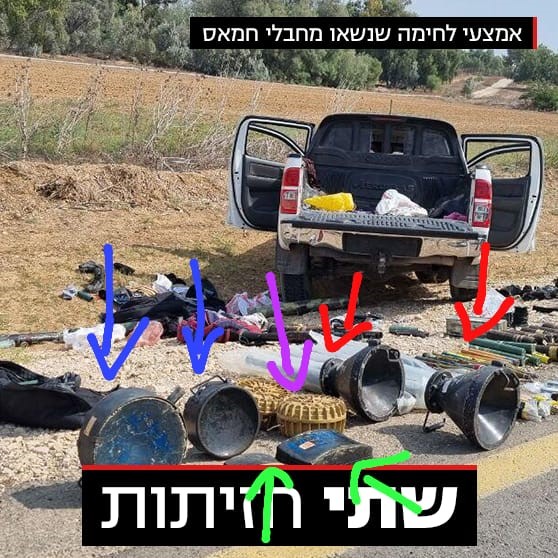
PHOTO OF HAMAS IEDS –
Different colored arrows denote different types, anti-armour or anti-personnel
By morning of October 11, Hamas and the other groups had fired approximately 5,000 rockets at cities, towns and villages across the southern half of Israel. More salvos were fired throughout the day but I have not yet seen a final number.
The Israeli air force has been given the mission of destroying every single known Hamas or other militia group’s site and has conducted the most massive bombing of Gaza ever. After warning the population to move out of the areas to be targeted and allowing time for them to do so, the bombing began, and by the evening of October 11, 2,687 targets had been struck. Photographs of the damage to the relevant areas have been published. Hamas and the other groups are deliberately ensconced and enmeshed in the civilian population to prevent the IDF from attacking them or to provide graphic photos of killed Gazan civilians if it does. The IDF has “played the game” by providing warnings of its impending attacks to enable the civilians to move out, which of course also provides early warning for Hamas to move its personnel out too or compel the civilians to stay (in some cases in the past they have actually brought more civilians in to serve as human shields to prevent the air strike).
This time, after the warnings were given, more than 187,000 Gazans evacuated the designated areas. However, the Gaza Ministry of Health claims that by noon on October 11 approximately 1,055 Gazans had been killed and 5,185 wounded. As usual, they claim the majority are civilians, but deep analysis during previous confrontations has shown that this is usually untrue.
This number apparently does not include the Hamas and Palestinian Islamic Jihad personnel that crossed the border into Israel and were killed there. There have not been final numbers published on these, but it is clear that of the approximately 1,500 terrorists who crossed, many hundreds were killed and many others were captured. The captured wounded are in Israeli hospitals, were there have been complaints that placing them next to wounded survivors of the massacre is unacceptable.
Israel has informed Gaza that it will shut down its supply of electricity and water. It has already shut all traffic into and out of Gaza so the supply of fuel has stopped. Gaza has its own electricity plant and water sources but they are not enough for the population’s needs. Gaza depends on Israel to augment that insufficient capability with Israeli-generated electricity and water.
Meanwhile, skirmishes continue along the border. Hamas is still sending attack units into Israel, though these are being defeated.
The IDF mobilization of 300,000 has been completed. As with all such mass undertakings it did not go without a hitch, though relatively speaking some of the complaints aired in social media were exaggerated. On October 10, the government authorized the mobilization of 60,000 more. The mobilization is not only of Israelis living in Israel; a few thousand Israelis abroad are struggling to get back to enlist. Thus, for example, a couple of hundred Israelis in South America are trying to raise money to charter a plane to bring them home after the airlines on which they had tickets stopped flying to Israel.
The mobilization of reserves is not only for Gaza. Some units were deployed on the border with Lebanon in case Hezbollah decides to join the war. Others have been deployed on the border with Syria in case the Iranians and their proxies join the war on that front. The forces in Judea and Samaria have been reinforced considerably too.
Residents in some of the Israeli villages along the Lebanese border have been evacuated further south.
OTHER EVENTS
The border with Lebanon has become active though much less than Gaza. An infiltration by a terrorist team from Lebanon to Israel was intercepted, two members of which were killed with one managing to flee back to Lebanon. Unfortunately an IDF deputy brigade commander was also killed in that skirmish. There have been a number of cross-border fire-attacks of various sizes and types of weapons from small arms to mortars, anti-tank missiles, and rockets. The IDF has responded with artillery and air strikes.
There have been sporadic Palestinian attacks throughout Judea and Samaria with a few casualties on each side. Israel has responded by stepping up its counter-terrorist operations, focusing on Hamas personnel – dozens have been arrested and a few have been killed or wounded while resisting arrest or trying to attack the IDF patrols.
WHY NOW?
The answer to this question is not clear and the available information is conflicting. There is no clear evidence or any smoking gun at this point.
WHY THE HAMAS SUCCESS?
A few more tactical details have emerged.
Hamas attacked the Israeli surveillance system and communications system with explosive drones.
The initial attack was successful but not as one-sided as originally thought. The Hamas forces took heavy casualties fighting the vastly outnumbered Israeli troops along the border, but overwhelmed them. I sat with the father of one of the soldiers from the Golani infantry brigade who was killed fighting and listened to the description of one of these initial battles by a friend from his unit who was wounded and evacuated. They were one of a small group of soldiers in a slightly rear camp who heard shooting in the distance, grabbed their weapons and rushed to the nearby village, where they ran into a numerically superior force from Hamas entering the village from the other direction. They fought in the streets for a few hours until finally there were no longer any Israeli soldiers able to fight. The young soldier who told us this was 10 months in the army, as was the son of my friend who was killed a couple of hours after the wounded soldier was evacuated.
While the fighting was proceeding near the border, other Hamas units drove quickly in all-terrain pickup trucks between the embattled strongpoints and villages, heading for the next row of villages, camps and the nature party.
Judging from the amount of supplies they brought with them, they were not planning a raid, but a conquest. They intended to stay and hold the ground they had captured.
During the day IDF units from all over Israel were rushed to the area, with speed taking precedence over organization. These units rushed to counterattack the Hamas troops. Gradually more units arrived in a more organized fashion and began fighting to take back the villages and extricate the survivors.
The new information shows a very well-thought out plan, executed by surprise and exploiting that surprise by rushing into Israel at high speed (motorcycles and all-terrain pickup trucks) against a numerically greatly inferior defense force dispersed over a very wide front.
However, given that Hamas intended to hold on to the ground it had won in the first rush, not only massacre the population, this second portion of their plan failed. I can only assume that since the Hamas leadership are well aware of the overall ratio of forces they did not expect their force to hold the ground indefinitely, but apparently they did intend to hold it longer than they succeeded in doing.
WHAT NEXT?
I am not privy to the decisions by the rival leaders so the answer to this question must be regarded as conjecture.
The number of casualties inflicted on Israel in a single day is the worst in its history. This is definitely the most catastrophic event Israel has suffered. This success by Hamas cannot be tolerated. It requires that Israel inflict in return a much more massive defeat on Hamas and Palestinian Islamic Jihad. This is what Israel’s leaders, including the opposition, are saying. The size of the mobilization is unprecedented since 1973 (in absolute numbers the greatest mobilization ever, but Israel’s population in 1973 was only about one-third what it is today, so in relative terms the 1973 mobilization was bigger). Taking the statements and the mobilization into consideration it is clear that Israel intends to conduct an all-out offensive against Hamas. However, the exact methods and timetable have not been divulged.
The questions I raised in my previous paper have not been answered yet, and will not be for some time:
- Will Hezbollah and Iran join the fighting?
- How long will the West support Israel – especially since fighting in Gaza will inevitably inflict severe casualties and general suffering on the population at large?
At least publicly, Hamas is not backing-down. Its rocket units are still firing into Israel, its offensive ground units continue to launch attacks into Israel, and its defensive units are preparing for the expected Israeli ground offensive. On the first day of the war, Ismail Haniya, one Hamas’s leaders and a previous president of the Hamas Gaza government, was interviewed in Al-Jazeera in Arabic on “Operation Al-Aqsa Deluge”:
…he called the operation a “great triumph” and said that that the enemy had suffered a political, military, intelligence, security, and moral defeat. He stated that the operation had begun in Gaza and would spread to the West Bank, Jerusalem, Israel within the pre-1967 borders, and to the resistance and Palestinian people abroad. This, he said, was not only a Palestinian battle but that of the entire nation, and went on to call on the sons of the nation to join the battle. Stressing that “We are on the verge of victory,” he concluded: “Get out of our Jerusalem and our Al-Aqsa Mosque… This land is ours, Jerusalem is ours, everything is ours. … I say to the sons of our Palestinian people and Arab and Islamic nation: Today, you are on the verge of a great triumph and a manifest victory.
***
October 7-9, 2023
WHAT HAS HAPPENED?
The Hamas offensive began shortly before 06:29 on October 7, 2023. By 10:00 IDF radars had detected approximately 2,200 rocket launches at dozens of Israeli cities, towns and villages between Gaza and the Tel-Aviv-Jerusalem-Beersheva line. During the day, Hamas and the other Palestinian militias fired many hundreds more; the exact number has not yet been reported.
The firing was conducted in salvos with multiple launchers in an attempt to penetrate the Iron Dome defense system. Many rockets landed in open areas, but even assuming a 95% success rate (the highest Iron Dome has ever achieved), that still means dozens of rockets that managed to hit inside Israeli cities, towns and villages. The number of fatalities and wounded is not very high relative to the size of the bombardment solely because of Iron Dome and the early-warning system that enabled most Israeli civilians to reach bomb shelters in time.
Simultaneously with the beginning of the rocket bombardment, Hamas troops began crossing the border into Israel at variety of locations. The majority had approached the border in tunnels, climbed out just before the underground wall built by Israel, and then, using explosives, broke through the above-ground obstacle of a steel-rod fence and advanced into Israel. Observation cameras monitoring the fence were shot up with small arms and RPG rockets. One group attacked and captured the civilian crossing into Israel at Erez where 20,000 Palestinian civilians cross daily into Israel to work and where hundreds of trucks transit with goods. A small group crossed the border using paragliders (parachutes with small propeller engines) and a final group attacked from the sea, landing on an Israeli beach. (Of this group only a few got through; most were intercepted by Israeli navy patrol boats and strike-drones).
All together, within the first couple of hours, more than 1,000 Hamas troops crossed the border into Israel in approximately 15 to 30 locations (different sources have provided different numbers) and then fanned out in groups to attack Israeli civilians and military positions. They entered two Israeli towns and 12 villages (at least), driving through the streets shooting at passersby and breaking into houses to kill the residents. In three locations they captured buildings and held the occupants as hostages. The biggest such case included 50 people of all ages at Kibbutz Be’eri who were herded into the communal dining room.
One group reached a large nature-party (like a rave party but held outdoors in nature) where approximately 3,000 young Israelis, mostly in their twenties, had gathered to dance. They attacked them with grenades and assault rifles, then chased the fleeing group, hunting down people who had sought to hide in the low brush. This is probably the location where the largest number of casualties was inflicted. The IDF and police units reaching this area have spent the past two days fighting off remaining teams of terrorists and collecting survivors and bodies.
One large and a few small IDF bases along the border were also attacked in the first rush, pinning down the outnumbered troops at those locations to fight for survival rather than assist the civilians who were simultaneously under attack.
The first responders in the civilian residential areas were local response teams of IDF reservists living in the villages (usually 10 to 20 people per village). They grabbed their weapons and ran out to face the attackers together with a few on-duty policemen in the towns. Here and there, Israelis with private weapons (pistols) also attempted to face the Hamas teams, who were armed with assault rifles.
The IDF units in the area were initially busy trying to fend off the surprise assault, so the first organized IDF response took a few hours as units located in other areas of Israel were rushed to the Gaza border. On arrival, they began trying to understand what was happening and determining how to allocate themselves to deal with the situation, including formulating a means of protecting villages not yet attacked in the initial strike. They began gradually counterattacking inside the villages captured by Hamas forces, combing the areas to find and kill the terrorists. Once a Hamas force was deemed destroyed, the IDF units evacuated Israeli residents who had locked themselves inside their homes during the onslaught. They also surrounded Hamas teams holding hostages.
The IDF units have been going through residential areas house by house, room by room, searching for terrorists to kill or capture and collecting Israeli survivors and bodies. The evacuated residents are being sent north to central Israel where they are being hosted by kibbutzim (communal villages), public facilities (converted schools), and private citizens who are donating rooms in their homes. Other units combed the areas between the villages to search for scattered civilians – especially from the nature-party – and other Hamas teams that might be hiding there waiting for an opportunity to strike when things seemed to calm down.
All the hostages held in Israeli territory have been rescued, but approximately 130 Israelis (the figure claimed by a Hamas spokesperson), including civilians both male and female, the elderly, young children, and soldiers were kidnapped and taken into Gaza. Hamas claims it has placed them in underground installations.
By the early afternoon of October 8, the number of confirmed Israeli casualties had reached at least 700 killed (some expect it to rise to over 1,000) and 2,240 wounded (some with grave injuries, so they might yet die) who have reached hospitals. There are at least another 700 Israeli citizens whose names are known but who are unaccounted for (some might be dead and not yet discovered; others might be among the kidnapped; others might still be in hiding somewhere and out of touch). There are probably more missing whose names are not yet known.
Hamas casualties are currently estimated to be at least 400 killed and almost 2,000 wounded. These figures include those hit inside Israel and those hit in Israeli counterstrikes in Gaza. Dozens more have been captured. Since these numbers were declared, there have been numerous skirmishes as IDF troops continue to comb the residential and open areas to a distance of several kilometers from the border with Gaza.
In an amphibious raid into Gaza, Israeli naval commandos captured a senior commander of the Hamas naval commando force.
The Israeli government has declared war and ordered the IDF to conduct a mass mobilization of reserves. It also ordered the beginning of an aerial offensive response on Hamas targets in Gaza. The initial strikes were delayed to allow Palestinian civilians living in the buildings and vicinity to evacuate as urged by the IDF using various means of communication – radio, telephone calls, etc.
By the evening of October 8, it was reported that about 75,000 Gaza residents had relocated to designated safe areas, clearing the declared areas for free action by the IDF. In the late evening of that night, the Israeli air force struck approximately 800 targets in Gaza and the navy struck some more. They included residential buildings used by Hamas for hiding command posts, combat positions and storage sites, two banks, numerous weapons storage sites, and some launchers of Hamas and other armed groups. In addition, Hamas troops moving to and from the border, between combat positions and launch sites, etc., were detected by surveillance drones and attacked.
The mobilization of reserves is not only for Gaza. Some IDF units are heading to the border with Lebanon in case Hezbollah decides to join the war; others are reinforcing the forces in Judea and Samaria or replacing regular units being sent to Gaza. Residents in some of the Israeli villages along the Lebanese border are being evacuated.
OTHER EVENTS
Shortly after 07:00 on October 8, Hezbollah fired a number of mortar bombs at an Israeli strongpoint on the border with Lebanon. The IDF returned fire with artillery. At time of writing, it is not clear whether this exchange was a harbinger for an escalation or an isolated incident.
In Egypt, an Egyptian policeman opened fire on a bus of Israeli tourists, killing two and wounding a few more. He also killed an Egyptian.
In east Jerusalem Arab residents began rioting. There have also been sporadic attacks throughout Judea and Samaria.
WHY NOW?
The answer to this question is not clear.
Several excuses were quickly published – such as the fact that Jews were allowed to pray on the Temple Mount, which Hamas sees as an infringement of an exclusive Muslim privilege. But only two days passed from that event till the attack. The extent and level of organization of this offensive prove that it had been planned and prepared for a far longer period of time.
Some believe Hamas felt it had to pressure Israel to improve the dire economic situation in Gaza. However, Israel has been acting to improve Gaza’s economic situation (including allowing 20,000 Gazans to cross the border every day to work in Israel). This attack will worsen Gazans’ economic situation, not help it. So this too is not a feasible argument.
Another theory is that this action was fomented by Iran. Hamas and Hezbollah officials have stated that Iran backed it, assisted in the planning, and approved the offensive. They have no particular reason to lie about this, though crediting Iran could be a ploy of psychological warfare – enhancing Iran’s image as a Middle Eastern power to be feared by its enemies.
Iran’s envoy to the UN has denied Iranian involvement. However, Iran’s backing, physical support in funds and weapons, and urging have been documented behind the surge in terror attacks in and emanating from Judea and Samaria over the past two years. In 2019 there were 1,346 terror attacks against Israelis in or emanating from Judea and Samaria; in 2020 there were 1,320. In 2021, the number leaped to 2,135 and in 2022 increased again, to 2,613. From January to August 2023 there were 1,502 attacks against Israelis. Though there were several intense cycles of fighting on the Gaza border during the same period, most of the time that border was almost quiet.
There is some logic to possible Iranian involvement in the current attack. Iran is deeply displeased with the progress in discussions on an agreement between Israel and Saudi Arabia – an agreement initiated very much as a treaty of cooperation against the common Iranian threat. Just last week, Khamenei, Iran’s Supreme Leader, stated that Saudi Arabia is “betting on a losing horse”. The theory goes that the current attack was to prove Israel’s weakness and give the Saudis second thoughts.
However, there is a weakness to this theory. A combined attack with Hezbollah would seem to have been a better way of proving Israel’s limitations. A Hezbollah offensive could yet be in the offing, but Israel is now more awake to the possibility and is preparing for it. Logic seems to dictate that a simultaneous offensive (like the simultaneous Egyptian-Syrian offensive in 1973) would have been a better course of action. There could, of course, be reasons why Iran might prefer a disjointed offensive – to pull the IDF into Gaza and then attack from Lebanon while it is being taxed in the south, for example. Or there might have been problems of coordination.
To sum it up – we do not yet know.
WHY THE HAMAS SUCCESS?
This is an issue that will require a very intensive inquiry after the war.
The supreme source of the failure is totally that of the intelligence services, which had concluded that Hamas was more interested in the economic well-being of its population than in furthering its ideological agenda by initiating a war that would damage that population’s well-being. In line with this supposition, the government made various decisions to help the Gazan economy. But more importantly, the IDF assumed that the current scenario was simply not on the table and convinced the government that that was the case. How Hamas managed to plan, organize, and assemble its forces without Israeli intelligence services discovering it will need a very deep analysis once the war is over.
While the details differ and will only come to light in an inquiry, in principle, this is the 1973 fiasco all over again.
The second failure is a long-term one, and not just a failure of this government but of Israeli society in general and IDF senior commanders over the past 20 years. It stems from the insufficient manpower available on a routine basis to man the IDF’s missions. This has always been a problem and has objective roots in the size of our population, the percentage of budget Israel can allocate to defense, and the extent of damage to the economy that is created by mobilizing reserves.
But this problem has been exacerbated by a 25-year shift in strategy concocted at the IDF’s most senior levels, based on new Western concepts of what wars are and how they are conducted. The result was a deliberate reduction in size of IDF reserves in general and the number of days per year that they serve. This created a built-in shortage of available troops per mission the IDF is required to conduct.
This shortage was dealt with by constantly shifting troops and taking risks in areas considered less imminently threatening. The recent need to reinforce IDF units in Judea and Samaria due to the escalation of attacks there caused the IDF to reduce its forces along the Gaza border – and why not, since IDF intelligence assessed that Hamas was not going to conduct a major offensive in the foreseeable future (see intelligence analysis above).
Text from the interrogation of a Hamas terrorist captured by the IDF has been published, and it illustrates the extent of the complete failure of Israel’s intelligence services. According to him:
- Hamas had been preparing this attack for more than a year.
- Hamas was encouraged by the political demonstrations in Israel, seeing them as a sign of Israeli weakness.
- The past weeks’ riots conducted by Hamas were a deception to enable them to prepare their attack and hide the preparations.
- The attack force included 1,000 men who broke through the border fence at 15 locations (as noted above, other sources claim more locations).
- This terrorist and his unit were surprised that the IDF was not waiting for them. They operated inside Israel for about five hours before they met armed resistance.
WHAT NEXT?
At time of writing (early afternoon on October 8), a few active terrorists remain inside Israel. The IDF is still busy clearing its territory of remnants of these Hamas teams. The question is, what comes afterwards?
I am not privy to the decisions of the rival leaders, so my answer to this question must be regarded as conjecture.
Hamas is understandably overjoyed at its success, which is the worst defeat inflicted on Israel since October 6, 1973.
The quote from Moshe Dayan at the beginning of this article, stated nearly 70 years ago, encapsulates Israel’s situation and the necessary strategy it must implement, albeit adapted to today’s conditions. It is not a foolproof strategy or an easy one to implement successfully, but it is probably the only one that has the potential, if successful, of ensuring a better situation in future. What it cannot achieve, just as it did not achieve it when implemented by Dayan himself and his successors, is eternal peace. Better vigilance and better preparation for future threats will have to be implemented too.
The Israeli government has declared its intention to conduct a major counter-offensive on Hamas in Gaza, the objective of which is to inflict mass casualties and destruction to the Hamas organization, personnel and equipment. But it has not indicated the methods or timeline (other than to say it will be a long war).
Experience has shown that a purely aerial offensive, as conducted in the past, even if significantly intensified, cannot achieve this objective. So it appears that a ground offensive will be conducted sooner or later, even if at first there is a prolonged aerial offensive to prepare the way. This will require preparation and will bring IDF units into dense urban terrain that favors the Hamas defenders who have considerably fortified it and trained in it. It therefore risks suffering heavy IDF casualties. It also risks inflicting major casualties to Palestinian civilians and prompting severe criticism by Israel’s only major international supporter, the US.
It will also take a long time to complete, and international support is unlikely to last very long. During Operation Defensive Shield in 2002, after a month in which 135 Israelis were killed in terrorist attacks, the US government initially accepted Israel’s need to conduct the operation and then demanded that it halt it midway. Another example occurred during the 2014 war with Gaza, when the US government and Europe tried to force Israeli concessions to Hamas. They were blocked by Egypt, which controls one of the borders of Gaza and views Hamas as a hostile ally of the Egyptian Muslim Brotherhood. Obama went so far as to deny Israel replenishment of a key armament item it had requested. After the public calls of commiseration have subsided, it is an open question how the US and Europe will actually act. As of right now, the US government is stating full support for Israel.
Furthermore, the longer the IDF is busy fighting in Gaza, the less it will be prepared for fighting on the Lebanese and Syrian fronts, having lost personnel both killed and wounded and used up stocks of supplies and funds for purchasing more. Thus the risk of another front opening up grows over time.
The final question that must be answered is this. Even if the Israeli counter-offensive is completely and rapidly successful, what then? Hamas rules Gaza because the majority of the population believes in its agenda. In the last democratic election to the Palestinian Authority parliament in January 2006, Hamas won the majority of seats. That is why Mahmoud Abbas, President of the Palestinian Authority, has consistently refused to conduct elections ever since. He is fully aware, and this is backed by the polls, that Hamas would gain an even higher proportion of seats. So if Hamas is thrown out of power in Gaza, who will replace it? Will the IDF have to stay there and conduct a non-stop counter-guerrilla campaign while attempting to provide administrative services to the population? That is the last thing Israel wants. The alternative is to withdraw and let the various factions fight each other for control. But given what is known about the opinions of the Palestinian populace, either Hamas will recover its organization and position or its only strong rival, the even more extreme Palestinian Islamic Jihad, might.
These are the questions Israel’s government and military must answer to achieve a better situation at the end of this catastrophic debacle.
***
Dr. Eado Hecht, a senior research fellow at the BESA Center, is a military analyst focusing mainly on the relationship between military theory, military doctrine, and military practice. He teaches courses on military theory and military history at Bar-Ilan University, Haifa University, and Reichman University and in a variety of courses in the Israel Defense Forces.