PSCRP-BESA Reports No 222 (August 05, 2026)
Freight volumes moving along the Middle Corridor in both directions are steadily increasing, Azerbaijani President Ilham Aliyev said at the opening of the Fourth Shusha Global Media Forum. “We are also increasing the volume of cargo transported from China, and Central Asian countries have joined this process. In short, our bilateral relations have a very solid history. Multilateral cooperation with the countries located along the Middle Corridor is developing,” the head of state said.
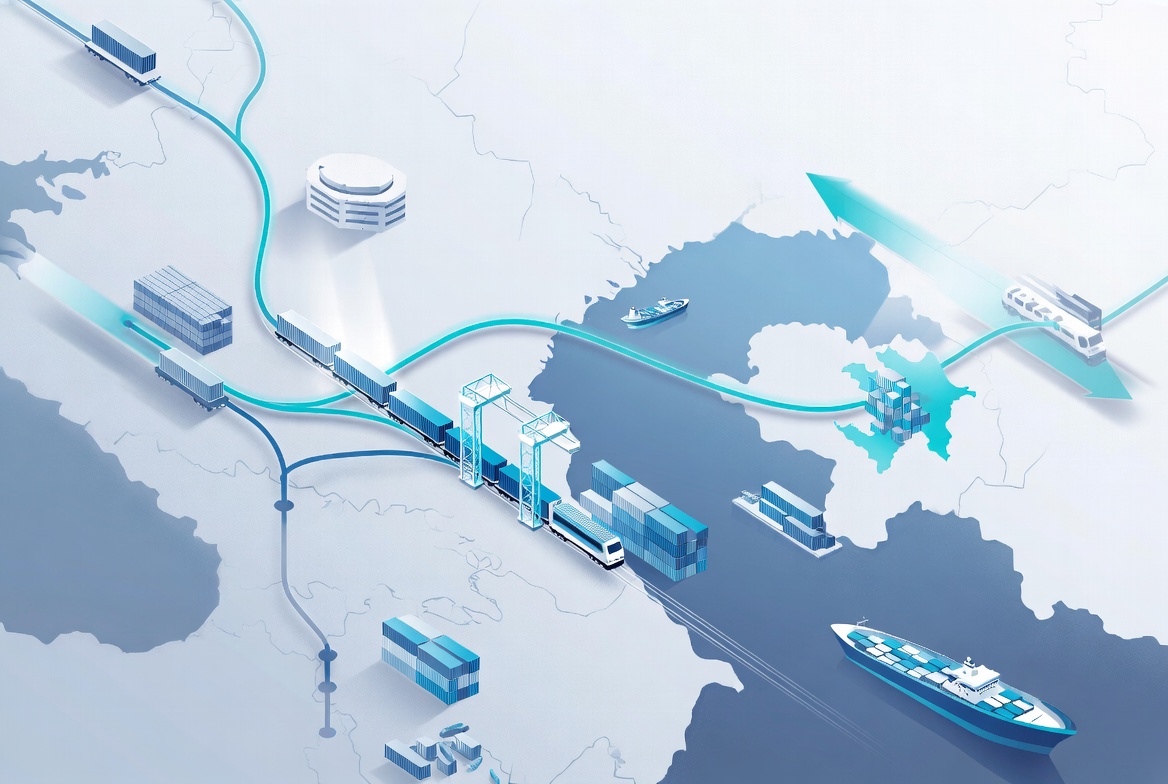
The Middle Corridor, officially known as the Trans-Caspian International Transport Route (TITR), is a vital logistics route connecting East Asia and Europe. It is a multimodal corridor combining road, rail and maritime transport. By bypassing traditional northern transport routes, it helps strengthen regional connectivity and improve trade efficiency.
Azerbaijan plays a key role in this transport network, using its strategic position on the Caspian Sea to ensure the uninterrupted transit of goods between China, Central Asian countries and European markets. Tensions around the Strait of Hormuz and the Bab el-Mandeb Strait have only increased the value of this stable corridor.
As global geopolitical processes continue to evolve, the Middle Corridor is gradually becoming a multilateral project in which the interests of China, the Central Asian countries, the Caucasus, Turkey, the EU and the United States converge.
According to official data, freight transported along the East–West route totalled 16.91 million tonnes in 2025. Of this volume, 8.17 million tonnes was transported through the Europe–Caucasus–Asia corridor, 9.29 million tonnes through the International North–South Transport Corridor, 5.80 million tonnes through the North-West Corridor and 533,600 tonnes through the South-West Corridor.
On 2 June, the Baku–Tbilisi–Kars railway began full-scale commercial operations. This is expected to significantly increase freight volumes along the Trans-Caspian International Transport Route, or Middle Corridor, and strengthen Azerbaijan’s role as the principal transit hub between Central Asia and Europe. Following the completion of modernisation work, the railway’s annual freight capacity increased from 1 million to 5 million tonnes. At the same time, the expansion of the Baku International Sea Trade Port in Alat is continuing, with its annual capacity expected to rise from 15 million to 25 million tonnes.
Azerbaijan is making considerable efforts to improve the efficiency of the Middle Corridor not only by modernising its own infrastructure. This summer alone, it signed a series of agreements with Turkmenistan aimed at developing energy cooperation and establishing a regular flow of goods between the two countries. Since early July, Baku has launched similar initiatives with Kazakhstan and Uzbekistan.
Uzbekistan’s Deputy Minister of Trade Khurram Teshabayev said that Tashkent and Baku intend to establish and jointly operate a Trans-Caspian freight fleet. The two countries are also working to simplify the tariff regime and transit procedures for maritime freight.
Meanwhile, Kazakh and Azerbaijani officials have announced the introduction of a digital permit system for road transport, which is expected to eliminate delays caused by paper-based documentation. The new system will take effect in 2027.
China has announced the beginning of the active construction phase of the China–Kyrgyzstan–Uzbekistan railway. The line is expected to become an important component of both the Middle Corridor and the broader Eurasian transport network. Once it becomes operational, the volume and speed of freight transportation between China and Europe along this route are expected to increase significantly.
Tajikistan also views the Middle Corridor as one of the key directions of its transport and foreign economic policy. Dushanbe is consistently implementing a strategy to develop transport and logistics infrastructure under the State Programme for the Development of the Logistics System for 2023–2028.
For the European Union, the development of alternative transport routes has become particularly important following the crises of recent years, which exposed the vulnerability of global supply chains. The EU is interested in establishing more resilient trade routes that would connect European markets with Central Asia and China without excessive dependence on any single route. It also urgently needs to diversify its energy supplies in order to ensure its energy security.
In this context, the South Caucasus has acquired new importance. Azerbaijan, Georgia and Turkey have come to be regarded as key participants in a system connecting East and West. A new “green energy corridor” linking Europe with solar and wind power facilities in Uzbekistan will pass through Azerbaijan, in addition to the existing supplies of Azerbaijani gas to the EU.
However, Europe’s interest in the Middle Corridor is not limited to trade and energy. It also reflects the European Union’s desire to strengthen ties with Central Asia, a region with significant natural resources, growing markets and an important geographical position. In addition, the United Kingdom, Italy, Germany and several other European countries are implementing their own initiatives and advancing their interests in Central Asia and the South Caucasus.
The United States is also showing growing interest in the development of regional transport connectivity. Washington views the South Caucasus and Central Asia as an area in which economic ties can be strengthened and alternative trade routes supported. In the US approach, the Middle Corridor is becoming part of a broader strategy aimed at supporting open trade routes and reducing the dependence of regional states on a limited number of external centers of influence.
Asian powers apart from China, particularly Japan and South Korea, have naturally also taken a strong interest in the region. They have established separate platforms for implementing various projects, including transit and transport initiatives.
Key Challenges Facing the Middle Corridor
Despite its considerable potential, the development of the Middle Corridor faces a number of challenges. The first is the need for the rapid development and modernisation of infrastructure at every level.
The route passes through several countries and involves different transport systems and administrative procedures. To increase its competitiveness, it is necessary to accelerate border crossings, harmonise customs regulations, introduce digital solutions, adopt common freight transport standards and take other similar measures. Historically, the northern routes across Eurasia have enjoyed an advantage due to their developed infrastructure and large freight volumes. The Middle Corridor must improve its efficiency at every level in order to compete with alternative routes. To achieve this, the participating countries are working to eliminate bureaucratic obstacles.
Another important factor is political stability. Any major international transport project requires long-term predictability. For this reason, the development of diplomatic relations among the countries of the region is becoming no less important than the construction of railways and ports.
However, many of these problems are gradually being resolved as a result of growing international interest and increasing investment. The peace process between Azerbaijan and Armenia demonstrates that the countries of the South Caucasus, as well as those of Central Asia, are capable of resolving conflicts among themselves when they do so bilaterally, without the involvement of external powers. In the longer term, the Middle Corridor could become one of the principal trade routes of the twenty-first century. Although it is still developing today as an alternative route, it has the potential to become one of the main components of the global logistics system in the future.
Within this new Eurasian architecture, Azerbaijan is positioning itself not merely as a transit country, but as one of the key participants in the formation of a new economic space between East and West.