BESA Center Perspectives Paper No. 2,397, July 28, 2026
EXECUTIVE SUMMARY: For many years, the Armenian question has constituted one of the most sensitive issues in Israeli–Turkish relations. Although it was never at the core of the bilateral relationship, it repeatedly resurfaced whenever the question of recognizing the Armenian Genocide was raised, confronting Israel with a complex dilemma: how to balance its commitment to historical memory and the struggle against genocide denial with the strategic importance of its relations with Turkey. Over the years, the Israeli Ministry of Foreign Affairs has regarded the issue primarily as a diplomatic matter with direct implications for relations with Ankara rather than merely as a historical or moral debate. Nor has this tension characterized Israeli policy alone. In recent years, Armenia itself has adopted a more pragmatic approach by advancing a process of normalization with Turkey without making Turkish recognition of the Armenian Genocide a precondition. The Armenian question therefore reflects a dynamic reality in which both Israel and Armenia are required to balance historical memory against changing strategic interests.
The transformation of the Israeli public and political discourse surrounding the Armenian Genocide began in the 1990s. The central figure leading this change was then Minister of Education Yossi Sarid. During his tenure, Sarid became the first serving Israeli minister to participate in the official Armenian Genocide commemoration ceremony in Jerusalem, marking the 85th anniversary of the genocide. In his speech in April 2000, he explicitly referred to the “Armenian Genocide” and declared his intention to ensure that Israeli students would study these events within the educational system. His actions, which constituted the first time an official public position was signaled by a serving Israeli minister in support of recognizing the Armenian Genocide, generated diplomatic tensions with Turkey.
The campaign was subsequently continued by Member of Knesset and later President of Israel Reuven (Rubi) Rivlin, who referred to the events of 1915 as a “genocide” from the Knesset podium. Beginning in 2011, additional Members of Knesset joined this effort. The culmination of this process came in 2015, when the Knesset Education, Culture and Sports Committee recognized the Armenian Genocide—although the Israeli government refrained at the time from adopting official recognition, primarily because of strategic considerations relating to its relations with Turkey.
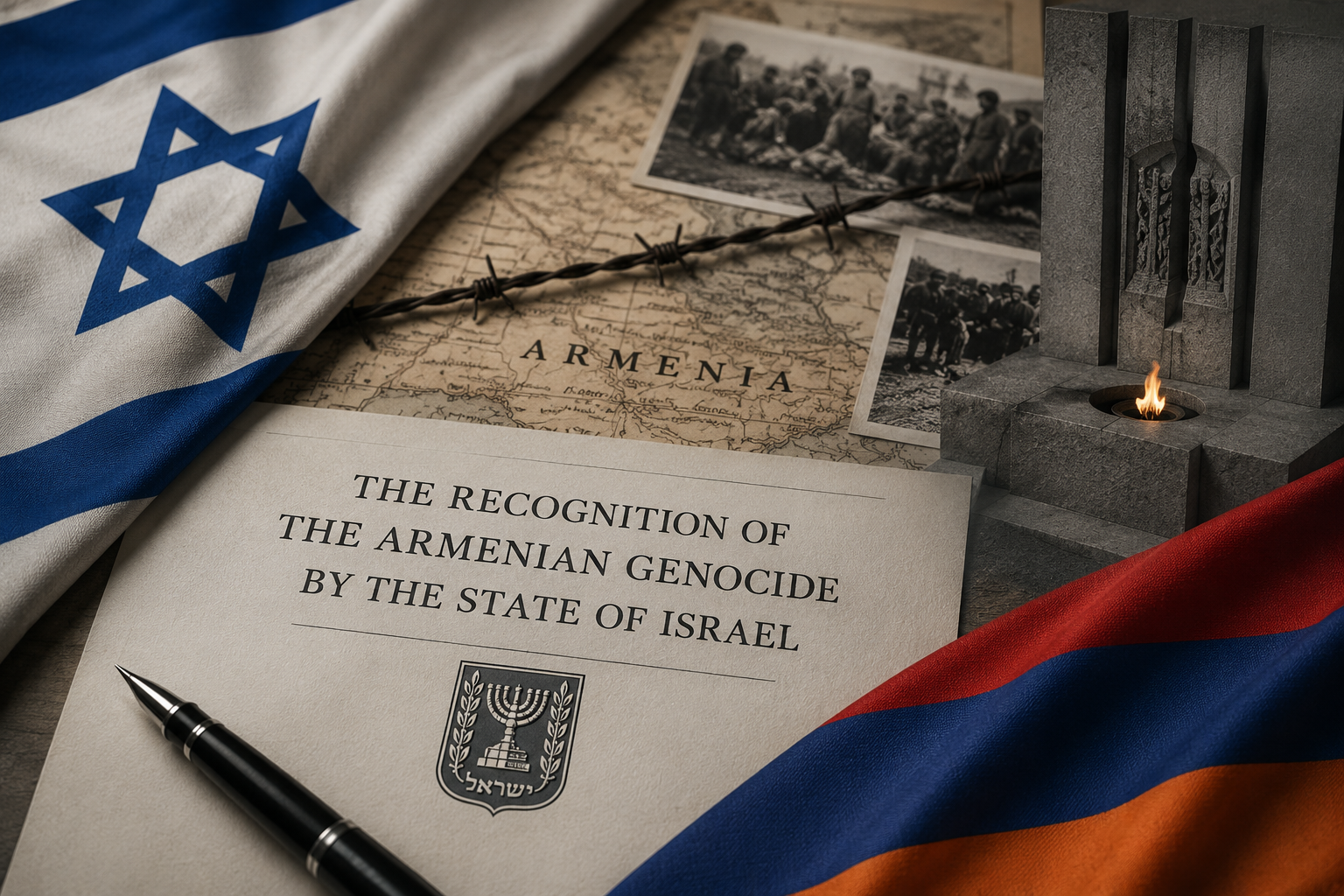
The Israeli government is no longer exhibiting this restraint. On 28 June 2026, it unanimously approved Foreign Minister Gideon Sa’ar’s proposal to recognize the Armenian Genocide. However, for that recognition to acquire full parliamentary validity, the decision must be approved by a vote in the Knesset. According to published reports, the vote did not take place, and the issue was removed from the Knesset agenda before the beginning of the summer recess.
It is widely believed that the issue was withdrawn following intervention by the Azerbaijani government, which, in addition to being Turkey’s principal strategic ally, remains engaged in a prolonged conflict with Armenia. It is reasonable to assume that the move also reflected Israel’s willingness to signal to Turkey that its hostile policy toward Israel carries diplomatic consequences. Explaining the timing of the decision, the Foreign Minister declared: “It is never too late to do the right thing.”
A document preserved in the Israel State Archives demonstrates that the debate over the Armenian question was conducted not only between governments but also within Jewish communities around the world. The document was submitted to the Israeli government by Jack Kamhi (1925-2020), a leading Turkish industrialist, chairman of the Profilo Group, founding chairman of the Quincentennial Foundation, and one of the most influential public figures in the Turkish Jewish community. It seeks to persuade its readers that a historical and legal controversy surrounds the events of 1915 and that no definitive conclusion should be reached without a comprehensive historical examination. Israeli policymakers fully understood that the Armenian question concerned not only the past but also the present, and that Turkey’s opposition to international recognition was rooted not only in historical interpretation but also in considerations of national identity, state responsibility, and concerns over legal claims and demands for compensation. The debate was thus understood to concern not merely competing interpretations of the past but also the strategic interests of the present.
For its part, Israel maintained that it was not its role to adjudicate a historical dispute between other nations, particularly when such a decision might inflict tangible damage upon its own national interests. The Turkish document also reflected Israel’s concern that recognizing the “Armenian Holocaust” could undermine the uniqueness of the Jewish Holocaust. The Turkish authors made a determined effort to convince Israel that Armenia was seeking to equate the Holocaust of European Jewry with the fate of the Armenians, warning that such recognition would create what they described as a “useful precedent”.
More broadly, the Turkish narrative sought to compare the Ottoman Empire before the genocide with Germany in the 1930s to demonstrate that minorities had not been subjected to systematic persecution within the Empire prior to the events of 1915. The document further argued that Turkish diplomats stationed in Europe had saved Jews from Nazi persecution. Among those mentioned was Selahattin Ülkümen, who was recognized by Yad Vashem in 1989 as one of the Righteous Among the Nations. Furthermore, the document emphasized that Turkey had been the first Muslim-majority country to recognize the State of Israel in 1949.
Throughout the document, Turkey sought to convince Israel that the Armenian question constituted a historiographical rather than a political dispute and that no broad scholarly consensus existed regarding whether the events of 1915 should be defined as genocide. Alongside these historical arguments, the document also contains a clear moral appeal to its Jewish readership. Its authors argue that the Jewish people, having experienced the Holocaust, understand better than anyone the meaning of national catastrophe and persecution and should therefore refrain from drawing historical conclusions without a prior critical examination of all available evidence. In other words, the Turkish authors attempted to mobilize the historical and moral sensitivities of the Jewish people to persuade them not to join the Armenian campaign for recognition but instead to support continued historical research and avoid politically motivated decisions.
In effect, Ankara sought to portray itself as a state friendly to both Israel and the Jewish people and therefore deserving of their support, even when confronted with international criticism. In this sense, the document is not merely an attempt to defend the Turkish narrative regarding the events of 1915 but also part of a broader diplomatic effort to preserve Turkey’s strategic alliance with Israel and mobilize the influence of Jewish organizations in the United States and the wider international arena. The Armenian question is thus presented as a test of the loyalty of Turkey’s friends.
At the same time, Israel was compelled to contend with pressure from Jewish organizations around the world. Some supported the government’s position out of a desire to preserve Israel’s strategic relationship with Turkey while others maintained that moral responsibility required recognition of the Armenian Genocide. Support for the Turkish position stemmed from the great strategic importance attributed to relations with Turkey, which, particularly during the 1990s and the early 2000s, was regarded as essential to Israel’s security and regional standing. Against this background, the Armenian question was pushed to the margins and subordinated to broader foreign policy considerations.
Taken together, the archival documents demonstrate that in the eyes of the Israeli Ministry of Foreign Affairs, the Armenian Genocide was not merely a historical controversy but a test of Israel’s ability to balance moral commitments with strategic interests. This explains the consistent policy that Israel pursued over many years. Israel’s policy of refraining from officially recognizing the Armenian Genocide did not vary, even after former US President Joe Biden formally recognized the Armenian Genocide on 24 April 2021, Armenian Genocide Remembrance Day.
Although Israel’s recent recognition of the Armenian Genocide carries considerable symbolic and historical significance, it is unlikely to fundamentally alter Israel’s relations with Turkey, Armenia (which did not officially respond to Israel’s recognition), or Azerbaijan. Channels of communication between Israel and Turkey remain open, and the continued presence of Turkish diplomats in Israel suggests that Ankara has no interest in severing relations completely and prefers to leave the door open for future reconciliation—at least until the issue is formally approved by the Knesset, should such a vote eventually take place. Israel will also have to consider whether its recognition will remain merely a symbolic political declaration or be reflected in the educational system, academic research, commemorative ceremonies, and the public discourse, which would turn it into a genuine value-based decision with long-term significance. It is also likely that Israel will be required to address additional questions concerning the recognition of other genocides committed under Ottoman rule, including those of the Pontic Greeks and the Assyrians (Sayfo).
A final point, no less important, is that since 2022, Turkey and Armenia have been engaged in a gradual process of normalization through special envoys. This process has accelerated over the past year and includes practical measures such as the rehabilitation and reopening of the historic railway line between Kars and Gyumri, the restoration of the Ani Bridge over the Akhuryan River on the border between the two countries, and the completion of preparations for the resumption of direct trade. Although this remains a process of confidence-building rather than full normalization, Armenia itself is now prepared to engage in dialogue with Ankara without making Turkish recognition of the Armenian Genocide a precondition. In so doing, it has, at least for the time being, chosen to prioritize strategic interests over historical memory. If that is the case, is political pragmatism legitimate when pursued by Armenia but unacceptable when Israel adopts the same approach?
Prof. Efrat Aviv is a Senior Research Fellow at the Begin-Sadat Center for Strategic Studies (BESA Center) and an Associate Professor in the Department of General History at Bar-Ilan University.
BESA Center publications and research are made possible
thanks to the generosity of Saul Koschitzky and family