
BESA Center Perspectives Paper No. 2,410, October 26, 2026
EXECUTIVE SUMMARY: The longstanding assumption that six submarines are sufficient for the Israeli Navy is now obsolete. Threats to Israel’s natural gas assets and sea approaches have multiplied across the Mediterranean, Red Sea, and Persian Gulf, and Turkey is developing its own undersea fleet in an assertive maritime expansion. An eight-submarine force would enable more effective simultaneous activity across all three theaters.
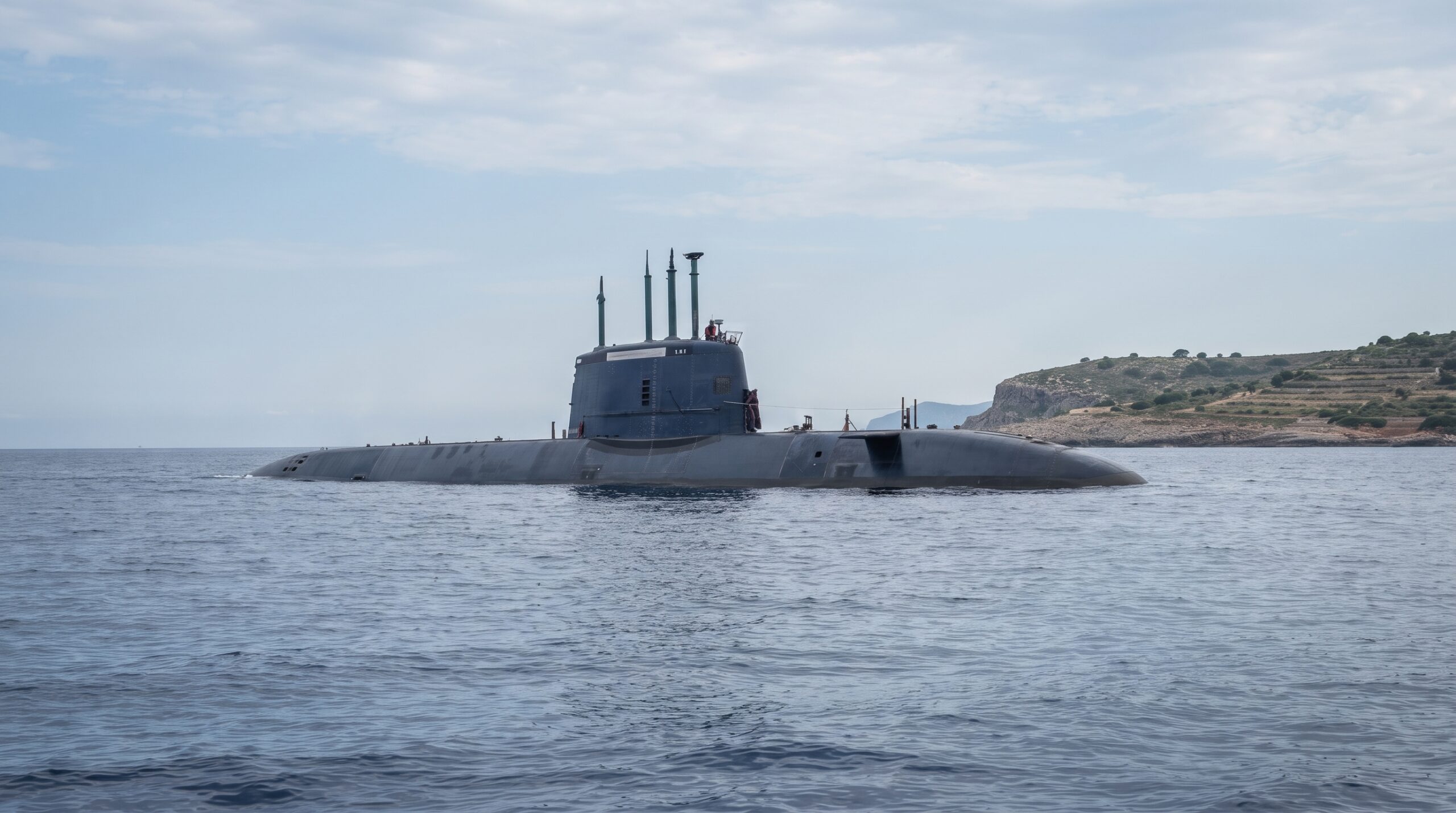
On September 24, 2026, INS Drakon arrived at Haifa Naval Base after a 25-day transit from Kiel, Germany, becoming the Israeli Navy’s sixth submarine and its largest operational vessel to date.
Measuring approximately 74 meters, Drakon is larger than its Dolphin II sister boats, INS Tanin and INS Rahav. Built by ThyssenKrupp Marine Systems (TKMS), it is the third and final Dolphin II-class submarine delivered to Israel, completing the Air-Independent Propulsion-equipped Dolphin II program.
The arrival of Drakon brings Israel’s submarine force to six platforms. However, Israel’s defense establishment has, according to an Army Radio report, recommended expanding the force to eight submarines, citing the changing regional environment, the need for persistent operations in more than one maritime theater, and the growth of Turkey’s submarine fleet.
Protection of offshore energy infrastructure, intelligence collection against Iran and its proxies, the Red Sea threat, and Turkey’s naval buildup all create requirements that exceed the original logic of a six-boat fleet.
On October 4, Prime Minister Benjamin Netanyahu and Defense Minister Israel Katz visited the Ashdod Naval Base, where they received operational briefings from the Head of the Naval Staff and the Commander of Ashdod Base. Prime Minister Netanyahu declared that the maritime domain has become an international battlefield, noted that Israel’s enemies seek to threaten its maritime space, and asserted that they will be denied. He said defense agencies are requesting additional submarines, naval combat vessels, and specialized equipment.
INS Drakon is a diesel-electric attack submarine. It is equipped with a hybrid propulsion system based on fuel-cell Air-Independent Propulsion (AIP). AIP enables Dolphin II submarines to conduct submerged operations for several weeks.
The main operational advantage of AIP technology is endurance. Diesel-electric submarines must rely more frequently on snorkeling to recharge batteries, creating a period of increased vulnerability to hostile radar, visual observation, detection by maritime patrol aircraft, unmanned systems, and anti-submarine warfare assets. Fuel-cell AIP enables longer submerged endurance, allowing a submarine to transit covertly, remain on station, gather intelligence, and wait for a mission with a lower exposure profile.
Jane’s Defense Weekly assessed in September that the INS Drakon’s longer hull and unusual sail could accommodate vertical-launch tubes for up to three ballistic missiles or eight submarine-launched cruise missiles. Neither Israel nor Germany has confirmed the submarine’s launcher configuration or payload.
The specific systems installed in Drakon remain classified. According to reporting in Jane’s, the vessel can plausibly accommodate a greater mix of weapons, intelligence systems, command-and-control equipment, special-mission payloads, and vertical-launch capacity than previous Dolphins.
With the arrival of Drakon, the Israeli Navy’s submarine flotilla reached six operational platforms. The INS Dolphin, INS Leviathan, and INS Tekuma are first-generation Dolphin class. The first two entered service in 1999 and Tekuma in 2000. The INS Tanin, INS Rahav, and INS Drakon are Dolphin II AIP class. Tanin entered service in 2014, Rahav followed in 2016, and Drakon arrived in September 2026.
A submarine fleet’s nominal size is not the same as its operational availability. Vessels rotate through deep maintenance, refit, systems upgrades, crew training, certification, transit, weapons loading, and post-deployment recovery. Six submarines give Israel meaningful capability but only limited margin if it needs simultaneous intelligence collection, deterrence patrols, and crisis readiness in the Mediterranean, Red Sea, and more distant waters.
In January 2022, Israel signed an agreement with TKMS valued at approximately €3 billion for three Dakar-class submarines. The agreement includes a simulator, spare parts, German support, and an industrial cooperation package worth over €850 million. TKMS stated that production began in November 2024 and that delivery of the first Dakar-class boat is expected in the early 2030s.
The Dakar program is structured as a replacement program, with the three future submarines replacing the original Dolphin-class boats. This means that without additional procurement, Israel will remain a six-submarine navy through the 2030s.
A submarine can covertly monitor naval movements, maritime traffic, coastal missile batteries, radar emissions, communications activity, port operations, and weapons-smuggling networks. Its value grows in distant theaters where Israel needs intelligence but wishes to avoid the overt signature of surface ships or aircraft. At Drakon’s reception ceremony, IDF Chief of Staff Lt. Gen. Eyal Zamir described the Navy as becoming “more covert, more distant, deeper, and more lethal”.
Israel’s offshore gas system rests on Tamar, Leviathan, and the Karish-Tanin development. Leviathan is Israel’s largest field and a major export source. Tamar is the primary supplier to the domestic market, and Karish provides an important additional domestic supply source. Karish and Tanin are both located in Israel’s northern EEZ. The protection of all three producing systems and their associated maritime approaches is considered a national security requirement.
Israel’s maritime energy assets and sea approaches face threats from missiles, drones, naval commandos, and hostile maritime activity. A submarine cannot replace the Sa’ar 6 corvettes that defend the platforms, but it can provide covert surveillance, sea-denial options, and early intelligence on hostile naval preparations.
The Houthis’ use of missiles, drones, and maritime coercion has turned the Red Sea, Bab el-Mandeb Strait, Gulf of Aden, and Arabian Sea into active threat areas. A submarine gives Israel an intelligence and strike platform that can operate in contested waters without exposing a surface crew.
Turkey’s maritime expansion is a central driver of the case for an eight-submarine Israeli fleet. Ankara’s “Blue Homeland” doctrine seeks a more assertive Turkish naval role across the Black Sea, Aegean, and Eastern Mediterranean, challenges the maritime framework favored by Greece and Cyprus, and treats control of the surrounding waters as a central national security objective.
Turkey operates Type 209 submarines and is building six Reis-class Type 214TN AIP submarines. Naval analysis assesses that the Turkish submarine force will grow from 12 existing diesel-electric boats to 18 once all six Reis-class submarines enter service.
Turkey’s military and maritime arrangements with Libya add another dimension. According to a report by Walla in late September, Ankara is constructing a naval and security corridor with Tripoli, strengthening its ability to project power toward the Eastern Mediterranean. Israel does not require numerical parity with Turkey, but Turkey’s undersea force changes the operational picture. Israel must be able to retain maritime awareness, defend offshore infrastructure, maintain sea lines of communication, and keep a persistent underwater presence.
Historically, senior Israeli naval planners viewed five submarines as the minimum and six as optimal. That calculation preceded the Red Sea theater, the Iranian maritime confrontation, the expansion of Israel’s gas infrastructure, and Turkey’s AIP submarine program.
An eight-submarine force would enable more persistent simultaneous activity across three broad theaters: the Eastern Mediterranean, the Red Sea, and distant waters toward the Persian Gulf. It would also provide redundancy during refits, technical faults, lengthy deployments, or combat damage. Most importantly, it would reduce the possibility that Israel’s deterrent and intelligence missions would be constrained by a narrow number of operationally available platforms.
In terms of financial investment, INS Drakon is estimated to cost around €550 million ($634 million), while the three upcoming Dakar-class submarines are contracted at approximately €3 billion total (or roughly €1 billion per vessel). These acquisitions represent the most expensive military platform in the IDF’s inventory. A decision on expanding the fleet to eight must take into account what Israel’s defense establishment would have to give up in other capabilities.
Conclusion
The commissioning of INS Drakon is a major step in Israeli naval force-building. It adds a larger AIP-equipped submarine with extended submerged endurance, a larger hull, an enlarged sail, and expanded mission flexibility. It provides Israel with additional options for covert intelligence collection, distant strikes, special operations support, EEZ protection, and deterrence against Iran and its proxies.
The Dakar-class program will modernize the fleet, but will only replace the three original Dolphins. It will not expand Israel’s submarine force beyond six. As threats multiply across the Mediterranean, Red Sea, and Persian Gulf, and as Turkey continues to develop its own undersea fleet, the case for an eight-submarine Israeli Navy is no longer theoretical.
Yaakov Lappin is an Israel-based military affairs correspondent and analyst. He provides insight and analysis for a number of media outlets, including Jane’s Defense Weekly and JNS.org.
BESA Center publications and research are made possible
thanks to the generosity of Saul Koschitzky and family