PSCRP-BESA Reports No 223 (August 10, 2026)
by Gershon Kogan, PhD
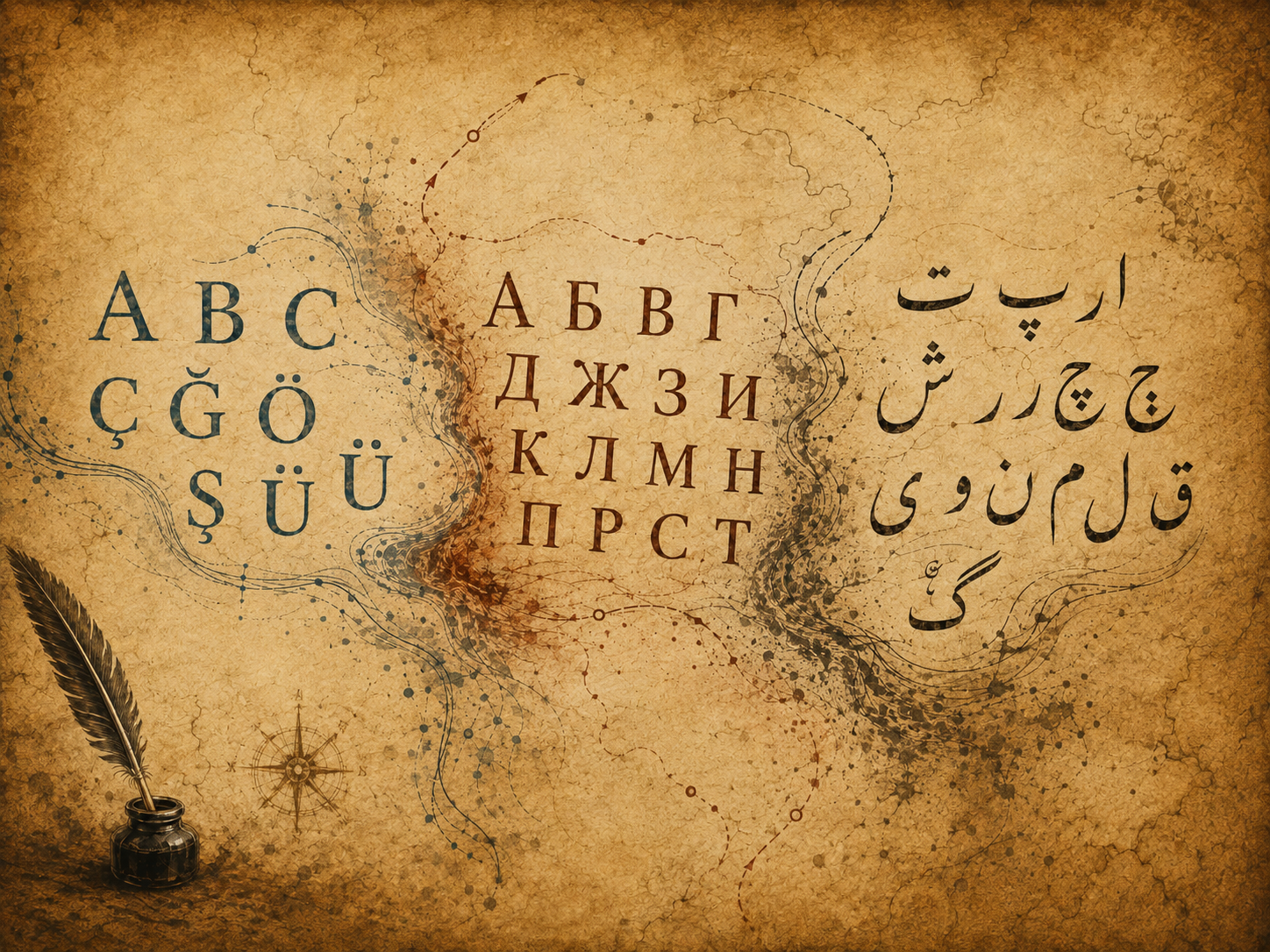
Script is rarely a neutral technical choice in this region. Which alphabet a state teaches its children is a declared vector of civilizational allegiance — a public signal of which power it expects to matter for its future. This is what “written sovereignty” means in practice: not legal independence, but the ongoing, contested right to decide whose cultural gravity a nation writes itself into. Three powers are currently making competing claims on that gravity in the post-Soviet Turkic and Persianate world — Turkey, Russia, and Iran — and they are not equally equipped to press the claim.
I. Facts on the Ground
On September 21, 2024, a commission convened in Baku under the Turkic Academy approved a Common Turkic Alphabet — a 34-letter Latin-based script intended to harmonize the writing systems of Azerbaijani, Turkish, Kazakh, Kyrgyz, Uzbek, and other Turkic languages.1 The project builds on decades of piecemeal Latinization: Azerbaijan completed its own transition from Cyrillic in the 1990s and has since positioned itself as one of the effort’s most committed sponsors, hosting the commission that produced the 2024 declaration. At the commission’s fourth meeting, held in Astana on June 15, 2026, delegates moved from declaration to implementation — endorsing practical recommendations for the alphabet’s use, reviewing proposed Kazakh and Kyrgyz variants, and citing new editions of Abai and Aitmatov printed in the common script as proof of concept.2 The recommendations remain non-binding; each state retains final authority over its own orthography, and the Academy has been explicit that adoption will proceed at each government’s own pace.
That authority has been exercised unevenly. Turkmenistan’s Latinization, begun in the 1990s, is the most institutionally complete in the region. Uzbekistan, officially Latin since 1993, still operates in practice as a digraphic society: a July 2026 reading in the lower chamber of parliament proposed bringing its script closer to the Turkish model by replacing the digraphs sh, ch, o’, g’ with dedicated letters — Ş, Ç, Ö, Ğ — though the bill has not completed the legislative process.3 Kazakhstan’s promised transition, announced in 2017, remains unfinished: as of June 2026 the Ministry of Science and Higher Education had not approved a final Latin alphabet, and its own projections anticipate only 5 percent of written communication in Latin script by 2027, rising to 15 percent by 2029 — modest targets for a reform now entering its second decade.4 Kyrgyzstan’s presidential administration has stated explicitly that the Kyrgyz alphabet — 36 Cyrillic letters — will not change, even as Bishkek continues to participate in the Turkic Academy’s alphabet commission on a symbolic and consultative basis.5
Tajikistan presents the sharpest counter-current. On July 30, 2026, its Ministry of Education confirmed the formation of a working group to strengthen instruction in the traditional Perso-Arabic script — officially termed alifboi niyogon, “the script of the ancestors” — following an instruction from President Emomali Rahmon.6 The announcement stopped short of proposing to replace Cyrillic, Tajikistan’s official script since the Soviet period; it framed the initiative as expanding, not substituting, literacy, and floated the possibility of publishing scholarly work in Persian and Arabic alongside Tajik Cyrillic. Meanwhile, in Iranian Azerbaijan, the Perso-Arabic script has never been displaced, though this continuity reflects the absence of Azerbaijani-language schooling in Iran — where the language is taught in no script at all — rather than any deliberate script policy on Tehran’s part.
A parallel but distinct trend deserves separate treatment: the expansion of Arabic-language instruction across the region under religious and cultural auspices. Between September 2025 and June 2026, ICESCO and the Sultan bin Abdulaziz Al Saud Foundation ran a six-phase teacher-training program — the Sultan bin Abdulaziz Al Saud International Language Training Program: Arabic Language in Central Asia and the Caucasus — moving through Kyrgyzstan, Kazakhstan (Almaty and Turkistan), Bashkortostan, Uzbekistan, and finally Azerbaijan, where it closed in Baku on June 22, 2026 after training more than 200 educators and postgraduate students.7 This is a substantial and well-documented initiative, but its object is modern standard Arabic as a foreign language and religious-educational tool, not the historical Perso-Arabic orthography of Uzbek, Kazakh, or Azerbaijani. Reciting Quranic Arabic, studying modern Arabic, and reading a historical text in Chaghatai or Persianate orthography are three distinct skills that do not automatically follow from one another.8 Growing Arabic literacy in the region is a measurable fact; a corresponding revival of the pre-Soviet national scripts written in Arabic characters is not — Tajikistan, discussed above, remains the only case where a state has moved to institutionalize the latter.
These developments are unfolding against a wider and more assertive Turkish security posture. On August 7, 2026, Turkey, Saudi Arabia, and Pakistan signed the Mecca Agreement, a mutual-defense pact under which an attack on any signatory is to be treated as an attack on all three — a formula Turkish Foreign Minister Hakan Fidan explicitly compared to NATO’s Article 5.9 Officials in Ankara and Riyadh describe the pact as defensive and not directed against any third state, but analysts trace its acceleration to the US-Iran war that began on February 28, 2026, and to the erosion of Gulf confidence in American security guarantees after Israel’s September 2025 strikes on Qatar.10 The Mecca Agreement is a hard-security instrument, not a cultural one, but it reflects the same underlying pattern that runs through the softer evidence collected above: Ankara is currently the most willing and best-resourced actor building new regional architecture — military, religious, and linguistic — while Tehran is largely reacting to events set by others.
II. Three Logics, Not One Contest
It is tempting to read these developments as a single contest between Latin and Cyrillic script, with Arabic-Persian writing as a marginal historical curiosity. That framing obscures more than it reveals. What is actually underway are three distinct mechanisms of influence, each rooted in a different kind of power — and, in Turkey’s case, one that carries an unresolved contradiction of its own.
Turkey: infrastructure with a contradiction at its core. The Common Turkic Alphabet is not merely a philological convenience; it is the latest instrument in a decades-long effort — through TİKA-funded schools, joint universities, satellite television, and now the Organization of Turkic States — to make Ankara the practical center of a shared Turkic communicative space. This effort has an intellectual genealogy that predates the Republic of Turkey itself. In the 1870s–80s, the Azerbaijani playwright and reformer Mirza Fatali Akhundov proposed replacing the Arabic-based script used for both Azerbaijani and Persian with a phonetic, largely Latin-based alternative, arguing that Arabic orthography obscured vowels and impeded literacy among Turkic speakers — a project he framed as part of a broader anticlerical and enlightenment agenda rather than a narrowly technical fix.11 Akhundov’s proposal failed in his own lifetime, but its logic — that the alphabet is a lever of enlightenment and modernization, not merely a technical convention — reappeared in Atatürk’s 1928 reform and again in Soviet Azerbaijan’s own Latinization, which drew on an overlapping pool of Turcological and nationalist thought even as the Soviet and Kemalist states pursued rival visions of modernity.12 What is new in the 2020s is the scale on which this old logic now operates: Turkey has the university system, media market, and diplomatic apparatus to make the same argument regionally rather than nationally, a divergence in outcome between the Turkish and Azerbaijani reforms that later comparative scholarship attributes to precisely this gap in institutional capacity.13
But this Latin-alphabet project sits awkwardly next to the other face of Erdoğan-era Turkey: a sustained ideological turn toward re-Islamization and Ottoman nostalgia, and an explicit bid for leadership of the Sunni Muslim world — a bid the Mecca Agreement itself advances. That bid is written, historically, in Arabic script; the Ottoman Empire whose legacy Ankara increasingly invokes never wrote Turkish in Latin letters at all. A state pursuing Islamic leadership while exporting a Latin alphabet is, in a specific and unresolved sense, offering the region a modernizing script attached to a re-traditionalizing politics. Whether this tension is felt as a contradiction by the governments adopting the Common Turkic Alphabet, or simply absorbed as one more inconsistency of contemporary Turkish self-presentation, is an open question — but it is a real fault line inside Ankara’s own project, not only in the region’s response to it.
Azerbaijan: agency, not submission. It would be a mistake to read Baku’s alignment with Ankara as passive absorption. Azerbaijan did not merely adopt the Common Turkic Alphabet — it hosted and chaired the 2024 commission that produced it, positioning itself as the administrative hub of Turkic script integration rather than a mere recipient of Turkish standards. Azerbaijan is Latin, has been for three decades, and is geographically the hinge between Turkey and Central Asia; hosting the institution that sets the regional standard is a way of converting proximity to Turkey into leverage over the entire Turkic space, not a symptom of losing independent standing. Baku continues to insist, in its own state rhetoric, on the distinctness of the Azerbaijani literary language from Istanbul Turkish, even as it absorbs Turkish media, vocabulary, and educational partnerships. This distinction matters beyond linguistics: a genuinely independent-minded Azerbaijan, using the Turkic-integration project for its own ends rather than simply following Ankara, is also the more useful and more predictable partner for outside actors — Israel among them — who have built a substantial relationship with Baku and have an interest in an Azerbaijan that hedges rather than one that becomes a straightforward extension of Turkish foreign policy.
Russia: inertia that is also leverage. Russia’s position rests on inertia rather than script reform — but it would understate Moscow’s hand to call this passive. An open push to entrench Cyrillic would invite immediate accusations of colonialism and empire-building, with uncertain returns; Russia has largely avoided that fight. What it has instead is the region’s principal labor market. A Tajik, Uzbek, or Kyrgyz citizen can rebrand his national identity as Turkic, adopt a Turkish-modeled alphabet, and consume Turkish television — and still find that the country where the money is earned is Russia, not Turkey. That fact requires functional Russian, and in practice Cyrillic literacy, regardless of what the state does with its own national orthography. Comparative sociolinguistic work on the post-Soviet space shows this persistence varies by domain — Russian retains particular strength in employment, higher education, and private life even where states have symbolically prioritized the titular language in law and public signage.14 Kazakhstan’s stalled transition and Kyrgyzstan’s explicit refusal to change script are not simply evidence of the cost of alphabet reform; they reflect a population for whom Cyrillic remains tied to the language of remittances.
Iran: an archive that activates itself, but not for Tehran. Iran’s position is different in kind from both. Unlike Turkey, it is not building new institutions to project script influence in the region; unlike Russia, it has no comparable economic leverage to fall back on. What it has is depth of prior text: a body of classical Persian and Persianate literature — Ferdowsi, Rudaki, Hafez, and the “Azerbaijani school” of Persian poetry produced in Ganja, Shirvan, and Tabriz — that predates the modern national borders of the region and remains, in principle, legible to anyone who can read the Perso-Arabic script. Tajikistan’s alifboi niyogon initiative draws on exactly this reservoir, and the fact that Dushanbe, not Tehran, is doing the drawing should be read carefully rather than simply as a mark of Iranian weakness. Persian literary capital appears able to activate itself transnationally precisely because it is not owned by any single state — it belongs to Tajik, Afghan, and diaspora communities as much as to Iran, and a third country can claim it without asking Tehran’s permission. That is a genuine strength of the tradition.
It is also, for Iran specifically, the source of the problem this paper is tracing: a cultural asset that does not require Iranian institutions to survive is also an asset that does not translate into Iranian diplomatic leverage over the states that draw on it. The Tajik government has taken care to frame the script as ancestral and national, not Iranian or Islamic — treating Iran’s literary heritage as a common inheritance to be claimed, not a patron relationship to be entered into. The historical record supports reading this as an Iranian institutional failure rather than a simple absence of interest: Shireen Hunter’s assessment of Iranian foreign policy in the post-Soviet space finds that Tehran’s civilizational capital has repeatedly been outweighed by sanctions, the securitized caution of secular Central Asian regimes toward a revolutionary Shia state, and competition from a more agile Turkey.15 Hamid Ahmadi’s study of Iran-Tajikistan relations is more pointed still: an earlier, more ambitious attempt to revive the Perso-Arabic script in Tajikistan stalled into what he calls a deadlock, undone not by cultural distance but by political friction between the two states.16 A separate study of Ahmadinejad-era “strategic partnership” rhetoric reaches a compatible conclusion — public amity between Tehran and Dushanbe repeatedly failed to translate into substantive cooperation, undercut by dysfunction in Iran’s own foreign-policy execution as much as by Tajik reluctance.17 The 2026 initiative is best read against this history: a second attempt, this time initiated and controlled by Dushanbe rather than proposed by Tehran, which may be precisely why it has gone further than its predecessor.
A second archive that stayed on the shelf. Iran’s position looks stronger still when set against the obvious counter-case: Uzbekistan’s own pre-Soviet literary canon, above all Alisher Navoi, who wrote in Chaghatai Turkic in Arabic script and remains a celebrated national symbol in Tashkent — a competing archive available to the Turkic side without reference to Persian sources at all. In practice, however, the Uzbek state has not developed a comparable script-literacy initiative around it. What Uzbekistan has built instead is a heritage brand: an international Uzbek-language olympiad bearing Navoi’s name for students abroad, a national theater and museum complex, and cultural showcases at events like the Bukhara Biennale.18 None of this restores the ability to read Navoi’s actual Chaghatai text in its historical orthography, in the way Tajikistan’s initiative is explicitly designed to restore Perso-Arabic reading competence. Navoi functions in today’s Uzbekistan largely as a museum exhibit and a source of national pride, not as a living, re-readable archive. This asymmetry — one tradition being reactivated for reading, the other mainly commemorated — is itself evidence for, not against, the paper’s central claim: Iran’s literary capital in the region remains comparatively the more “alive” of the two available archives, even though Iran itself is not the one reviving it.
What ordinary readers actually do. It is worth being concrete about who bears the cost of these choices. A construction laborer from Tajikistan or a cleaner from Uzbekistan working in Moscow learned one alphabet in school and knows it; repeated state-level script changes do not touch their daily literacy so much as they threaten to leave the next generation stranded between the schoolbooks their parents can read and the ones the state now prints. For this population, the practical alphabet is whichever one is tied to where the work and the money are — which is currently Cyrillic, because that is Russia’s script, not because of any residual ideological attachment to it. Emerging machine-transliteration tools for the Tajik-Persian language pair are a genuine technical development, and may eventually make cross-script reading easier for scholars, journalists, and diaspora communities with reliable internet access.19 But they are not yet, and may not soon be, part of the daily toolkit of a Tajik construction worker or an Uzbek migrant cleaner, and it would overstate the case to treat this technology as a near-term equalizer of the region’s script politics. For the population actually doing the writing and reading day to day, the practical alphabet remains the one tied to employment, not to historical depth or software.
III. Archives Are Not Instruments
None of this points toward a single alphabet’s victory. The more likely trajectory, over the next five to ten years, is a functionally stratified writing landscape: Latin script consolidating as the medium of Turkic integration and digital modernity; Cyrillic persisting wherever Russian-language labor markets and infrastructure remain more valuable than any alternative; and Perso-Arabic script surviving as a register reserved for religion, classical literature, and acts of historical reclamation rather than for everyday state communication. Kazakhstan’s stalled transition and Uzbekistan’s enduring digraphia suggest this stratification is already the default outcome even where governments have formally committed to something cleaner.
Turkey did not win its current position through cultural affinity alone; it won it through universities, broadcasters, and a diplomatic and now security apparatus willing to spend money and attention on the region for three decades — and, as of August 2026, willing to formalize that commitment into a defense pact with explicit NATO-style obligations. Russia did not preserve Cyrillic through persuasion; it preserved it by remaining the region’s most reliable source of income, which is a harder thing to dislodge than any single government’s alphabet decree. Iran’s advantage, by contrast, remains what it has been since the Qajar period: an archive without a delivery system — one that other states can and do activate for their own purposes, but which Tehran itself has repeatedly failed to convert into diplomatic or cultural leverage of its own.
This has a bearing beyond orthography. The Mecca Agreement shows Turkey building hard-security architecture around exactly the same set of states — Central Asia, the Caucasus, the wider Sunni world — where it is also setting the cultural and linguistic pace, at a moment when Iran has been substantially weakened by the war that began in February 2026. For an Israeli and Western policy audience, the interesting conclusion is not that Iran is culturally rich but strategically impotent, an observation that by itself has limited operational value. It is that the region’s cultural and linguistic vacuum left by Iran’s institutional weakness is not staying empty — it is being filled, systematically and on multiple fronts, by an assertive Ankara that is simultaneously building a Sunni-aligned military bloc, a pan-Turkic linguistic bloc, and a media and education footprint that stretches from the Caucasus to Central Asia. A Turkey that leads unopposed in all three registers — security, script, and religious authority — across this space is a materially different regional actor than a Turkey that has to share civilizational ground with a weakened but still-present Iranian archive. That may be a real, if narrow, argument for why Western and Israeli policy should not treat Iran’s cultural weakness in this region purely as good news: an Iran with zero capacity to project its literary and linguistic capital removes one of the few countervailing claims on a space Turkey is otherwise positioned to dominate outright.
This is the real fault line in Eurasia’s alphabet politics, and it will not be resolved by counting how many states use which letters. The question that will determine the region’s cultural realignment over the coming decade is not which script prevails, but which power — or which government acting on its own initiative — proves able to convert written heritage into a functioning instrument of statecraft. On present evidence, Turkey and Russia both can, in different registers. Iran, so far, cannot — and that gap is now opening at the same moment Ankara is converting the same regional relationships into a formal security bloc.
Bibliography
- Academic literature
- Landau, Jacob M.; Kellner-Heinkele, Barbara. Politics of Language in the Ex-Soviet Muslim States: Azerbayjan, Uzbekistan, Kazakhstan, Kyrgyzstan, Turkmenistan and Tajikistan. London: Hurst, 2001.
- Landau, Jacob M.; Kellner-Heinkele, Barbara. “Alphabet Reform in the Six Independent Ex-Soviet Muslim Republics.” Journal of the Royal Asiatic Society 20, no. 1 (2010).
- Algar, Hamid. “Āḵūndzāda.” Encyclopaedia Iranica.
- Swietochowski, Tadeusz. Russian Azerbaijan, 1905–1920: The Shaping of National Identity in a Muslim Community. Cambridge: Cambridge University Press, 1985.
- Fierman, William. Language Planning and National Development: The Uzbek Experience. Berlin/New York: Mouton de Gruyter, 1991.
- Dave, Bhavna. Kazakhstan: Ethnicity, Language and Power. London: Routledge, 2007.
- Kudaibergen, Diana T. The Kazakh Spring: Digital Activism and the Challenge to Dictatorship. Cambridge: Cambridge University Press, 2024. Esp. ch. 5, “Generation Q and Decolonizing Alash.”
- Perry, John R. “Modern Tajiki Persian: Gharbzadagi of a Different Kind.” Nationalities Papers.
- Ahmadi, Hamid. “Iran and Tajikistan: How Culture and Civilization Fade in the Shadow of Politics and the Political.” Iran and the Caucasus 23, no. 1 (2019): 105–.
- Clark, B. “Ahmadinejad, Iran, and Foreign Policy Dysfunction in Tajikistan.” Asian Politics & Policy 7, no. 2 (2015): 213–244.
- Hunter, Shireen T. Iran’s Foreign Policy in the Post-Soviet Era: Resisting the New International Order. Westport, CT: Praeger, 2010.
- Khalid, Adeeb. Islam after Communism: Religion and Politics in Central Asia. Berkeley: University of California Press, 2007.
- Güven Kılıçarslan, Zehra. “Language Policy in Turkey and Azerbaijan: A Comparative Approach to the Two Language Reforms.” Littera Turca Journal of Turkish Language and Literature 8, no. 2 (2022): 1660–.
- Lummus, Wesley. “One Nation, Two Languages: Latinization and Language Reform in Turkey and Azerbaijan, 1905–1938.” PhD diss., University of Minnesota, 2021.
- Pavlenko, Aneta. “Russian in post-Soviet countries.” Russian Linguistics 32, no. 1 (2008): 59–80.
- Primary / official documents
- Turkic Academy. “Declaration on the Common Turkic Alphabet.” Baku, September 21, 2024.
- Turkic Academy. Materials of the Fourth Meeting of the Commission on the Common Turkic Alphabet. Astana, June 15, 2026.
- Republic of Uzbekistan, Legislative Chamber (Oliy Majlis). First reading on alphabet amendment (introduction of Ş, Ç, Ö, Ğ), July 2026.
- Republic of Kazakhstan, Ministry of Science and Higher Education. Statement on Latin alphabet implementation timeline, June 2026.
- Tajikistan, Ministry of Education and Science / Asia-Plus. “This Is the Script of Our Ancestors.” July 30, 2026.
- ICESCO / Sultan bin Abdulaziz Al Saud Foundation. Closing ceremony announcement, Sultan bin Abdulaziz Al Saud International Language Training Program — Arabic Language in Central Asia and the Caucasus. Baku, June 22, 2026.
- APA. “Хакан Фидан: Мекканское соглашение готовилось 2 года и 8 месяцев.” August 8, 2026.
- Vfokuse.mail.ru. “«Мусульманское НАТО»: что стоит за соглашением Турции, Саудовской Аравии и Пакистана.” August 2026.
- Podrobno.uz. “Олимпиада имени Навои. В Узбекистане запустят международное соревнование по узбекскому языку.” May 19, 2026.
III. Preprints / technical
- Arabov, Mullosharaf K. “A Systematic Benchmark of Machine Transliteration Models for the Tajik-Farsi Language Pair: A Comparative Study from Rule-Based to Transformer Architectures.” arXiv:2605.02270, 2026.
- Arabov, Mullosharaf K. “TajPersLexon: A Tajik–Persian Lexical Resource and Hybrid Model for Cross-Script Low-Resource NLP.” arXiv:2605.06886, 2026. (Note: author is affiliated with Kazan Federal University, not with a Tajik or Iranian institution.)
Footnotes
- Turkic Academy, “Declaration on the Common Turkic Alphabet,” Baku, September 21, 2024.
- Turkic Academy, Materials of the Fourth Meeting of the Commission on the Common Turkic Alphabet, Astana, June 15, 2026.
- Republic of Uzbekistan, Legislative Chamber, first reading on alphabet amendment, July 2026.
- Republic of Kazakhstan, Ministry of Science and Higher Education, statement on Latin alphabet implementation timeline, June 2026.
- Statement of the Kyrgyz presidential administration on the retention of the 36-letter Cyrillic alphabet, 2026.
- Tajikistan Ministry of Education and Science / Asia-Plus, “This Is the Script of Our Ancestors,” July 30, 2026.
- ICESCO / Sultan bin Abdulaziz Al Saud Foundation, closing ceremony announcement, Baku, June 22, 2026.
- Khalid, Islam after Communism, 2007.
- APA, “Хакан Фидан: Мекканское соглашение готовилось 2 года и 8 месяцев,” August 8, 2026.
- Vfokuse.mail.ru, “«Мусульманское НАТО»: что стоит за соглашением Турции, Саудовской Аравии и Пакистана,” August 2026.
- Algar, “Āḵūndzāda,” Encyclopaedia Iranica.
- Lummus, “One Nation, Two Languages,” 2021.
- Güven Kılıçarslan, “Language Policy in Turkey and Azerbaijan,” 2022.
- Pavlenko, “Russian in post-Soviet countries,” Russian Linguistics 32, no. 1 (2008): 59–80.
- Hunter, Iran’s Foreign Policy in the Post-Soviet Era, 2010.
- Ahmadi, “Iran and Tajikistan,” Iran and the Caucasus 23, no. 1 (2019): 105–.
- Clark, “Ahmadinejad, Iran, and Foreign Policy Dysfunction in Tajikistan,” Asian Politics & Policy 7, no. 2 (2015): 213–244.
- Podrobno.uz, “Олимпиада имени Навои,” May 19, 2026.
- Arabov, “A Systematic Benchmark of Machine Transliteration Models for the Tajik-Farsi Language Pair,” arXiv:2605.02270, 2026; Arabov, “TajPersLexon,” arXiv:2605.06886, 2026.