
PSCRP-BESA Reports No 203 (May 15, 2026)
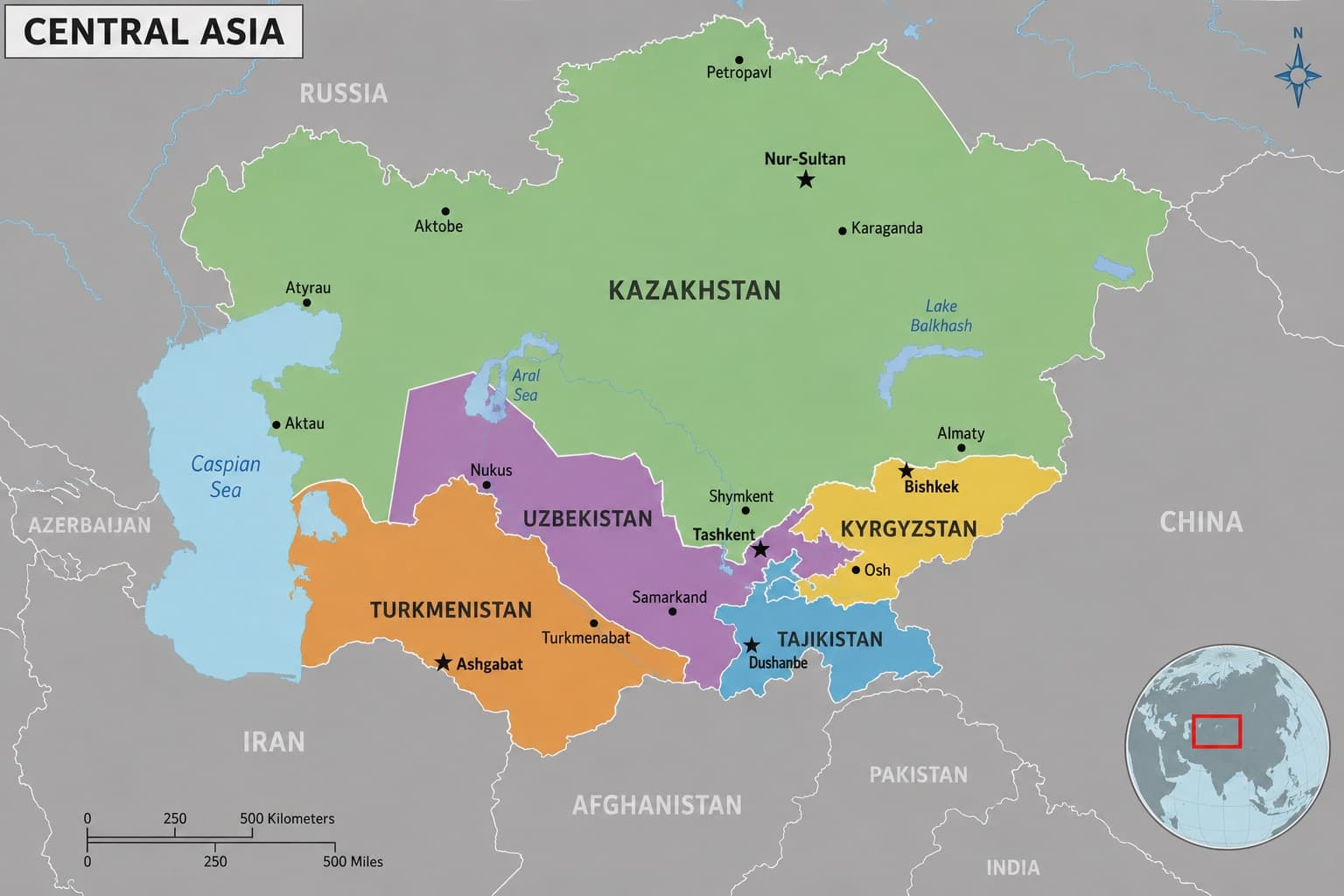
For more than two decades, U.S. policy in Central Asia and the Caspian region was closely linked to the military operation in Afghanistan. The region was viewed primarily as a logistical and political periphery of the Afghan campaign: supply routes ran through it, transit agreements were concluded, and counterterrorism cooperation was developed. The withdrawal of U.S. troops from Afghanistan in August 2021 marked not only the military end of the campaign, but also the end of an entire era of U.S. regional policy. The Afghan factor ceased to be the structural element of the American presence in Central Asia. A strategic vacuum emerged: whereas security had previously defined the agenda, after 2021 Washington no longer had an obvious new “anchor” for a systematic policy in the region. Under these circumstances, the key question is as follows: what will become the new driver of U.S. strategy in Central Asia and the Caspian region? In 2026, the United States Strategy for Central Asia 2019–2025: Advancing Sovereignty and Economic Prosperity expired. Accordingly, a process is underway to formulate a new U.S. strategy. Below, I analyze the new trends that may form a strategy that has in fact been taking shape under the Trump administration in Central Asia and the Caspian region. Many elements of this new policy were already outlined in the 2019–2025 strategy and in the policy of the previous administration; however, the specific features of the Trump administration’s foreign policy have clearly accelerated the transition to a new model of relations. This model can be described as one based on business transactions and flexible diplomatic formats.
Kazakhstan and Uzbekistan as the key Eurasian players in the Board of Peace
Kazakhstan and Uzbekistan played the role of important participants at the inaugural summit of the Board of Peace on February 19, 2026. They were the only representatives of the post-Soviet space (along with Azerbaijan and Armenia). They also represented (together with Azerbaijan) a distinct Eurasian, Turkic and Former Soviet cluster of participants in this organization. Kazakhstan and Uzbekistan were the only Soviet countries that assumed certain financial, political, and even military commitments during this summit. Kazakhstan agreed to participate in the reconstruction of Gaza, undertook financial commitments, and expressed its readiness to send peacekeepers. Uzbekistan declared its readiness to take part in the construction of housing, hospitals, schools, and kindergartens.
In the context of the evolving relations between the Trump administration and these three countries, this carries strategic significance. The participation of the three states signals their willingness to deepen dialogue with the United States on terms that do not imply military-political confrontation with Russia or China — a matter of fundamental importance for the states of Central Asia. All of them pursue multi-vector foreign policies, seeking to maintain good relations simultaneously with the West, Russia, and China. The active participation of the regional countries in the inaugural summit of the Board of Peace demonstrates their readiness to work with Washington outside traditional multilateral frameworks — such as the UN. The emphasis of U.S. foreign policy under the current administration is shifting toward flexible diplomatic formats, business transactions, and infrastructure deals. The countries of Central Asia and the Caspian region are actively seeking to integrate into this model, adapting their multi-vector diplomacy to it.
The renewed interest of the current U.S. administration in Central Asia
It is important to emphasize that the Board of Peace summit continues and consolidates an already existing trend in U.S. relations with Kazakhstan and Uzbekistan as two regional leaders of Central Asia.
The most recent U.S.–Central Asia summit in the C5+1 format took place on November 6, 2025, in Washington under the chairmanship of President Donald Trump. It demonstrated a shift toward concrete economic deals. The emphasis was placed on critical minerals, energy, transport infrastructure, and supply chains.
Uzbekistan announced its intention to purchase American goods and services worth approximately $100 billion over the next decade and about $35 billion in the next three years. Kazakhstan presented a package of 29 agreements, including joint investments totaling nearly $17 billion. At the same time, Kazakhstan announced its support for the Abraham Accords, which creates a favorable political and diplomatic backdrop for economic cooperation with the United States, as well as with Israel as Washington’s key Middle Eastern ally.
In December 2025, Donald Trump invited the presidents of Kazakhstan and Uzbekistan to participate as guests in the G20 summit in Miami in 2026, thereby elevating their international status.
The above-described line of the Trump administration toward flexible diplomacy based on business deals became even more evident during the visit of U.S. Special Representative for South and Central Asia Sergio Gor to Kyrgyzstan and his participation in the B5+1 summit in Bishkek on February 4–5, 2026. “B5+1” is a two-day business forum that brought together representatives of business communities and government bodies from Central Asian countries and the United States. During the forum, discussions focused on the development of agriculture, tourism, the financial and banking sector, transport and logistics, e-commerce and information technology, as well as cooperation in the field of critical minerals.
Gor noted that the “B5+1” forum in Bishkek became a logical continuation of the “C5+1” summit in Washington. He also stated that the United States would strengthen its economic presence in the countries of Central Asia in the coming years. At the same time, the key instrument of engagement will be the private sector. The U.S. government intends to support American businesses operating in the region in order to reduce investment risks. Gor also emphasized the role of TRIPP and the Middle Corridor in enhancing the economic interconnection between the South Caucasus and Central Asia.
Will the Middle Corridor Become “Western” Again Rather Than “Chinese” project?
The Middle Corridor (TITR – Trans-Caspian International Transport Route) connects China, Central Asia, the Caspian Sea, the South Caucasus, Turkey, and Europe. In recent years, it has gained additional relevance for the countries of Central Asia surrounded by the conflicts in Eastern Europe, Afghanistan and the Middle East. In 2026, in particular, southern trade routes from Central Asia have become constrained due to the crisis surrounding Iran and internal instability in Afghanistan. Consequently, the importance of the Middle Corridor for the functioning of Central Asian economies has increased significantly.
From the perspective of geo-economic competition, it is important to note that although today the Middle Corridor is integrated into China’s Belt and Road Initiative, its institutional roots lie in the supported by the West TRACECA project, launched in the 1990s as a tool to ensure the economic independence of the newly independent states of Central Asia and the South Caucasus. This fundamental Western interest in the Middle Corridor persists today.
The intensification of U.S. policy in the South Caucasus (including the TRIPP project -Trump Route for International Peace and Prosperity) and Central Asia under current administration may restore the Western geo-economic dimension of the Middle Corridor and reduce the dominance of the Chinese aspect in the logic of this route. In this sense, the revitalization of the corridor can be seen as a kind of “return” of the Western agenda to Eurasian logistics, with significant geo-economic consequences.
Economic cooperation with the United States within the context of multi-vector foreign policy of Central Asian states
Cooperation with the United States in matters related to transport infrastructure not only serves economic interests but also aligns with the logic of the multi-vector foreign policies pursued by the countries of Central Asia. Through such cooperation, they do not enter into confrontation with China or Russia, while diversifying their foreign partnerships and strengthening their agency in the international arena.
China allows the states of Central Asia to pursue multi-vector foreign policies, provided that China itself remains one of their key vectors. The Middle Corridor — although ideologically and strategically not entirely favorable for Beijing — has significant practical economic importance for the Belt and Road project, particularly at a time when the war between Russia and Ukraine negatively affects the Northern Corridor, and the crisis surrounding Iran constrains the Southern route. Beijing would compete with Washington in Central Asia using geoeconomic instruments, which would be useful for the countries of the region.
Russia has traditionally viewed the Middle Corridor negatively, proposing the Northern route as an alternative. However, in the context of the war with Ukraine and the crisis in its relations with Europe, Russia cannot guarantee the uninterrupted functioning of the Northern route as a viable alternative for Central Asian economies. Moreover, Russia has traditionally anchored its position in Central Asia through military and security-based instruments, whereas China has projected its influence predominantly through economic penetration, infrastructure investment, and trade integration. Consequently, U.S. transaction-based engagement in the region increasingly places Washington in direct geoeconomic competition with China, not with Russia — not only over the development of the Middle Corridor, but also over the long-term configuration of Central Asia’s economic architecture.
Iran has historically taken the most negative stance toward any idea of transit across the Caspian Sea. This project competes with the North–South Corridor via Iran and also contributes to the distancing of the northern Eurasian neighbors from Iran. In the past Iran even attempted to block the division of the sea into national sectors for this purpose. However, under the current conditions of military crisis surrounding Iran, it will not be able to exert significant pressure on the countries of Central Asia. So, the degree of Iranian influence in Central Asia is much less than the influence of China or Russia. Therefore, Central Asian elites may afford serious disagreements with Iranian policy concerning cooperation with USA and Israel.
Conclusion. From a military logic to a logic of geoeconomic influence
If the Afghan era defined the nature of the American presence in Central Asia through security and military instruments, the geoeconomic model emerging under the current administration places strong emphasis on infrastructure, transit, resources, and flexible diplomacy. Formally embedding these three pillars in an articulated U.S. regional strategy would send a clear message to the Central Asian states that American engagement is not ad hoc or crisis-driven, but designed as a durable, long-term framework adapted to contemporary geopolitical realities.
The C5+1 summit in Washington on November 6, 2025, demonstrated the consolidation of the economic agenda as central to U.S. strategy. The focus on critical minerals, investment, and infrastructure became the core element of the dialogue. The Board of Peace (2025) further strengthened the trend toward flexible diplomatic engagement with the countries of the region.
For Kazakhstan, Uzbekistan, and other Central Asian states, it is fundamentally important today that engagement with the United States not be perceived as an anti-Russian or anti-Chinese geopolitical project. The geo-economic logic of cooperation with the United States and flexible engagement formats enables them to maintain balance within the framework of their multi-vector foreign policies. Thus, the demand of Central Asian states has aligned successfully with the new foreign policy emphases advanced by the Trump administration. The softer geoeconomic approach it proposes — compared to the period of the Afghan campaign — is the only politically acceptable format for the countries of Central Asia today.
At the same time, this policy allows for minimizing costs to American taxpayers while maximizing commercial benefits for U.S. investors. Moreover, it enables the United States to address many strategic objectives in a “containment-light” style. Washington is beginning to operate in Central Asia not through direct geostrategic containment of China, Iran, and Russia, as before, but through regionalization, trade, and infrastructure integration. At the same time, it is precisely in Central Asia and the Caspian region that Washington now has a realistic opportunity to engage China on symmetrical terms — through geoeconomic instruments capable of competing with Beijing’s model of outward economic expansion.
Paradoxically, despite the deep ideological differences between the Trump administration on the one hand and the overwhelming majority of European political elites on the other, the administration’s political style in several respects resembles European approaches to Central Asia. The European Union and individual European states operating in the region similarly prioritize pragmatic economic cooperation while avoiding large-scale geopolitical initiatives that could carry significant risks of conflict. That said, unlike the Trump administration, European policy in Central Asia also incorporates support for civil society and the promotion of European values.
For Israel, the Trump administration’s shift in Central Asia toward business-oriented initiatives and transactional diplomacy may prove broadly advantageous. Israel itself has pursued a comparable approach in the region. At present, Central Asian states are actively seeking to expand economic and diplomatic engagement with Israel. In this context, the administration’s operational style in the region can be seen as largely compatible with Israeli approaches.