PSCRP-BESA Reports No 143 (July 20, 2025)
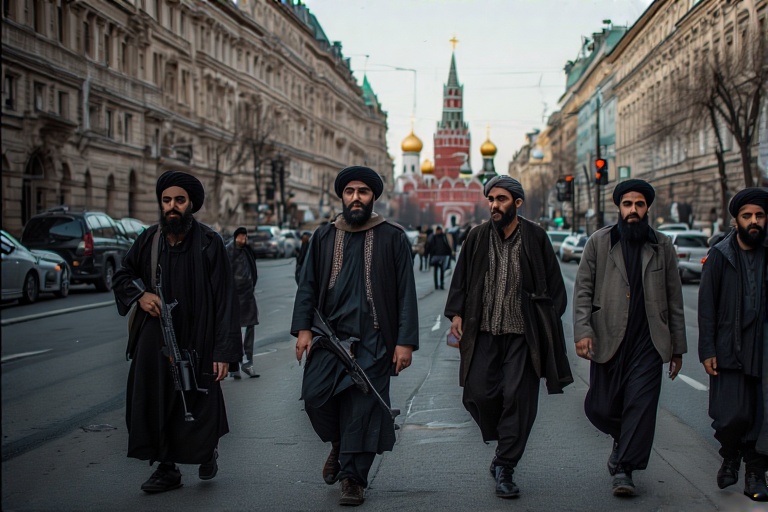
On July 3rd 2025, Russia officially recognized the Taliban as the legitimate government of Afghanistan, becoming the first permanent member of the UN Security Council to do so. The announcement was made by Russia’s Foreign Ministry after it formally accepted the credentials of Taliban-appointed ambassador. The Afghan flag used by the Taliban regime was also raised over the embassy in Moscow—a symbolic step that underscored the shift in Russia’s position from pragmatic engagement to formal recognition.According to the Russian Foreign Ministry, this move reflects “the de facto situation” in Afghanistan and is aimed at establishing a dialogue with the current authorities. Russian officials stressed that the Taliban had consolidated power across the country, which justifies official recognition.
Russia’s official recognition of the Taliban in the summer of 2025 was preceded by a series of gradual steps: since 2022, Moscow maintained diplomatic contacts, allowed the Taliban to manage the Afghan embassy, and included them in a number of cultural and economic forums, including those in Kazan and St. Petersburg. The Taliban appointed an official representative to Moscow in April 2022 and subsequently began to participate regularly in meetings of the “Moscow Format” of consultations on Afghanistan, although their invitations to these events were inconsistent, reflecting internal fluctuations in Russian policy. A notable indicator of these fluctuations was the Taliban’s absence from the St. Petersburg International Economic Forum in 2022 and their exclusion from the “Moscow Format” in October 2022 due to unfulfilled commitments in combating terrorism and in the establishing an inclusive government.
The main obstacle to recognizing the Taliban was Russia’s own counterterrorism legislation. The organization had been designated as a terrorist group since 2003. In December 2024, President Putin signed a law allowing the Supreme Court to remove the Taliban from the list of banned organizations in Russia. In May 2024, the Ministry of Foreign Affairs and the Ministry of Justice submitted a formal request to the president to delist the Taliban as a terrorist organization. Due to continued resistance from the security services involved in counterterrorism, the issue remained stalled during inter-agency coordination. It was only on March 31, 2025, that the Prosecutor General’s Office filed a petition with the Supreme Court requesting permission for the Taliban to operate legally in Russia. On April 17, 2025, the Supreme Court of the Russian Federation suspended the ban on the Taliban’s activities on Russian territory.
An important motive behind Russia’s recognition of the Taliban was the Kremlin’s hope for cooperation with the group in countering the international terrorist organization ISIS-Khorasan, or ISIS-K (originally a branch of the Islamic State operating in Afghanistan and Central Asia), which has been attempting to expand into the post-Soviet space. In this context, ISIS-K carried out a terrorist attack in March 2024 at the Crocus City Hall near Moscow, resulting in 149 deaths. However, many Russian security experts on Afghan issues — including Andrei Serenko — question both the capability and, more importantly, the willingness of the Taliban to combat ISIS-K effectively (according to him some factions of Taliban are connected to ISIS-K).
Officially, the Russian authorities reject such arguments, but unofficially, these concerns are widespread among the security apparatus, including the military and intelligence services. It should be noted that the Taliban’s reputation as a potential ally in the fight against terrorism is viewed with skepticism in many post-Soviet countries due to the group’s ties to various terrorist organizations from Central Asia (for example, there is evidence of connections between the Taliban and the Tajik terrorist group Ansarullah) and the Caucasus. According to persistent reports circulating among Afghanistan experts, following the defeat of ISIS in Iraq and Syria, some militants affiliated with organizations such as the Caucasus Emirate — which had cooperated with ISIS — were relocated to Afghanistan, reportedly with informal assistance from certain Taliban factions)[1].
This has generated skepticism toward the Taliban among some pragmatically minded elements within Russia’s security establishment. Since 2021, such concerns have been actively voiced, particularly within the frameworks of the Collective Security Treaty Organization (CSTO) and the Ministry of Defense. However, the Russian Foreign Ministry has consistently maintained the firm belief that genuine counterterrorism cooperation with the Taliban can be achieved. This viewpoint is reinforced by a broader pattern of state propaganda in contemporary Russia, which portrays the modern world in starkly dualistic terms: all threats to Russia are attributed to the secret services of United States and the United Kingdom, and increasingly to Ukrainian intelligence services (in a more conspiratorial version tailored to the Russian far right, Israel is also implicated). For instance, although international bodies—primarily the U.S. government—identified the Crocus City Hall terrorist attack as having been organized by ISIS-K, a group based in Afghanistan, and executed by ethnic Tajiks, the Russian government officially blamed Ukraine. Thus, Moscow appears to prioritize geopolitical and security calculations, particularly its desire to counter U.S. and NATO influence in Central and South Asia and to deepen its alignment with authoritarian regimes such as Iran and China.
From Israel’s perspective, the primary short-term concern arising from Russia’s policy toward the Taliban stems from the fact that ISIS-K’s likely priority targets in post-Soviet states — and in Russia in particular — may include locations associated with ethnic Jewish communities. Notably, the mentioned bloody terrorist attack at Crocus City Hall near Moscow was preceded by an attempted attack by ISIS-K on a synagogue in the city. This attempted attack was foiled, possibly due to intelligence provided to Russian authorities by Western security services.
Geopolitical aspects of the recognition potentially are even more important for Israel. Russia’s recognition comes amid broader attempts to project influence in Afghanistan through regional forums such as the “Moscow Format” talks, which have included China, Pakistan, Iran, and Central Asian states.
Russia’s recognition of the Taliban should not be viewed in isolation but rather as part of a broader strategic effort to construct an alternative axis of states, united not only by shared interests but also by a common ideological rejection of the Western liberal order. In the Russian strategic imagination, this axis takes the form of a notional “authoritarian international,” comprising states such as:
- China – regarded as the leading power of an alternative bloc opposed to the United States;
- Iran – positioned as the principal anti-Western force in the Middle East, in confrontation with both the U.S. and its primary regional ally, Israel;
- Pakistan – the closest partner of China and an ambiguous broker in Afghan affairs;
- The Taliban – a radical but effectively controlling the territory of the country regime, viewed in Moscow today, first of all, as an “anti-Western force.”
For Russian diplomacy in the late-Putin era, the political utility of such regimes lies less in their economic or strategic weight and more in their rhetorical and symbolic value: they serve as proof of a supposedly “anti-Western world” that presents itself as multipolar and as “a defender of the Global South”. In practice, however, this vision often reproduces imperial and neocolonial dynamics — particularly, toward smaller states in Central Asia. The formation of such a bloc could pressure Central Asian states — currently wavering both in their approach to cooperation with the West in the context of the conflict in Ukraine and in their relations with Israel in the context of current Middle Eastern conflict — to adopt a firmer anti-Western and pro-authoritarian stance in favor of alignment with the Russia–China–Iran axis. Faced with a geopolitical environment increasingly polarized between liberal democracies and authoritarian powers, these states may be compelled to prioritize short-term security guarantees and economic dependencies over diversified foreign relations. This shift would not only undermine their emerging multi-vector diplomacy but could also weaken their independence. Potential terrorist threat from Taliban could contribute to this shift, so from this point of view Russia and CSTO can provide a security guarantee at the cost of independence.
In the medium- to long-term perspective, the formation of such a bloc could pose serious strategic challenges for both the United States and Israel by granting Iran greater strategic depth, thereby making it less vulnerable to aerial strikes and external military pressure. In the short term, the primary risk to Israel lies in a growing diplomatic isolation across Central Eurasia and South Asia, where shifting alliances could limit its regional engagement.
That said, this emerging authoritarian Eurasian bloc still remains largely hypothetical. It lacks institutional consolidation: neither BRICS, nor the Shanghai Cooperation Organization (SCO), nor the Moscow Format on Afghanistan constitutes a cohesive alliance. These platforms function more as discussion forums than unified geopolitical groupings. Moreover, deep internal contradictions persist among the bloc’s prospective members, particularly regarding each other and the Taliban:
- Iran and the Taliban are divided by entrenched sectarian hostility, representing radical Shi’a and Sunni Islamist regimes, respectively, and involving the issue of Afghanistan’s Shi’a Hazara minority.
- China, while engaged diplomatically, is cautious about publicly endorsing radical Islamist governments. This caution stems from its domestic concerns in Xinjiang, where the Uyghur Islamist movement has established links with certain Taliban factions, much like jihadist groups from Central Asia and the post-Soviet space[2].
- Pakistan maintains a precarious balance between its deepening dependency on China and its enduring need for Western support, particularly in economic and security domains. At the same time, serious tensions exist between Pakistan and Iran, especially along their shared border, where cross-border attacks and insurgent movements have fuelled mutual distrust. Pakistan also harbours grievances toward both Russia and Iran due to their growing strategic overtures toward India — Islamabad’s principal regional rival. Moreover, Pakistan’s relationship with the Taliban is strained by the ongoing insurgency in the country’s northwest, where Tehrik-e-Taliban Pakistan (TTP) continues its armed struggle against the Pakistani state. Although formally distinct from the Afghan Taliban, the two groups have maintained operational and ideological linkages, with reported cooperation involving Middle Eastern and post-Soviet jihadist networks[3]. Finally, the Afghan Taliban, like many Afghan political actors across the spectrum, rejects the legitimacy of the Durand Line — the colonial-era boundary drawn by the British in 1893 that divided the Pashtun population between Afghanistan and what was then British India. This enduring non-recognition fuels strategic mistrust and nationalist sensitivities in Pakistan, which regards the boundary as settled and inviolable.
Finally, it should be emphasized that, in the long term, the recognition of the Taliban challenges the very foundation of international law and, as such, is likely to undermine prospects for sustainable peace in Eurasia and the wider Middle East. By legitimizing a regime that came to power through force, lacks democratic legitimacy, commits serious violations against human rights (in particular, against women and girls) and continues to maintain ties with transnational terrorist groups, this move sets a precedent that weakens international norms regarding governance, human rights, and counterterrorism. In doing so, it risks deepening instability across already fragile region.
[1] Kazantsev A. International Networks of Jihadism: Central Asia, Caucasus, Middle East and Afghanistan, Moscow, MGIMO publishing house, 2019.
[2] Kazantsev A. International Networks of Jihadism: Central Asia, Caucasus, Middle East and Afghanistan, Moscow, MGIMO publishing house, 2019.
[3] Kazantsev A. International Networks of Jihadism: Central Asia, Caucasus, Middle East and Afghanistan, Moscow, MGIMO publishing house, 2019.