Perspectives Papers

Perspectives Papers provide analysis from BESA Center research associates and other outside experts on the most important issues pertaining to Israel and the Middle East.

View Archive

The Syrian regime unleashed full military grade chemical weapons against IS several weeks ago, a move that occasioned little response from the wider world. The assault demonstrated that the dismantling of the Syrian chemical arsenal has not been fulfilled. If repeated, the attack might precipitate a dangerous escalation of the conflict in which IS accelerates its own pursuit of WMDs.
Israel has gradually come to realize that the Palestinians are neither a partner for peace nor capable of establishing a viable state. Therefore, Israel's recent governments have adopted a de facto conflict-management approach, rather than a conflict-resolution strategy. This prompts several questions. Should Israel speak explicitly about the dim prospects of a two-state solution, or play along with the illusory preferences and pretensions of the international community? Should Israel apply more “stick” than “carrot” to the hostile Palestinian Authority? Would the collapse of the Palestinian Authority serve Israel's interests? And how diplomatically active should Israel be on the Palestinian issue?
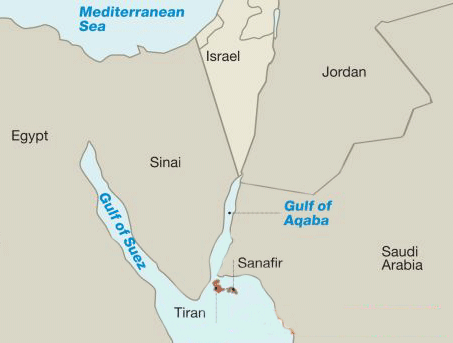
Tiran and Sanafir Islands
The fact that Saudi Arabia has now undertaken to uphold in practice the obligations assumed by Egypt under its peace treaty with Israel, means that Israel's place in the region is no longer perceived by Arab leader Saudi Arabia as an anomaly to be corrected. This is a far cry from normalization of Saudi relations with Israel, but it is nevertheless a welcome ray of light, demonstrating the benefits of cooperation and coordination in a region beset by violence.
The three types of area jurisdiction in Judea and Samaria (the West Bank) – A, B and C – were meant as a short-term fix until a real Israeli-Palestinian peace accord could be crafted. More than 20 years later, both sides have broadly infringed on these parameters. Israel regularly penetrates Area A for security reasons, while the PA (with EU support) is building illegally and dangerously in key parts of Area C that are critical to Israel. Israel should halt this encroachment with determination.
The desire of the international community to end the Syrian civil war is offset by the inability of any individual party to enforce its preferred solution. The conflict, which is likely to continue for some time, has solidified the centrality of Russia and Iran in regional affairs. Israel’s options are limited.
Terror attack in Brussels March 2016
Israel, which unfortunately has had a great deal of experience with terrorist violence, has much to offer Europe in its own confrontation with Islamist terror. Once Europe has internalized the reality that it is fighting a war, Israel can advise it regarding strategies like effective intelligence collection, disruption of enemy money supply, and interference with enemy access to the internet.
When Mahmoud Abbas departs from his post as leader of the Palestinian Authority, Israel will have to make strategic choices. This paper discusses five possible policy approaches, none of which is ideal. They are caretaker conflict resolution, creative friction, constructive chaos, unilateral withdrawal, and unilateral annexation. The caretaker option is probably the most feasible; unilateral withdrawal is the least. In every case, however, Israel will have to maintain a military presence in Judea and Samaria.
Russia's intervention in Syria cannot be fully explained by strategic or economic factors. Russian political culture, which has been permeated since the fifteenth century by a messianic vision of apocalyptic redemption, has long been a significant guiding factor in the decision-making of Russia's leaders.

Accessibility Toolbar