China

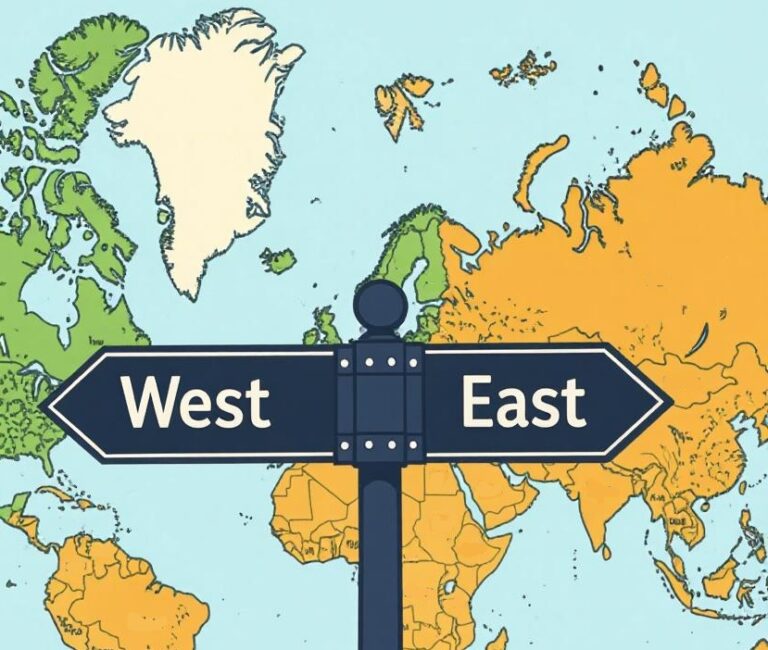
East or West? (AI generated illustration)
The core element in the foreign policy of post-Soviet countries in Central Asia and the South Caucasus is so-called multivectoralism: maintaining relations with multiple global actors without binding themselves exclusively to any single one. These states seek to balance ties with the China–Russia axis and the collective West (including the USA and the EU—although it should be noted that the internal fragility of this grouping has never been as evident as it is now).
Between Moscow and China (Grok illustration)
At the United Nations General Assembly this year, Kyrgyz President Sadyr Japarov did not disguise where Bishkek’s loyalties lie. In his speech, he castigated Western sanctions on Kyrgyz banks and reaffirmed that his country would not sever ties with Russia. That intervention was not just diplomatic theater. It was a blunt reminder that Kyrgyzstan’s leadership views Moscow not as an optional partner but as the central axis of its political and economic survival.
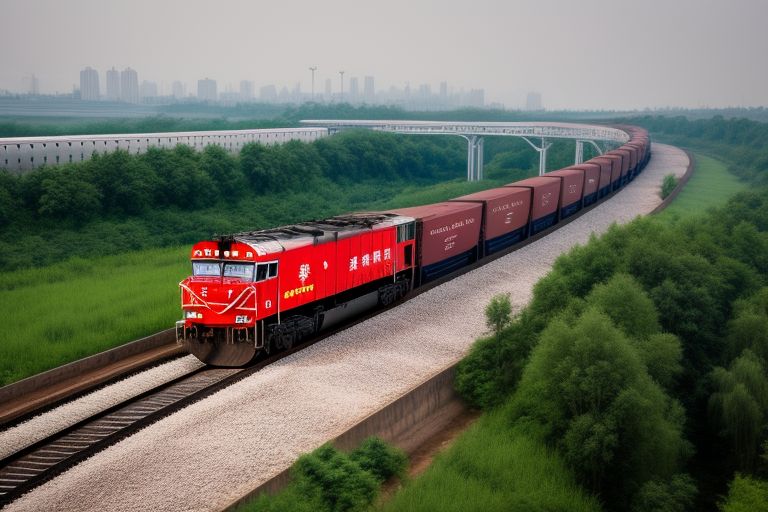
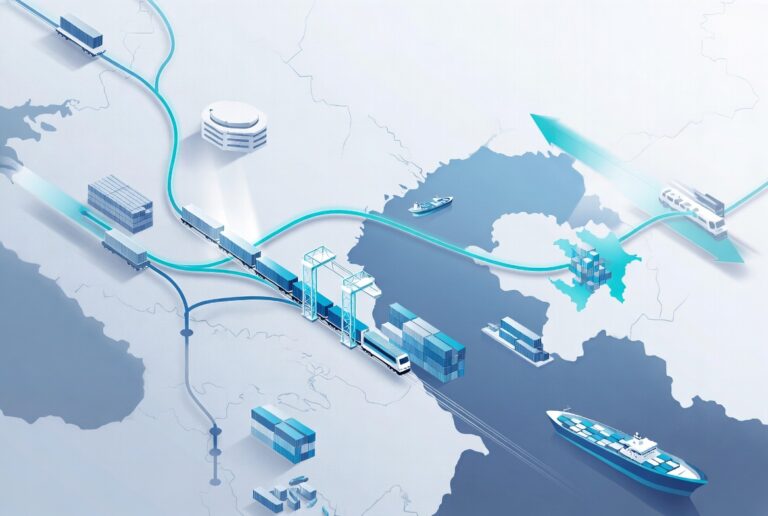
Chinese fright train (AI generated illustration)
Russia, which a dozen years ago aspired to be a major transportation corridor from the Pacific to the Atlantic, is gradually turning into a transportation and logistics desert. The new joint Chinese-Kazakh railroad project has become another stepping stone to exclude Russia from transcontinental logistics chains. At that, Russia loses not only Europe and the Far East as customers and partners: it also loses its leverage in the region it used to consider its fiefdom - namely, Central Asia.
A year and a half ago, in the summer of 2023, a forum titled "Yakutia and the Provinces of China: Sister-City Relations for Strengthening Russian-Chinese Relations" was held in Yakutsk. The ties between China and the Republic of Sakha continue to strengthen. It is also worth noting that directly south of Yakutia are Russian regions to which China has almost openly laid claim, as they were once part of the Qing Empire. From the Chinese perspective, Russia still occupies much larger Chinese territories, meaning historical justice has not been restored.
In the ongoing geopolitical conflict between Iran and Israel, Iran’s relations with post-Soviet states—especially those with which it shares a direct border—play a crucial role. The tensions between Iran and Azerbaijan are well-known to experts, same goes for Iran’s close ties with Armenia. However, a less frequently discussed yet highly significant aspect is the nature of Iran’s relationship with the third post-Soviet state with which it shares a border—Turkmenistan.
IDF OPERATION
Israel is perceived as an important part of the Western, American-centric world. Consequently, relations with Israel are seen as a component of an intricate set of strategies in the multi-vector foreign policy of Central Asian governments. This policy aims to maintain a delicate balance, primarily in the triangle of relations among the three key powers in Eurasia: China, Russia and the West.
China has become a major player in the MENA region, and its soft power projection strategy plays a key role. Confucius Institutes are a highly visible manifestation of this strategy, and they have been welcomed by many in the region and beyond. However, there are concerns about their lack of transparency and potential to be used for propaganda purposes. While these concerns have caused Western governments and institutions to close several Confucius Institutes down, their numbers continue to grow in the MENA region.
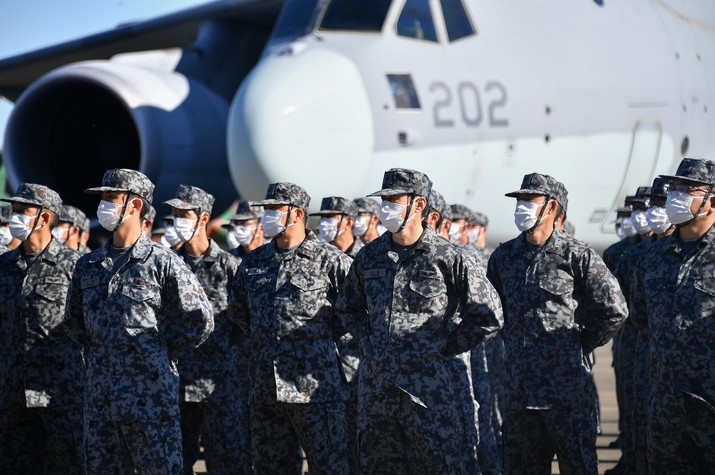
JASDF Air Review 2020 Japan Ministry of Defense
Japan has stated that it will broaden its defense policy, a sign of growing concerns in Tokyo about the threat of North Korean and Chinese aggression. The change of policy also reflects the continued influence of the late Prime Minister Shinzo Abe, who expanded Japan’s definition of what constitutes acts of self defense.
China may have no short-term interest in contributing to guaranteeing security in parts of a swath of land stretching from Central Asia to the East coast of Africa, but that does not prevent the People’s Republic from preparing for a time when it may wish to build on longstanding political and military relationships in various parts of the world to project power and maintain an economic advantage.
Following the withdrawal of the US from Afghanistan, Washington is allegedly trying to reestablish a military presence in Central Asia, similar to what it did in the early 2000s. Though some level of cooperation is possible with Russia within the framework of great power relations (and much still depends on Moscow’s goodwill), China opposes any American military or security expansion near its restive Xinjiang province.

Accessibility Toolbar