Perspectives Papers

Perspectives Papers provide analysis from BESA Center research associates and other outside experts on the most important issues pertaining to Israel and the Middle East.

View Archive

If the Iranians have their way and are able to control the level of the flames, they will make sure that tensions with the US fall short of war due to the massive disparity in military capability and lack of mutual vulnerability. A Hezbollah attack on Israel in such a scenario would lead to Hezbollah’s destruction, a result Tehran would prefer to avoid.
No organization in Europe can rival the British Labour party for the promotion of antisemitic hate, rendering it an ideal case study. As soon as the picture of Labour’s antisemitism appears reasonably complete, massive stores of new data emerge. The forthcoming investigation of Labour by the Equality and Human Rights Commission (EHRC) is likely to provide one of history’s most profound analyses of antisemitism within a single organization.
In the Persian Gulf, tensions are rising over the sanctions recently imposed by the US on Iran in the wake of its refusal to comply with Washington’s demand that the nuclear agreement signed by Barack Obama be reopened. Tehran does not wish to submit to this demand, as it would suggest weakness on the part of the regime and would inhibit Iran’s nuclear ambitions. But its refusal could lead to the collapse of the Iranian economy, war, and possibly the overthrow of the regime.
The recent rise in military tensions in the Persian Gulf between the US and Iran introduces a heightened possibility that Iran will activate proxies against Israel. In the event of further escalation, Jerusalem must assume that Tehran’s plans will include possible proxy attacks on Israeli territory and overseas Israeli targets.
Notwithstanding Hamas’s recent success at partially overwhelming Iron Dome, it has failed to accomplish one of its signal goals: nothing it has done has succeeded in galvanizing the Arab population in Ramallah and Hebron to rise up against either Israel or the PA.
A recent annual survey of Arab youth provides insights that should inform autocrats’ quest for social and economic reform. The survey also suggests, as do the intermittent anti-government protests that continue to erupt in different parts of the Arab world, that Western and Middle Eastern interests would be better served by more nuanced US and European approaches toward the region’s regimes.
Despite the best efforts of the Boycott, Divestment and Sanctions movement (BDS), Israeli tourism has flourished beyond any expectation. Two tunnels in Jerusalem that testify to Israel’s incontrovertible connection to the land and its history have proven to hold great interest for tourists from abroad.
The former commanders who are demanding a referendum on the possible annexation of parts of the West Bank’s Area C misunderstand the threats confronting Israel. One need only consider the latest round of fighting in Gaza to understand what the threat to the cities of the coastal plain would look like if Israel were to give up control of the mountainous terrain dominating the country’s economic-social-industrial heartland.
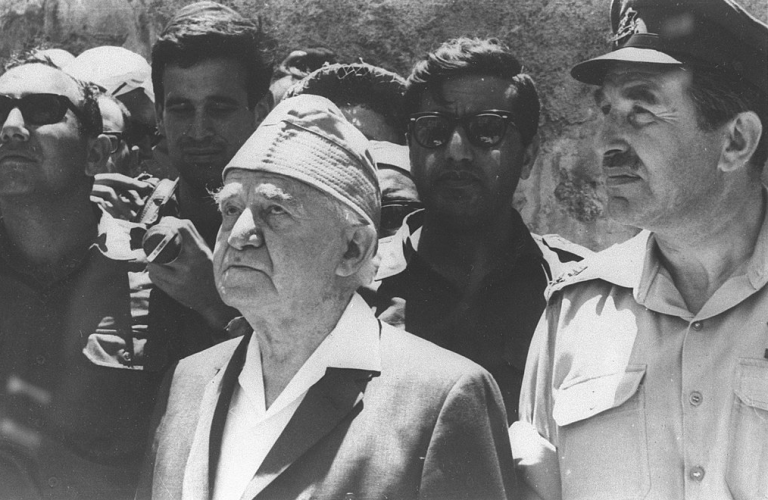
For David Ben-Gurion, the concept of mamlachtiut captured the perennial tension between the establishment of the state of Israel as an orderly and delimited institutional project and the view of the state as a means in an exalted process of redemption. Hence, even after its establishment, Israel would continue – as an instrument through which to fulfill an infinite vision – to be “a state in the making.”  

Accessibility Toolbar