Perspectives Papers

Perspectives Papers provide analysis from BESA Center research associates and other outside experts on the most important issues pertaining to Israel and the Middle East.

View Archive

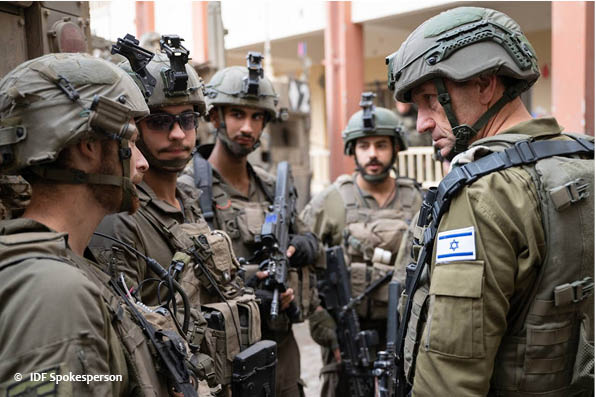
Unit 8200 in the IDF - © IDF Spokesperson
After Israel’s disengagement from the Gaza Strip and the entrenchment of the Hamas terrorist organization there, a war of attrition commenced between Hamas and Israel that has lasted for almost two decades. As Israel’s defense doctrine leans heavily on technological superiority, it has depended primarily on its numerous technological assets to manage this conflict. By contrast, Hamas, which is significantly disadvantaged in terms of technology, has pursued a strategy designed to neutralize Israel’s technological superiority through the use of terror tactics against civilian populations and the employment of low-tech and readily available means of warfare. The success of the surprise attack initiated by Hamas on October 7, 2023, demonstrated that Israel’s overreliance on technology in a conflict like this one was a flawed and even perilous concept.
Fighting in the Gaza Strip IDF - © IDF Spokesperson
Until the end of the seventies, Israel's policy on hostages, prisoners and missing persons was based on national considerations. The Entebbe Doctrine permitted no negotiations with terrorist organizations that involved comprehensive deals for the mass release of prisoners as doing so would amount to a surrender to terror. Israeli hostages would be released either through operational means, local negotiations, or prisoner exchanges after fighting was concluded. But over the past four decades, ever since the Jibril Agreement of 1985, there has been a change in Israel's policy on this matter to involve wholesale prisoner releases. This has caused Israel profound strategic damage. Negotiating with Hamas for the release of the hostages in Gaza through comprehensive, all-inclusive deals mediated by Qatar (“everyone for everyone”) would undermine Israel's strategy in the Swords of Iron war. It's time to make a fundamental change in Israel's policy on this issue and readopt the Entebbe Doctrine, which can save the lives of the current hostages and prevent the taking of more in the future.
Fuel tanks at gaza strip - © IDF Spokesperson
This article provides an overview of the current fuel supply situation in the Gaza Strip. It examines how much fuel is needed for Gaza’s basic humanitarian needs, how much fuel is held by Hamas, and who is responsible for providing more fuel once it runs out. It concludes that Israel’s denial of fuel supply into Gaza offers relatively marginal tactical advantages since Hamas has enough diesel stored away to last for several months. Diesel denial mainly affects the operation of hospitals and water supply to Gaza’s population, adding to international pressure against Israel to end its military campaign.
The commander of Southern Command conducting a situation assessment in the Gaza Strip - © IDF Spokesperson
Infiltrations of armed militants for the purpose of killing and looting are nothing new in the troubled history of the Gaza Strip. The attack by Hamas on October 7, 2023, which led to the deaths of approximately 1,500 people, most of whom were Israeli citizens, is just one link in the chain of suffering between Israel and the Gaza Strip. Only when a determined governing authority held full control over the Strip, as  Egypt did from 1956 to 1967 and Israel did from 1967 to 1993, could the development of the western Negev and southern Israel thrive. Israel has spent 17 years trying to disengage from Gaza without success, and there has been round after round of fighting. Despite its economic dependence on Israel, Gaza has remained a significant security problem that only worsened over time. The Swords of Iron War could be an opportunity to change the reality in the Gaza Strip, but it might require the return of Israeli military governance until, with the help of regional and local actors and international support, a solution is found - a solution that does not merely establish temporary quiet but that ensures peace and stability in the Gaza region for all.
IDF forces activity in the Gaza Strip © IDF Spokesperson
Over six and a half years ago, two researchers from the BESA Center, Dr. Eado Hecht and Prof. Eitan Shamir, warned of a development that could lead to a scenario similar to the one that occurred on October 7 in the Gaza envelope. They and others made similar warnings about Hezbollah, but few pointed to the possibility of such a scenario unfolding in the south. The BESA researchers not only outlined a scenario markedly similar to what actually happened in the south on 7th October 2023 but made practical suggestions regarding the force-structure required by the IDF to provide an effective response to such a scenario. They criticized the significant reduction in ground forces, especially in the armored and artillery units. The authors analyzed the various non-state military organizations facing Israel, including Hamas, and revealed the goal of their force build-up: creating the capacity to launch incursions with significant forces to occupy Israeli settlements close to the border. The researchers argued that in view of this enemy strategy, the IDF’s continued reduction and neglect of major ground forces, coupled with reliance on precision weaponry and airpower, constituted a flawed strategy.
© IDF Spokesperson הצגת תר"ש מעלות
The IDF’s new multi-year strategy, Ma’alot (Ascent), led by IDF Chief of Staff Lt. Gen. Herzi Halevi, was formulated before the Hamas mass murder attack on Israel of October 7, 2023. It was intended to build upon its predecessor, Momentum, emphasizing human capital, countering Iranian threats, boosting land maneuvers and border defenses, and refining organizational culture. It will need a drastic update following the war.
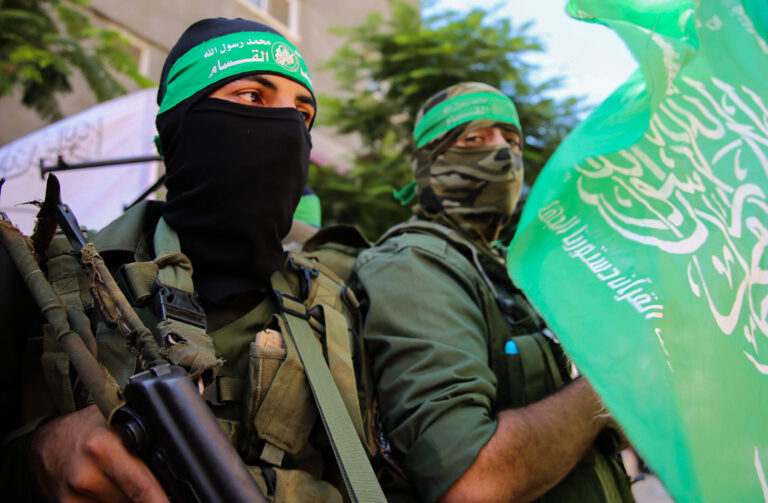
Flag of Hamas
Are Hamas’s brutal patterns of action, especially those of Saturday, October 7, 2023, comparable to those of ISIS? A comparison of the two Islamic terrorist organizations indicates a conceptual and practical similarity, including: shared fundamentalist ideology, their status as hybrid entities, their control over populations, Islamic indoctrination, education to hate, brutal operating methods, and commitment to jihad. The State of Israel, which just experienced the worst terrorist attack since its establishment, must continue to advance its tactical and strategic goal of eliminating Hamas with the clear message: Hamas is equal to ISIS.
In its obligatory war against Palestinian terror – a criminal process encouraged and sustained by Iran – Israel is acting within the bounds of pertinent international law. Though this assessment is difficult to acknowledge by many who can see only the tangible effects of Israeli military counterterrorism, it is offered here from the informed standpoint of authoritative legal standards. Palestinian civilian casualties of Operation Swords of Iron are the predictable and indeed intended result of Hamas’s perfidy. It is beyond legal question that the original Hamas terror acts of October 7, 2023, which included murder, rape, and hostage-taking, represent egregious, Nuremberg-level violations of humanitarian international law.
Israelis have united around the goal of toppling the Hamas regime, but little has been said about what would come after. This issue is critical to Israel’s security and must be addressed. Israeli interests are best served by establishing in Gaza a PA-linked administration alongside a massive reconstruction program backed by the US and other international and regional actors. Israel’s declaration of support for establishing such a regime in Gaza as soon as possible would provide a political direction to the military operation and enhance its international legitimacy. Defeating Hamas must ultimately mean not only its military destruction but the empowerment of a moderate Palestinian alternative.

Accessibility Toolbar